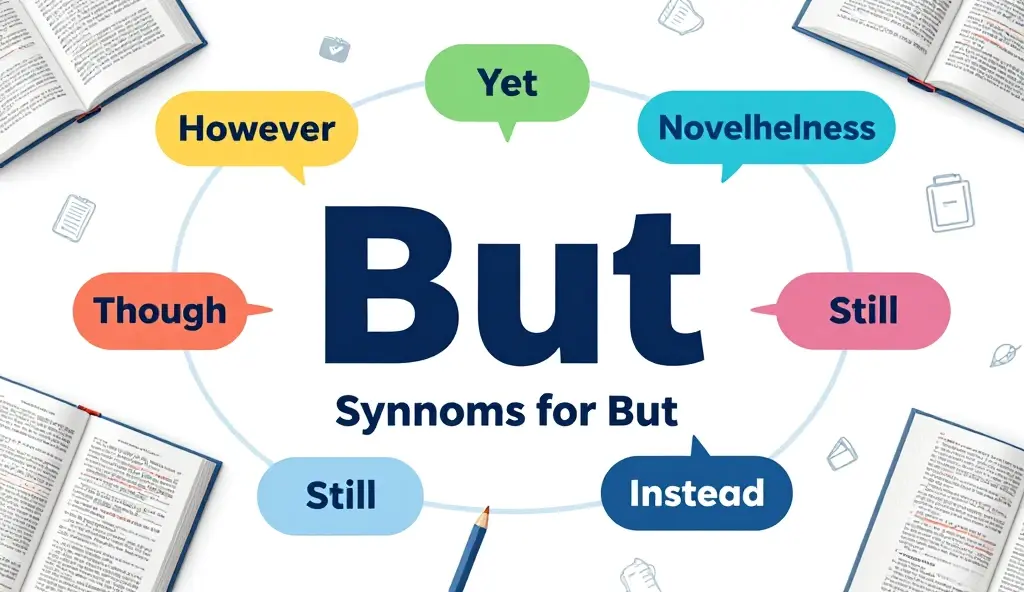
The best synonyms for but include however, yet, although, though, nevertheless, nonetheless, still, whereas, except, and only.
The right choice depends on the meaning of but in your sentence.
Use however or yet to show contrast, although to introduce a surprising fact, except to leave something out, and only when but means “merely.”
But is one of the most useful words in English.
It connects ideas, shows differences, introduces exceptions, and changes the direction of a sentence.
Still, writers often use it too many times:
The hotel was nice, but it was expensive.
The room was clean but small.
The staff was helpful, but the service was slow.
The paragraph is easy to understand, but the repeated word sounds flat.
A stronger version might say:
The hotel was nice, although it was expensive.
The room was clean yet small.
The staff was helpful.
However, the service was slow.
The new words create variety without changing the basic meaning.
This guide explains the meaning, pronunciation, grammar, alternatives, antonyms, punctuation, common phrases, and the best ways to replace “but” in both formal and informal writing.
What Does But Mean?
But most often connects two ideas that contrast with each other.
I wanted to leave, but the rain became heavier.
The first idea creates one expectation. The second idea changes or limits that expectation.
The word can also mean:
- Except
- Apart from
- Other than
- Only
- Merely
- Unless
- Without
- On the other hand
Cambridge Dictionary explains that but links words, phrases, or clauses of the same grammatical type and commonly introduces a contrasting idea. Merriam-Webster lists several additional meanings, including “except,” “only,” and “on the contrary.” (Merriam-Webster)
| Meaning of But | Simple Explanation | Example |
| Contrast | Shows that two ideas differ | The room is small but comfortable. |
| Unexpected result | Introduces a surprising outcome | He studied hard but failed the test. |
| Exception | Leaves one person or thing out | Everyone but Ali attended. |
| Limitation | Makes the first statement less complete | The plan is useful but costly. |
| Only | Means merely or no more than | She is but a child. |
| Emphasis | Strengthens a negative or limited statement | We have nothing but time. |
| Alternative | Rejects one choice in favor of another | It was not red but orange. |
| Condition | Appears in older or formal expressions | But for your help, we would have failed. |
The correct synonym depends on which meaning appears in your sentence.
For example:
Everyone but Lisa arrived.
Here, but means except.
The bag is small but useful.
Here, but shows contrast.
It was but a minor error.
Here, but means only or merely.
Why Do Writers Search for Synonyms for But?
People search for another word for but because they want to reduce repetition, improve sentence flow, or choose a more formal transition.
Compare these two paragraphs:
We liked the house, but it needed repairs. The kitchen was large, but it was outdated. The yard was beautiful, but it required a lot of work.
A revised version sounds smoother:
We liked the house, although it needed repairs. The kitchen was large. However, it was outdated. The yard was beautiful, yet it required a lot of work.
Writers may also need alternatives for specific situations, such as:
- Formal essays
- Academic papers
- Business emails
- Creative writing
- Daily conversation
- Product descriptions
- Reports
- Speeches
- Social media captions
- Professional proposals
Changing every use of but is not necessary. The word is clear, short, and natural. You only need an alternative when repetition weakens the writing or when another word expresses the relationship more accurately.
How to Pronounce But
The standard pronunciation of but is:
/bʌt/
It sounds like:
buht
The vowel sounds like the vowel in:
- Cup
- Luck
- Sun
- Run
- Much
In fast, natural speech, speakers may reduce the vowel and pronounce the word closer to:
/bət/
For example:
I tried, but I couldn’t finish.
The word may sound softer because the speaker does not stress it.
To practice the full pronunciation, say:
But what happened?
Give the word more stress at the start of the sentence.
Part of Speech of But
The word but can serve several grammatical roles. It most commonly acts as a conjunction, but it can also work as a preposition, adverb, or noun. (Merriam-Webster)
But as a Conjunction
A conjunction connects words, phrases, or clauses.
The shirt is simple but stylish.
Here, but connects two adjectives.
She called but did not leave a message.
Here, it connects two verb phrases.
I wanted to attend, but I had to work.
Here, it connects two complete clauses.
This is the most common use of but.
But as a Preposition
As a preposition, but usually means except.
Everyone but Marcus agreed.
I told no one but my sister.
The store opens every day but Sunday.
In these examples, one person or thing is excluded from a group.
But as an Adverb
As an adverb, but may mean only or merely.
It was but a small mistake.
She is but twelve years old.
We can but hope.
This use sounds formal, literary, or old-fashioned in many modern situations.
But as a Noun
As a noun, but refers to an objection or excuse.
No buts. Finish your homework.
I don’t want to hear any buts.
This use often appears in the phrase no ifs, ands, or buts.
Complete Table of Synonyms for But
The table below shows the most useful alternatives and the situations in which they work best.
| Word or Phrase | Meaning | Best Usage | Formality | Example | Difficulty |
| However | Despite that | Separate contrasting statements | Formal-neutral | The room was clean. However, it was small. | Easy |
| Yet | But despite that | Strong or surprising contrast | Neutral | The task was hard yet rewarding. | Easy |
| Although | Even though | Dependent contrast clause | Neutral-formal | Although it rained, we went out. | Easy |
| Though | Although | Conversation and flexible contrast | Informal-neutral | It was useful, though expensive. | Easy |
| Nevertheless | Despite what was stated | Strong contrast | Formal | The risk was high. Nevertheless, they continued. | Medium |
| Nonetheless | In spite of that | Formal written contrast | Formal | The route was long but safe. | Medium |
| Still | Even with that fact | Mild contrast | Neutral | It was late. Still, we stayed. | Easy |
| Even so | Despite that | Unexpected continuation | Neutral | The price was high. Even so, I bought it. | Easy |
| Whereas | In contrast with | Direct comparison | Formal-neutral | Mina likes tea, whereas Sara prefers coffee. | Medium |
| While | Although or whereas | Balanced contrast | Neutral | While the idea is useful, it may cost too much. | Easy |
| On the other hand | Presents another side | Comparing two views | Neutral | The job pays well. On the other hand, it requires travel. | Easy |
| In contrast | Shows a clear difference | Formal comparisons | Formal | The first plan is cheap. In contrast, the second is reliable. | Medium |
| By contrast | Highlights a difference | Academic comparisons | Formal | City rents rose. By contrast, rural rents fell. | Medium |
| Conversely | Introduces an opposite case | Logical or academic writing | Formal | High demand raises prices. Conversely, low demand may reduce them. | Hard |
| Despite | In spite of | Contrast before a noun | Formal-neutral | Despite the rain, we left. | Easy |
| In spite of | Despite | Contrast before a noun or gerund | Neutral | In spite of feeling tired, she worked. | Easy |
| Except | Leaving out | Exclusion | Neutral | Everyone except Tom arrived. | Easy |
| Except for | Apart from | Exclusion or minor limitation | Neutral | The room was empty except for a chair. | Easy |
| Other than | Except for | Exclusion or alternative | Neutral | I spoke to no one other than Mia. | Easy |
| Apart from | Except for or in addition to | Exclusion | Neutral | Apart from one error, the work was excellent. | Easy |
| Excluding | Not including | Lists and calculations | Formal | The price is $50, excluding tax. | Medium |
| Save | Except | Literary or formal exclusion | Formal | All save one agreed. | Hard |
| Bar | Except for | Informal, often British | Informal | Everyone bar Chris attended. | Medium |
| Only | Merely | Limitation | Neutral | It was only a suggestion. | Easy |
| Merely | Only and nothing more | Formal limitation | Formal | This is merely a draft. | Medium |
| Just | Only | Casual limitation | Informal-neutral | I was just trying to help. | Easy |
| Rather than | In place of | Preferred alternative | Neutral | Call rather than text. | Easy |
| Instead | As an alternative | Replacing one action | Neutral | I didn’t argue. Instead, I left. | Easy |
| Instead of | In place of | Replacing a noun or action | Neutral | We walked instead of driving. | Easy |
| Notwithstanding | Despite | Legal and highly formal writing | Very formal | Notwithstanding the delay, the deal continued. | Hard |
Best Synonyms for But Explained
No alternative can replace but in every sentence. Each option creates a slightly different tone, structure, or level of contrast.
However
However means despite that, nevertheless, or on the other hand.
It works well when you want to contrast two complete statements.
The apartment is affordable. However, it is far from work.
You may also write:
The apartment is affordable; however, it is far from work.
Difference from but:
But is a coordinating conjunction. However commonly works as a conjunctive adverb. Because of this difference, the words often require different punctuation.
Correct:
The apartment is affordable, but it is small.
Correct:
The apartment is affordable; however, it is small.
Incorrect:
The apartment is affordable, however it is small.
When however connects two independent clauses, use a period or semicolon before it and a comma after it. Purdue OWL gives the same rule for conjunctive adverbs such as however, nevertheless, and therefore. (Purdue OWL)
Best situation: Academic papers, formal emails, reports, and business writing.
Common mistake: Treating however exactly like but.
Yet
Yet shows contrast, often with a sense of surprise.
The design is simple yet effective.
She was tired, yet she continued working.
Difference from but:
Yet often contrasts feel stronger or more unexpected.
Compare:
He is young but experienced.
He is young yet experienced.
The second sentence draws more attention to the surprising combination.
Cambridge Dictionary explains that yet can act as a conjunction meaning but or nevertheless. (Cambridge Dictionary)
Best situation: Short, polished sentences, descriptions, essays, and creative writing.
Common mistake: Adding unnecessary words before yet.
Wordy:
She was tired, but yet she continued.
Better:
She was tired, yet she continued.
Although
Although means even though.
The although store was busy, the staff remained helpful.
You can also place the although clause second:
The staff remained helpful although the store was busy.
Difference from but:
But joins two equal parts. Although begins a dependent clause.
Correct:
The plan is expensive, but it may work.
Correct:
Although the plan is expensive, it may work.
Incorrect:
Although the plan is expensive, it may work.
Do not normally use although and but together in the same sentence structure.
Best situation: Essays, reports, explanations, and balanced arguments.
Common mistake: Writing “although…but.”
Though
Usually though means the same as although, but it often sounds more conversational.
Though the drive was long, we enjoyed the trip.
It can also appear at the end of a sentence:
The drive was long. We enjoyed it, though.
This ending pattern is common in daily speech.
Best situation: Conversation, informal writing, stories, and friendly messages.
Difference from although:
Although sounds slightly more formal and rarely appears at the end of a sentence.
Nevertheless
Nevertheless means despite what has just been said.
The evidence was limited. Nevertheless, the team continued its review.
It creates a strong and clear contrast.
Best situation: Academic papers, reports, formal arguments, and serious discussions.
Difference from but:
Nevertheless gives more weight to the obstacle or opposing fact.
Common mistake: Using it too often. The word can make simple writing sound heavy when but or still would work better.
Nonetheless
Nonetheless has nearly the same meaning as nevertheless.
The product has a few flaws. Nonetheless, it offers good value.
Best situation: Formal and professional writing.
Difference from nevertheless:
The two words are often interchangeable. Nonetheless may feel slightly shorter and more direct.
Common mistake: Writing it as two words. Standard modern usage usually treats nonetheless as one word.
Still
As a contrast word, still means even with that fact.
The forecast looked bad. Still, we decided to travel.
The work was difficult but still enjoyable.
Best situation: Natural speech, articles, emails, and less formal essays.
Difference from but:
Still often stresses that something remains true despite a problem.
The car is old but useful.
The car is old. Still, it runs well.
The second example focuses on the car’s continued performance.
Even So
Even so means despite that.
The instructions were unclear. Even so, we completed the task.
It often introduces an action or fact that seems surprising after the previous sentence.
Best situation: Conversation, explanatory writing, and storytelling.
Difference from nevertheless:
Even so sounds more natural and less formal.
Whereas
Whereas compares two people, things, facts, or situations.
Adam enjoys city life, whereas his brother prefers the country.
The first model is light, whereas the second is more durable.
Cambridge groups whereas with contrast conjunctions, especially when a writer directly compares two different facts. (Cambridge Dictionary)
Best situation: Comparisons, reports, academic writing, and formal explanations.
Difference from but:
Whereas creates a direct side-by-side comparison. But may simply introduce any contrast.
Common mistake: Using whereas when the sentence does not compare two clear subjects or conditions.
While
While can mean although or whereas when it shows contrast.
The While proposal has benefits, it also carries risks.
Nadia prefers printed books, while Omar reads online.
Best situation: Balanced arguments, comparisons, and formal writing.
Common mistake: Creating confusion with the time meaning of while.
Unclear:
While I reviewed the report, it had several errors.
This may sound as though the errors appeared during the review.
Clear:
Although I reviewed the report carefully, I missed several errors.
On the Other Hand
On the other hand introduces another side of an issue.
Working from home saves travel time. On the other hand, some workers miss face-to-face contact.
Best situation: Comparing advantages and disadvantages, discussing choices, and presenting balanced views.
Difference from but:
This phrase usually starts a new sentence or follows a semicolon. It gives the second idea more space and importance.
Common mistake: Using it without first presenting one clear side of the issue.
In Contrast
In contrast shows that two things are clearly different.
The old system was slow. In contrast, the new one processes orders quickly.
Cambridge notes that in contrast and by contrast place strong focus on the difference between two people, things, or situations. (Cambridge Dictionary)
Best situation: Reports, essays, data comparisons, and formal writing.
Difference from but:
In contrast sounds more deliberate and works best when both sides of the comparison are clear.
By Contrast
By contrast has almost the same meaning as in contrast.
Online sales increased. By contrast, store sales remained flat.
It is especially useful when comparing results, trends, groups, or periods.
Best situation: Academic, analytical, and business writing.
Conversely
Conversely introduces an opposite or reversed situation.
Higher demand may increase prices. Conversely, lower demand may cause prices to fall.
Best situation: Logical explanations, research papers, and analytical reports.
Difference from but:
Conversely does not merely show a difference. It often reverses the direction or relationship described in the first statement.
Common mistake: Using it for any minor contrast.
Despite
Despite means without being prevented by.
In spite of the rain, the event continued.
Despite feeling tired, she finished the report.
Difference from but:
Despite is a preposition. It is followed by a noun, pronoun, or gerund.
Correct:
Despite the delay, we arrived on time.
Correct:
Despite being delayed, we arrived on time.
Incorrect:
Despite we were delayed, we arrived on time.
Use although before a full clause:
Although we were delayed, we arrived on time.
Despite
Despite has the same basic meaning as despite.
In spite of the cold weather, they went hiking.
In spite of working late, he attended the meeting.
Best situation: Neutral writing and conversation.
Difference from despite:
Despite uses three words, while despite uses one. Despite often sounds slightly more concise and formal.
Common mistake: Writing “despite of.” Use either despite or in spite of.
Except
Except means not including.
Everyone except Noah attended the meeting.
The store is open every day except Sunday.
Merriam-Webster lists except, except for, other than, and apart from among the closest synonyms when but introduces an exclusion. (Merriam-Webster)
Best situation: Leaving a person, object, time, or choice out of a group.
Difference from contrast words:
Except does not show two opposing ideas. It marks an exclusion.
Except For
Except for means apart from or not including.
The room was empty except for a desk.
Except for one spelling error, the article was ready.
Best situation: Mentioning one small exception to a general statement.
Difference from except:
Both can express exclusion, but except for often introduces a detail that limits a complete statement.
Other Than
Other than means except for or different from.
I spoke to no one other than the manager.
We have no choice other than to wait.
Best situation: Exclusion, limited choices, and formal conversation.
Common mistake: Using it when a shorter except would sound clearer.
Apart From
From apart may mean except for.
Apart from one damaged box, the order arrived safely.
It can also mean in addition to in some contexts:
Apart from English, she speaks Spanish.
Because the phrase can carry two meanings, the surrounding sentence must make the meaning clear.
Only
When but means merely, only may replace it.
It was but a dream.
It was only a dream.
She is but a child.
She is only a child.
Best situation: Modern, clear writing.
Difference from but:
Only sounds more natural than adverbial but in most everyday sentences.
Merely
Merely means only and nothing more.
The comment was merely a suggestion.
He was not angry. He was merely disappointed.
Best situation: Formal writing and careful explanations.
Difference from only:
Merely may sound more formal or dismissive.
Compare:
It was only a question.
It was merely a question.
The second sentence may place stronger limits on the importance of the question.
Rather Than
Rather than presents a preferred choice or replacement.
I decided to call rather than text.
We should solve the problem rather than ignore it.
Merriam-Webster explains that rather than can function as a conjunction or preposition, depending on the structure that follows it. (Merriam-Webster)
Best situation: Showing that one option is chosen over another.
Difference from but:
But contrasts two ideas. Rather than rejects or replaces one choice.
Synonyms for But by Meaning
The following groups can help you choose a word quickly.
| Meaning of But | Best Alternatives |
| General contrast | However, yet, still, although |
| Surprising contrast | Yet, nevertheless, even so |
| Formal contrast | However, nevertheless, nonetheless |
| Direct comparison | Whereas, while, in contrast |
| Opposite case | Conversely, by contrast |
| Exception | Except, except for, apart from |
| Exclusion from a group | Except, other than, excluding |
| Only or merely | Only, merely, just |
| Preferred alternative | Rather than, instead of |
| Despite an obstacle | Although, despite, despite |
| Casual contrast | Though, still, yet |
| Legal contrast | Notwithstanding |
| Adding a limitation | However, but still, although |
| Correcting an idea | Rather, instead, not…but |
| Introducing another side | On the other hand |
Formal Synonyms for But
Formal writing often needs clear transitions. The following words work well in essays, research papers, reports, proposals, and business documents.
| Informal or Basic | More Formal Alternative | Example |
| But | However | The results improved. However, costs increased. |
| But still | Nevertheless | The evidence was limited. Nevertheless, the finding was useful. |
| But even then | Nonetheless | The sample was small. Nonetheless, the pattern was clear. |
| But while | Whereas | One group improved, whereas the other remained stable. |
| But on the other side | On the other hand | The plan saves time. On the other hand, it costs more. |
| But unlike | In contrast | The first method failed. In contrast, the second worked. |
| But despite | Notwithstanding | Notwithstanding the delay, the contract remained valid. |
| But only | Merely | The change was merely temporary. |
| But except | Except | All sections passed, except Section C. |
| But instead | Rather than | The company expanded rather than reduced its services. |
A formal word is not always a better word. Choose the shortest option that expresses the relationship clearly.
Informal Synonyms for But
Daily conversation allows shorter and more relaxed choices.
Useful informal alternatives include:
- Though
- Still
- Yet
- Just
- Except
- Then again
- Even so
- At the same time
- On the flip side
- Mind you
Examples:
The movie was long. I liked it, though.
It costs a lot. Still, it may be worth it.
He is quiet yet very funny.
I’d come, except I have to work.
The job is stressful. Then again, the pay is good.
The apartment is small. On the flip side, the rent is low.
Phrases such as on the flip side work in conversation but may sound too casual in academic or professional writing.
Academic Alternatives to But
Academic writing should make the relationship between ideas clear.
| Purpose | Useful Alternative | Example |
| Show a basic contrast | However | The intervention improved sleep. However, it did not reduce stress. |
| Introduce a limitation | Although | Although the sample was small, the findings were consistent. |
| Compare two groups | Whereas | Group A improved, whereas Group B showed no change. |
| Continue despite a weakness | Nevertheless | The evidence was limited. Nevertheless, the pattern deserves attention. |
| Present an opposite result | By contrast | Urban rates increased. By contrast, rural rates declined. |
| Show an unexpected result | Yet | The method was simple, yet it produced accurate results. |
| Recognize another side | On the other hand | The policy may reduce costs. On the other hand, it may limit access. |
| Introduce an exception | Except for | Except for one measure, all results were significant. |
| Replace one choice | Rather than | The researchers measured behavior rather than self-reported attitudes. |
| Show an obstacle | Despite | Despite several limitations, the study adds useful evidence. |
Avoid changing but only to make the writing sound more advanced. The replacement must match the sentence structure and meaning.
Using But in Daily Conversation
But remains common because it sounds natural and direct.
Disagreeing Politely
I understand your point, but I see the issue differently.
Alternative:
I understand your point. However, I see the issue differently.
Softer alternative:
I understand your point, though I see the issue differently.
Giving Mixed Feedback
The design looks good, but the text is hard to read.
Alternative:
The design looks good. Still, the text is hard to read.
Declining an Invitation
I’d love to come, but I have to work.
Alternative:
I’d love to come. Unfortunately, I have to work.
Comparing Choices
The blue shirt is cheaper, but the black one fits better.
Alternative:
The blue shirt is cheaper, whereas the black one fits better.
Correcting Someone
It wasn’t Monday but Tuesday.
Alternative:
It wasn’t Monday. It was Tuesday.
In casual speech, but it usually remains the clearest choice. Do not replace a natural word with a formal transition unless the situation requires it.
Grammar Rules for But
Use a Comma Before But Between Two Complete Clauses
Use a comma when but joins two independent clauses. Each clause must contain a subject and verb and express a complete thought.
I called the office, but no one answered.
First clause:
I called the office.
Second clause:
No one answered.
Both can stand alone, so the comma belongs before but.
Purdue OWL lists but among the coordinating conjunctions that take a comma when they join two independent clauses. (Purdue OWL)
Do Not Always Use a Comma Before But
You may not need a comma when but joins single words, short phrases, or parts that share the same subject.
The bag is small but strong.
She called but did not speak.
We need a simple but effective plan.
The parts after but are not complete independent clauses.
Use Parallel Grammar on Both Sides
The words or structures joined by but should match when possible.
Parallel:
The course is useful but expensive.
Both words are adjectives.
Parallel:
She wanted to call but decided to wait.
Both parts use verb phrases.
Less balanced:
She wanted to call, but a delay happened.
Improved:
She wanted to call but decided to wait because of a delay.
But and However Need Different Punctuation
Correct:
The plan is costly, but it may succeed.
Correct:
The plan is costly; however, it may succeed.
Correct:
The plan is costly. However, it may succeed.
Incorrect:
The plan is costly; however, it may succeed.
A comma alone cannot normally join two complete clauses with however.
You Can Start a Sentence With But
Starting a sentence with but is grammatically acceptable.
I understood the rule. But I still made a mistake.
Merriam-Webster states that writers may begin sentences with coordinating conjunctions such as and, but, and or. This usage has a long history in English. (Merriam-Webster)
Beginning with but can:
- Add emphasis
- Create a natural voice
- Show a sudden change
- Keep a long sentence from becoming confusing
Do not begin too many sentences with it. Variety improves flow.
Avoid Although and But Together
Incorrect:
Although the weather was cold, we went outside.
Correct:
Although the weather was cold, we went outside.
Correct:
The weather was cold, but we went outside.
Both words introduce contrast, so using both is usually unnecessary.
Use But Not for a Direct Limitation
The pattern but not limits or corrects the first idea.
You may look but not touch.
The room was painted, but not in the color we requested.
The offer applies to members but not guests.
Cambridge notes that writers often omit repeated words after but not because the intended meaning remains clear. (Cambridge Dictionary)
Use Not Only With But Also
The standard pair is:
Not only…but also
Example:
The program saves not only time but also money.
Keep the parts parallel:
Correct:
She is not only talented but also hardworking.
Correct:
He not only designed the site but also wrote the content.
Unbalanced:
He not only designed the site but also the content was written by him.
Common Collocations and Patterns With But
But Also
This phrase adds a second fact, often one that carries equal or greater importance.
The software is fast but also easy to use.
It commonly appears with not only:
The software is not only fast but also easy to use.
But Not
This phrase includes one idea while excluding another.
The medicine may reduce pain but not swelling.
You can join us tomorrow but not tonight.
Nothing But
Nothing but means only.
The box contained nothing but old papers.
He did nothing but complain.
The phrase may add a critical or emotional tone.
Anything But
Anything but means not at all.
The task was anything but easy.
This sentence means the task was very difficult.
Her response was anything but polite.
This means her response was not polite.
All But
All but usually means almost completely.
The town was all but empty.
The project is all but finished.
It may also mean everyone except:
All but one student passed.
Context shows which meaning applies.
Everyone But
This phrase excludes one person.
Everyone but Daniel received the message.
Alternatives include:
- Everyone except Daniel
- All except Daniel
- Everyone other than Daniel
But for
But for means if it were not for.
For your but help, we would have missed the deadline.
Modern alternative:
Without your help, we would have missed the deadline.
This phrase often appears in formal or legal writing.
Last but Not Least
This phrase introduces the final person or item while stressing that it remains important.
Last but not least, I want to thank our volunteers.
Avoid using it when the final item truly has less importance.
Slowly but Surely
This phrase means making steady progress, even if the progress is slow.
Slowly but surely, the business began to grow.
It often carries a hopeful tone.
Small but Mighty
This phrase describes something that has more power or value than its size suggests.
The device is small but mighty.
It works well in casual descriptions and marketing copy.
Tried but Failed
This pattern shows an attempt followed by an unsuccessful result.
We tried but failed to reach the owner.
More formal:
We attempted to contact the owner but were unsuccessful.
But Then
But then introduces a new fact that changes the situation.
I planned to walk, but then it started raining.
It can also show reconsideration:
The house is expensive. But then, it is in a great location.
No Ifs, Ands, or Buts
This phrase means no excuses, objections, or arguments will be accepted.
Finish the assignment today, with no ifs, ands, or buts.
It sounds firm and may be unsuitable when a softer tone is needed.
Phrases and Idioms Using But
There but for the Grace of God Go I
This expression recognizes that another person’s hardship could happen to anyone under different circumstances.
It often shows humility or compassion.
But of Course
This phrase expresses strong agreement or confirms something expected.
But of course you can join us.
But Seriously
Speakers use this phrase to move from humor to a serious point.
That was funny. But seriously, we need to leave.
But Wait
This phrase pauses the current idea and introduces something new.
The offer sounds good. But wait, there’s one more condition.
It appears often in speech, stories, and advertisements.
But Why?
This short question asks for a reason and may express surprise or disagreement.
We have to cancel the trip.
But why?
Who but
This pattern means no one other than the named person.
Who but Maya would remember every detail?
What but
This formal or literary pattern introduces the only possible answer.
What but luck could explain their escape?
30 Real-World Examples of But and Its Synonyms
- The jacket looks stylish, but it is not warm.
- The jacket looks stylish. However, it is not warm.
- The jacket looks stylish yet offers little warmth.
- Although the jacket looks stylish, it is not warm.
- The trip was tiring but enjoyable.
- The trip was tiring. Nevertheless, we enjoyed it.
- The road was rough. Even so, the driver remained calm.
- I liked the apartment, though the kitchen was small.
- The first phone is cheaper, whereas the second has a better camera.
- While the plan may save money, it could increase delays.
- The old website was slow. In contrast, the new one loads quickly.
- The temperature rose in June. By contrast, rainfall declined.
- The task looked simple yet took several hours.
- Despite the heavy traffic, we arrived on time.
- Despite feeling nervous, she gave a clear speech.
- Everyone but Nora attended the workshop.
- Everyone except Nora attended the workshop.
- The room was empty except for one chair.
- Apart from a small scratch, the table looked new.
- No one other than the manager could approve the request.
- The price includes delivery but excludes tax.
- It was but a minor problem.
- It was only a minor problem.
- He was merely trying to explain.
- We chose to repair the car rather than replace it.
- I did not send an email. Instead, I called.
- The product is affordable but not durable.
- The change affected not only staff but also customers.
- The work was all but complete.
- But for her quick response, the problem would have grown worse.
25 Natural Sentences Using Alternatives to But
- The course was difficult; however, it taught me valuable skills.
- The room is small yet comfortable.
- Although the price is high, the product may last for years.
- I enjoyed the book, though the ending felt rushed.
- The team lacked experience. Nevertheless, it performed well.
- The evidence was limited. Nonetheless, the result was encouraging.
- The weather was cold. Still, we enjoyed the walk.
- The deadline was close. Even so, the staff checked every detail.
- Leah enjoys working alone, whereas Maya prefers group projects.
- While the first option is cheaper, the second offers better support.
- The job offers flexible hours. On the other hand, the salary is low.
- The old process required several days. In contrast, the new one takes hours.
- Sales rose in the city. By contrast, rural sales remained steady.
- Higher costs may reduce demand. Conversely, lower prices may attract buyers.
- Despite the delay, the order arrived before the event.
- In spite of his injury, he completed the race.
- Everyone except the team leader approved the change.
- Other than one missing page, the file was complete.
- Apart from the noise, the hotel was pleasant.
- The message was merely a reminder.
- She was only trying to help.
- We stayed home instead of driving in the storm.
- The company chose to improve the product rather than discontinue it.
- Notwithstanding the objection, the meeting continued.
- The road was long, but the view made the trip worthwhile.
Similar Words to But
| Word | Main Meaning | Key Difference | Example |
| But | Shows contrast or exception | Short and general | I called, but no one answered. |
| However | Despite that | Often links separate sentences | I called. However, no one answered. |
| Yet | Surprising contrast | Stronger sense of surprise | He is young yet wise. |
| Although | Despite the fact that | Begins a dependent clause | Although I called, no one answered. |
| Though | Although | More conversational | I called, though no one answered. |
| Nevertheless | Despite an obstacle | Formal and strong | It was risky. Nevertheless, we continued. |
| Still | Even with that fact | Natural and mild | It was risky. Still, we continued. |
| Whereas | In contrast with | Directly compares two sides | He drives, whereas she walks. |
| Despite | Without being prevented by | Followed by a noun or gerund | Despite the rain, we left. |
| Except | Not including | Expresses exclusion | Everyone except Ben left. |
| Only | Merely | Expresses limitation | It was only a test. |
| Instead | As a replacement | Introduces another action | I didn’t drive. Instead, I walked. |
But vs. However
Use but within a compound sentence:
I wanted to stay, but I had to leave.
Use however after a period or semicolon when it means despite that:
I wanted to stay. However, I had to leave.
I wanted to stay; however, I had to leave.
But sounds more direct and conversational. However often sounds more formal and gives the second idea greater emphasis.
But vs. Yet
Both words can join contrasting ideas.
The box is light but strong.
The box is light yet strong.
The sentence with yet makes the strength feel more surprising.
Use but for a normal contrast. Use yet when the second quality seems unexpected.
But vs. Although
Use but between two equal clauses:
The store was busy, but the service was fast.
Use although to make one idea dependent:
Although the store was busy, the service was fast.
Both sentences express the same basic contrast, but the structure changes.
But vs. Though
Though often sounds softer and more conversational.
The food was expensive, but it tasted good.
The food was expensive. It tasted good, though.
The second version feels natural in casual speech.
But vs. Nevertheless
But gives a simple contrast:
The route was difficult, but we continued.
Nevertheless places more focus on overcoming the difficulty:
The route was difficult. Nevertheless, we continued.
Use nevertheless when the obstacle matters to the argument.
But vs. Whereas
But can introduce many types of contrast:
The car is old but reliable.
Whereas usually compares two separate subjects or facts:
The old car is reliable, whereas the newer one often breaks down.
Use whereas when you want a clear side-by-side comparison.
But vs. Despite
But joins clauses or similar sentence parts:
It was raining, but we went outside.
Despite appears before a noun or gerund:
In spite of the rain, we went outside.
Despite getting wet, we stayed outside.
Do not write:
Despite it was raining, we went outside.
Use:
Although it was raining, we went outside.
But vs. Except
But can mean except, but only in certain sentence patterns.
Everyone but Maria attended.
Everyone except Maria attended.
Both sentences mean that Maria did not attend.
However, except cannot replace a contrastive but:
The room is small but comfortable.
You cannot write:
The room is small except comfortable.
But vs. Only
But may mean only in formal or literary writing:
She is but a beginner.
A more natural modern version is:
She is only a beginner.
When but expresses contrast, only cannot replace it.
The laptop is old but useful.
“Only” would change the meaning.
Common Mistakes When Replacing But
Replacing But With However Without Changing Punctuation
Incorrect:
The plan is useful, however it is expensive.
Correct:
The plan is useful, but it is expensive.
Correct:
The plan is useful; however, it is expensive.
Using Although and But Together
Incorrect:
Although the car is old, but it runs well.
Correct:
Although the car is old, it runs well.
Correct:
The car is old, but it runs well.
Using Despite Before a Complete Clause
Incorrect:
Despite she was tired, she continued.
Correct:
Although she was tired, she continued.
Correct:
Despite being tired, she continued.
Using Whereas Without a Real Comparison
Weak:
The report was long, whereas I finished it.
Better:
The first report was long, whereas the second was brief.
Choosing a Word That Is Too Formal
Stiff:
I wanted pizza. Notwithstanding, I ordered a salad.
Natural:
I wanted pizza, but I ordered a salad.
Removing Every Use of But
But is not a weak or incorrect word. Replacing every instance can make your writing sound forced.
Natural:
I tried, but I couldn’t finish.
Less natural:
I tried; nevertheless, I was unable to bring the task to completion.
Expert Tips for Choosing the Right Alternative
Identify the Exact Relationship
Ask what but means in the sentence.
Does it show:
- A contrast?
- An exception?
- A surprising result?
- A limitation?
- An alternative?
- A direct comparison?
- The meaning “only”?
Your answer will guide your word choice.
Check the Grammar After the Word
Use:
- Although + subject + verb
- Despite + noun or gerund
- However + complete statement
- Except + excluded person or thing
- Rather than + rejected choice
Examples:
Although she was tired, she worked.
Despite being tired, she worked.
She was tired. However, she worked.
Match the Tone
For conversation:
- But
- Though
- Still
- Yet
- Even so
For formal writing:
- However
- Nevertheless
- Whereas
- In contrast
- Notwithstanding
Avoid False Variety
Do not select a transition only because you have already used but. The new word must express the same relationship.
Rewrite the Sentence When Needed
Sometimes the best alternative is no transition at all.
Original:
The shop was closed, but we returned the next day.
Rewritten:
The shop was closed, so we returned the next day.
The second sentence shows cause and result, which may express the intended meaning more accurately.
Frequently Asked Questions
What Is the Best Synonym for But?
The best general synonyms for but are however, yet, although, though, nevertheless, and still. The correct option depends on grammar and meaning. Use however between separate statements, yet for a surprising contrast, although before a dependent clause, and except when one person or thing is left out.
What Is Another Word for But?
Another word for but may be however, yet, although, nevertheless, whereas, except, only, or still. But has several meanings, so no single alternative works in every sentence. “Everyone but Sam” needs except, while “The task was hard but useful” may take yet or although.
What Can I Use Instead of But in an Essay?
Useful essay alternatives include however, although, nevertheless, nonetheless, whereas, in contrast, despite, and on the other hand. Choose the transition that shows the exact relationship between ideas. However introduces contrast, whereas compares two sides, and nevertheless shows that something remains true despite a problem or limitation.
What Is a Formal Synonym for But?
Formal synonyms for but include however, nevertheless, nonetheless, whereas, notwithstanding, in contrast, and conversely. However works well for a general contrast. Nevertheless emphasizes that an action or fact continues despite an obstacle. Notwithstanding is highly formal and often appears in legal or official writing.
Can However Always Replace But?
No. However cannot always replace but without changing the punctuation or sentence structure. But can join two independent clauses with a comma. However usually needs a period or semicolon before it when it connects two complete statements. It may also sound more formal than the original sentence.
Can I Start a Sentence With But?
Yes. You can start a sentence with but. Writers have used this structure for centuries. It can create emphasis, show a clear shift, or keep a sentence short. However, starting too many sentences with but may make the writing repetitive. Use it when the contrast deserves attention.
What Is the Difference Between But and Yet?
Both words show contrast. Yet often contrasts feel more surprising. “The bag is small but useful” gives a normal contrast. “The bag is small yet powerful” suggests that its power is unexpected because of its size. Yet can also sound slightly more polished in descriptions.
What Is the Difference Between But and Although?
But is a coordinating conjunction that joins equal sentence parts. Although is a subordinating conjunction that introduces a dependent clause. Write “The work was hard, but we finished it” or “Although the work was hard, we finished it.” Do not normally use although and but together.
What Is the Difference Between But and However?
But usually connects two parts within one sentence. However often connects two separate sentences or follows a semicolon. But sounds natural in speech and informal writing. However sounds more formal and gives the contrast more emphasis. The two words also follow different punctuation rules.
Is Nevertheless a Synonym for But?
Yes. Nevertheless can replace but when the meaning is “despite that.” It works best when the second statement remains true despite a clear obstacle. For example: “The evidence was limited. Nevertheless, the researchers continued.” It sounds more formal and forceful than but.
What Is Another Word for But in Academic Writing?
Strong academic alternatives include however, nevertheless, whereas, although, in contrast, by contrast, and conversely. Use however for a general contrast, whereas for a direct comparison, and conversely for an opposite relationship. Do not choose a formal transition unless it accurately describes the connection between the ideas.
What Can Replace But at the Start of a Sentence?
Depending on the meaning, you may start with however, nevertheless, still, even so, on the other hand, in contrast, or yet. Each option has a different tone. However sounds formal, still feels natural, and on the other hand introduces another side of an issue.
Is Except a Synonym for But?
Except is a synonym when but means “not including.” “Everyone but Jack attended” means the same as “Everyone except Jack attended.” Except cannot replace but when it introduces a normal contrast. “The room is small but comfortable” cannot become “The room is small except comfortable.”
What Does But Mean in “Nothing but”?
In the phrase nothing but, but means only. “The box contained nothing but papers” means that the box contained only papers. The phrase can also express criticism. “He did nothing but complain” suggests that complaining was his only action and that the speaker found it annoying.
What Does “Anything but” Mean?
Anything but means not at all or the complete opposite of a description. “The test was anything but easy” means the test was difficult. “Her reply was anything but friendly” means her reply was unfriendly. The phrase does not mean that many choices were available.
What Does “All but” Mean?
All but often means almost completely. “The project is all but finished” means it is nearly finished. It can also mean everyone or everything except one. “All but one applicant arrived” means only one applicant did not arrive. The sentence context reveals the intended meaning.
Should I Avoid the Word But?
No. But is short, clear, and natural. You should not replace it simply because someone says it is weak. Replace it when repetition becomes distracting, when another word expresses the relationship more precisely, or when formal writing requires a more structured transition.
How Can I Avoid Using But Repeatedly?
First, identify the purpose of each use. Replace contrastive but with however, yet, although, or still. Replace exclusion but with except. But Replace meaning only with merely or only. You can also divide long sentences, change the sentence order, or remove an unnecessary contrast.
Final Thoughts on Synonyms for But
The word but can show contrast, introduce an exception, limit a statement, correct an idea, or mean only. That range explains why one synonym cannot replace it everywhere.
Use:
- However for a clear or formal contrast
- Yet for a surprising difference
- Although before a contrasting clause
- Though for natural, conversational contrast
- Nevertheless when something remains true despite a problem
- Whereas for direct comparisons
- Despite before a noun or gerund
- Except when leaving someone or something out
- Only or merely when but means no more than
- Rather than when one choice replaces another
The best synonyms for but do more than prevent repetition. They tell the reader how two ideas connect. Choose the word that matches the meaning, grammar, punctuation, and tone of your sentence.

Christopher Ward writes practical guides on word usage, synonyms, and effective written communication for a global audience.