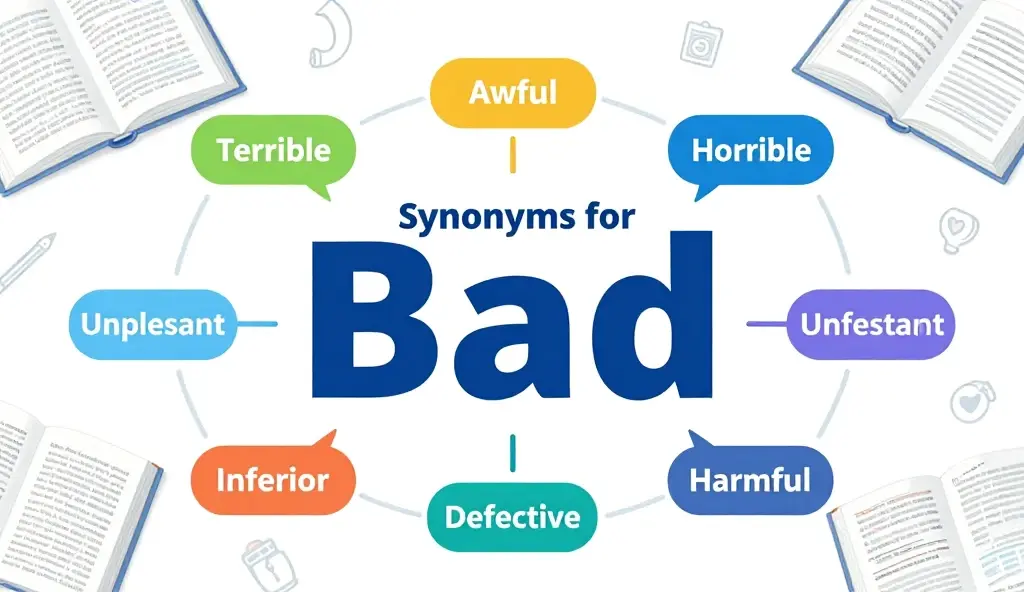
The most useful synonyms for bad include poor, awful, terrible, harmful, wrong, weak, unpleasant, faulty, inferior, and unacceptable.
The right word depends on what you mean. A bad meal may be “awful,” a bad decision may be “unwise,” and a bad product may be “faulty.” Choosing a more exact word makes your message clearer, stronger, and easier to understand.
People often search for synonyms for bad because “bad” is a very broad word. It can describe low quality, poor behavior, pain, danger, mistakes, unpleasant experiences, or weak results. A more precise word helps your reader understand exactly what went wrong.
You may use “bad” in daily talk, school writing, work emails, reviews, stories, and formal reports. However, it isn’t always the best choice. This article explains the meaning, pronunciation, grammar, alternatives, antonyms, phrases, examples, and best uses of the word.
What Does Bad Mean?
“Bad” means something is not good, not correct, not pleasant, or below an expected level. It can also describe something harmful, serious, unfair, weak, or poorly made.
The exact meaning changes with the context.
For example:
- A bad meal tastes unpleasant.
- A bad grade is lower than expected.
- A bad choice may cause trouble.
- A bad person may act in a cruel or dishonest way.
- A bad storm is strong and dangerous.
- A bad injury is serious.
- A bad product may be broken or poorly made.
- A bad habit may harm your health or progress.
The word is common because it is short, easy, and flexible. However, it can also be unclear. Saying “The service was bad” does not explain whether it was slow, rude, careless, confusing, or expensive.
A better sentence might be:
“The service was slow, and the staff was rude.”
That sentence gives the reader useful details.
Simple Definition of Bad
Bad: Not good in quality, behavior, condition, effect, or result.
Common Meanings of Bad
| Meaning | Simple Explanation | Example |
| Low quality | Not made or done well | The shoes were bad quality. |
| Unpleasant | Not enjoyable | We had a bad experience. |
| Harmful | Likely to cause damage | Too much sugar is bad for your teeth. |
| Wrong | Not correct or suitable | That was a bad answer. |
| Serious | Severe or dangerous | He suffered a bad injury. |
| Immoral | Cruel, dishonest, or unfair | It was a bad thing to do. |
| Weak | Below the expected level | The team gave a bad performance. |
| Unhealthy | Not good for the body or mind | Smoking is a bad habit. |
“Bad” does not always mean something is completely terrible. Sometimes it only means that something is not as good as expected.
For example:
“The movie was not bad.”
This usually means the movie was fairly good, even though the sentence contains the word “bad.”
Pronunciation of Bad
The word “bad” is pronounced:
/bæd/
It sounds like:
BAD
The vowel sound is the same sound heard in:
- Cat
- Hat
- Map
- Sad
- Bag
To pronounce it naturally, begin with the “b” sound. Open your mouth slightly wider for the short “a” sound. End with a clear “d” sound.
Say it slowly:
B-A-D
Then say it at normal speed:
Bad
Pronunciation Examples
- That was a bad idea.
- I had a bad day.
- The food smelled bad.
- She feels bad about the mistake.
- The weather is getting bad.
Some English learners confuse “bad” with “bed.” The vowel sounds are different.
| Word | Pronunciation | Example |
| Bad | /bæd/ | It was a bad plan. |
| Bed | /bed/ | The child is in bed. |
The “a” in bad has a wider and brighter sound than the “e” in bed.
What Part of Speech Is Bad?
“Bad” is mainly an adjective. An adjective describes a noun or pronoun.
Examples:
- A bad result
- A bad smell
- A bad decision
- A bad manager
- A bad storm
In each example, “bad” describes a person, object, event, feeling, or result.
Bad as an Adjective
“Bad” usually comes before a noun.
- It was a bad idea.
- He made a bad choice.
- We received bad news.
- She had a bad headache.
It may also come after a linking verb such as “be,” “feel,” “look,” “seem,” “sound,” or “smell.”
- The food smells bad.
- The plan seems bad.
- I feel bad about what happened.
- The weather looks bad.
- His cough sounds bad.
Is Bad an Adverb?
In standard English, “bad” is not normally used as an adverb. The adverb form is badly.
Correct:
- He played badly.
- The project was badly planned.
- She wanted the job badly.
However, in informal American speech, people sometimes say:
- I want it bad.
- He hurt his knee bad.
These forms are common in casual talk, songs, and dialogue, but “badly” is safer in formal writing.
Comparative and Superlative Forms
The comparative form of bad is worse.
The superlative form is worst.
| Form | Word | Example |
| Positive | Bad | The first result was bad. |
| Comparative | Worse | The second result was worse. |
| Superlative | Worst | The final result was the worst. |
Do not write “badder” or “baddest” in standard English.
Incorrect:
- This result is badder.
- That was the baddest day.
Correct:
- This result is worse.
- That was the worst day.
The word “baddest” may appear in slang, where it can mean bold, powerful, or impressive. That use is very informal.
Complete List of Synonyms for Bad
There are many synonyms for bad, but they are not always interchangeable. Some describe quality. Others describe behavior, danger, mistakes, health, or emotional experiences.
| Word | Meaning | Usage | Formality | Example | Difficulty Level |
| Poor | Below a good standard | Quality, work, results | Neutral | The report was poor. | Easy |
| Awful | Very unpleasant or very bad | Experiences, taste, weather | Informal | The soup tasted awful. | Easy |
| Terrible | Extremely bad | Events, quality, feelings | Neutral | We received terrible news. | Easy |
| Horrible | Very unpleasant or shocking | Smells, events, behavior | Neutral | The room had a horrible smell. | Easy |
| Dreadful | Extremely unpleasant | Weather, service, experiences | Neutral | The service was dreadful. | Medium |
| Unpleasant | Not enjoyable or comfortable | Experiences, smells, people | Neutral | We had an unpleasant talk. | Easy |
| Harmful | Causing damage | Health, environment, behavior | Formal | The chemical is harmful. | Easy |
| Damaging | Causing harm or loss | Reputation, health, property | Formal | The rumor was damaging. | Medium |
| Dangerous | Likely to cause harm | Actions, places, products | Neutral | It is a dangerous road. | Easy |
| Wrong | Not correct or morally right | Answers, choices, behavior | Neutral | You entered the wrong number. | Easy |
| Incorrect | Not factually correct | Answers, data, statements | Formal | The total was incorrect. | Easy |
| False | Not true | Claims, information, beliefs | Formal | The report contained false claims. | Easy |
| Faulty | Not working correctly | Machines, logic, products | Formal | The device has faulty wiring. | Medium |
| Defective | Having a serious fault | Products, parts, equipment | Formal | The store replaced the defective item. | Medium |
| Broken | Damaged and not working | Objects, systems, promises | Neutral | The chair is broken. | Easy |
| Inferior | Lower in quality | Products, materials, performance | Formal | The cheaper copy was inferior. | Medium |
| Substandard | Below an accepted standard | Work, housing, products | Formal | The building work was substandard. | Medium |
| Weak | Lacking strength or quality | Arguments, skills, performance | Neutral | The ending was weak. | Easy |
| Ineffective | Not producing the desired result | Plans, medicine, methods | Formal | The old method was ineffective. | Medium |
| Unsuccessful | Not achieving the goal | Attempts, plans, projects | Neutral | The first launch was unsuccessful. | Easy |
| Unacceptable | Not good enough or not allowed | Behavior, work, conditions | Formal | His conduct was unacceptable. | Easy |
| Unsatisfactory | Not meeting expectations | Results, service, work | Formal | The outcome was unsatisfactory. | Medium |
| Disappointing | Not as good as hoped | Results, events, products | Neutral | Sales were disappointing. | Easy |
| Regrettable | Causing sadness or regret | Decisions, events, behavior | Formal | The delay was regrettable. | Medium |
| Unwise | Likely to cause problems | Choices, actions, plans | Formal | It would be unwise to rush. | Easy |
| Foolish | Showing poor judgment | Choices, behavior, risks | Neutral | It was a foolish mistake. | Easy |
| Careless | Not giving enough attention | Work, actions, people | Neutral | The error was careless. | Easy |
| Cruel | Causing pain on purpose | People, words, behavior | Neutral | That was a cruel comment. | Easy |
| Evil | Deeply immoral or harmful | People, plans, actions | Strong | The story had an evil ruler. | Easy |
| Corrupt | Dishonest, often for personal gain | Officials, systems, groups | Formal | The corrupt officer took bribes. | Medium |
| Rude | Not polite | Behavior, replies, service | Neutral | The clerk was rude. | Easy |
| Nasty | Very unpleasant, unkind, or dirty | Behavior, taste, weather | Informal | He made a nasty remark. | Easy |
| Severe | Very serious or intense | Pain, weather, punishment | Formal | The area faced severe flooding. | Medium |
| Serious | Important, dangerous, or severe | Problems, injuries, errors | Neutral | This is a serious issue. | Easy |
| Rotten | Decayed or extremely poor | Food, mood, experiences | Informal | The fruit was rotten. | Easy |
| Lousy | Very poor or unpleasant | Service, mood, performance | Informal | We received lousy service. | Easy |
| Miserable | Very unhappy or unpleasant | Feelings, weather, conditions | Neutral | The cold made us miserable. | Easy |
| Adverse | Harmful or unfavorable | Effects, conditions, reactions | Formal | The drug caused adverse effects. | Hard |
| Negative | Unfavorable or harmful | Results, comments, effects | Formal | The campaign received negative feedback. | Easy |
| Unfavorable | Not helpful or positive | Conditions, reviews, outcomes | Formal | The test produced unfavorable results. | Medium |
This table shows why context matters. “Faulty,” “cruel,” “poor,” and “dangerous” may all replace bad, but they describe very different problems.
Best Synonyms for Bad and How to Use Them
The best synonyms for bad are words that explain the exact type of problem. A precise choice helps the reader understand your meaning without needing extra details.
Poor
Meaning: Below an expected or acceptable standard.
Difference: “Poor” is softer and more professional than “awful” or “terrible.”
Example: The company received poor customer reviews.
Best situation: Use it for work quality, performance, service, results, health, or living conditions.
Common mistake: Do not assume “poor” always means low quality. It can also mean having little money.
- Poor performance
- Poor health
- Poor planning
- Poor families
Awful
Meaning: Extremely unpleasant or very bad.
Difference: “Awful” is emotional and strong. It often shows personal dislike.
Example: The milk tasted awful.
Best situation: Use it for food, smells, weather, service, feelings, or experiences.
Common mistake: Avoid it in very formal reports. “Unsatisfactory” or “unacceptable” may sound more professional.
Terrible
Meaning: Extremely bad, serious, or unpleasant.
Difference: “Terrible” is strong but common. It works in both speech and general writing.
Example: The team made a terrible mistake.
Best situation: Use it for accidents, news, pain, weather, service, behavior, or quality.
Common mistake: Do not use it for every small problem. A five-minute delay may be annoying, but calling it terrible can sound dramatic.
Horrible
Meaning: Very unpleasant, frightening, or shocking.
Difference: “Horrible” often creates a stronger emotional image than “bad.”
Example: We heard a horrible noise outside.
Best situation: Use it for smells, sights, experiences, behavior, accidents, and feelings.
Common mistake: It may sound too emotional in technical writing.
Dreadful
Meaning: Extremely bad or unpleasant.
Difference: “Dreadful” is close to awful and terrible. It is common in British English but is also understood in American English.
Example: The hotel room was dreadful.
Best situation: Use it when describing weather, service, food, conditions, or an unpleasant experience.
Common mistake: Do not confuse “dreadful” with “afraid.” It describes something that causes discomfort or concern.
Unpleasant
Meaning: Not enjoyable, friendly, or comfortable.
Difference: “Unpleasant” is softer and more polite than “horrible.”
Example: We had an unpleasant conversation.
Best situation: Use it in professional writing, reviews, or polite criticism.
Common mistake: It may be too mild for serious harm or danger.
Harmful
Meaning: Causing physical, emotional, social, or environmental damage.
Difference: “Harmful” explains the effect rather than the quality.
Example: Loud noise can be harmful to hearing.
Best situation: Use it for health advice, environmental writing, relationships, products, habits, and policies.
Common mistake: Do not use it when something is simply low quality. A poorly written story is not always harmful.
Dangerous
Meaning: Likely to cause injury, damage, or death.
Difference: “Dangerous” is more exact than bad when safety is the main concern.
Example: Driving at high speed on wet roads is dangerous.
Best situation: Use it for roads, weather, chemicals, actions, equipment, and health risks.
Common mistake: Do not use it for something that is only annoying or disappointing.
Wrong
Meaning: Not correct, suitable, fair, or morally right.
Difference: “Wrong” focuses on correctness or judgment.
Example: I entered the wrong password.
Best situation: Use it for answers, decisions, directions, choices, and behavior.
Common mistake: “Wrong” does not always mean morally bad. It may simply mean incorrect.
Faulty
Meaning: Containing a fault or not working correctly.
Difference: “Faulty” is used for objects, machines, systems, or reasoning.
Example: The fire started because of faulty wiring.
Best situation: Use it in product reviews, safety reports, repair notes, and technical writing.
Common mistake: Do not usually describe a person as faulty.
Defective
Meaning: Made with a serious fault.
Difference: “Defective” is more formal and specific than bad.
Example: The company recalled the defective batteries.
Best situation: Use it for products, parts, machines, tools, and manufactured goods.
Common mistake: Use care when talking about people. Describing a person as defective is insulting and dehumanizing.
Inferior
Meaning: Lower in quality, value, or ability than something else.
Difference: “Inferior” usually includes a comparison.
Example: The copy used inferior materials.
Best situation: Use it for products, ingredients, methods, or performance.
Common mistake: Avoid using it to attack a person or group.
Weak
Meaning: Lacking strength, force, skill, detail, or support.
Difference: “Weak” is often better than bad when something fails to convince or perform.
Example: The writer made a weak argument.
Best situation: Use it for arguments, evidence, skills, signals, drinks, teams, and performances.
Common mistake: A weak result is not always a complete failure.
Ineffective
Meaning: Not producing the wanted result.
Difference: “Ineffective” judges whether something works.
Example: The first treatment was ineffective.
Best situation: Use it for methods, plans, tools, policies, teaching methods, and treatments.
Common mistake: Do not use it when something works but is simply slow or expensive.
Unacceptable
Meaning: Not allowed, not suitable, or not good enough.
Difference: “Unacceptable” sets a clear standard or limit.
Example: Bullying at work is unacceptable.
Best situation: Use it for conduct, safety failures, low-quality work, delays, or broken rules.
Common mistake: It can sound firm or confrontational. Use a softer word when you want to protect the relationship.
Unsatisfactory
Meaning: Not meeting a need, rule, or expected standard.
Difference: “Unsatisfactory” is formal and often used in evaluations.
Example: The inspection found the repairs unsatisfactory.
Best situation: Use it in reports, school feedback, business reviews, inspections, and formal complaints.
Common mistake: It sounds distant in casual conversation.
Disappointing
Meaning: Not as good as expected or hoped.
Difference: It focuses on unmet hopes rather than total failure.
Example: The final score was disappointing.
Best situation: Use it for results, events, products, service, and personal experiences.
Common mistake: A disappointing result may still be acceptable.
Unwise
Meaning: Showing poor judgment or creating an unnecessary risk.
Difference: “Unwise” is a polite way to describe a bad decision.
Example: It would be unwise to spend all your savings.
Best situation: Use it for advice, financial choices, health decisions, and work plans.
Common mistake: It does not always mean foolish. A smart person can make an unwise choice.
Careless
Meaning: Not giving enough attention or thought.
Difference: “Careless” explains why work or behavior was bad.
Example: The article contained several careless errors.
Best situation: Use it for mistakes, driving, writing, handling objects, or unsafe actions.
Common mistake: Do not call every accidental mistake careless. Sometimes a person took reasonable care and still made an error.
Cruel
Meaning: Causing pain or sadness without care.
Difference: “Cruel” is about unkind behavior, not poor quality.
Example: It was cruel to laugh at him.
Best situation: Use it for words, actions, treatment of people, or treatment of animals.
Common mistake: Do not use “cruel” for normal criticism or fair discipline.
Nasty
Meaning: Very unpleasant, unkind, dirty, or harmful.
Difference: “Nasty” is informal and has several meanings.
Example: She received a nasty email.
Best situation: Use it for remarks, behavior, smells, injuries, weather, and surprises.
Common mistake: Because it is broad, the reader may still need more detail.
Synonyms for Bad Quality
When “bad” describes quality, choose a word that shows how the product, service, or work failed.
Useful options include:
- Poor
- Inferior
- Substandard
- Faulty
- Defective
- Weak
- Flimsy
- Unreliable
- Shoddy
- Low-grade
- Unsatisfactory
- Second-rate
Poor Quality
“Poor” is the most flexible choice.
“The camera takes poor-quality pictures.”
It means the pictures are below the expected standard.
Inferior Quality
“Inferior” shows that one thing is worse than another.
“The replacement part was inferior to the original.”
This word works well in formal product comparisons.
Substandard Quality
“Substandard” means below an official, common, or accepted standard.
“The inspector found substandard building materials.”
This is useful in reports, inspections, and professional complaints.
Faulty Quality
“Faulty” describes a product or system with a specific problem.
“The alarm failed because of a faulty sensor.”
Defective Quality
“Defective” means the product was made with a fault.
“The customer returned the defective blender.”
Shoddy Quality
“Shoddy” means carelessly or cheaply made.
“The bag looked stylish, but the stitching was shoddy.”
This word is strong and often critical.
Flimsy Quality
“Flimsy” describes something weak, thin, or easy to break.
“The chair felt flimsy.”
It may also describe a weak excuse or argument.
Unreliable Quality
“Unreliable” describes something that cannot be trusted to work properly.
“The old printer is slow and unreliable.”
The best word depends on the problem. A chair may be flimsy, an engine may be faulty, and customer service may be unsatisfactory.
Synonyms for Bad Behavior
Bad behavior may be rude, cruel, dishonest, careless, aggressive, selfish, unfair, or disrespectful. Each word points to a different type of conduct.
| Synonym | Meaning | Example |
| Rude | Not polite | His rude reply upset the customer. |
| Cruel | Causing pain without care | The joke was cruel. |
| Dishonest | Not truthful | The dishonest worker changed the records. |
| Selfish | Caring mainly about yourself | It was selfish to take all the food. |
| Unfair | Not treating people equally | The rule seemed unfair. |
| Disrespectful | Showing little respect | Her comment was disrespectful. |
| Aggressive | Ready to argue, attack, or force | His aggressive tone made people nervous. |
| Careless | Not paying enough attention | Careless driving caused the crash. |
| Mean | Unkind | That was a mean thing to say. |
| Immoral | Against accepted moral rules | The court examined the immoral conduct. |
| Corrupt | Dishonest for money or power | Corrupt officials accepted bribes. |
| Abusive | Using harmful words or actions | The company reported abusive behavior. |
“Bad person” is often too broad. It may also sound like a complete judgment of someone’s character. It is usually better to name the behavior.
Instead of:
“He is a bad person.”
Write:
“He often lies to customers.”
Or:
“He treated his staff unfairly.”
These descriptions are clearer and focus on actions that can be observed.
Synonyms for Bad Experiences and Feelings
A bad experience can be unpleasant, upsetting, painful, disappointing, stressful, awkward, embarrassing, frightening, or miserable.
Unpleasant
Use “unpleasant” for an experience that was uncomfortable but not extreme.
“The meeting became unpleasant after the argument.”
Upsetting
Use “upsetting” when something causes emotional pain or worry.
“The phone call was upsetting.”
Painful
Use “painful” for physical or emotional suffering.
“The breakup was painful for both of them.”
Disappointing
Use “disappointing” when the result is worse than you hoped.
“The concert was disappointing.”
Stressful
Use “stressful” when a situation creates pressure or worry.
“Moving to a new city can be stressful.”
Awkward
Use “awkward” when a situation feels uncomfortable or socially difficult.
“There was an awkward silence after the question.”
Embarrassing
Use “embarrassing” when something causes shame or social discomfort.
“Forgetting her name was embarrassing.”
Frightening
Use “frightening” when something causes fear.
“The sudden noise was frightening.”
Miserable
Use “miserable” for an experience or feeling that is deeply unhappy or uncomfortable.
“We felt miserable in the cold rain.”
A general word such as bad gives a basic idea. A more exact synonym tells the reader what the experience felt like.
Synonyms for Bad Decisions and Ideas
A bad decision can be unwise, foolish, risky, careless, mistaken, shortsighted, irresponsible, or poorly planned.
Unwise Decision
An unwise decision shows poor judgment.
“Leaving without checking the weather was unwise.”
Foolish Decision
A foolish decision ignores clear facts or common sense.
“It was foolish to share the password.”
This word can sound judgmental, so use it with care.
Risky Decision
A risky decision may lead to loss, danger, or failure.
“Investing all the money in one company was risky.”
A risky choice is not always wrong. It simply carries a higher chance of trouble.
Careless Decision
A careless decision is made without enough attention.
“Sending the email without reading it was careless.”
Mistaken Decision
A mistaken decision is based on a false belief or misunderstanding.
“The manager made a mistaken decision based on old data.”
Shortsighted Decision
A shortsighted decision focuses on quick results and ignores future effects.
“Cutting all staff training would be shortsighted.”
Irresponsible Decision
An irresponsible decision ignores duties, risks, or the needs of others.
“Driving after drinking is irresponsible.”
Poorly Planned Decision
A poorly planned decision lacks preparation.
“The rushed move was poorly planned.”
These synonyms for bad make advice and criticism more useful because they explain what was wrong with the choice.
Synonyms for Bad Health, Pain, and Conditions
Health language should be clear. Instead of saying someone has a bad condition, use a word that shows how serious or uncomfortable it is.
Useful choices include:
- Serious
- Severe
- Painful
- Chronic
- Acute
- Harmful
- Unhealthy
- Critical
- Worsening
- Debilitating
Serious
A serious condition needs attention and may have major effects.
“She developed a serious infection.”
Severe
“Severe” means very intense or strong.
“He had severe back pain.”
Painful
“Painful” describes something that causes physical or emotional pain.
“The swelling made walking painful.”
Chronic
A chronic condition lasts for a long time or returns often.
“She lives with chronic headaches.”
Acute
An acute condition begins quickly and may be intense.
“He was treated for acute chest pain.”
Critical
A critical condition is extremely serious and may be life-threatening.
“The patient remained in critical condition.”
Unhealthy
“Unhealthy” describes a habit, environment, relationship, or condition that does not support well-being.
“Skipping sleep is an unhealthy habit.”
Debilitating
“Debilitating” means making normal activity very difficult.
“She experiences debilitating migraines.”
Avoid using medical terms unless you understand them. “Severe,” “chronic,” “acute,” and “critical” are not exact replacements for one another.
Antonyms of Bad
Antonyms of bad include good, excellent, pleasant, helpful, safe, correct, kind, effective, healthy, and acceptable.
| Antonym | Meaning | Example |
| Good | Positive or of a suitable quality | The food was good. |
| Excellent | Extremely good | She gave an excellent speech. |
| Great | Very good or enjoyable | We had a great trip. |
| Fine | Acceptable or satisfactory | The final design looks fine. |
| Pleasant | Enjoyable or comfortable | We had a pleasant evening. |
| Helpful | Giving useful support | The guide was helpful. |
| Beneficial | Producing a good effect | Exercise is beneficial to health. |
| Safe | Not likely to cause harm | The road is now safe. |
| Correct | Free from error | Your answer is correct. |
| Accurate | Exact and factually right | The report was accurate. |
| Kind | Caring and gentle | She gave a kind reply. |
| Honest | Truthful | He gave an honest answer. |
| Fair | Treating people properly | The judge made a fair decision. |
| Effective | Producing the desired result | The new method is effective. |
| Successful | Achieving the goal | The event was successful. |
| Healthy | Supporting good health | They serve healthy meals. |
| Acceptable | Good enough or allowed | The quality is acceptable. |
| Satisfactory | Meeting the expected standard | Her work was satisfactory. |
| Superior | Better in quality | This material is superior. |
| Positive | Favorable or encouraging | We received positive feedback. |
Good
“Good” is the main opposite of bad.
- A good plan
- Good behavior
- Good health
- Good news
- A good result
Excellent
“Excellent” means far above the normal standard.
“The service was excellent.”
It is a stronger opposite than “good.”
Pleasant
“Pleasant” is the opposite of unpleasant or uncomfortable.
“The room had a pleasant smell.”
Helpful
“Helpful” is the opposite of harmful, useless, or unhelpful.
“Her advice was helpful.”
Safe
“Safe” is the opposite of dangerous.
“The repaired bridge is now safe.”
Correct
“Correct” is the opposite of wrong or incorrect.
“You chose the correct answer.”
Kind
“Kind” is the opposite of cruel or mean.
“He was kind to the new student.”
Effective
“Effective” is the opposite of ineffective.
“The updated plan was effective.”
Healthy
“Healthy” is the opposite of unhealthy.
“Fresh fruit is a healthy snack.”
Acceptable
“Acceptable” means meeting a basic standard.
“The final result was acceptable, but it could still improve.”
An antonym should match the same sense of the original word. The opposite of “bad weather” may be “good weather” or “pleasant weather.” The opposite of “bad data” is usually “accurate data,” not “kind data.”
30 Real-World Examples Using Synonyms for Bad
The following examples show how different alternatives can replace bad in natural situations.
- The restaurant received poor reviews because the food arrived cold.
- We had an awful drive home during the storm.
- The doctor warned him that smoking was harmful to his lungs.
- The laptop stopped working because of a faulty battery.
- Her first test result was disappointing, but she improved the next week.
- The manager called the employee’s rude comments unacceptable.
- The team lost because its defense was weak.
- Entering personal details on that unknown site could be dangerous.
- The report included incorrect sales figures.
- The company replaced the defective charger without charging a fee.
- The hotel room had a horrible smell.
- He made an unwise choice when he ignored the warning signs.
- The construction work was substandard and failed the inspection.
- The medicine caused an adverse reaction.
- Her careless mistake delayed the entire project.
- The customer complained about the unpleasant service.
- The old plan was ineffective and wasted too much time.
- His cruel joke hurt several people.
- The trip became miserable after three days of heavy rain.
- The cheaper material was inferior to the original.
- The school took action after hearing about the student’s aggressive behavior.
- The first business launch was unsuccessful.
- The workers reported unsafe conditions at the factory.
- The movie had a weak ending that felt rushed.
- The fruit was rotten, so we threw it away.
- The company faced negative press after the data leak.
- The service was lousy, and our order took more than an hour.
- The judge described the act as dishonest and corrupt.
- The repairs were unsatisfactory, so the customer asked for a refund.
- Heavy traffic created unfavorable conditions for the delivery team.
Each example gives more information than the word bad alone.
25 Natural Sentences with Bad and Its Synonyms
These sentences use different tones, settings, and writing styles.
- I had a bad feeling about the deal from the start.
- The coffee tasted awful, but I drank it anyway.
- Her poor planning caused several delays.
- The weather became dangerous after sunset.
- That answer is incorrect.
- We received terrible news this morning.
- The new software has a few serious faults.
- His rude tone surprised everyone in the room.
- The final result was disappointing.
- The road is in poor condition.
- The teacher said my first draft was weak.
- It would be unwise to ignore the contract.
- The company apologized for the defective product.
- She felt bad about missing the event.
- The hotel offered a refund after our unpleasant stay.
- Careless spending can create long-term money problems.
- The old rule was unfair to part-time workers.
- That was a cruel thing to say.
- The chemical may have harmful effects.
- His explanation sounded false.
- The meal looked fine, but it smelled horrible.
- The plan failed because it was poorly designed.
- The customer described the service as unacceptable.
- We made the wrong turn near the bridge.
- The first week was stressful, but things soon improved.
These sentences show that synonyms for bad can express quality, emotion, danger, mistakes, behavior, and results.
Formal vs. Informal Synonyms for Bad
Some alternatives sound natural in conversation. Others are better for reports, school papers, complaints, legal documents, or workplace messages.
| Meaning | Informal Word | Formal Word |
| Very bad quality | Lousy | Unsatisfactory |
| Not working | Broken | Defective |
| Very unpleasant | Awful | Unpleasant |
| Not good enough | Crummy | Substandard |
| Wrong | Off | Incorrect |
| Bad result | A flop | Unsuccessful |
| Harmful | Bad for you | Detrimental |
| Poor decision | Dumb | Unwise |
| Bad behavior | Nasty | Unacceptable |
| Weak product | Cheap | Inferior |
| Very serious | Really bad | Severe |
| Negative effect | Bad effect | Adverse effect |
Informal Usage
Informal language is common in conversation, social posts, reviews, text messages, and personal stories.
Examples:
- The service was lousy.
- I had an awful day.
- That was a dumb mistake.
- The weather was nasty.
- This phone is pretty bad.
- The movie was a total flop.
These words express feeling quickly. They can sound natural and direct.
Formal Usage
Formal language is common in reports, business emails, academic writing, complaints, policies, and evaluations.
Examples:
- The service was unsatisfactory.
- The data was inaccurate.
- The equipment was defective.
- The conduct was unacceptable.
- The decision was unwise.
- The policy had adverse effects.
Formal words often sound more exact and less emotional.
Informal and Formal Comparison
Informal:
“The product was really bad.”
Formal:
“The product failed to meet basic quality and safety standards.”
Informal:
“The meeting went terribly.”
Formal:
“The meeting was unproductive and ended without a clear decision.”
Informal:
“That was a bad idea.”
Formal:
“That approach carries serious financial and legal risks.”
The best choice depends on your reader, purpose, and setting.
Academic Usage of Bad and Its Synonyms
Academic writing values precision. The word “bad” is often too general for a paper, report, study, or analysis.
Instead of writing:
“The program had bad results.”
Write:
“The program produced disappointing results.”
Or:
“The program had no measurable effect on attendance.”
The second version is even better because it explains the result.
Better Academic Alternatives
| General Wording | Better Academic Wording |
| Bad effect | Harmful effect |
| Bad result | Unfavorable outcome |
| Bad data | Inaccurate data |
| Bad method | Unreliable method |
| Bad argument | Weak argument |
| Bad behavior | Unethical conduct |
| Bad condition | Poor condition |
| Bad decision | Unwise decision |
| Bad product | Defective product |
| Bad performance | Unsatisfactory performance |
| Bad relationship | Dysfunctional relationship |
| Bad for health | Harmful to health |
| Bad evidence | Weak or insufficient evidence |
| Bad policy | Ineffective policy |
| Bad change | Adverse change |
Academic Examples
“The small sample size was a weakness in the study.”
“The policy had an adverse effect on low-income families.”
“The researcher removed inaccurate records from the dataset.”
“The first method produced unreliable results.”
“The argument was weak because it lacked supporting evidence.”
“The inspection found unsafe working conditions.”
“The campaign was ineffective in changing public behavior.”
“The report identified several ethical concerns.”
“The decline in sales created unfavorable market conditions.”
“The proposed solution was not financially viable.”
Academic writing should name the problem. Was the method inaccurate, biased, limited, unreliable, or ineffective? These terms give readers more useful information.
Using Synonyms for Bad in Daily Conversation
Daily conversation often uses simple and emotional alternatives.
Talking About Food
- The soup tastes awful.
- The milk smells sour.
- The meat has gone bad.
- The fries are cold and soggy.
- This sauce is too salty.
“Sour,” “soggy,” and “salty” are better than bad because they explain the exact problem.
Talking About Weather
- The weather is terrible.
- The roads are dangerous.
- The heat is unbearable.
- The storm is severe.
- Driving conditions are poor.
Talking About Work
- I had a rough day.
- The meeting was unproductive.
- The results were disappointing.
- The schedule is unrealistic.
- The instructions were confusing.
Talking About People
- He was rude to the waiter.
- Her comment was unkind.
- That behavior was unfair.
- The manager was dishonest.
- His response seemed careless.
Try to describe the behavior rather than labeling the whole person.
Talking About Products
- The camera quality is poor.
- The battery is unreliable.
- The screen is defective.
- The material feels cheap.
- The design is uncomfortable.
Talking About Feelings
- I feel awful.
- She seems upset.
- He looked miserable.
- We were disappointed.
- They felt embarrassed.
In daily conversation, context often makes the meaning clear. Still, a more exact word can make a story more vivid.
Grammar Tips for Using Bad Correctly
“Bad” is a simple word, but a few grammar errors are common.
Use Bad After Linking Verbs
Use “bad” after linking verbs when you are describing a condition, feeling, smell, look, or sound.
- I feel bad.
- The milk smells bad.
- The plan sounds bad.
- His injury looks bad.
- The situation seems bad.
Here, “bad” describes the subject.
Use Badly for Actions
Use “badly” when describing how an action is done.
- He sang badly.
- The room was badly damaged.
- She handled the complaint badly.
- The team played badly.
Feel Bad vs. Feel Badly
“I feel bad” usually means:
- I feel sick.
- I feel sorry.
- I feel unhappy.
“I feel badly” can technically mean your sense of touch is weak.
For most everyday situations, use:
“I feel bad about what happened.”
Worse and Worst
Use “worse” when comparing two things.
“This version is worse than the first.”
Use “worst” for the lowest level among three or more things.
“This is the worst version of all.”
Avoid Badder and Baddest
In standard English:
- Bad becomes worse.
- Worse becomes worst.
“Badder” and “baddest” appear in slang, jokes, brand names, and informal creative writing, but they are not standard comparative forms.
Bad at and Bad for
Use bad at for a weak skill.
- I am bad at math.
- He is bad at remembering names.
- She is bad at cooking rice.
Use bad for for a harmful effect.
- Too much salt is bad for your health.
- Sitting all day is bad for your back.
- The delay was bad for business.
Bad to and Bad with
Use bad to for unkind treatment.
- He was bad to his dog.
Use bad with for poor ability in a certain area.
- I am bad with numbers.
- She is bad with directions.
- He is bad with money.
A Bad Person vs. Bad Behavior
“A bad person” judges the whole person.
“Bad behavior” judges the action.
In careful writing, focus on the action:
“His behavior was dishonest.”
This is often fairer and more precise than:
“He is bad.”
Common Collocations with Bad
A collocation is a group of words that commonly appear together. Learning collocations helps your English sound natural.
Bad Idea
A plan that may cause failure, loss, or trouble.
“Driving without insurance is a bad idea.”
Better alternatives may include risky idea, foolish idea, or unwise idea.
Bad Decision
A choice that leads to an unwanted result.
“Selling the house too quickly was a bad decision.”
Bad Habit
A repeated action that causes harm or problems.
“Checking your phone during every conversation is a bad habit.”
Bad Mood
An unhappy, angry, or irritable emotional state.
“He woke up in a bad mood.”
Bad Day
A day with several unpleasant events.
“I missed the bus, lost my keys, and had a bad day.”
Bad Weather
Rain, snow, heat, wind, or other conditions that cause trouble.
“The flight was delayed because of bad weather.”
Bad News
Information about an unwanted event.
“I have some bad news about the repair.”
Bad Experience
An event that was unpleasant, painful, or disappointing.
“She had a bad experience with the company.”
Bad Behavior
Actions that are rude, harmful, or against rules.
“The teacher spoke to the class about bad behavior.”
Bad Influence
A person or thing that encourages harmful actions.
“His parents thought the older group was a bad influence.”
Bad Reputation
A negative public opinion about someone or something.
“The restaurant gained a bad reputation for poor hygiene.”
Bad Condition
A damaged, unhealthy, or poorly maintained state.
“The house was in bad condition.”
Bad Taste
An unpleasant flavor or poor judgment about style.
“The medicine left a bad taste in my mouth.”
It may also mean poor style:
“That joke showed bad taste.”
Bad Smell
An unpleasant odor.
“There was a bad smell near the drain.”
Bad Attitude
A negative, rude, or unhelpful way of thinking or acting.
“Skill matters, but a bad attitude can harm the whole team.”
Bad Timing
Choosing an unsuitable moment.
“His question came at a bad time.”
Bad Luck
An unwanted event caused by chance.
“Missing both flights felt like bad luck.”
Bad Choice
An option that creates a poor result.
“Skipping the inspection was a bad choice.”
Bad Example
Behavior that others should not copy.
“Adults should not set a bad example for children.”
Bad Sign
A clue that suggests trouble.
“A sudden drop in pressure is a bad sign.”
Bad Memory
A memory of an unpleasant event or a weak ability to remember.
“That street brings back bad memories.”
“I have a bad memory for names.”
The surrounding words often show which synonym works best.
Common Phrases and Idioms with Bad
The word “bad” appears in many common English expressions.
Go from Bad to Worse
Meaning: A difficult situation becomes even more difficult.
“The day went from bad to worse when the car broke down.”
Not Bad
Meaning: Fairly good or better than expected.
“The meal was not bad.”
The speaker usually means the meal was acceptable or good.
Too Bad
Meaning: Used to show regret, disappointment, or lack of sympathy.
“It is too bad that you missed the show.”
In a colder tone, “Too bad” may mean the speaker does not care.
My Bad
Meaning: My mistake.
“My bad. I sent the message to the wrong group.”
This phrase is informal.
Feel Bad About Something
Meaning: Feel sorry, guilty, or sad.
“I feel bad about canceling the visit.”
Have It Bad
Meaning: Experience a difficult condition or have very strong feelings.
“He has it bad this winter because his allergies are severe.”
It can also refer to strong romantic feelings.
In a Bad Way
Meaning: In poor health, serious trouble, or a difficult condition.
“The injured driver was in a bad way.”
Get a Bad Rap
Meaning: Receive an unfairly negative reputation.
“Frozen vegetables sometimes get a bad rap, but they can still be nutritious.”
“Bad rap” is the standard form, though “bad rep” is also used informally.
Leave a Bad Taste in Your Mouth
Meaning: Create an unpleasant memory or feeling.
“The company’s response left a bad taste in my mouth.”
Bad Blood
Meaning: Anger or resentment between people or groups.
“There has been bad blood between the two families for years.”
A Bad Apple
Meaning: A dishonest or harmful person within a group.
“One bad apple can damage the team’s reputation.”
Catch Someone at a Bad Time
Meaning: Contact someone when they are busy or facing a problem.
“Sorry, you caught me at a bad time.”
Make the Best of a Bad Situation
Meaning: Try to create a positive result from a difficult event.
“The flight was canceled, so we made the best of a bad situation and explored the city.”
Be Bad at Something
Meaning: Have little skill in an area.
“I am bad at drawing.”
Bad-Mouth Someone
Meaning: Say negative things about someone.
“He kept bad-mouthing his former employer.”
This phrase is informal and often suggests unfair criticism.
Similar Words Commonly Confused with Bad
Some words look like synonyms for bad but have narrower meanings.
| Word | Main Meaning | Difference from Bad | Example |
| Sad | Unhappy | Describes emotion, not general quality | She felt sad. |
| Mad | Angry or mentally unwell | Describes anger or mental state | He was mad about the delay. |
| Evil | Deeply immoral | Much stronger than bad | The story describes an evil ruler. |
| Wrong | Incorrect or immoral | Focuses on correctness | You chose the wrong door. |
| Poor | Below standard or lacking money | Often softer and more formal | The report was poor. |
| Awful | Extremely unpleasant | Stronger and more emotional | The smell was awful. |
| Harmful | Causing damage | Focuses on effects | The smoke is harmful. |
| Faulty | Not working correctly | Used for objects or reasoning | The machine had a faulty switch. |
| Weak | Lacking strength or support | Used for skill, evidence, or force | His argument was weak. |
| Severe | Very intense or serious | Used for pain, weather, or punishment | She had severe pain. |
| Nasty | Unpleasant or unkind | Informal and broad | He made a nasty remark. |
| Negative | Unfavorable or critical | Often neutral or formal | We received negative feedback. |
Bad vs. Sad
“Bad” describes something negative or below standard.
“Sad” describes unhappiness.
- It was a bad day.
- I felt sad all day.
Bad vs. Evil
“Evil” is much stronger. It describes deep cruelty or immorality.
- Stealing the pen was bad behavior.
- The villain formed an evil plan to harm the town.
Do not use evil for ordinary mistakes.
Bad vs. Wrong
“Wrong” means incorrect, unsuitable, or immoral.
- That is the wrong answer.
- It was bad to lie.
The words overlap when discussing behavior, but “wrong” often focuses on rules or correctness.
Bad vs. Poor
“Poor” is often softer and more formal.
- Bad service sounds direct.
- Poor service sounds measured and professional.
“Poor” can also mean having little money, so context matters.
Bad vs. Awful
“Awful” is stronger and more emotional.
- The coffee was bad.
- The coffee was awful.
The second sentence shows stronger dislike.
Bad vs. Harmful
“Harmful” explains that something causes damage.
- The policy was bad.
- The policy was harmful to small businesses.
The second sentence is more informative.
Word Comparisons for More Precise Writing
Choosing between close synonyms can be difficult. These comparisons show the small differences.
Poor vs. Terrible
| Word | Meaning | Difference | Example |
| Poor | Below standard | Mild to moderate criticism | The sound quality was poor. |
| Terrible | Extremely bad | Strong criticism | The sound quality was terrible. |
Faulty vs. Defective
| Word | Meaning | Difference | Example |
| Faulty | Has a fault | May describe one part or problem | The lamp had faulty wiring. |
| Defective | Made with a fault | Often used for manufactured goods | The batch contained defective lamps. |
Harmful vs. Dangerous
| Word | Meaning | Difference | Example |
| Harmful | Causes damage | Damage may happen over time | Excess sugar can be harmful. |
| Dangerous | Creates immediate or serious risk | Stronger focus on safety | The exposed wire is dangerous. |
Weak vs. Ineffective
| Word | Meaning | Difference | Example |
| Weak | Lacks strength or support | May still have some value | The argument was weak. |
| Ineffective | Does not produce the wanted result | Focuses on failure to work | The treatment was ineffective. |
Unpleasant vs. Horrible
| Word | Meaning | Difference | Example |
| Unpleasant | Not enjoyable | Polite and mild | The conversation was unpleasant. |
| Horrible | Extremely unpleasant | Strong and emotional | The accident was horrible. |
Unwise vs. Foolish
| Word | Meaning | Difference | Example |
| Unwise | Showing poor judgment | Polite and formal | It would be unwise to rush. |
| Foolish | Lacking good sense | More direct and critical | It was foolish to ignore the warning. |
Unsatisfactory vs. Unacceptable
| Word | Meaning | Difference | Example |
| Unsatisfactory | Does not meet expectations | May allow improvement | The first draft was unsatisfactory. |
| Unacceptable | Cannot be allowed or approved | Stronger rejection | The safety failure was unacceptable. |
Disappointing vs. Unsuccessful
| Word | Meaning | Difference | Example |
| Disappointing | Below hopes | May still achieve part of the goal | Attendance was disappointing. |
| Unsuccessful | Did not achieve the goal | Clear lack of success | The launch was unsuccessful. |
Rude vs. Cruel
| Word | Meaning | Difference | Example |
| Rude | Not polite | May not be intended to hurt | The reply was rude. |
| Cruel | Causes pain without care | Stronger and more harmful | The public insult was cruel. |
Incorrect vs. False
| Word | Meaning | Difference | Example |
| Incorrect | Not accurate | May be an honest error | The date was incorrect. |
| False | Not true | May suggest a misleading claim | The ad made false claims. |
These comparisons help writers avoid vague or unfair wording.
How to Choose the Right Synonym for Bad
Start by asking what kind of problem you are describing.
Is It a Quality Problem?
Use:
- Poor
- Inferior
- Substandard
- Faulty
- Defective
- Flimsy
Example:
“The table was poorly made and felt flimsy.”
Is It a Safety Problem?
Use:
- Dangerous
- Unsafe
- Harmful
- Hazardous
- Risky
Example:
“The exposed cable created a dangerous condition.”
Is It a Behavior Problem?
Use:
- Rude
- Cruel
- Dishonest
- Unfair
- Careless
- Aggressive
Example:
“His rude comment ended the discussion.”
Is It a Correctness Problem?
Use:
- Wrong
- Incorrect
- False
- Inaccurate
- Mistaken
Example:
“The chart contains inaccurate data.”
Is It a Performance Problem?
Use:
- Weak
- Poor
- Ineffective
- Unsuccessful
- Disappointing
Example:
“The campaign was ineffective because it reached the wrong audience.”
Is It an Emotional Experience?
Use:
- Unpleasant
- Upsetting
- Painful
- Miserable
- Stressful
- Frightening
Example:
“The interview became stressful after several unexpected questions.”
Is It a Serious Problem?
Use:
- Severe
- Critical
- Serious
- Grave
- Extreme
Example:
“The region is facing a severe water shortage.”
The strongest word is not always the best word. The most accurate word is usually better.
Frequently Asked Questions About Synonyms for Bad
What Is the Best Synonym for Bad?
The best synonym depends on the meaning. Use “poor” for low quality, “awful” for a very unpleasant experience, “harmful” for something that causes damage, “wrong” for an incorrect choice, and “faulty” for a broken product. There is no single replacement that works in every sentence. Choose the word that explains the exact problem.
What Is a Stronger Word Than Bad?
Strong words for bad include terrible, horrible, dreadful, disastrous, appalling, and atrocious. These words show that something is far below an acceptable level. Use them only when the situation is truly serious. Calling a small error “atrocious” may sound exaggerated, while “careless” or “minor” may be more accurate.
What Is a Professional Synonym for Bad?
Professional alternatives include poor, unsatisfactory, unacceptable, ineffective, unfavorable, substandard, defective, and inappropriate. The best option depends on the context. A business may report “unsatisfactory performance,” “defective equipment,” or “unfavorable market conditions.” These choices sound clearer and less emotional than simply saying something was bad.
What Is Another Word for Bad Quality?
Common alternatives for bad quality include poor, inferior, substandard, defective, faulty, shoddy, flimsy, unreliable, and low-grade. “Defective” means the item has a fault, while “inferior” means it is lower in quality than another option. “Shoddy” suggests careless work, and “flimsy” describes something weak or easy to break.
What Is Another Word for a Bad Person?
Instead of calling someone a bad person, describe the behavior. Useful words include dishonest, cruel, selfish, unfair, corrupt, abusive, disrespectful, or unkind. This approach is more exact and often fairer. For example, “He lied to customers” gives clearer information than “He is a bad person.”
What Is Another Word for Bad Behavior?
Synonyms for bad behavior include misconduct, rudeness, dishonesty, cruelty, aggression, disrespect, selfishness, and improper conduct. In schools or workplaces, “misconduct” and “inappropriate behavior” sound formal. In daily conversation, people may say rude, mean, unfair, or nasty behavior.
What Is a Polite Way to Say Bad?
Polite alternatives include disappointing, less effective, below expectations, unsatisfactory, limited, not ideal, or in need of improvement. Instead of saying, “Your work is bad,” you could say, “The draft needs more detail and clearer examples.” Specific feedback sounds more respectful and gives the person a way to improve.
What Is an Academic Synonym for Bad?
Academic alternatives include adverse, harmful, unfavorable, ineffective, inaccurate, unreliable, unethical, insufficient, and unsatisfactory. The correct choice should name the type of weakness. For example, use “insufficient evidence,” “unreliable data,” “an ineffective method,” or “an adverse outcome” instead of vague phrases such as “bad evidence” or “bad results.”
Is Poor a Synonym for Bad?
Yes, “poor” is a common synonym for bad when discussing quality, performance, health, conditions, or planning. For example, you can say “poor service,” “poor health,” or “poor judgment.” However, “poor” can also mean lacking money, so the surrounding words must make the meaning clear.
Is Awful Stronger Than Bad?
Yes, “awful” is usually stronger and more emotional than bad. “The meal was bad” means the meal was not good. “The meal was awful” shows strong dislike. Because awful carries more feeling, it works well in conversation and reviews but may sound too emotional in formal reports.
What Is the Opposite of Bad?
The main opposite of bad is good. Other antonyms include excellent, pleasant, safe, correct, kind, healthy, effective, successful, accurate, acceptable, and beneficial. The correct opposite depends on the meaning. The opposite of bad information is accurate information, while the opposite of bad behavior may be kind or respectful behavior.
What Is the Difference Between Bad and Badly?
“Bad” is mainly an adjective, while “badly” is an adverb. Say, “The food tastes bad,” because bad describes the food. Say, “He cooked badly,” because badly describes how he cooked. In the sentence “I feel bad,” bad correctly describes your physical or emotional state.
Can Bad Mean Good in Slang?
Yes. In some slang uses, “bad” can mean attractive, powerful, bold, impressive, or highly skilled. A person may call someone “bad” or “badass” as praise. This meaning is informal and depends heavily on tone and culture. Avoid it in formal writing because many readers may understand the usual negative meaning.
What Is a Better Word Than Bad in a Review?
Use a word that describes the exact problem. A product may be defective, flimsy, unreliable, uncomfortable, overpriced, or poorly designed. Service may be slow, rude, careless, or unhelpful. A more specific review is more credible because it tells other buyers what they may experience.
How Can I Avoid Repeating Bad in Writing?
Identify what is wrong each time. Replace bad with words such as poor, unsafe, inaccurate, rude, weak, harmful, or disappointing. You can also explain the problem directly. Instead of “The hotel was bad,” write, “The room was dirty, the bed was uncomfortable, and the staff ignored our calls.”
What Is Another Word for a Bad Situation?
Alternatives include difficult situation, serious problem, crisis, hardship, setback, troubling condition, unpleasant experience, dangerous situation, and unfortunate event. “Crisis” is suitable for urgent and severe problems, while “setback” describes a delay or temporary failure. Choose a word that matches the level of seriousness.
Expert Tips for Using Synonyms for Bad
Name the Exact Problem
Do not replace one vague word with another vague word. Ask what makes the thing bad.
Instead of:
“The website is bad.”
Write:
“The website loads slowly, has confusing menus, and does not work well on phones.”
Match the Strength to the Situation
“Poor” is milder than “terrible.” “Unpleasant” is milder than “horrific.”
Use strong words only when the facts support them.
A late order may be disappointing. A dangerous product defect may be unacceptable.
Separate Facts from Feelings
A personal review may use emotional words:
“The movie was awful.”
A formal report should explain the evidence:
“The film received low audience ratings and earned less than expected during its opening week.”
Focus on Actions Instead of Labels
Avoid attacking a person’s whole character.
Instead of:
“She is bad.”
Write:
“She repeatedly ignored customer complaints.”
The second sentence is more specific and easier to support.
Use Technical Words Carefully
Words such as defective, hazardous, chronic, critical, unethical, and fraudulent have strong meanings. Use them only when they are accurate.
For example, a product that feels cheap is not always defective. A mistake is not always fraud.
Choose Words Your Reader Understands
Simple words are often stronger than difficult words.
“Harmful” may work better than “detrimental.”
“Wrong” may work better than “erroneous.”
Clear writing is more useful than impressive wording.
Improve Reviews with Details
Instead of:
“The shoes were bad.”
Write:
“The sole began to separate after two days, and the heel felt unstable.”
Specific details make a review more trustworthy.
Use Softer Words for Constructive Feedback
When helping someone improve, try:
- Needs improvement
- Below expectations
- Unclear
- Incomplete
- Inconsistent
- Not yet effective
- Missing key details
These phrases are more useful than simply saying the work is bad.
Avoid Repeating the Same Strong Word
If every problem is terrible, the word loses power. Vary your language based on the problem:
- Poor planning
- Unsafe conditions
- Rude service
- Weak evidence
- Inaccurate figures
- Disappointing sales
- Defective equipment
Read the Sentence Aloud
A word may be correct but sound unnatural in the sentence. Reading aloud helps you notice stiff, dramatic, or unclear phrasing.
For example:
“The sandwich was unsatisfactory.”
This is grammatically correct, but it sounds formal for daily conversation.
“The sandwich tasted awful” sounds more natural.
Conclusion:
The word “bad” is useful, but it often leaves important questions unanswered. Is something harmful, weak, wrong, rude, broken, disappointing, or unsafe? The best synonyms for bad explain the exact type of problem.
Use “poor” for low quality, “awful” or “terrible” for very unpleasant experiences, “faulty” for something that does not work, “harmful” for damaging effects, “unwise” for poor decisions, and “unacceptable” for conduct or results that fail an important standard.
Strong writing does not depend on rare words. It depends on accurate ones. Before using “bad,” pause and ask what you truly mean. A more exact choice will make your sentence clearer, more natural, and more helpful to the reader.

Abigail Hughes enjoys creating educational resources that make English vocabulary simple, practical, and enjoyable to learn.