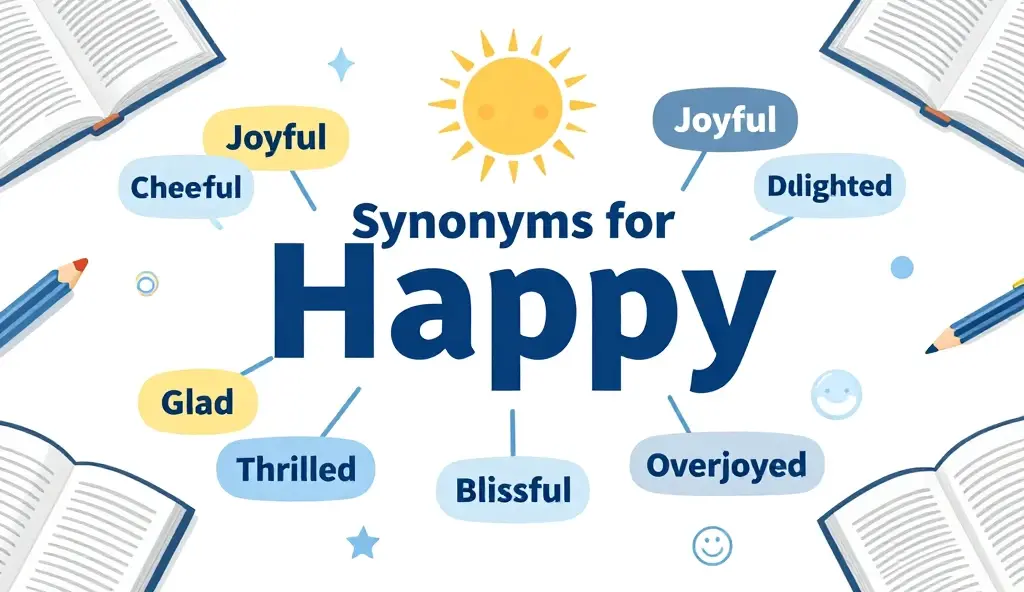
Synonyms for happy include glad, joyful, cheerful, pleased, delighted, content, satisfied, thrilled, upbeat, merry, elated, ecstatic, blissful, and overjoyed.
The best word depends on the feeling you want to show. Use glad for simple pleasure, content for calm happiness, delighted for strong pleasure, and ecstatic for extreme joy.
This guide explains each choice with meanings, examples, grammar tips, comparisons, phrases, and real-life sentences.
What Does Happy Mean?
The word happy means feeling or showing pleasure, joy, or satisfaction. A person may feel happy after hearing good news, seeing a friend, finishing a task, or spending time with family.
Happy can also describe something that creates a pleasant feeling:
- A happy memory
- A happy child
- A happy ending
- A happy home
- A happy smile
It may also mean being satisfied with something:
I’m happy with the results.
In some sentences, happy means willing:
I’d be happy to help.
It can even describe good luck or a good result:
It was a happy accident.
Merriam-Webster defines happy as an adjective connected with well-being, contentment, pleasure, satisfaction, willingness, or good fortune.
Happy Meaning in Simple English
Happy means feeling good because something is pleasant, successful, safe, or satisfying.
You may feel happy when:
- Someone gives you a kind gift.
- You pass an important test.
- Your family visits you.
- You finish a hard job.
- You hear good news.
- You help another person.
- You reach a goal.
- You enjoy a peaceful day.
The feeling can be quiet or strong. A person reading a book by a window may feel content, while a person winning a major prize may feel ecstatic.
That is why choosing the right happy synonym matters. Each word shows a different level or type of pleasure.
Pronunciation of Happy
The word happy is pronounced:
HAP-ee
Phonetic spelling:
/ˈhæp.i/
The stress falls on the first part:
HAP-ee
Say it in two short parts:
- Hap, like the beginning of “happen.”
- Ee, like the sound at the end of “baby.”
The vowel in the first part sounds like the a in “cat” or “hat.”
The American and British pronunciations are very close. Cambridge lists both as /ˈhæp.i/.
Part of Speech for Happy
Happy is mainly an adjective.
An adjective describes a person, place, thing, feeling, or situation.
Examples:
- She is happy.
- He gave me a happy smile.
- We have many happy memories.
- It was a happy day.
- They seem happy together.
Comparative Form
The comparative form is happier.
Use it when comparing two people, times, or situations.
Maya seems happier in her new job.
I feel happier today than I did yesterday.
Superlative Form
The superlative form is happiest.
Use it when comparing three or more people, times, or situations.
That was the happiest day of my life.
She is happiest when she is with her family.
Related Word Forms
| Form | Part of Speech | Meaning | Example |
| Happy | Adjective | Feeling pleasure | He looks happy. |
| Happier | Comparative adjective | More happy | I feel happier now. |
| Happiest | Superlative adjective | Most happy | This is my happiest memory. |
| Happily | Adverb | In a happy way | They laughed happily. |
| Happiness | Noun | The state of being happy | Her happiness was clear. |
| Unhappy | Adjective | Not happy | He felt unhappy at work. |
Complete Synonyms for Happy
The following table gives useful synonyms of happy, their meanings, levels of formality, and natural examples.
| Word | Meaning | Best Usage | Formality | Example | Difficulty |
| Glad | Pleased about something | Good news or relief | Neutral | I’m glad you came. | Easy |
| Joyful | Full of joy | Celebrations and warm moments | Neutral | It was a joyful reunion. | Easy |
| Cheerful | Bright and positive | Mood or personality | Neutral | She sounded cheerful today. | Easy |
| Pleased | Satisfied or glad | Work and polite speech | Formal-neutral | We are pleased with the results. | Easy |
| Delighted | Very pleased | Strong pleasure | Neutral-formal | I’m delighted to meet you. | Easy |
| Content | Calmly satisfied | Peaceful happiness | Neutral | He felt content at home. | Easy |
| Contented | Peaceful and satisfied | Long-term comfort | Neutral | The baby looked contented. | Medium |
| Satisfied | Feeling that needs were met | Results or service | Neutral-formal | She was satisfied with the work. | Easy |
| Thrilled | Very excited and happy | Great news or events | Informal-neutral | We’re thrilled about the trip. | Easy |
| Excited | Happy and eager | Future events | Neutral | The children are excited. | Easy |
| Elated | Extremely happy | Success or major news | Formal | She felt elated after winning. | Medium |
| Ecstatic | Overwhelmingly happy | Very strong joy | Neutral | The fans were ecstatic. | Medium |
| Overjoyed | Extremely pleased | Emotional news | Neutral | He was overjoyed to see her. | Medium |
| Blissful | Deeply peaceful and happy | Rest, love, or comfort | Neutral-literary | We enjoyed a blissful afternoon. | Medium |
| Merry | Cheerful and lively | Holidays and groups | Neutral | They had a merry evening. | Easy |
| Jolly | Friendly and cheerful | Personality or festive mood | Informal | Our host was warm and jolly. | Easy |
| Upbeat | Positive and hopeful | Mood, tone, or attitude | Informal-neutral | She stayed upbeat. | Easy |
| Radiant | Showing great happiness | Appearance or expression | Neutral-literary | The bride looked radiant. | Medium |
| Jubilant | Showing victory or success | Public celebrations | Formal | The team was jubilant. | Hard |
| Euphoric | Feeling intense happiness | Rare, powerful emotion | Formal | Investors felt euphoric. | Hard |
| Grateful | Happy because of kindness | Thanks and appreciation | Neutral | I’m grateful for your support. | Easy |
| Fortunate | Having good luck | Life conditions or chances | Formal-neutral | We feel fortunate to be here. | Medium |
| Lucky | Having good fortune | Casual conversation | Informal-neutral | I’m lucky to know you. | Easy |
| Carefree | Free from worry | Relaxed happiness | Neutral | They enjoyed a carefree summer. | Medium |
| Lighthearted | Cheerful and not serious | Fun talks or stories | Neutral | It was a lighthearted film. | Medium |
Best Synonyms for Happy and How to Use Them
A thesaurus may offer many other words for happy, but those words are not fully interchangeable. The following sections explain the most useful choices.
Glad
Glad means pleased or thankful about a certain event.
It often follows good news, relief, or a welcome meeting.
I’m glad you’re safe.
We’re glad the problem is fixed.
Difference from happy: Glad is often tied to one clear reason. Happy can describe a wider or longer mood.
Best situation: Use glad when someone arrives, agrees, improves, returns, or shares good news.
Common mistake: Do not use glad before every noun. “A glad child” sounds less natural than “a happy child” or “a cheerful child.”
Joyful
Joyful means full of deep, clear joy.
It often describes special moments such as weddings, births, reunions, festivals, and family celebrations.
The family shared a joyful meal.
Her joyful laugh filled the room.
Difference from happy: Joyful usually feels warmer and stronger than happy.
Best situation: Use it for emotional moments that bring people together.
Common mistake: Joyful can sound too strong for small events. “I was joyful because my coffee arrived” may sound dramatic unless you are joking.
Cheerful
Cheerful means bright, positive, and pleasant.
It can describe a person’s mood, face, voice, room, color, or attitude.
He gave us a cheerful greeting.
The yellow walls made the room feel cheerful.
Difference from happy: Happy describes an inner feeling. Cheerful often describes how that feeling appears to others.
Best situation: Use cheerful for a friendly mood or positive personality.
Common mistake: A person can act cheerful without feeling deeply happy. The words are related but not always equal.
Pleased
Pleased means happy or satisfied about a result, choice, or action.
The manager was pleased with the report.
I’m pleased to hear that you’re doing well.
Difference from happy: Pleased is more controlled and often more formal.
Best situation: Use it in business messages, polite speech, announcements, reviews, and professional writing.
Common mistake: Pleased may sound too formal in warm personal moments. “I’m pleased that you love me” sounds distant compared with “I’m so happy.”
Delighted
Delighted means very pleased.
We’re delighted to welcome you.
She was delighted by the surprise.
Difference from happy: Delighted shows stronger pleasure and often sounds polished.
Best situation: Use it for invitations, meetings, announcements, gifts, and pleasant surprises.
Common mistake: Do not use it for sad or serious situations just because the result is useful. The word carries a bright emotional tone.
Content
Content means calm, peaceful, and satisfied with what you have.
It is pronounced kuhn-TENT when used as an adjective.
He felt content with his simple life.
The cat looked warm and content.
Difference from happy: Happy may be lively or excited. Content is quiet and steady.
Best situation: Use content for comfort, peace, balance, and enoughness.
Common mistake: Do not confuse adjective content, meaning satisfied, with noun content, meaning material in a book, video, or website.
Satisfied
Satisfied means that a need, hope, or standard has been met.
The customer was satisfied with the service.
I’m satisfied with my progress.
Difference from happy: Satisfied focuses more on a result than an emotion.
Best situation: Use it for work, purchases, goals, services, answers, meals, and performance.
Common mistake: Someone can be satisfied without feeling joyful. A task may be good enough, but not exciting.
Thrilled
Thrilled means very happy and excited.
I’m thrilled to join the team.
She was thrilled by the invitation.
Difference from happy: Thrilled adds energy and excitement.
Best situation: Use it for new jobs, travel, awards, events, opportunities, and surprises.
Common mistake: Thrilled may sound too strong when the feeling is only mild.
Excited
Excited means happy, interested, and eager about something.
The children are excited about the party.
I’m excited to start the course.
Difference from happy: Excited usually points toward something that is happening soon.
Best situation: Use it for plans, trips, launches, meetings, games, and new experiences.
Common mistake: Excited can also mean nervous energy. Context helps the reader understand whether the feeling is positive.
Elated
Elated means extremely happy because something wonderful happened.
She was elated after receiving the scholarship.
The players felt elated by their victory.
Difference from happy: Elated is much stronger and is often linked to success.
Best situation: Use it after a major win, achievement, recovery, offer, or life event.
Common mistake: Avoid using elated for everyday pleasure. It may make the sentence sound exaggerated.
Ecstatic
Ecstatic means filled with overwhelming happiness.
The crowd was ecstatic when the final goal was scored.
He was ecstatic about becoming a father.
Difference from happy: Ecstatic is near the top of the happiness scale.
Best situation: Use it when the emotion is powerful, visible, and hard to control.
Common mistake: Do not use ecstatic in every positive review. Strong words lose power when they appear too often.
Overjoyed
Overjoyed means extremely happy, often because of emotional or personal news.
She was overjoyed to find her lost dog.
We were overjoyed by the baby’s safe arrival.
Difference from happy: Overjoyed feels warm, personal, and heartfelt.
Best situation: Use it for reunions, births, recoveries, family news, and answered hopes.
Common mistake: It may sound unnatural for a small business result or ordinary daily event.
Blissful
Blissful means deeply happy, peaceful, and free from trouble.
They spent a blissful week by the sea.
The house was blissfully quiet.
Difference from happy: Blissful combines happiness with peace and comfort.
Best situation: Use it for rest, vacations, love, silence, sleep, nature, and relaxing experiences.
Common mistake: Blissful does not usually fit loud excitement or fast action.
Upbeat
Upbeat means hopeful, positive, and cheerful.
She remained upbeat during the difficult week.
The meeting ended on an upbeat note.
Difference from happy: Upbeat often describes a positive attitude rather than pure happiness.
Best situation: Use it for workplace tone, public messages, music, news, and hopeful behavior.
Common mistake: A person may be upbeat while facing a problem. It does not mean that everything is perfect.
Radiant
Radiant means clearly showing happiness, beauty, warmth, or health.
She looked radiant in the family photo.
His face was radiant with pride.
Difference from happy: Radiant describes how joy appears on a person’s face or in their manner.
Best situation: Use it for smiles, faces, weddings, success, love, and proud moments.
Common mistake: Radiant is not normally used for a basic opinion, such as being happy with a bill or report.
Synonyms for Happy by Strength
Not every positive emotion has the same strength. This scale can help you select a natural word.
| Emotion Level | Synonyms | Example |
| Mild | Fine, satisfied, pleased | I’m pleased with the result. |
| Calm | Content, contented, peaceful | She felt content at home. |
| Bright | Cheerful, glad, joyful | He gave us a cheerful smile. |
| Strong | Delighted, thrilled, overjoyed | We’re delighted by the news. |
| Very strong | Elated, ecstatic, euphoric | The winners were ecstatic. |
Mild Happiness
Use pleased, glad, or satisfied when the feeling is positive but controlled.
Calm Happiness
Use content, contented, or peaceful when the feeling is steady and quiet.
Bright Happiness
Use cheerful, joyful, or merry when happiness is easy to see.
Excited Happiness
Use thrilled, excited, or delighted when the person has energy and enthusiasm.
Extreme Happiness
Use elated, ecstatic, euphoric, or overjoyed when the emotion is very strong.
Formal Synonyms for Happy
Formal writing often needs words that sound clear, controlled, and professional.
| Formal Word | Best Context | Example |
| Pleased | Results or polite messages | We are pleased with the outcome. |
| Delighted | Welcomes and announcements | We are delighted to announce the opening. |
| Satisfied | Reviews and assessments | Participants were satisfied with the program. |
| Gratified | Rewarding results | The team was gratified by the response. |
| Content | Calm satisfaction | Most residents appeared content. |
| Elated | Major success | Researchers were elated by the finding. |
| Jubilant | Public victory | Supporters were jubilant after the result. |
| Fortunate | Gratitude for good conditions | We feel fortunate to serve this community. |
Formal Examples
We are pleased to confirm your appointment.
The board was satisfied with the final proposal.
The organizers were delighted by the strong attendance.
Researchers were gratified to see positive results.
The winning team appeared jubilant.
Formal synonyms for happy work well in emails, reports, speeches, press releases, academic papers, and business announcements.
Informal Synonyms for Happy
Casual speech often sounds better with shorter or more expressive words.
| Informal Word or Phrase | Meaning | Example |
| Glad | Pleased | I’m glad you called. |
| Excited | Happy and eager | I’m excited for Friday. |
| Thrilled | Very happy | I’m thrilled you can come. |
| Upbeat | Positive | She seems upbeat today. |
| In a good mood | Feeling cheerful | Dad’s in a good mood. |
| On cloud nine | Extremely happy | He’s been on cloud nine all day. |
| Over the moon | Very happy | She was over the moon. |
| Pumped | Very excited | We’re pumped for the game. |
| Chuffed | Very pleased, mainly British | He was chuffed with the gift. |
| Walking on air | Feeling wonderfully happy | I’ve been walking on air. |
In American English, thrilled, excited, pumped, glad, and in a good mood are common casual choices.
Happy Antonyms
Antonyms are words with opposite or nearly opposite meanings.
| Antonym | Meaning | Example |
| Sad | Feeling sorrow | She felt sad after leaving. |
| Unhappy | Not pleased or satisfied | He was unhappy with the service. |
| Miserable | Extremely unhappy | The cold made everyone miserable. |
| Gloomy | Dark, sad, or without hope | She seemed gloomy all morning. |
| Upset | Emotionally troubled | I was upset by the news. |
| Disappointed | Sad because hopes were not met | He felt disappointed by the result. |
| Depressed | Deeply low in mood | She had been feeling depressed. |
| Sorrowful | Full of sadness | The family looked sorrowful. |
| Melancholy | Quiet and thoughtful sadness | The song had a melancholy tone. |
| Dejected | Sad after failure | The players looked dejected. |
| Dissatisfied | Not satisfied | Customers were dissatisfied. |
| Displeased | Annoyed or not pleased | The teacher was displeased. |
| Irritated | Slightly angry | He became irritated by the delay. |
| Bitter | Angry and hurt | She felt bitter about the decision. |
| Despairing | Without hope | His voice sounded despairing. |
Sad
Sad is the most direct opposite of happy.
She felt sad when her friend moved away.
It describes emotional pain, loss, or disappointment.
Unhappy
Unhappy means not happy, not pleased, or not satisfied.
The client was unhappy with the delay.
It can describe emotions, relationships, living conditions, or opinions.
Miserable
Miserable means extremely unhappy or uncomfortable.
He felt miserable during the long illness.
It is much stronger than sad or unhappy.
Gloomy
Gloomy describes a dark or low mood.
The rainy weather made him feel gloomy.
It may also describe a dark place or a situation with little hope.
Disappointed
Disappointed means sad because something did not happen as hoped.
She was disappointed by her test score.
This word points to an unmet hope, promise, or expectation.
Dissatisfied
Dissatisfied means that a result, product, service, or condition is not good enough.
Several customers were dissatisfied with the meal.
It is the opposite of satisfied rather than the exact opposite of joyful.
Thirty Real-World Examples of Happy Synonyms
These examples show how words meaning happy change across daily situations.
- Glad: I’m glad the doctor said everything looks fine.
- Joyful: The children made a joyful noise when school ended.
- Cheerful: Our new neighbor gave us a cheerful wave.
- Pleased: The teacher was pleased with Mia’s progress.
- Delighted: Grandma was delighted by the handmade card.
- Content: After dinner, he felt warm and content.
- Satisfied: The customer was satisfied with the quick repair.
- Thrilled: I was thrilled to get tickets to the concert.
- Excited: The class is excited about the museum trip.
- Elated: Nina felt elated after winning first place.
- Ecstatic: The fans were ecstatic when their team won.
- Overjoyed: The parents were overjoyed to see their son return.
- Blissful: We spent a blissful morning beside the lake.
- Merry: The guests were merry after the holiday meal.
- Jolly: A jolly shopkeeper welcomed us inside.
- Upbeat: Carla stayed upbeat even when plans changed.
- Radiant: The bride looked radiant as she entered the room.
- Jubilant: Jubilant supporters filled the streets after the victory.
- Euphoric: The runner felt euphoric after breaking the record.
- Grateful: I’m grateful that you stayed to help.
- Fortunate: We feel fortunate to have kind friends nearby.
- Lucky: You’re lucky to have such a caring teacher.
- Carefree: The children enjoyed a carefree afternoon in the park.
- Lighthearted: Their lighthearted talk made the long drive easier.
- Gratified: The doctor was gratified by the patient’s progress.
- In a good mood: Sam is in a good mood this morning.
- On cloud nine: She was on cloud nine after getting engaged.
- Over the moon: His parents were over the moon about the award.
- Walking on air: I’ve been walking on air since the interview.
- Pumped: The players are pumped for tonight’s game.
Twenty-Five Natural Sentences Using Happy and Its Synonyms
The following happy sentence examples use different styles, situations, and levels of emotion.
- I’m happy that you decided to join us.
- She felt glad when the power came back.
- The baby gave us a joyful little laugh.
- Marcus remained cheerful throughout the trip.
- We were pleased with the final design.
- I’m delighted to welcome you to the team.
- He felt content sitting beside the fire.
- The manager seemed satisfied with our work.
- They were thrilled to hear the announcement.
- The children are excited about summer break.
- I felt elated when I saw my name on the list.
- The crowd became ecstatic after the winning goal.
- Her family was overjoyed by the good news.
- We enjoyed three blissful days in the mountains.
- Everyone looked merry at the holiday dinner.
- Our guide was friendly, jolly, and full of stories.
- She gave an upbeat answer despite the delay.
- His radiant smile made the whole room feel warmer.
- Jubilant players lifted the trophy above their heads.
- The audience felt euphoric when the singer returned.
- I’m grateful for every person who helped.
- We are fortunate to live near such a beautiful park.
- I feel lucky to work with people I trust.
- The friends shared a carefree weekend by the beach.
- Her lighthearted joke eased the tension.
Academic Usage of Happy and Related Words
Academic writing often needs more exact language than daily conversation. The word happy is not wrong, but a precise synonym may explain the kind of positive feeling being studied.
Satisfaction
Use satisfaction when discussing whether needs, goals, or standards were met.
The survey measured employee satisfaction with workplace support.
Students reported higher satisfaction after the course was updated.
Well-Being
Use well-being for a wider state that may include emotional, physical, and social health.
The study explored the link between sleep and emotional well-being.
Positive Affect
Positive affect is a formal term used for pleasant emotional states.
Participants reported stronger positive affect after the activity.
Contentment
Use contentment for calm satisfaction rather than active excitement.
The interviews showed a sense of contentment among older residents.
Joy
Use joy when the emotion is strong, clear, or personally meaningful.
Many participants described feelings of joy after reconnecting with family.
Appropriate Academic Examples
- The findings suggest that social support may improve life satisfaction.
- Participants expressed contentment with their current routines.
- The program was linked to higher levels of reported well-being.
- Students showed positive emotional responses during group activities.
- Respondents described joy, relief, and gratitude after receiving support.
Avoid writing that every positive feeling is simply “happiness.” More exact terms can make an academic sentence clearer.
Happy Synonyms in Daily Conversation
Daily speech usually favors simple words.
When You Hear Good News
- I’m so glad!
- That’s wonderful!
- I’m thrilled for you.
- I’m happy to hear that.
- That’s great news.
When You Meet Someone
- I’m glad to meet you.
- It’s great to see you.
- I’m happy you could come.
- I’m delighted to meet you.
- We’re so pleased you’re here.
When Someone Succeeds
- I’m proud of you.
- I’m so happy for you.
- You must be thrilled.
- That’s amazing.
- I’m glad your hard work paid off.
When You Like a Result
- I’m happy with it.
- I’m pleased with the result.
- This looks great.
- I’m satisfied with the work.
- I love how it turned out.
When You Feel Calm
- I feel content.
- I’m at peace.
- Life feels good.
- I’m comfortable here.
- I have everything I need.
Grammar Tips for Using Happy
The word happy appears in several common sentence patterns.
Happy About Something
Use happy about before a situation, change, idea, or result.
Are you happy about the move?
She isn’t happy about the new rule.
Happy With Something
Use happy with when you are satisfied with a person, product, service, result, or choice.
I’m happy with my new phone.
The client is happy with the design.
Happy for Someone
Use happy for when another person receives good news.
I’m happy for you.
We’re all happy for Daniel and Priya.
Do not say “happy with you” when you mean that you are pleased about someone’s success. “Happy with you” means satisfied with that person’s behavior.
Happy to Do Something
Use happy to + verb to show willingness or pleasure.
I’m happy to help.
We’re happy to answer your questions.
She was happy to wait.
Happy That
Use happy that + complete idea.
I’m happy that you came.
He was happy that the test went well.
In casual speech, “that” is sometimes removed:
I’m happy you came.
Very Happy or So Happy
Both are correct.
I’m very happy with the result.
I’m so happy to see you.
So happy often sounds more emotional. Very happy may sound more measured.
Happier Than
Use happier than for comparisons.
She is happier than she was last year.
I’m happier here than in my old apartment.
The Happiest
Use the happiest for the highest degree.
This is the happiest I’ve ever felt.
It was the happiest moment of their trip.
Common Collocations With Happy
A collocation is a group of words that often appear together.
Happy Birthday
A greeting used on someone’s birthday.
Happy birthday, Mia!
Happy Ending
A pleasant ending to a story or situation.
Everyone wanted the movie to have a happy ending.
Happy Childhood
A childhood filled with love, safety, fun, or pleasant memories.
He often talks about his happy childhood.
Happy Family
A family that appears loving, close, and satisfied.
They looked like a happy family.
Happy Couple
Two people who are pleased in their relationship.
Friends gathered to celebrate the happy couple.
Happy Marriage
A marriage that is loving and satisfying.
They have shared a happy marriage for many years.
Happy Memory
A memory that brings pleasure.
That song brings back a happy memory.
Happy Place
A real or imagined place that makes someone feel calm and joyful.
The garden is my happy place.
Happy Face
A face that shows pleasure, often through a smile.
The child drew a happy face on the card.
Happy Mood
A pleasant emotional state.
Music put everyone in a happy mood.
Perfectly Happy
Fully satisfied with a situation.
I’m perfectly happy staying home tonight.
Genuinely Happy
Truly happy rather than pretending.
She seems genuinely happy in her new role.
Extremely Happy
Very strongly pleased.
He was extremely happy with his score.
Happily Married
Living in a pleasant and successful marriage.
They have been happily married for ten years.
More Than Happy
Very willing to do something.
I’d be more than happy to explain it again.
Common Phrases With Happy
These phrases often appear in natural English.
Happy to Help
This means you are willing and pleased to assist.
“Thanks for fixing the file.”
“Happy to help.”
Happy for You
This shows pleasure about another person’s success or good news.
I’m happy for you and your family.
Happy With the Result
This means satisfied with an outcome.
The owner was happy with the result.
Keep Someone Happy
This means doing what is needed to please someone.
The hotel added more staff to keep guests happy.
Make Someone Happy
This means causing someone to feel joy or pleasure.
Your kind message made me happy.
As Happy as Can Be
This means extremely happy.
The puppy was as happy as can be in its new home.
Not a Happy Camper
This informal phrase means someone is annoyed or dissatisfied.
After waiting two hours, Dad was not a happy camper.
Many Happy Returns
This is a birthday wish that means you hope the person enjoys many more happy birthdays.
Many happy returns, Uncle Ray!
Happy-Go-Lucky
A happy-go-lucky person is cheerful and does not worry much.
Leo has a happy-go-lucky attitude.
Trigger-Happy
Trigger-happy describes someone who acts too quickly or aggressively. It does not mean joyful.
The editor was too trigger-happy with the delete button.
The phrase may also have a literal weapons-related meaning, so it should be used with care.
Idioms That Mean Very Happy
Idioms add color to casual writing, but they are not always suitable for formal work.
On Cloud Nine
Meaning: Extremely happy.
She was on cloud nine after receiving the offer.
Over the Moon
Meaning: Very pleased and excited.
We were over the moon when our daughter came home.
Walking on Air
Meaning: Feeling light and joyful.
He was walking on air after his first successful show.
In Seventh Heaven
Meaning: In a state of great happiness.
The children were in seventh heaven at the theme park.
Full of the Joys of Spring
Meaning: Very cheerful and energetic.
She arrived full of the joys of spring.
This phrase is more common in British English.
Grinning From Ear to Ear
Meaning: Smiling very widely because you are happy.
Ben was grinning from ear to ear when he opened the gift.
Have a Whale of a Time
Meaning: Have a very enjoyable time.
We had a whale of a time at the party.
Like a Kid in a Candy Store
Meaning: Very excited because many enjoyable choices are available.
The book lover was like a kid in a candy store.
Similar Words to Happy
Several words seem close to happy but carry a different meaning.
| Word | Main Meaning | Key Difference | Example |
| Happy | Feeling pleasure | Broad positive feeling | She feels happy today. |
| Glad | Pleased about one thing | Often tied to a reason | I’m glad you came. |
| Joyful | Full of joy | Warmer and stronger | It was a joyful event. |
| Cheerful | Bright and positive | Often visible to others | He sounded cheerful. |
| Content | Calmly satisfied | Quiet, steady feeling | She felt content. |
| Satisfied | Needs were met | Result-focused | I’m satisfied with it. |
| Excited | Happy and eager | Looks toward an event | We’re excited about Friday. |
| Delighted | Very pleased | Strong and polished | I’m delighted by the news. |
| Thrilled | Very happy and excited | Energetic and strong | She was thrilled. |
| Elated | Extremely happy after success | Often follows achievement | He felt elated. |
| Ecstatic | Overwhelming joy | Extremely strong | Fans were ecstatic. |
| Grateful | Thankful and pleased | Caused by help or kindness | I’m grateful for you. |
| Proud | Pleased by achievement | Linked to respect or success | Her parents felt proud. |
| Relieved | Happy because worry ended | Comes after fear or stress | I’m relieved you’re safe. |
| Amused | Finding something funny | Linked to humor | She looked amused. |
Happy vs. Glad
Both words show pleasure, but their sentence patterns differ.
| Happy | Glad |
| Can describe a general mood | Often describes pleasure about one fact |
| Common before nouns | Less common before nouns |
| Can describe satisfaction | Often shows relief |
| Works in many situations | Sounds natural in short reactions |
Examples:
She is a happy person.
I’m glad she came.
We had a happy weekend.
I’m glad the weekend went well.
Use happy for a wider emotional state. Use glad when reacting to an event or piece of news.
Happy vs. Joyful
Happy is broad and common. Joyful is warmer, stronger, and more expressive.
It was a happy day.
This means the day was pleasant.
It was a joyful day.
This suggests deeper emotion, celebration, or shared love.
Joyful works well for reunions, births, faith events, weddings, and heartfelt celebrations. Happy works almost anywhere.
Happy vs. Pleased
Happy is emotional and flexible. Pleased is controlled and often more formal.
I’m happy you’re here.
This sounds warm and personal.
I’m pleased you’re here.
This sounds polite and slightly formal.
Use pleased for professional results:
We are pleased with your performance.
Use happy for a personal feeling:
I’m happy that we can spend time together.
Happy vs. Content
Happy may include energy, laughter, or excitement. Content suggests peace and quiet satisfaction.
The children were happy at the party.
Their grandfather felt content sitting by the window.
A happy person may want to celebrate. A content person may simply feel that life is good enough as it is.
Happy vs. Excited
Happy describes pleasure. Excited adds energy and expectation.
I’m happy with my new job.
This describes satisfaction now.
I’m excited about my new job.
This suggests eagerness about what will happen next.
A person can be excited and nervous at the same time. Happy is usually more clearly positive.
Happy vs. Satisfied
Happy focuses on emotion. Satisfied focuses on whether expectations or needs were met.
I’m happy with the meal.
This sounds warm and positive.
I’m satisfied with the meal.
This means the meal met your needs or standards, but it may not have been wonderful.
Use satisfied in reviews, assessments, customer service, and professional reports.
Happy vs. Thrilled
Thrilled is stronger than happy.
I’m happy to attend.
This is positive and calm.
I’m thrilled to attend.
This shows strong excitement.
Choose thrilled only when the feeling deserves extra force.
Happy vs. Lucky
Happy describes an emotion. Lucky describes good fortune.
She feels happy because she won.
She was lucky to win.
A person may be lucky but unhappy. A person may also be happy without having unusual luck.
Common Mistakes When Choosing a Happy Synonym
Using Strong Words for Small Feelings
Words such as ecstatic, euphoric, and elated are very strong.
Weak match:
I was ecstatic that the bus arrived.
Better:
I was glad that the bus arrived.
Strong words should match strong events.
Confusing Content and Excited
Content is calm. Excited is active.
He felt content while resting at home.
He felt excited before the concert.
Using Satisfied for Warm Personal Feelings
Satisfied can sound like an evaluation.
Cold:
I’m satisfied that you came to my birthday party.
Natural:
I’m happy that you came to my birthday party.
Saying Happy With You Instead of Happy for You
Use happy for you when someone receives good news.
I’m happy for you.
Use happy with you when you approve of someone’s behavior.
I’m happy with the way you handled the problem.
Overusing Happy
Repeated:
I was happy to see the happy family at the happy event.
Improved:
I was glad to see the cheerful family enjoying the joyful event.
Variation should improve meaning, not merely replace every repeated word.
Expert Tips for Choosing the Right Synonym
Identify the Cause
Ask why the person feels happy.
- Good news: glad or delighted
- A major win: elated or ecstatic
- Peace and comfort: content
- A future plan: excited
- A good result: pleased or satisfied
- Kind support: grateful
Match the Strength
Do not call a mild feeling euphoric. Do not call a life-changing victory merely fine.
Think of a scale:
Pleased → happy → delighted → thrilled → elated → ecstatic
Check the Setting
Use formal synonyms for business and academic writing:
- Pleased
- Satisfied
- Gratified
- Delighted
- Content
Use casual words and idioms in friendly speech:
- Glad
- Pumped
- Over the moon
- On cloud nine
- In a good mood
Decide Whether the Feeling Is Calm or Active
Calm happiness:
- Content
- Peaceful
- Satisfied
- Blissful
Active happiness:
- Excited
- Thrilled
- Jubilant
- Ecstatic
Think About What the Reader Can See
Use cheerful or radiant when happiness is visible.
She wore a radiant smile.
He gave us a cheerful greeting.
Use content when the emotion is quiet and may not be dramatic.
Read the Sentence Aloud
A synonym may be correct but still sound unnatural. Read the full sentence. Choose the word that fits the rhythm, relationship, and situation.
Frequently Asked Questions About Synonyms for Happy
What Is the Best Synonym for Happy?
The best general synonym for happy is glad, but the right choice depends on context. Use cheerful for a bright mood, content for calm satisfaction, pleased for a polite or formal tone, and delighted for stronger pleasure. For extreme happiness, choose elated, ecstatic, or overjoyed.
What Is a Stronger Word for Happy?
A stronger word for happy may be thrilled, delighted, elated, ecstatic, or overjoyed. Thrilled combines happiness with excitement. Elated often follows major success. Ecstatic describes overwhelming joy. Overjoyed sounds warm and emotional, especially when used for family news, reunions, recovery, or long-awaited events.
What Is a Formal Synonym for Happy?
Good formal synonyms for happy include pleased, delighted, satisfied, gratified, content, and fortunate. “We are pleased to announce” works well in business writing. “Participants were satisfied” fits reports. “The researchers were gratified by the response” is useful when a result feels rewarding.
What Is an Informal Word for Happy?
Common informal choices include glad, excited, thrilled, pumped, and upbeat. You can also use phrases such as in a good mood, on cloud nine, over the moon, or walking on air. Pumped is very casual and usually shows excitement about an event, game, trip, or challenge.
What Word Means Calm and Happy?
Content is one of the best words for feeling calm and happy. It means satisfied with what you have and free from a strong need for change. Contented, peaceful, serene, and blissful may also fit. Blissful is stronger and often describes deep comfort, rest, love, or quiet pleasure.
What Word Means Extremely Happy?
Ecstatic means extremely happy. Other strong options include elated, euphoric, overjoyed, and jubilant. Elated often follows personal success. Jubilant often describes a group celebrating a victory. Euphoric suggests an intense emotional high, while overjoyed is common for deeply personal good news.
Are Glad and Happy the Same?
Glad and happy are close, but they are not always used in the same way. Happy can describe a general mood, personality, memory, home, or period of life. Glad usually reacts to a clear event or fact. “She is a happy child” sounds natural, while “I’m glad she is safe” shows relief about one situation.
Is Cheerful a Synonym for Happy?
Yes, cheerful is a synonym for happy, but it often describes visible behavior or a positive manner. A cheerful person smiles, speaks warmly, and lifts the mood around them. Happy may describe an inner feeling that others cannot see. Someone may act cheerful even while dealing with a private worry.
Is Content Stronger Than Happy
Content is not usually stronger than happy. It describes a different type of positive feeling. Contentment is calm, steady, and peaceful. Happiness can be quiet or lively. A person may feel content while reading at home, while another person feels thrilled after receiving exciting news.
What Is the Difference Between Happy and Excited?
Happy means pleased or joyful. Excited means eager and full of energy, often because something is about to happen. You may be happy with your current home but excited about an upcoming vacation. Excitement can also include nervousness, while happiness is usually a more clearly pleasant feeling.
What Is a Professional Way to Say “I’m Happy to Help”?
Professional alternatives include “I’d be pleased to assist,” “I’d be glad to help,” “I’m available to support you,” and “I’d be delighted to assist.” “Happy to help” is already polite and widely accepted in professional messages. Choose a more formal phrase when writing to a client, executive, or new contact.
What Can I Say Instead of “I’m Happy for You”?
You can say “I’m thrilled for you,” “I’m so glad to hear that,” “That’s wonderful news,” “You deserve it,” or “I’m delighted for you.” Choose a phrase that matches your relationship. “I’m thrilled for you” sounds warm and excited, while “I’m pleased to hear the news” sounds more formal.
What Is the Opposite of Happy?
The most direct opposite of happy is sad or unhappy. Other antonyms depend on the situation. Use disappointed when a hope was not met, dissatisfied when a result was not good enough, miserable for extreme unhappiness, and gloomy for a dark or low mood.
Can Happy Mean Lucky?
Yes. Happy can sometimes mean fortunate, well-timed, or producing a good result. The phrase “a happy accident” describes an unplanned event that leads to something useful or pleasant. This meaning is less common than the emotional meaning, but it still appears in natural English.
Is Happy an Adjective or an Adverb?
Happy is an adjective. It describes a person, mood, memory, family, event, or situation. The adverb form is happily. Compare “She is happy,” where happy describes she, with “She smiled happily,” where happily describes how she smiled. The noun form is happiness.
Conclusion:
The most useful synonyms for happy include glad, cheerful, joyful, pleased, delighted, content, satisfied, excited, thrilled, elated, ecstatic, blissful, and overjoyed.
Choose the word by asking three simple questions:
How strong is the feeling? What caused it? Is the setting formal or casual?
Use glad for simple good news, pleased for polite approval, content for quiet satisfaction, thrilled for excited happiness, and ecstatic for overwhelming joy. The right word does more than avoid repetition. It helps the reader feel the exact emotion you want to express.

Natalie Phillips is an experienced content writer with expertise in vocabulary education and language-learning resources.