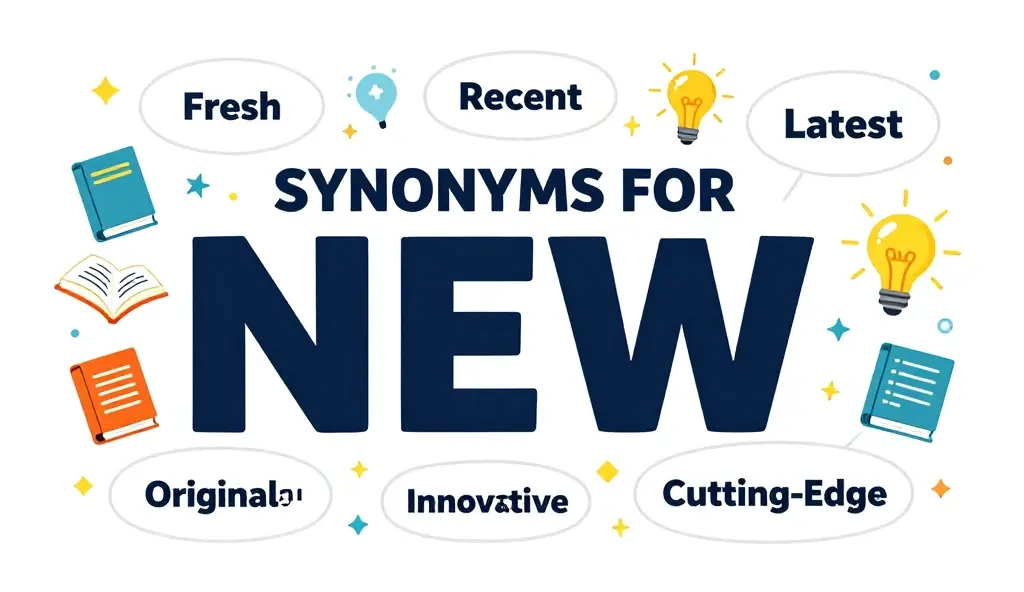
The word new is one of the most common and flexible words in English.
People use it to describe things that did not exist before, recently appeared, changed from an older version, or have not been used yet. Because new has many meanings, choosing the right alternative can make your writing clearer and more accurate.
Many people search for synonyms for new because repeating the same word can make writing feel boring.
However, not every synonym has the same meaning.
A new phone may be a recently released device, while a modern phone focuses on advanced features.
A fresh idea suggests creativity, while a novel idea suggests something unusual or original.
Understanding these differences helps you choose better words for essays, articles, conversations, business writing, and everyday communication.
Meaning of New
Definition
New means something that has recently appeared, been created, purchased, discovered, changed, or introduced.
It can describe:
- Objects
- Ideas
- Experiences
- Technology
- Places
- People
- Information
- Changes
Examples
- I bought a new laptop.
- She started a new job.
- Scientists discovered new information.
- They introduced a new plan.
Pronunciation
New
IPA:
/nuː/ or /njuː/
Natural pronunciation:
NOO (American English)
NYOO (some British accents)
Pronunciation Tips
- The American pronunciation usually sounds like “noo.”
- Some speakers add a slight “y” sound before the vowel.
- Keep the sound long and clear.
Examples:
- New car
- New idea
- New experience
Part of Speech
Adjective
New is mainly used as an adjective.
Examples:
- A new house
- A new opportunity
- A new technology
Noun
In some contexts, new can be used as a noun to mean new information or something newly introduced.
Example:
- I heard some new today. (informal and uncommon)
Adverb
The word newly is the adverb form.
Examples:
- A newly built house.
- A newly discovered planet.
Synonyms for New
| Word | Meaning | Usage | Formality | Example | Difficulty Level |
| Fresh | Recently made or different | Ideas, food, experiences | Neutral | A fresh idea | Easy |
| Modern | Current and advanced | Technology, design | Neutral | Modern technology | Easy |
| Recent | Happened lately | Events, news | Formal | Recent changes | Easy |
| Novel | Original and unusual | Ideas, research | Formal | A novel approach | Medium |
| Original | First or unique | Creativity, designs | Neutral | An original concept | Medium |
| Latest | Most recent version | Products, updates | Neutral | Latest features | Easy |
| Current | Existing now | Information, situations | Formal | Current trends | Medium |
| Innovative | Introducing new ideas | Technology, business | Formal | Innovative solutions | Medium |
| Advanced | Highly developed | Technology, systems | Formal | Advanced equipment | Medium |
| Unused | Not used before | Objects | Neutral | An unused product | Easy |
| Brand-new | Completely new | Products | Informal | A brand-new car | Easy |
| Contemporary | Belonging to the present time | Art, culture | Formal | Contemporary design | Medium |
| Updated | Improved with changes | Software, information | Neutral | Updated version | Easy |
Best Synonyms for New
1. Fresh
Meaning
Fresh means recently made, obtained, created, or full of new energy.
Difference
Fresh often suggests something renewed, natural, or recently produced.
Examples
- Fresh ideas can solve problems.
- We bought fresh vegetables.
- She brought fresh energy to the team.
Best Situation
Use for:
- Food
- Ideas
- Experiences
- Perspectives
Common Mistakes
Do not use fresh for every physical object.
Incorrect:
- A fresh laptop.
Better:
- A new laptop.
2. Modern
Meaning
Modern means related to the present time, especially with updated styles, technology, or methods.
Difference
New means recently created, while modern means current or advanced.
Examples
- They built a modern home.
- Modern technology changes quickly.
- The office has a modern design.
Best Situation
Use for:
- Technology
- Architecture
- Fashion
- Lifestyle
Common Mistakes
Something can be old but modern in style.
Example:
- A renovated historic building can have a modern interior.
3. Recent
Meaning
Recent means something that happened or appeared not long ago.
Difference
Recent focuses on time, not necessarily improvement or originality.
Examples:
- Recent studies show changes.
- I read a recent article.
- Recent events affected the market.
Best Situation
Use for:
- News
- Research
- History
- Events
Common Mistakes
Recent does not mean better or improved.
4. Novel
Meaning
Novel means new, original, or different from what existed before.
Difference
Novel focuses on uniqueness rather than just being recent.
Examples:
- Scientists developed a novel method.
- She presented a novel idea.
- The company created a novel product.
Best Situation
Use for:
- Academic writing
- Research
- Innovation
- Creativity
Common Mistakes
Novel can also mean a book-length fictional story, so context matters.
5. Original
Meaning
Original means created first, unique, or not copied.
Difference
Original focuses on creativity and uniqueness.
Examples:
- He created an original design.
- The artist has an original style.
- That is an original idea.
Best Situation
Use for:
- Art
- Writing
- Ideas
- Designs
Common Mistakes
Original does not always mean recently created.
Best Synonyms for New (Continued)
6. Latest
Meaning
Latest means the most recent or newest version of something.
Difference
Latest focuses on being the newest available option, while new can simply mean something that did not exist before.
Examples
- I bought the latest smartphone.
- Check the latest news updates.
- The company released its latest model.
Best Situation
Use latest for:
- Technology
- News
- Products
- Updates
- Trends
Common Mistakes
Do not use latest for things that are simply new to you.
Incorrect:
- This is my latest house. (if you just bought it)
Better:
- This is my new house.
7. Current
Meaning
Current means existing or happening now.
Difference
New refers to something recently introduced, while current refers to what is true or active at the present time.
Examples
- Current trends influence fashion.
- Please provide your current address.
- The current system needs improvement.
Best Situation
Use current for:
- Information
- Situations
- Trends
- Positions
- Conditions
Common Mistakes
Something current is not always new.
Example:
- My current job may be five years old.
8. Innovative
Meaning
Innovative means introducing new ideas, methods, or technology.
Difference
Innovative suggests creativity and improvement, not just being recently created.
Examples
- The company developed an innovative solution.
- She has innovative ideas.
- Innovative technology changes industries.
Best Situation
Use for:
- Business
- Technology
- Science
- Creativity
Common Mistakes
A new product is not always innovative. It must introduce something different.
9. Advanced
Meaning
Advanced means highly developed, improved, or using modern methods.
Difference
Advanced focuses on progress and higher quality rather than simply being new.
Examples
- The hospital uses advanced equipment.
- Students learn advanced skills.
- The software has advanced features.
Best Situation
Use for:
- Technology
- Education
- Science
- Systems
Common Mistakes
Advanced does not always mean new.
Example:
- An advanced machine may have existed for years.
10. Unused
Meaning
Unused means something has never been used before.
Difference
Unused focuses on condition, while new focuses on age or creation.
Examples:
- The package contains an unused product.
- I found an unused notebook.
- The equipment is unused.
Best Situation
Use for:
- Products
- Items
- Materials
Common Mistakes
Something can be old but unused.
Example:
- An unused book from ten years ago.
11. Brand-New
Meaning
Brand-new means completely new and never used before.
Difference
Brand-new is stronger than new and often emphasizes freshness or excitement.
Examples:
- She bought a brand-new car.
- I moved into a brand-new apartment.
- They launched a brand-new website.
Best Situation
Use for:
- Purchases
- Products
- Homes
- Experiences
Common Mistakes
Brand-new is informal, so avoid it in highly formal writing.
12. Contemporary
Meaning
Contemporary means belonging to the present time or modern period.
Difference
Contemporary often relates to style, culture, and design rather than recent creation.
Examples:
- Contemporary art is popular worldwide.
- The building has contemporary architecture.
- She enjoys contemporary music.
Best Situation
Use for:
- Art
- Fashion
- Culture
- Design
Common Mistakes
Contemporary does not always mean newly created.
13. Updated
Meaning
Updated means improved or changed with new information, features, or corrections.
Difference
Updated usually refers to something existing that has been improved.
Examples:
- The app has an updated version.
- Please check the updated report.
- The website contains updated information.
Best Situation
Use for:
- Software
- Documents
- Information
- Systems
Common Mistakes
Updated does not mean completely new.
Example:
- An updated phone model may still be based on an older design.
Antonyms of New
The opposite of new depends on the meaning. It may refer to age, previous use, or lack of change.
| Word | Meaning | Usage | Example |
| Old | Existing for a long time | General | An old building |
| Ancient | Very old | History | Ancient civilization |
| Used | Previously owned or used | Products | A used car |
| Previous | Existing before | Time/order | Previous version |
| Former | Earlier or past | People/roles | Former employee |
| Traditional | Based on old customs | Culture | Traditional methods |
| Outdated | No longer modern | Technology | Outdated software |
| Obsolete | No longer useful | Technology | Obsolete equipment |
| Original | First version | History/products | Original design |
| Familiar | Already known | Experience | A familiar place |
Understanding Each Antonym
1. Old
Meaning
Something that has existed for a long time.
Examples:
- I live in an old house.
- This is an old tradition.
Best Use:
General opposite of new.
2. Ancient
Meaning
Extremely old, often from history.
Examples:
- Ancient buildings attract tourists.
- Ancient cultures influenced modern life.
Best Use:
History and archaeology.
3. Used
Meaning
Something that belonged to or was used by someone before.
Examples:
- He bought a used car.
- The store sells used furniture.
Best Use:
Products and possessions.
4. Previous
Meaning
Something that came before the current one.
Examples:
- The previous version had problems.
- I preferred my previous job.
Best Use:
Time, versions, situations.
5. Outdated
Meaning
No longer suitable because something newer exists.
Examples:
- This technology is outdated.
- The information is outdated.
Best Use:
Technology and information.
6. Obsolete
Meaning
No longer used because it has been replaced.
Examples:
- Many old machines are obsolete.
- The method became obsolete.
Best Use:
Technology, systems, processes.
Real-World Examples of Using Synonyms for New
The following examples show how different alternatives to new fit naturally in real-life situations.
- She bought a new laptop for her online classes.
- The company introduced an innovative product to the market.
- Scientists discovered a novel method for solving the problem.
- I read a recent article about climate change.
- The restaurant offers a fresh menu every season.
- They built a modern office with smart technology.
- The app released its latest update yesterday.
- The website contains updated information.
- The hospital uses advanced medical equipment.
- He moved into a brand-new apartment.
- The designer created an original fashion collection.
- The museum displays contemporary artwork.
- She shared a fresh perspective during the meeting.
- The company follows current industry trends.
- I purchased an unused notebook from the store.
- The team developed an innovative business strategy.
- The researcher presented a novel theory.
- They renovated the building with a modern design.
- The newspaper reported recent events.
- The software includes advanced features.
- The teacher provided an updated learning guide.
- The artist created an original painting.
- The store sells both new and used products.
- The latest smartphone has many modern features.
- The company launched a brand-new service.
- The city introduced a new transportation system.
- The organization adopted a fresh approach.
- The report includes current market information.
- The scientist used an advanced research technique.
- The designer created a contemporary home style.
25 Example Sentences Using Synonyms for New
These sentences demonstrate different ways to replace new naturally.
- The company launched a new product last month.
- She shared a fresh idea during the discussion.
- The building has a modern architectural style.
- I saw a recent announcement online.
- The scientist developed a novel approach.
- He bought the latest version of the software.
- The website provides current information.
- The team created an innovative solution.
- The laboratory uses advanced technology.
- She moved into a brand-new home.
- The author wrote an original story.
- The company released an updated application.
- The gallery features contemporary artwork.
- I found an unused notebook in my drawer.
- The designer created a fresh style.
- The organization needs a modern strategy.
- Researchers studied a recent development.
- The engineer designed an innovative machine.
- They installed advanced security systems.
- The magazine published the latest trends.
- The teacher explained a new concept.
- The brand introduced an original collection.
- The app has an updated interface.
- The company follows current business practices.
- The city created a modern public space.
Formal vs. Informal Usage
Different synonyms for new create different tones.
| Informal Word | Formal Alternative | Best Context |
| New | Recent | Reports and news |
| New | Innovative | Business and technology |
| New | Novel | Research and academics |
| New | Contemporary | Art and design |
| New | Advanced | Technology |
| New | Updated | Software and documents |
| New | Fresh | Ideas and communication |
| New | Brand-new | Casual conversations |
Informal Usage
In everyday conversations, people commonly use:
New
Examples:
- I got a new phone.
- She has a new job.
- We moved to a new house.
Brand-New
Examples:
- I bought a brand-new car.
- They opened a brand-new store.
Fresh
Examples:
- I need a fresh start.
- That is a fresh idea.
Latest
Examples:
- Did you see the latest update?
- I bought the latest model.
These words sound natural in:
- Conversations
- Messages
- Social media
- Daily communication
Formal Usage
Professional and academic writing often requires more precise alternatives.
Basic:
The company created a new method.
Formal:
The company developed an innovative method.
Basic:
Researchers found new information.
Formal:
Researchers discovered recent findings.
Basic:
The building has a new design.
Formal:
The building features contemporary architecture.
Academic Usage of Synonyms for New
In academic writing, new can be replaced with more specific terms depending on the meaning.
Research Context
Basic:
Scientists discovered a new method.
Academic:
Scientists developed a novel methodology
Technology Context
Basic:
The company created new technology.
Academic:
The company introduced innovative technology.
Information Context
Basic:
The study provides new information.
Academic:
The study presents recent findings.
Academic Alternatives Table
| Common Word | Academic Alternative | Example |
| New idea | Novel concept | The research introduces a novel concept. |
| New method | Innovative approach | The study uses an innovative approach. |
| New information | Recent findings | Recent findings show improvement. |
| New technology | Advanced technology | Advanced technology improves efficiency. |
| New design | Contemporary design | The product has a contemporary design. |
| New version | Updated version | The software includes an updated version. |
Daily Conversation Usage
The best synonym depends on the situation.
Talking About Products
Natural:
Talking About Ideas
Natural:
- That is a fresh idea.
- She has an innovative approach.
- That is a novel concept.
Talking About News
Natural:
- I heard some recent news.
- Did you see the latest update?
Talking About Places
Natural:
- They built a modern apartment.
- This is a new neighborhood.
Conversation Tips
- Use new when you want a simple and natural word.
- Use fresh for ideas, energy, or food.
- Use modern for style and technology.
- Use recent for time-related events.
- Use latest for the newest version.
- Use innovative for creative improvements.
- Use updated for something improved from an older version.
- Use novel for something original or unusual.
Grammar Tips for Using Synonyms for New
Understanding how to use new and its synonyms correctly helps you write clearer and more natural English.
1. Use “New” as an Adjective
The most common use of new is to describe something that has recently appeared, changed, or been created.
Correct:
- I bought a new phone.
- She started a new job.
- They opened a new store.
Incorrect:
- I bought a phone new.
The adjective usually comes before the noun.
2. Understand New vs. Newly
These two words are related but used differently.
| Word | Meaning | Example |
| New | Recent or different | A new building |
| Newly | Recently done or created | A newly built building |
Examples:
- They moved into a new house.
- They moved into a newly renovated house.
3. Understand New vs. Modern
Many people confuse these words.
| New | Modern |
| Recently created | Current style or advanced |
| Focuses on time | Focuses on development |
| A new phone | Modern technology |
Examples:
- I bought a new laptop. (recent purchase)
- This laptop has modern features. (advanced features)
4. Use Recent for Time, Not Objects
Recent describes events, information, or changes that happened not long ago.
Correct:
- Recent news
- Recent studies
- Recent changes
Less natural:
- Recent car
Better:
- New car
5. Use Latest for the Most Recent Version
Latest means the newest available option.
Examples:
- The latest iPhone model.
- The latest software update.
- The latest fashion trends.
Do not use it when you simply mean something is new to you.
Incorrect:
- My latest house.
Correct:
- My new house.
6. Use Fresh for Ideas and Experiences
Fresh often describes something new, creative, or renewed.
Examples:
- A fresh idea
- A fresh perspective
- A fresh start
It usually does not describe manufactured objects.
Incorrect:
- A fresh computer
Correct:
- A new computer
7. Use Novel in Formal Writing
Novel means new and original.
It is common in:
- Research papers
- Academic writing
- Professional articles
Examples:
- The study presents a novel approach.
- Researchers discovered a novel solution.
Avoid using it for ordinary things.
Incorrect:
- I bought a novel shirt.
8. Use Innovative for Improvement and Creativity
Innovative describes something that introduces a better or creative way of doing something.
Examples:
- An innovative product.
- An innovative business model.
- Innovative technology.
A thing can be new without being innovative.
9. Use Updated for Changes to Existing Things
Updated means improved or changed.
Examples:
- Updated information.
- Updated software.
- Updated guidelines.
Difference:
- New software = created recently.
- Updated software = improved version of existing software.
10. Comparative and Superlative Forms
The word new does not usually use “newer” and “newest” in every situation, but these forms are correct.
| Form | Example |
| New | This is a new phone. |
| Newer | This model is newer than the old one. |
| Newest | This is the newest version. |
11. Avoid Repeating “New”
Instead of:
The company created a new product with new features for a new market.
Use:
The company created an innovative product with advanced features for an emerging market.
This creates stronger writing.
Common Collocations With New
Collocations are words that naturally appear with new.
| Collocation | Meaning | Example |
| New idea | Fresh thought | She shared a new idea. |
| New technology | Recently developed technology | New technology changes lives. |
| New product | Recently created item | The company launched a new product. |
| New version | Updated release | Download the new version. |
| New opportunity | Fresh chance | This is a new opportunity. |
| New experience | Different experience | Traveling was a new experience. |
| New beginning | Fresh start | Today is a new beginning. |
| New generation | Younger or newer group | A new generation uses technology. |
| New trend | Emerging style | This is a new trend. |
| New approach | Different method | They used a new approach. |
| New skills | Recently learned abilities | She developed new skills. |
| New information | Recently discovered facts | We received new information. |
| New environment | Different surroundings | He adapted to a new environment. |
| New challenge | Fresh difficulty | This job brings new challenges. |
| New relationship | Recently formed connection | They built a new relationship. |
Common Phrases Using New
1. New Beginning
Meaning: A fresh start.
Example:
- Moving to a new city gave him a new beginning.
2. Brand New
Meaning: Completely unused or recently created.
Example:
- She bought a brand-new laptop.
3. New and Improved
Meaning: A changed version that is better than before.
Example:
- The company released a new and improved product.
4. Turn Over a New Leaf
Meaning: To make a positive change.
Example:
- He decided to turn over a new leaf.
5. Start Fresh
Meaning: Begin again with a clean situation.
Example:
- She moved away to start fresh.
6. Break New Ground
Meaning: Do something innovative or different.
Example:
- The scientist broke new ground with her research.
7. Something New
Meaning: A different or unfamiliar thing.
Example:
- I want to learn something new.
8. Try Something New
Meaning: Experience something different.
Example:
- I decided to try something new this year.
Idioms Related to New
| Idiom | Meaning | Example |
| Turn over a new leaf | Change behavior positively | He turned over a new leaf. |
| Break new ground | Create something innovative | The company broke new ground. |
| Out with the old, in with the new | Replace old things | They followed the idea: out with the old, in with the new. |
| New kid on the block | New person in a group | She is the new kid on the block. |
| Ring in the new year | Celebrate a new year | Families ring in the new year together. |
| Start from scratch | Begin completely new | They started from scratch. |
| Fresh start | New opportunity | The move gave him a fresh start. |
| A whole new world | Completely different experience | Travel opened a whole new world. |
| New lease on life | Renewed energy or opportunity | The treatment gave him a new lease on life. |
| See the light of day | Finally appear or become available | The project finally saw the light of day. |
Similar Words Comparison
| Word | Meaning | Difference | Example |
| New | Recently created | General term | A new phone |
| Fresh | Recently made or renewed | Ideas, food, energy | A fresh idea |
| Modern | Current and advanced | Style and technology | Modern design |
| Recent | Happened lately | Time-focused | Recent events |
| Latest | Most recent version | Newest available | Latest model |
| Novel | Original and unusual | Creativity-focused | Novel approach |
| Innovative | New and creative | Improvement-focused | Innovative solution |
| Advanced | Highly developed | Progress-focused | Advanced system |
| Updated | Improved version | Changed from old | Updated software |
| Contemporary | Current period/style | Culture and design | Contemporary art |
FAQs
Q1. What are the best synonyms for new?
A: Common synonyms include fresh, modern, recent, novel, latest, innovative, and brand-new.
Q2. What is a stronger synonym for new?
A: Stronger alternatives include brand-new, groundbreaking, innovative, and cutting-edge.
Q3. What is a formal synonym for new?
A: Recent, novel, innovative, and contemporary are common formal choices.
Q4. What is an informal synonym for new?
A: Popular informal options include fresh, brand-new, latest, and updated.
Q5. What is the difference between new and modern?
A: New means recently introduced, while modern means current or advanced.
Q6. What is the difference between new and recent?
A: New refers to something newly introduced, while recent focuses on time.
Q7. What is another word for new idea?
A: Good alternatives include fresh idea, novel idea, original idea, and innovative idea.
Q8. What is the opposite of new?
A: Common opposites include old, used, outdated, and obsolete.
Q9. Can new describe people?
A: Yes. It can describe someone who has recently joined a group or organization.
Q10. What is the difference between latest and newest?
A: Latest means the most recent version, while newest compares something with others.
Q11. What is a synonym for new in academic writing?
A: Novel, recent, innovative, and emerging are suitable academic alternatives.
Q12. What is a synonym for new technology?
A: Common choices include advanced, innovative, emerging, and cutting-edge technology.
Q13. How can I avoid repeating new?
A: Use alternatives like fresh, recent, modern, updated, or innovative, depending on the context.
Q14. Is fresh a synonym for new?
A: Yes, but only in certain contexts, such as fresh ideas or fresh food.
Q15. Which synonym is best for SEO writing?
A: Use natural variations like latest, updated, recent, modern, or innovative where they fit the topic.
Expert Tips for Using Synonyms for New
1. Understand the Exact Meaning Before Replacing New
The word new has several meanings:
- Recently created
- Recently purchased
- Different
- Improved
- Original
Example:
“New technology” could mean:
- Recently invented technology
- Advanced technology
- Improved technology
Choose the synonym that matches the intended meaning.
2. Use Specific Words Instead of General Words
Specific vocabulary creates stronger writing.
Weak:
The company created a new product.
Better:
The company created an innovative product with advanced features.
3. Match the Synonym With the Topic
Technology:
Best words:
- Advanced
- Innovative
- Latest
- Cutting-edge
Research:
Best words:
- Novel
- Recent
- Original
Fashion:
Best words:
- Modern
- Contemporary
- Latest
Ideas:
Best words:
- Fresh
- Creative
- Innovative
4. Do Not Use Innovative for Everything
Many writers overuse innovative.
Incorrect:
- Innovative chair
- Innovative color
- Innovative birthday cake
Better:
- New chair
- Beautiful color
- Creative cake design
Innovative should suggest a meaningful improvement or invention.
5. Avoid Confusing New With Better
Something new is not always better.
Examples:
- A new method may fail.
- An old method may still work well.
Use:
- Improved
- Advanced
- Better
Only when quality has increased.
6. Use Natural English Combinations
Native speakers use certain combinations more often.
Natural:
- Latest update
- Recent news
- Modern technology
- Fresh idea
- Novel approach
- Updated version
Less natural:
- Recent phone
- Fresh software
- Novel shoes
Conclusion:
The word new is a powerful and flexible English word that can describe recent objects, fresh ideas, modern developments, and different experiences.
However, choosing the right synonyms for new can make your writing clearer, more professional, and more engaging.
Words such as fresh, modern, recent, novel, original, latest, innovative, advanced, updated, and contemporary each carry a unique meaning.
Recent focuses on time, modern highlights current style, innovative shows creativity, and updated describes improvement.
The best synonym depends on the situation.
Good vocabulary is not about using difficult words; it is about choosing the word that communicates your exact idea naturally.

Megan Stewart is dedicated to producing reliable English language resources that support vocabulary growth and better writing habits.