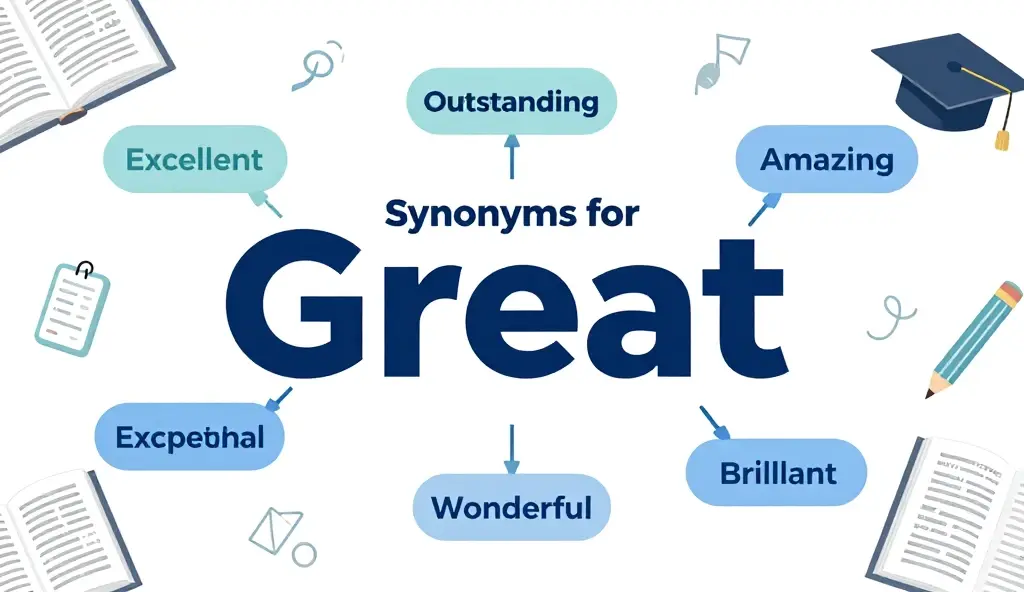
Synonyms for great include excellent, amazing, wonderful, outstanding, impressive, superb, exceptional, remarkable, terrific, fantastic, brilliant, and first-rate.
The best choice depends on what you mean. A great meal may be delicious. A great worker may be outstanding. A great change may be major. A great leader may be influential.
The word great is useful, but it can also feel plain when used too often. A stronger word can make your meaning clearer. It can show quality, size, skill, importance, joy, or success.
People often search for another word for great when writing an email, school paper, review, speech, story, social post, or work report. This guide will help you choose a natural word for each situation.
What Does Great Mean?
The word great has several meanings. It often describes something that is very good. It can also describe something large, important, powerful, skilled, or intense.
Definition of Great
Great means:
- Very good or enjoyable
- Much better than normal
- Large in size, amount, or degree
- Important or well known
- Highly skilled or successful
- Strong or serious
The right meaning comes from the sentence.
Consider these examples:
- “We had a great dinner.”
Here, great means very enjoyable or excellent. - “The storm caused great damage.”
Here, great means large or serious. - “She was a great leader.”
Here, great means important, skilled, or respected. - “He has great strength.”
Here, great means a high level of strength.
This is why one great synonym cannot fit every sentence. You must first know what great means in your exact context.
Common Uses of Great
People use great to describe:
- People
- Ideas
- Work
- Experiences
- Results
- Size
- Importance
- Skill
- Feelings
- Events
It is common in both speech and writing. It sounds friendly, positive, and easy to understand.
How to Pronounce Great
The phonetic pronunciation of great is:
/ɡreɪt/
It sounds like:
GRAYT
The word has one syllable. It rhymes with:
- Date
- Late
- Plate
- State
- Wait
- Eight
To pronounce it naturally, begin with a hard “g” sound. Then say the long “a” sound heard in day. End with a clear “t.”
Say it slowly:
g + rate
Then join the sounds:
great
Do not pronounce it like grit or greet. The vowel sound should be the same as the vowel sound in late.
Examples in natural speech:
- “That was great.”
- “You did a great job.”
- “We had a great time.”
- “She has a great idea.”
In fast daily speech, the final “t” may sound soft, but it should still be present.
What Part of Speech Is Great?
Great is mainly an adjective. An adjective describes a noun or pronoun.
Great as an Adjective
Examples:
- A great teacher
- A great movie
- A great result
- A great amount
- A great leader
In each example, great adds information about a person, thing, result, amount, or role.
It can come before a noun:
- “She gave a great speech.”
It can also come after a linking verb:
- “The speech was great.”
- “You look great.”
- “Everything feels great.”
Great as a Noun
Great can also act as a noun in the plural form greats. It means famous or highly skilled people.
Examples:
- “She is one of the greats of modern tennis.”
- “The museum honors the greats of American art.”
- “He studied the greats of jazz.”
This use is less common in basic daily speech. It often appears in sports, music, art, history, and culture.
Is Great an Adverb?
People often say:
- “I’m doing great.”
- “The plan worked great.”
This is common in informal American English. However, greatly is the standard adverb in many formal sentences.
Compare:
- Informal: “The new system works great.”
- Formal: “The new system works very well.”
- Formal: “The change greatly improved the system.”
Use great freely as an adjective. Use greatly when you need an adverb meaning “to a large degree.”
Complete List of Synonyms for Great
The following table shows common synonyms for great, their meanings, tone, and best use.
| Word | Meaning | Usage | Formality | Example | Difficulty Level |
| Excellent | Extremely good | Work, service, results | Formal and neutral | She gave an excellent answer. | Easy |
| Amazing | Very surprising or very good | Experiences, talent, sights | Informal and neutral | The view was amazing. | Easy |
| Wonderful | Very pleasing or enjoyable | People, news, events | Neutral | We had a wonderful evening. | Easy |
| Outstanding | Much better than others | Work, skill, performance | Formal | His performance was outstanding. | Medium |
| Superb | Of very high quality | Food, art, service | Formal | The hotel offered superb service. | Medium |
| Fantastic | Extremely good or exciting | Ideas, trips, news | Informal | That is a fantastic idea. | Easy |
| Terrific | Very good or impressive | People, work, results | Informal | You did a terrific job. | Easy |
| Exceptional | Unusually good | Talent, quality, service | Formal | She showed exceptional skill. | Medium |
| Remarkable | Worth noticing | Success, change, ability | Formal | He made remarkable progress. | Medium |
| Impressive | Causing respect or admiration | Work, buildings, results | Neutral | The final design is impressive. | Easy |
| Brilliant | Very clever or successful | Ideas, people, plans | Neutral | It was a brilliant solution. | Easy |
| Magnificent | Very beautiful or grand | Buildings, views, events | Formal | The palace looked magnificent. | Medium |
| Splendid | Very good or beautiful | News, events, appearance | Formal or old-fashioned | We had a splendid time. | Medium |
| Marvelous | Extremely good or pleasing | Experiences, people, work | Neutral | She did a marvelous job. | Medium |
| Fabulous | Very good, stylish, or exciting | Fashion, places, events | Informal | You look fabulous. | Easy |
| First-rate | Of the highest quality | Service, work, products | Neutral | They provide first-rate care. | Medium |
| Top-notch | Of excellent quality | Skills, service, products | Informal | Their support team is top-notch. | Medium |
| Fine | Good or high in quality | Art, food, condition | Neutral | This is a fine example of design. | Easy |
| Admirable | Deserving respect | Actions, behavior, effort | Formal | Her honesty was admirable. | Medium |
| Extraordinary | Far beyond normal | Talent, events, results | Formal | He has extraordinary patience. | Medium |
| Tremendous | Very great in amount or quality | Growth, effort, success | Neutral | The team made tremendous progress. | Medium |
| Awesome | Extremely good or exciting | Daily speech, experiences | Very informal | The concert was awesome. | Easy |
| Stellar | Extremely good | Performance, career, results | Neutral | She gave a stellar performance. | Medium |
| Phenomenal | Extremely impressive | Growth, talent, results | Neutral | Sales showed phenomenal growth. | Medium |
| Elite | Among the best | Groups, athletes, services | Formal | She joined an elite research team. | Medium |
| Masterful | Showing great skill | Writing, performance, control | Formal | It was a masterful speech. | Hard |
| Glorious | Beautiful, joyful, or impressive | Weather, victory, history | Formal | It was a glorious day. | Medium |
| Praiseworthy | Deserving praise | Conduct, effort, actions | Formal | His calm response was praiseworthy. | Hard |
| Commendable | Worthy of approval | Effort, behavior, service | Formal | Her dedication is commendable. | Hard |
| Unmatched | Better than all others | Quality, skill, service | Neutral | Their attention to detail is unmatched. | Medium |
Best Synonyms for Great and How to Use Them
Not every positive word means the same thing. The following options are among the best synonyms for great because they work in many common situations.
Excellent
Meaning: Extremely good or of very high quality.
Difference: Excellent is more exact and professional than great. It often suggests a high standard.
Example:
“Your report was excellent.”
Best situation:
Use it for work, grades, customer service, skills, writing, results, and professional feedback.
Common mistake:
Do not use it for size. “Excellent damage” does not mean “great damage.”
Amazing
Meaning: Very surprising, impressive, or enjoyable.
Difference: Amazing often shows strong emotion. It can suggest that something surprised you.
Example:
“The mountain view was amazing.”
Best situation:
Use it for trips, talent, food, news, performances, and beautiful places.
Common mistake:
It may sound too emotional in a serious business report.
Wonderful
Meaning: Very pleasant, enjoyable, or kind.
Difference: Wonderful feels warm and personal. It is less focused on rank or performance.
Example:
“She is a wonderful friend.”
Best situation:
Use it for people, memories, news, family events, meals, and friendly messages.
Common mistake:
It may sound too soft when you need to describe technical skill.
Outstanding
Meaning: Much better than normal or better than most others.
Difference: Outstanding suggests that something stands above the rest.
Example:
“He received an award for outstanding service.”
Best situation:
Use it for employees, students, athletes, performances, service, and achievements.
Common mistake:
Do not use it for every small success. It should describe something clearly above average.
Superb
Meaning: Of extremely high quality.
Difference: Superb sounds refined and confident. It is common in reviews.
Example:
“The chef prepared a superb meal.”
Best situation:
Use it for food, hotels, music, art, products, and skilled work.
Common mistake:
It can sound unnatural in very casual talk between young children.
Fantastic
Meaning: Extremely good, exciting, or pleasing.
Difference: Fantastic is lively and more informal than excellent.
Example:
“We had a fantastic vacation.”
Best situation:
Use it for plans, ideas, news, trips, parties, and friendly praise.
Common mistake:
In fiction, fantastic can also mean strange or unreal. Context matters.
Exceptional
Meaning: Unusually good and far above normal.
Difference: Exceptional points to rare quality, talent, or performance.
Example:
“The doctor showed exceptional care.”
Best situation:
Use it in formal praise, reviews, job references, school reports, and award statements.
Common mistake:
Avoid using it for ordinary work. The word loses strength when overused.
Remarkable
Meaning: Unusual enough to deserve attention.
Difference: Remarkable may describe something good, surprising, or important. It does not always mean perfect.
Example:
“She made remarkable progress in six weeks.”
Best situation:
Use it for improvement, recovery, success, skill, discoveries, and change.
Common mistake:
Do not assume it always means positive. A “remarkable failure” is also possible.
Impressive
Meaning: Strong enough to create respect or admiration.
Difference: Impressive focuses on the effect something has on people.
Example:
“Her knowledge of the subject was impressive.”
Best situation:
Use it for presentations, buildings, skills, records, results, and portfolios.
Common mistake:
Something may be impressive without being useful. Do not treat the words as exact matches in every case.
Brilliant
Meaning: Very clever, bright, or successful.
Difference: Brilliant is especially useful for ideas, minds, plans, and solutions.
Example:
“That was a brilliant way to fix the problem.”
Best situation:
Use it for smart ideas, talented people, writing, strategy, and creative work.
Common mistake:
In American English, it can sound stronger or more expressive than it does in some forms of British English.
Terrific
Meaning: Very good, pleasing, or impressive.
Difference: Terrific is friendly and energetic. It is common in spoken praise.
Example:
“You did a terrific job on the project.”
Best situation:
Use it in conversations, feedback, reviews, and informal work messages.
Common mistake:
The older meaning of terrific was “causing fear,” but that meaning is rare in modern daily use.
Magnificent
Meaning: Extremely beautiful, grand, or impressive.
Difference: Magnificent is stronger and more visual than great.
Example:
“The hall had a magnificent ceiling.”
Best situation:
Use it for views, buildings, art, ceremonies, clothing, and grand events.
Common mistake:
It can sound too dramatic for a normal object, such as a basic pen or plain chair.
Tremendous
Meaning: Very large, powerful, or excellent.
Difference: Tremendous can refer to both high quality and large degree.
Example:
“The new policy had a tremendous effect.”
Best situation:
Use it for growth, effort, pressure, change, value, support, and success.
Common mistake:
Check whether you mean “very good” or “very large.” The sentence should make this clear.
Extraordinary
Meaning: Far beyond what is normal.
Difference: Extraordinary suggests rarity. It is stronger than great.
Example:
“She showed extraordinary courage.”
Best situation:
Use it for rare talent, courage, events, achievements, beauty, and skill.
Common mistake:
Do not use it for routine events unless you truly mean they were unusual.
First-Rate
Meaning: Among the best in quality.
Difference: First-rate sounds clear and measured. It often describes a service or product.
Example:
“The clinic provides first-rate care.”
Best situation:
Use it for service, products, schools, workers, training, and professional work.
Common mistake:
Always write it with a hyphen when it comes before a noun: “first-rate service.”
Top-Notch
Meaning: Of very high quality.
Difference: Top-notch is more casual than first-rate.
Example:
“The company offers top-notch support.”
Best situation:
Use it in reviews, friendly business writing, ads, conversations, and recommendations.
Common mistake:
It may sound too informal in academic or legal writing.
Stellar
Meaning: Extremely good or successful.
Difference: Stellar often describes performance, results, records, and careers.
Example:
“The team had a stellar season.”
Best situation:
Use it for business results, sports, performances, reviews, and professional praise.
Common mistake:
Avoid using it too often in formal reports. It can sound promotional.
Phenomenal
Meaning: Extremely impressive or successful.
Difference: Phenomenal is strong and energetic. It often describes growth, talent, or results.
Example:
“The product saw phenomenal demand.”
Best situation:
Use it for sales, progress, skill, success, growth, and popular events.
Common mistake:
Do not use it when the evidence only shows a small improvement.
Synonyms for Great by Meaning
The best replacement depends on what great means in your sentence.
Great Meaning “Very Good”
Use:
- Excellent
- Wonderful
- Superb
- Fantastic
- Terrific
- Outstanding
- First-rate
- Top-notch
Example:
- Basic: “The service was great.”
- Better: “The service was excellent.”
- Friendly: “The service was fantastic.”
- Strong review: “The service was first-rate.”
Great Meaning “Large”
Use:
- Large
- Huge
- Vast
- Massive
- Enormous
- Immense
- Considerable
- Substantial
Example:
- Basic: “The project required great effort.”
- Clearer: “The project required considerable effort.”
- Stronger: “The project required immense effort.”
Great Meaning “Important”
Use:
- Important
- Major
- Significant
- Influential
- Historic
- Leading
- Powerful
- Notable
Example:
- Basic: “It was a great moment in history.”
- Clearer: “It was a historic moment.”
- More formal: “It was a significant moment in history.”
Great Meaning “Highly Skilled”
Use:
- Skilled
- Talented
- Gifted
- Brilliant
- Expert
- Masterful
- Accomplished
- Exceptional
Example:
- Basic: “She is a great painter.”
- Clearer: “She is a gifted painter.”
- Formal: “She is an accomplished painter.”
- Strong praise: “She is an exceptional painter.”
Great Meaning “Strong or Intense”
Use:
- Deep
- Strong
- Intense
- Severe
- Powerful
- Extreme
- Serious
- Overwhelming
Example:
- Basic: “He felt great sadness.”
- Better: “He felt deep sadness.”
- Stronger: “He felt overwhelming sadness.”
Great Meaning “Famous or Respected”
Use:
- Famous
- Celebrated
- Renowned
- Distinguished
- Respected
- Legendary
- Eminent
- Illustrious
Example:
- Basic: “She was a great scientist.”
- Better: “She was a renowned scientist.”
- Formal: “She was a distinguished scientist.”
- Strong historical praise: “She was a legendary scientist.”
Synonyms for Great in Different Situations
A good writer chooses words based on the noun being described.
Synonyms for a Great Person
Use:
- Wonderful
- Kind
- Admirable
- Remarkable
- Exceptional
- Inspiring
- Respected
- Outstanding
Examples:
- “He is a wonderful person.”
- “She is an inspiring leader.”
- “Your teacher sounds exceptional.”
- “His patience is admirable.”
Calling someone a “great person” is warm but broad. A more exact word tells readers what makes that person great.
Synonyms for a Great Job
Use:
- Excellent
- Outstanding
- Impressive
- Terrific
- Superb
- Exceptional
- First-rate
- Professional
Examples:
- “You did an excellent job.”
- “The design team produced outstanding work.”
- “That was an impressive presentation.”
- “Your final draft is first-rate.”
Synonyms for a Great Idea
Use:
- Brilliant
- Smart
- Clever
- Strong
- Creative
- Practical
- Effective
- Promising
Examples:
- “That is a brilliant idea.”
- “Your plan sounds practical.”
- “She offered a creative solution.”
- “The new approach looks promising.”
Synonyms for a Great Day
Use:
- Wonderful
- Lovely
- Fantastic
- Enjoyable
- Memorable
- Beautiful
- Perfect
- Delightful
Examples:
- “We had a wonderful day.”
- “It was a lovely afternoon.”
- “The trip made the day memorable.”
- “We enjoyed a beautiful day at the lake.”
Synonyms for a Great Experience
Use:
- Memorable
- Rewarding
- Enjoyable
- Meaningful
- Wonderful
- Valuable
- Unforgettable
- Positive
Examples:
- “The internship was a rewarding experience.”
- “Our tour was unforgettable.”
- “Volunteering was deeply meaningful.”
- “The course gave me valuable experience.”
Synonyms for Great Results
Use:
- Excellent
- Strong
- Impressive
- Positive
- Outstanding
- Successful
- Encouraging
- Remarkable
Examples:
- “The campaign produced strong results.”
- “The treatment showed encouraging results.”
- “Her test scores were outstanding.”
- “The company reported impressive growth.”
Synonyms for Great Food
Use:
- Delicious
- Flavorful
- Tasty
- Excellent
- Fresh
- Appetizing
- Mouthwatering
- Superb
Examples:
- “The pasta was delicious.”
- “They serve flavorful soup.”
- “The meal looked appetizing.”
- “The chef prepared a superb dinner.”
Synonyms for a Great Movie or Book
Use:
- Engaging
- Moving
- Powerful
- Entertaining
- Gripping
- Brilliant
- Thought-provoking
- Memorable
Examples:
- “The movie was deeply moving.”
- “The book was gripping from the first page.”
- “It was a thought-provoking story.”
- “The final scene was powerful.”
Synonyms for Great Customer Service
Use:
- Excellent
- Responsive
- Helpful
- Reliable
- Professional
- Attentive
- First-rate
- Exceptional
Examples:
- “The staff provided attentive service.”
- “Customer support was responsive.”
- “The team was helpful and professional.”
- “The hotel is known for exceptional service.”
Antonyms for Great
Antonyms are words with opposite or nearly opposite meanings. Since great has several meanings, its antonym also changes by context.
| Antonym | Meaning | Best Context | Example |
| Bad | Not good | General quality | The service was bad. |
| Poor | Below a good standard | Work, quality, results | The report showed poor research. |
| Terrible | Extremely bad | Experiences, quality | The weather was terrible. |
| Awful | Very unpleasant or bad | Feelings, food, events | The meal tasted awful. |
| Mediocre | Only average | Skill, art, work | The performance was mediocre. |
| Average | Normal, not special | Results, ability, quality | The product was average. |
| Ordinary | Not special or unusual | People, objects, events | It looked like an ordinary house. |
| Minor | Not very important | Problems, changes, roles | The update made a minor change. |
| Small | Limited in size | Size, amount | They made a small payment. |
| Tiny | Very small | Physical size | A tiny mark appeared on the wall. |
| Insignificant | Too small or unimportant to matter | Effects, details, amounts | The difference was insignificant. |
| Weak | Lacking strength | Arguments, skills, results | The plan had a weak ending. |
| Inferior | Lower in quality | Products, work, rank | The copy was inferior to the original. |
| Unimpressive | Not causing admiration | Work, design, results | The final display was unimpressive. |
| Unremarkable | Not unusual or notable | Events, work, people | The first half was unremarkable. |
| Unknown | Not famous or recognized | People, brands, places | He was still an unknown artist. |
| Unimportant | Having little value or influence | Ideas, events, roles | The detail seemed unimportant. |
| Limited | Small in amount or range | Resources, success, power | The project had limited success. |
Bad
Bad is the most direct opposite of great when talking about quality.
- “The movie was great.”
- “The movie was bad.”
It is clear but not very detailed.
Poor
Poor suggests that something falls below an expected standard.
- “The team gave a poor performance.”
- “The report had poor structure.”
It is common in reviews, education, health, work, and business.
Terrible
Terrible is much stronger than bad.
- “We had a terrible experience.”
- “The road conditions were terrible.”
Use it when something is extremely unpleasant or low in quality.
Awful
Awful is common in casual speech. It can describe taste, smell, weather, pain, service, or an experience.
- “The coffee tasted awful.”
- “I had an awful morning.”
It may sound too emotional for formal reports.
Mediocre
Mediocre means only average when better quality was expected.
- “The restaurant received mediocre reviews.”
- “His first attempt was mediocre.”
It often carries a negative tone because the speaker expected more.
Ordinary
Ordinary means normal and not special.
- “It was an ordinary day.”
- “The building looked ordinary from outside.”
An ordinary thing is not always bad. It is simply not great or unusual.
Minor
Minor is the opposite of great when great means important, large, or serious.
- “The accident caused minor damage.”
- “We made a minor change.”
It does not mean low quality.
Insignificant
Insignificant means too small or unimportant to have much effect.
- “The cost difference was insignificant.”
- “The error had an insignificant effect.”
It is useful in academic, scientific, and business writing.
Weak
Weak is an antonym when great means strong, effective, or powerful.
- “The evidence was weak.”
- “The team had a weak start.”
It can describe people, arguments, results, systems, and physical strength.
Inferior
Inferior means lower in quality than something else.
- “The cheaper material was inferior.”
- “This model is inferior to the newer version.”
Use inferior to, not inferior than.
Unimpressive
Unimpressive means not strong enough to earn praise or attention.
- “The sales numbers were unimpressive.”
- “The display looked plain and unimpressive.”
It is often less harsh than terrible.
Unremarkable
Unremarkable means normal and not worth special notice.
- “The first test result was unremarkable.”
- “The hotel room was clean but unremarkable.”
It can sound neutral rather than strongly negative.
Thirty Real-World Examples of Great and Its Synonyms
These examples show how different words work in natural settings.
- The hotel gave us excellent service from the moment we arrived.
- Mia had a wonderful time at her cousin’s wedding.
- The new teacher made a great first impression on the class.
- Our team achieved outstanding results during the final quarter.
- The restaurant serves superb seafood at fair prices.
- Daniel offered a brilliant solution to the parking problem.
- The children saw an amazing rainbow after the storm.
- Her progress in reading has been remarkable.
- The carpenter did an exceptional job on the kitchen cabinets.
- We had a fantastic weekend in the mountains.
- Your presentation looked clear, calm, and professional.
- The museum has an impressive collection of early American art.
- That small bakery makes delicious bread every morning.
- The manager thanked Ava for her admirable honesty.
- The company received terrific feedback from new customers.
- Our guide gave us a memorable tour of the old city.
- The doctor showed extraordinary patience with the nervous child.
- The school provides first-rate support for new students.
- The repair team did a top-notch job on the roof.
- The singer delivered a stellar performance at the festival.
- The new store saw phenomenal growth in its first year.
- The garden looked magnificent in the morning light.
- The charity made a significant difference in the community.
- Her masterful use of color made the painting stand out.
- The new software produced strong results during testing.
- We enjoyed a lovely lunch beside the river.
- His speech had a powerful message about courage.
- The final chapter gave the story a satisfying ending.
- The coach praised the players for their tremendous effort.
- She became a respected voice in local education.
These sentences do more than replace great. They show the exact reason something deserves praise.
Twenty-Five Natural Sentences Using Great
The word great still has value. It sounds natural, simple, and friendly in many situations.
- We had a great time at the beach.
- That sounds like a great idea.
- You did a great job on the report.
- She is a great teacher.
- The room has a great view of the city.
- It was great to see you again.
- He has a great sense of humor.
- We found a great little café near the station.
- Your new haircut looks great.
- The team made great progress this month.
- I have great respect for her work.
- The news brought great joy to the family.
- The fire caused great damage to the building.
- She showed great courage during the emergency.
- This is a great place to raise a family.
- They gave us a great deal on the car.
- He could become a great player one day.
- We faced great pressure before the deadline.
- The book had a great effect on me.
- It would be great to meet next week.
- The course gave me a great start in design.
- She has great faith in her team.
- Our new neighbor has been great with the kids.
- The event was a great success.
- Thanks for all your help. You’ve been great.
Some sentences use great to mean excellent. Others use it to mean large, strong, important, or highly respected.
Formal vs. Informal Synonyms for Great
The tone of your writing matters. A word that sounds natural in a text message may sound too casual in a report.
| Informal Word | Formal Alternative | Example |
| Awesome | Excellent | The workshop received excellent feedback. |
| Cool | Impressive | The building has an impressive design. |
| Fantastic | Outstanding | The team delivered outstanding results. |
| Terrific | Exceptional | She provided exceptional support. |
| Amazing | Remarkable | The study showed remarkable progress. |
| Top-notch | First-rate | The firm offers first-rate legal services. |
| Great | Significant | The change had a significant effect. |
| Great | Substantial | The company made a substantial investment. |
| Great | Distinguished | He had a distinguished career. |
| Great | Highly effective | The new process was highly effective. |
Informal Usage
Informal words work well in:
- Friendly emails
- Text messages
- Social posts
- Personal reviews
- Casual talks
- Family conversations
- Notes to coworkers you know well
Examples:
- “You did an awesome job!”
- “That’s a fantastic idea.”
- “The food was amazing.”
- “We had a terrific time.”
- “Your new office looks great.”
Formal Usage
Formal synonyms work well in:
- Business reports
- Academic papers
- Job references
- Professional emails
- Research summaries
- Award statements
- Official reviews
Examples:
- “The employee demonstrated exceptional judgment.”
- “The project produced significant benefits.”
- “The committee praised her outstanding leadership.”
- “The data showed a substantial improvement.”
- “He made a remarkable contribution to the field.”
Choosing the Right Tone
Ask three questions:
- Who will read this?
- What is the purpose?
- How strong is the evidence?
A word like phenomenal may fit an ad but feel exaggerated in a financial report. A word like commendable may fit an evaluation but sound stiff in a birthday message.
How to Use Synonyms for Great in Academic Writing
Academic writing values clear and exact language. The word great is often too broad because it does not explain size, effect, quality, or importance.
Replace Great with a Measurable Word
Weak:
- “The program had a great effect on attendance.”
Better:
- “The program had a significant effect on attendance.”
Best when supported by data:
- “The program increased attendance by 18 percent.”
The last sentence gives the reader evidence instead of general praise.
Useful Academic Alternatives
Use these words in essays, studies, and research papers:
- Significant
- Substantial
- Considerable
- Major
- Important
- Influential
- Effective
- Notable
- Exceptional
- Extensive
- Meaningful
- Strong
Academic Examples
- “The study found a significant link between sleep and memory.”
- “The policy led to a substantial rise in school attendance.”
- “The author made an important point about social trust.”
- “The treatment showed promising early results.”
- “The movement had a major effect on public debate.”
- “The sample showed considerable variation.”
- “Her work made a notable contribution to the field.”
- “The evidence provides strong support for the main claim.”
Avoid Empty Praise
Instead of writing:
- “This is a great study.”
Explain why:
- “This study uses a large sample and a clear method.”
Instead of:
- “The author gives a great argument.”
Write:
- “The author gives a well-supported argument.”
Instead of:
- “The findings are great.”
Write:
- “The findings are useful because they confirm the earlier results.”
Exact language sounds more informed and more trustworthy.
How to Use Synonyms for Great in Daily Conversation
In daily talk, great remains one of the easiest positive words. It is short, warm, and clear. Still, other words can make your speech more expressive.
When Someone Shares Good News
You can say:
- “That’s wonderful!”
- “That’s amazing!”
- “That’s fantastic!”
- “That’s terrific!”
- “That’s excellent news!”
Example:
Friend: “I got the job.”
Reply: “That’s fantastic! You worked hard for it.”
When Praising Someone’s Work
You can say:
- “You did an excellent job.”
- “That looks impressive.”
- “Your work is outstanding.”
- “You handled that really well.”
- “That was a smart solution.”
A specific compliment often feels more honest.
Instead of:
- “Great work.”
Try:
- “Your layout is clear and easy to follow.”
- “You explained the main point very well.”
- “The final design looks polished.”
When Describing an Experience
Use:
- Enjoyable
- Fun
- Relaxing
- Memorable
- Exciting
- Rewarding
- Unforgettable
Instead of:
- “The trip was great.”
Try:
- “The trip was relaxing.”
- “The trip was full of fun.”
- “The trip was unforgettable.”
- “The trip was a rewarding experience.”
When Talking About Food
Instead of saying “great food,” try:
- Delicious food
- Fresh food
- Flavorful food
- Tasty food
- Well-cooked food
- Rich and creamy food
- Light and refreshing food
Specific words help the listener imagine the meal.
Grammar Tips for Using Great
Great is simple, but a few grammar rules can improve your writing.
Use Great Before a Noun
Correct:
- A great plan
- A great leader
- A great chance
- Great care
- Great value
Example:
- “We found a great place for lunch.”
Use Great After Linking Verbs
Common linking verbs include be, seem, look, feel, and sound.
Examples:
- “The idea is great.”
- “You look great.”
- “The plan sounds great.”
- “I feel great.”
- “The room seems great for meetings.”
Use Very Great Carefully
The phrase very great is grammatically possible, but it often sounds awkward when great means excellent.
Awkward:
- “The movie was very great.”
Better:
- “The movie was excellent.”
- “The movie was really good.”
- “The movie was fantastic.”
However, very great can work when great means large or serious.
Example:
- “The decision carries very great risk.”
Even then, extreme risk or substantial risk may sound clearer.
Great vs. Greatly
Great is usually an adjective.
- “The change was great.”
Greatly is an adverb.
- “The change greatly improved safety.”
- “Your support is greatly appreciated.”
- “The cost has greatly increased.”
Incorrect:
- “The update great improved performance.”
Correct:
- “The update greatly improved performance.”
Greater and Greatest
The comparative form is greater.
- “The second plan offers greater value.”
- “This issue is of greater importance.”
The superlative form is greatest.
- “Her greatest strength is patience.”
- “This was the greatest challenge of his career.”
Do not use more great or most great in standard writing.
Incorrect:
- “This idea is more great.”
Correct:
- “This idea is greater.”
- “This idea is better.”
- “This idea is more effective.”
A Great Number vs. A Great Amount
Use a great number of with countable nouns.
- A great number of students
- A great number of books
- A great number of visitors
Use a great amount of with uncountable nouns.
- A great amount of time
- A great amount of money
- A great amount of work
In simple modern writing, many and much may sound more natural.
- “Many students attended.”
- “The task required much effort.”
Common Collocations with Great
A collocation is a group of words that often appear together. Learning collocations helps your English sound natural.
Great Job
Meaning: Work done very well.
Example:
- “You did a great job fixing the door.”
Alternative words:
- Excellent job
- Outstanding job
- Terrific job
- Impressive work
Great Idea
Meaning: A useful, smart, or exciting suggestion.
Example:
- “Bringing extra water is a great idea.”
Alternatives:
- Brilliant idea
- Smart idea
- Practical idea
- Creative idea
Great Time
Meaning: An enjoyable experience.
Example:
- “We had a great time at the party.”
Alternatives:
- Wonderful time
- Fantastic time
- Enjoyable evening
- Memorable experience
Great Deal
This phrase has two common meanings.
It can mean a good price:
- “We got a great deal on the sofa.”
It can also mean a large amount:
- “She learned a great deal from the course.”
Alternatives:
- Good bargain
- Fair price
- A lot
- A large amount
Great Success
Meaning: A strong or important success.
Example:
- “The event was a great success.”
Alternatives:
- Major success
- Huge success
- Remarkable success
- Outstanding achievement
Great Opportunity
Meaning: A valuable chance.
Example:
- “This internship is a great opportunity.”
Alternatives:
- Valuable opportunity
- Excellent chance
- Promising opportunity
- Important opening
Great Pleasure
Meaning: Strong happiness or enjoyment.
Example:
- “It is a great pleasure to welcome you.”
This phrase is common in speeches, formal messages, and introductions.
Alternatives:
- A real pleasure
- A true pleasure
- A special honor
Great Respect
Meaning: Strong admiration.
Example:
- “I have great respect for her honesty.”
Alternatives:
- Deep respect
- High regard
- Strong admiration
Great Care
Meaning: Close and serious attention.
Example:
- “The artist restored the painting with great care.”
Alternatives:
- Close attention
- Exceptional care
- Careful skill
Great Effort
Meaning: A large amount of work or energy.
Example:
- “The team made a great effort to finish on time.”
Alternatives:
- Strong effort
- Serious effort
- Tremendous effort
- Major effort
Great Value
Meaning: High usefulness or good quality for the price.
Example:
- “This phone offers great value.”
Alternatives:
- Excellent value
- Good value
- Strong value
- Worthwhile benefit
Great Importance
Meaning: A high level of importance.
Example:
- “Clean water is of great importance to public health.”
Alternatives:
- Major importance
- High importance
- Critical importance
- Central importance
Great Detail
Meaning: A high level of exact information.
Example:
- “She explained the process in great detail.”
Alternatives:
- In full detail
- With close attention
- In a clear and exact way
Great Length
Meaning: A long distance, period, or amount of effort.
Example:
- “They went to great lengths to protect the child.”
This form usually appears in the phrase go to great lengths.
Common Phrases and Expressions with Great
These phrases appear often in American English.
That’s Great
Meaning: That is very good news.
Example:
- “I passed my exam.”
- “That’s great!”
It sounds friendly and natural. Tone matters. A flat voice can make it sound less sincere.
Great to Meet You
Meaning: A friendly phrase used after meeting someone.
Example:
- “It was great to meet you, Sarah.”
A more formal version is:
- “It was a pleasure meeting you.”
Great to Hear From You
Meaning: You are pleased that someone contacted you.
Example:
- “It’s great to hear from you after so long.”
This phrase works well in friendly emails and messages.
So Far, So Great
This is a playful version of so far, so good.
Example:
- “How is the new job?”
- “So far, so great.”
It sounds cheerful and informal.
The Great Outdoors
Meaning: Nature and open outdoor areas.
Example:
- “They spend every weekend enjoying the great outdoors.”
It often refers to forests, mountains, lakes, parks, and outdoor trips.
The Greater Good
Meaning: A benefit shared by many people.
Example:
- “The rule was created for the greater good.”
This phrase is common in social, political, and ethical discussions.
No Great Shakes
Meaning: Not very good or impressive.
Example:
- “The first movie was no great shakes.”
This phrase is informal and less common among younger speakers.
Go to Great Lengths
Meaning: Make a very strong effort.
Example:
- “She went to great lengths to keep the event a surprise.”
It often suggests extra effort, time, or trouble.
Have a Great One
Meaning: Have a great day, evening, or weekend.
Example:
- “Thanks for visiting. Have a great one!”
It is friendly and informal.
Great Minds Think Alike
Meaning: Two people had the same idea.
Example:
- “I brought coffee too.”
- “Great minds think alike.”
People often use it in a playful way.
From Great to Greater
Meaning: Moving from strong success to even greater success.
Example:
- “The company hopes to move from great to greater results.”
The phrase is positive but may sound promotional.
With Great Power Comes Great Responsibility
Meaning: A person with power must use it with care.
Example:
- “Managers should remember that with great power comes great responsibility.”
This phrase is widely used in discussions about leadership, authority, and duty.
Similar Words Often Confused with Great
Several words look like synonyms for great but carry different meanings.
| Word | Main Meaning | Difference from Great | Example |
| Good | Positive or acceptable | Weaker than great | The food was good. |
| Better | Higher in quality than another | Requires comparison | This plan is better. |
| Best | Highest in quality | Strongest rank in a group | This is the best option. |
| Big | Large in size | Focuses on physical size or scale | They live in a big house. |
| Grand | Large, impressive, or important | Often suggests style or ceremony | They held a grand opening. |
| Major | Important or large in effect | More formal and exact | The storm caused major damage. |
| Fine | Good or acceptable | Often softer than great | The design looks fine. |
| Nice | Pleasant or kind | Less strong and less exact | She gave me a nice gift. |
| Awesome | Extremely good | Much more informal | The show was awesome. |
| Perfect | Without faults | Stronger and more absolute | The size is perfect. |
| Excellent | Extremely good | More formal and measured | Her work was excellent. |
| Wonderful | Very pleasing | Warmer and more emotional | We had a wonderful visit. |
Great vs. Good
Good is positive. Great is stronger.
- “The meal was good.”
It was pleasant or acceptable. - “The meal was great.”
It was much better than normal.
Use good when you want calm praise. Use great when you want stronger praise.
Great vs. Excellent
Both describe high quality.
- Great sounds more relaxed and conversational.
- Excellent sounds more exact and professional.
Compare:
- “You gave a great answer.”
- “You gave an excellent answer.”
The second sentence sounds more like formal feedback.
Great vs. Amazing
Great means very good. Amazing often adds surprise.
- “The hotel was great.”
- “The hotel was amazing.”
The second sentence suggests a stronger emotional reaction.
Great vs. Wonderful
Wonderful often feels warmer.
- “He is a great manager.”
- “He is a wonderful father.”
The first sentence may focus on skill. The second focuses more on personal warmth.
Great vs. Awesome
Awesome is more casual.
- “The results were great.”
- “The concert was awesome.”
Avoid awesome in serious academic papers or formal business reports.
Great vs. Perfect
Great allows small flaws. Perfect suggests no flaw or an exact fit.
- “The apartment is great, but the kitchen is small.”
- “The apartment is perfect for our needs.”
Do not use perfect when you only mean very good.
Great vs. Big
Big mainly describes size. Great can describe size, value, importance, or quality.
- “They built a big house.”
- “They built a great house.”
The first sentence focuses on size. The second may focus on quality.
Great vs. Grand
Grand often suggests large size, beauty, wealth, or ceremony.
- “They planned a grand celebration.”
- “We had a great celebration.”
The first sounds more formal and impressive. The second simply says the event was very good.
Great vs. Major
Major is more exact when discussing importance, scale, or effect.
- “The leak caused great damage.”
- “The leak caused major damage.”
The second sentence sounds clearer in news, insurance, and business writing.
Great vs. Remarkable
Remarkable means worthy of attention. It may describe progress, courage, change, or an unusual fact.
- “She is a great student.”
- “She made remarkable progress.”
The second sentence explains what deserves attention.
Common Mistakes When Choosing Another Word for Great
Writers often replace great with a stronger word without checking the meaning. This can make a sentence sound odd or exaggerated.
Using a Quality Word for Size
Incorrect:
- “The storm caused excellent damage.”
Correct:
- “The storm caused major damage.”
- “The storm caused extensive damage.”
Excellent means very good. It cannot describe harmful damage in a normal sentence.
Using Formal Words in Casual Messages
Stiff:
- “Your birthday dinner was exceptionally commendable.”
Natural:
- “Your birthday dinner was wonderful.”
A formal word is not always a better word.
Using Strong Words Without Evidence
Exaggerated:
- “The new form created phenomenal improvement.”
Better:
- “The new form made the process easier.”
Use strong praise only when the facts support it.
Replacing Every Great with Amazing
Repetitive:
- “We had an amazing meal at an amazing place with amazing service.”
Better:
- “We had a delicious meal at a beautiful place with excellent service.”
Exact words create a clearer picture.
Confusing Greatly and Great
Incorrect:
- “The new rule great reduced delays.”
Correct:
- “The new rule greatly reduced delays.”
Writing More Great
Incorrect:
- “The second design is more great.”
Correct:
- “The second design is better.”
- “The second design is more impressive.”
Calling Normal Work Exceptional
Exceptional means far above normal. It should not describe every routine task.
Weak praise becomes stronger when used less often.
Ignoring the Noun
Ask what you are describing.
- Great food may be delicious.
- Great news may be wonderful.
- Great growth may be substantial.
- Great pain may be severe.
- Great skill may be exceptional.
- Great care may be close or attentive.
The noun guides the synonym.
Expert Tips for Choosing the Best Great Synonym
Name the Exact Quality
Before replacing great, ask why the thing is great.
Was the meal:
- Delicious?
- Fresh?
- Creative?
- Filling?
- Well presented?
Was the employee:
- Reliable?
- Skilled?
- Helpful?
- Fast?
- Honest?
Exact praise sounds more real.
Match the Strength of the Word to the Facts
Use a simple scale:
- Good: positive
- Great: strongly positive
- Excellent: very high quality
- Outstanding: better than most
- Exceptional: unusually high quality
- Extraordinary: far beyond normal
Do not call every good result extraordinary.
Match the Word to the Reader
For a friend:
- Awesome
- Fantastic
- Wonderful
For a manager:
- Excellent
- Impressive
- Strong
For an academic reader:
- Significant
- Substantial
- Effective
- Notable
For a customer review:
- Excellent
- Helpful
- Reliable
- First-rate
Replace Praise with Proof
Instead of:
- “She is a great worker.”
Write:
- “She meets every deadline and helps new team members.”
Instead of:
- “The product is great.”
Write:
- “The product is light, durable, and easy to clean.”
Proof builds trust.
Avoid Too Many Strong Adjectives
Weak:
- “The event was amazing, fantastic, wonderful, and incredible.”
Better:
- “The event was well planned and full of useful ideas.”
One exact phrase is often stronger than four broad words.
Read the Sentence Aloud
A synonym may look correct but sound unnatural.
For example:
- “We had an exceptional picnic.”
This is possible, but “wonderful picnic” or “lovely picnic” sounds more natural in most daily conversations.
Check the Hidden Meaning
Some synonyms carry extra meaning:
- Amazing suggests surprise.
- Brilliant suggests intelligence.
- Magnificent suggests beauty or grandeur.
- Outstanding suggests being better than others.
- Remarkable suggests something worth noticing.
- Tremendous suggests high degree or large size.
- Admirable suggests moral respect.
Choose the extra meaning you need.
Use Simple Words When They Work
A rare word is not always a better word. Clear writing matters more than showing a large vocabulary.
Sometimes great is still the best choice:
- “Have a great day.”
- “It was great to see you.”
- “That sounds great.”
- “You look great.”
These phrases are natural and do not need a fancy replacement.
Suggested Image ALT Text
Use clear image descriptions rather than stuffing keywords.
- “Synonyms for great with meanings and example sentences”
- “Best words to use instead of great in English”
- “Formal and informal synonyms for great comparison chart”
- “Another word for great in writing and conversation”
- “Great synonym list for students and writers”
- “Excellent amazing outstanding and other words like great”
Good ALT text should describe the actual image. Do not add words that have no link to what the image shows.
Frequently Asked Questions About Synonyms for Great
What Is the Best Synonym for Great?
The best general synonym for great is excellent. It works well for work, quality, service, results, and performance. However, the best choice still depends on context. Use wonderful for warm personal praise, outstanding for work above normal standards, brilliant for a smart idea, and major when great means large or important.
What Is Another Word for Great?
Another word for great may be excellent, amazing, wonderful, outstanding, superb, impressive, exceptional, remarkable, fantastic, or terrific. Choose the word based on your meaning. A great meal can be delicious. A great plan can be brilliant. A great amount can be substantial. A great person can be admirable or inspiring.
What Is a Stronger Word Than Great?
Words stronger than great include exceptional, extraordinary, phenomenal, magnificent, outstanding, and superb. These words suggest a very high level of quality, skill, beauty, or success. Use them carefully. Calling a routine result “phenomenal” may sound exaggerated. The strength of the word should match the real strength of the result.
What Is a Professional Synonym for Great?
Professional alternatives include excellent, outstanding, impressive, exceptional, effective, first-rate, significant, and remarkable. For employee feedback, you might write, “She delivered outstanding work.” For business results, write, “The campaign produced strong results.” For an important change, use “significant” or “substantial” instead of the broad word great.
What Is an Informal Synonym for Great?
Common informal synonyms include awesome, fantastic, terrific, amazing, cool, fabulous, and top-notch. These words work well in friendly messages, casual reviews, and daily conversation. For example, “We had an awesome time” sounds natural among friends. In a formal report, “We had a productive meeting” would usually be a better choice.
What Is a Synonym for a Great Person?
A great person may be described as wonderful, admirable, inspiring, remarkable, kind, exceptional, respected, or outstanding. Choose the word that explains the person’s best quality. Admirable points to actions worthy of respect. Inspiring shows that the person motivates others. Wonderful sounds warm, personal, and friendly.
What Can I Say Instead of Great Job?
You can say excellent work, outstanding job, impressive work, terrific effort, well done, first-rate work, or you handled that very well. Specific praise is even better. Instead of only saying “great job,” say, “Your report was clear, accurate, and easy to follow.” This tells the person exactly what they did well.
What Is a Better Word for a Great Idea?
Use brilliant, smart, clever, creative, practical, effective, promising, or thoughtful. A brilliant idea is highly intelligent. A practical idea is easy to use. A creative idea is original. A promising idea has a good chance of success. The best word depends on what makes the idea useful or special.
What Is a Formal Word for Very Great?
Formal choices include substantial, considerable, exceptional, extraordinary, significant, profound, immense, and extensive. The correct choice depends on meaning. Use substantial for amount, significant for importance, profound for deep effects, immense for size, and exceptional for quality. Avoid choosing a formal word only because it sounds advanced.
Is Amazing a Synonym for Great?
Yes, amazing can be a synonym for great when something is very impressive, enjoyable, or surprising. However, amazing often carries a sense of wonder or surprise. “The concert was amazing” sounds more emotional than “The concert was great.” It may be too casual for some academic, legal, or technical writing.
Is Excellent Better Than Great?
Excellent is not always better, but it is often more exact and formal. Great sounds natural in conversation. Excellent suggests a high standard and fits professional feedback, reviews, reports, and school work. Compare “You did a great job” with “You produced excellent work.” Both are positive, but the second sounds more measured.
Can Great Mean Large?
Yes. Great can mean large in size, amount, degree, or effect. Examples include great pressure, great damage, great effort, and great distance. In these cases, useful synonyms include large, major, substantial, immense, considerable, severe, and extensive. A quality word such as excellent would not fit this meaning.
What Is the Opposite of Great?
The most common opposite is bad, but other antonyms include poor, terrible, awful, average, mediocre, ordinary, minor, small, weak, inferior, insignificant, and unimpressive. The correct antonym depends on the sentence. The opposite of great quality is poor quality. The opposite of great importance is minor importance.
How Do I Avoid Repeating Great in Writing?
First, identify what makes each thing great. Replace the broad praise with an exact quality. A great meal may be delicious. A great speaker may be engaging. A great result may be significant. You can also rewrite the sentence with proof: “The app is fast, clear, and easy to use.” This is stronger than simply saying, “The app is great.”
What Is Another Word for Great Experience?
Useful choices include wonderful, memorable, rewarding, meaningful, enjoyable, positive, exciting, unforgettable, and valuable. Use rewarding when you gained something useful. Use memorable when the experience stayed in your mind. Use meaningful when it had emotional or personal value. Use enjoyable for simple pleasure.
What Is Another Word for Great Results?
Try excellent results, strong results, outstanding results, positive outcomes, impressive progress, remarkable improvement, or successful performance. In business and research writing, include numbers when possible. “Sales rose by 22 percent” is more useful than “Sales showed great results.” Specific data makes the statement clear and trustworthy.
What Is a Synonym for Great in an Essay?
In an essay, good replacements include significant, important, major, substantial, notable, influential, effective, remarkable, and considerable. The correct choice depends on the claim. Instead of writing “The law had a great effect,” write “The law had a significant effect.” Academic writing improves when broad praise is replaced with exact meaning.
Can I Use Awesome Instead of Great?
You can use awesome instead of great in casual American English. It fits friendly speech, text messages, social posts, and personal reviews. “The party was awesome” sounds natural and lively. Avoid it in academic papers, legal documents, and formal reports. In those settings, use excellent, effective, impressive, or outstanding.
Conclusion
There are many useful synonyms for great, but no single word fits every sentence. Excellent is a strong general choice. Wonderful adds warmth. Outstanding shows performance above the normal level. Brilliant fits clever ideas. Magnificent describes beauty or grandeur. Significant works when great means important, while substantial works for a large amount.
Before choosing another word for great, look at the noun and ask what you truly mean. Is the person kind, skilled, or inspiring? Is the result strong, rare, or measurable? Is the experience fun, rewarding, or unforgettable?
The clearest word is usually the best word. Use strong synonyms when they are earned, simple words when they sound natural, and specific details whenever they can show why something is truly great.

Christopher Ward writes practical guides on word usage, synonyms, and effective written communication for a global audience.