
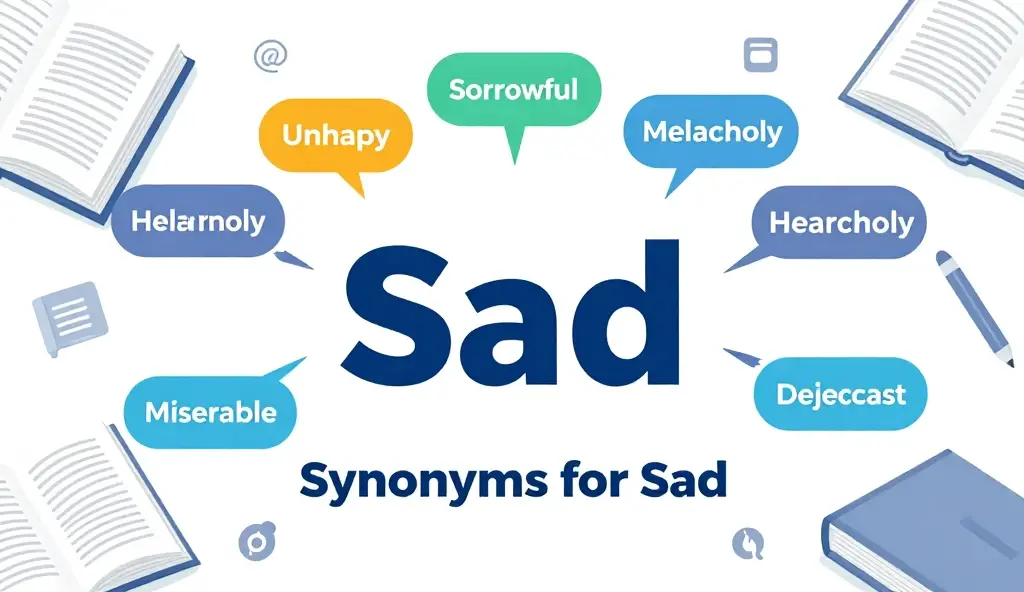
Synonyms for sad include unhappy, upset, sorrowful, gloomy, heartbroken, miserable, downcast, depressed, melancholy, mournful, blue, discouraged, somber, and dejected.
The best word depends on the type and strength of the feeling. For example, upset fits a short-term feeling, while heartbroken describes deep emotional pain. Somber often describes a serious mood, place, or event.
The word sad is common, clear, and easy to understand. Still, it may not always express the exact feeling you want to share. A child who loses a toy may feel upset.
A person who loses a loved one may feel grief-stricken. A worker who misses a goal may feel discouraged.
Learning different synonyms for sad helps you speak and write with more care. It also makes stories, school work, messages, and daily conversations feel more real.
What Does Sad Mean?
Sad means feeling unhappy, hurt, or full of sorrow. A person may feel sad after a loss, a mistake, a fight, a disappointment, or a painful change.
The feeling may be small and brief. It may also be deep and last for a long time.
A person can feel sad because:
- A friend moved away.
- A pet became sick.
- A plan failed.
- Someone said something hurtful.
- A favorite team lost.
- A loved one died.
- A happy time ended.
- A person feels lonely.
Sad can also describe something that causes unhappy feelings.
For example:
- It was a sad story.
- We heard some sad news.
- The empty house looked sad.
- The movie had a sad ending.
The exact meaning often depends on the setting. That is why learning other words for sad can improve your word choice.
Definition of Sad
The simplest definition of sad is:
Feeling or showing unhappiness, sorrow, pain, or disappointment.
Sad is often used for emotions, but it can also describe events, faces, sounds, places, stories, and situations.
Common meanings of sad
| Meaning | Explanation | Example |
| Unhappy | Not feeling pleased or joyful | Mia felt sad after the argument. |
| Sorrowful | Feeling pain after a loss | He was sad when his dog died. |
| Disappointing | Causing a feeling of failure or regret | It was a sad result for the team. |
| Gloomy | Looking dark, dull, or without joy | The room had a sad feeling. |
| Unfortunate | Describing something painful or regrettable | It was a sad mistake. |
In casual speech, sad may also describe something weak, poor, or disappointing.
For example:
- That was a sad excuse.
- The broken chair was in a sad state.
- Their effort was quite sad.
This use is informal and can sound rude. Use it with care.
Pronunciation of Sad
The word sad is pronounced:
/sæd/
It sounds like:
SAD
The vowel sound is the same short “a” sound heard in:
- Bad
- Mad
- Cat
- Hat
- Glad
To pronounce sad naturally:
- Place the tip of your tongue near the back of your top teeth.
- Make a soft “s” sound.
- Open your mouth for the short “a” sound.
- Finish with a clear “d” sound.
Say it slowly:
s-a-d
Then say it at a normal speed:
sad
Do not stretch the vowel too much. The word has only one syllable.
Part of Speech of Sad
The word sad is mainly an adjective.
An adjective describes a person, place, thing, feeling, or situation.
Sad as an adjective
- She looks sad.
- We heard sad news.
- It was a sad day.
- His voice sounded sad.
- The story had a sad ending.
Sad can appear before a noun:
- A sad child
- A sad song
- A sad memory
- A sad face
- A sad event
It can also appear after linking verbs such as be, feel, look, seem, sound, become, and appear.
- I feel sad.
- He seems sad.
- The music sounds sad.
- They became sad after hearing the news.
- Her face appeared sad.
Related word forms
| Word | Part of Speech | Meaning | Example |
| Sad | Adjective | Feeling unhappy | She felt sad. |
| Sadly | Adverb | In an unhappy or regrettable way | Sadly, the trip was canceled. |
| Sadness | Noun | The feeling of being sad | His sadness was clear. |
| Sadden | Verb | To make someone feel sad | The news saddened us. |
| Saddened | Adjective or verb form | Made unhappy | We were saddened by the loss. |
| Saddening | Adjective | Causing sadness | It was a saddening story. |
Do not use sad as a noun.
Incorrect:
- I felt a sad.
Correct:
- I felt sadness.
- I felt sad.
Synonyms for Sad
There are many synonyms for sad, but they do not all mean the same thing. Some describe mild unhappiness. Others describe deep pain, grief, hopelessness, or disappointment.
| Word | Meaning | Best Usage | Formality | Example | Difficulty |
| Unhappy | Not pleased or joyful | General sadness | Neutral | She felt unhappy at school. | Easy |
| Upset | Emotionally troubled | Short-term pain or worry | Neutral | He was upset about the mistake. | Easy |
| Down | Feeling low | Casual conversation | Informal | I’ve been feeling down today. | Easy |
| Blue | Slightly sad | Casual speech | Informal | She felt blue after the holiday. | Easy |
| Gloomy | Dark or without hope | Mood, weather, or setting | Neutral | He was in a gloomy mood. | Easy |
| Sorrowful | Full of sorrow | Loss or serious pain | Formal | She gave him a sorrowful look. | Medium |
| Mournful | Showing grief | Death, loss, sounds, or faces | Formal | A mournful song filled the room. | Medium |
| Melancholy | Quiet, thoughtful sadness | Art, memories, or mood | Formal | The old photo gave him a melancholy feeling. | Medium |
| Miserable | Very unhappy or uncomfortable | Strong sadness | Neutral | She felt miserable after the fight. | Easy |
| Heartbroken | Deeply hurt by loss or love | Breakups or major loss | Neutral | He was heartbroken when she left. | Easy |
| Dejected | Low in spirit after failure | Rejection or defeat | Formal | The dejected player left the field. | Medium |
| Downcast | Looking or feeling discouraged | Facial expression or mood | Formal | She looked downcast after the meeting. | Medium |
| Discouraged | Losing hope or confidence | Failure or slow progress | Neutral | He felt discouraged by the low score. | Easy |
| Depressed | Deeply low or medically unwell | Serious or lasting low mood | Neutral | She had felt depressed for several weeks. | Medium |
| Somber | Serious, dark, and sad | Events, rooms, clothing, or mood | Formal | The crowd became somber. | Medium |
| Grief-stricken | Filled with strong grief | Death or major loss | Formal | The grief-stricken family stayed close. | Medium |
| Despondent | Without hope | Deep discouragement | Formal | He became despondent after many setbacks. | Hard |
| Forlorn | Lonely and without hope | People, animals, or places | Literary | The puppy gave a forlorn cry. | Medium |
| Woeful | Full of sorrow or very poor | Pain or disappointing quality | Formal | She told a woeful tale. | Medium |
| Dismal | Dark, depressing, or poor | Weather, results, or places | Neutral | The team had a dismal season. | Medium |
| Crestfallen | Sad after disappointment | Bad news or failure | Formal | He looked crestfallen after losing. | Hard |
| Tearful | Crying or close to crying | Visible emotion | Neutral | She gave a tearful goodbye. | Easy |
| Troubled | Worried and unhappy | Problems or concern | Neutral | His troubled face worried me. | Easy |
| Distressed | Very worried, upset, or hurt | Serious emotional pain | Formal | The child appeared distressed. | Medium |
| Regretful | Sad about a choice or action | Mistakes and apologies | Formal | He felt regretful after the argument. | Medium |
Best Synonyms for Sad and How to Use Them
Choosing the right synonym depends on cause, strength, length, and setting. The following words are some of the most useful alternatives to sad.
Unhappy
Meaning: Not happy, pleased, or satisfied.
Difference: Unhappy is broad and direct. It can describe sadness, dissatisfaction, or discomfort.
Example: Ava was unhappy with the final result.
Best situation: Use it when the reason is clear but the feeling is not extremely strong.
Common mistake: Do not assume unhappy always means crying or deep sorrow. A person may simply be displeased.
Upset
Meaning: Emotionally bothered, worried, hurt, or angry.
Difference: Upset can include sadness, anger, worry, or shock. It is wider than sad.
Example: Noah was upset when his friend forgot his birthday.
Best situation: Use it for recent events, arguments, bad news, or mistakes.
Common mistake: Upset does not always mean sad. Context should show the exact emotion.
Down
Meaning: Feeling low or less cheerful than usual.
Difference: Down is softer and more casual than sad.
Example: I’ve been feeling a little down this week.
Best situation: Use it in friendly conversation when someone has a low mood.
Common mistake: Do not use it in very formal writing unless it appears in a quote.
Blue
Meaning: Feeling mildly sad.
Difference: Blue is an informal and gentle way to describe sadness.
Example: She felt blue after her children left for college.
Best situation: Use it for short, quiet, or mild sadness.
Common mistake: Blue can also describe a color, so the sentence must make the emotional meaning clear.
Gloomy
Meaning: Dark, sad, and without much hope.
Difference: Gloomy can describe a person, mood, room, day, story, or future.
Example: The rainy weather made him feel gloomy.
Best situation: Use it when sadness feels dark or when the setting adds to the mood.
Common mistake: Gloomy does not always describe a person. It often describes weather or surroundings.
Sorrowful
Meaning: Full of sorrow or emotional pain.
Difference: Sorrowful is stronger and more formal than sad.
Example: She gave a sorrowful speech at the memorial.
Best situation: Use it for grief, serious loss, or respectful writing.
Common mistake: It may sound too formal for a small problem, such as losing a pencil.
Mournful
Meaning: Showing grief or deep sadness.
Difference: Mournful is often linked to death, loss, music, sounds, or facial expressions.
Example: A mournful tune played during the final scene.
Best situation: Use it for funerals, farewells, sad music, and visible grief.
Common mistake: Do not use mournful for simple annoyance or disappointment.
Melancholy
Meaning: A soft, quiet, and thoughtful kind of sadness.
Difference: Melancholy often feels calm, reflective, or even beautiful. It appears often in art and literature.
Example: The empty playground gave her a melancholy feeling.
Best situation: Use it for old memories, quiet evenings, poems, music, and thoughtful moods.
Common mistake: Melancholy is not usually sudden or angry sadness.
Miserable
Meaning: Extremely unhappy, uncomfortable, or troubled.
Difference: Miserable is stronger than sad. It can also describe physical discomfort.
Example: He felt miserable after being sick all night.
Best situation: Use it for strong emotional pain, illness, bad weather, or very poor conditions.
Common mistake: Do not use it for every small disappointment. It may make the feeling sound stronger than it is.
Heartbroken
Meaning: Feeling deep emotional pain after losing someone or something important.
Difference: Heartbroken is personal and intense. It often relates to love, death, separation, or major disappointment.
Example: Maya was heartbroken when her best friend moved away.
Best situation: Use it when the emotional bond was strong.
Common mistake: Avoid using it for minor problems unless you are joking or speaking dramatically.
Dejected
Meaning: Sad and low in spirit after failure or rejection.
Difference: Dejected often follows a clear setback.
Example: The dejected applicant left the office quietly.
Best situation: Use it after losing, failing, being rejected, or receiving disappointing news.
Common mistake: Dejected is not a general word for grief. It usually connects to defeat or disappointment.
Downcast
Meaning: Sad, discouraged, or lacking hope.
Difference: Downcast often describes how someone looks. A downcast person may lower their eyes or head.
Example: The boy looked downcast after missing the goal.
Best situation: Use it for body language, facial expressions, or quiet disappointment.
Common mistake: Do not confuse downcast with cast down, though both can express sadness.
Discouraged
Meaning: Losing confidence, hope, or the desire to continue.
Difference: Discouraged focuses on reduced motivation, not only emotional pain.
Example: She felt discouraged after receiving another rejection.
Best situation: Use it for school, work, sports, business, or personal goals.
Common mistake: A discouraged person may still keep trying. The word does not always mean complete hopelessness.
Somber
Meaning: Serious, dark, and sad.
Difference: Somber often describes the mood of a group, place, event, color, or voice.
Example: The room became somber when the news was announced.
Best situation: Use it for funerals, serious meetings, public tragedies, and respectful moments.
Common mistake: Somber does not usually describe private crying or emotional panic.
Grief-Stricken
Meaning: Overcome by powerful grief.
Difference: Grief-stricken is much stronger than sad and is commonly tied to death or severe loss.
Example: The grief-stricken parents were supported by their family.
Best situation: Use it for major loss when the person is deeply affected.
Common mistake: Do not use it for ordinary disappointments. It would sound exaggerated.
Despondent
Meaning: Deeply discouraged and almost without hope.
Difference: Despondent combines sadness with hopelessness.
Example: He became despondent after months of failed job searches.
Best situation: Use it in serious, formal, or literary writing.
Common mistake: It is stronger than disappointed or upset.
Forlorn
Meaning: Lonely, sad, and without hope.
Difference: Forlorn often creates a clear picture of someone or something left alone.
Example: The abandoned dog looked forlorn.
Best situation: Use it in stories, descriptions, and emotional scenes.
Common mistake: Forlorn may sound literary in daily conversation.
Crestfallen
Meaning: Suddenly sad or disappointed after hopes are lost.
Difference: Crestfallen often describes a visible change in a person’s face or posture.
Example: Liam looked crestfallen when his name was not called.
Best situation: Use it after sudden rejection, defeat, or bad news.
Common mistake: It is not usually used for long-lasting grief.
Antonyms of Sad
Antonyms are words with opposite or nearly opposite meanings. The best antonym depends on the type of sadness being described.
| Antonym | Meaning | Best Usage | Example |
| Happy | Feeling joy or pleasure | General opposite | She felt happy to see her friend. |
| Joyful | Full of strong happiness | Celebrations and good news | The family was joyful after the birth. |
| Cheerful | Bright and positive | Mood or personality | He stayed cheerful all morning. |
| Glad | Pleased about something | Daily conversation | I’m glad you came. |
| Delighted | Very pleased | Strong positive reaction | She was delighted with the gift. |
| Content | Calmly satisfied | Peaceful happiness | He felt content at home. |
| Hopeful | Expecting a good result | Future plans | They remained hopeful. |
| Excited | Full of eager energy | Upcoming events | The children were excited for the trip. |
| Pleased | Satisfied or happy | Polite or formal use | The teacher was pleased with the work. |
| Elated | Extremely happy | Major success | She was elated after winning. |
| Lighthearted | Free from worry | Relaxed moments | The talk became lighthearted. |
| Optimistic | Expecting good things | Plans and challenges | He stayed optimistic during the search. |
| Amused | Finding something funny | Humor | We were amused by the puppy. |
| Jubilant | Showing great joy after success | Public celebration | Jubilant fans filled the streets. |
Happy
Happy is the clearest opposite of sad. It describes pleasure, joy, or satisfaction.
Example: She was happy to be home.
Joyful
Joyful is stronger than happy. It often fits weddings, births, reunions, and celebrations.
Example: It was a joyful day for the whole family.
Cheerful
Cheerful describes a bright mood or positive manner. A cheerful person may smile, speak warmly, and help others feel better.
Example: His cheerful voice lifted the room.
Glad
Glad means pleased or thankful about a certain event.
Example: I’m glad the test went well.
Delighted
Delighted shows strong pleasure.
Example: They were delighted by the surprise.
Content
Content describes quiet and peaceful happiness. It does not suggest great excitement.
Example: She felt content while reading by the fire.
Hopeful
Hopeful is the opposite of hopeless or despondent. It means believing that something good may happen.
Example: The doctors were hopeful about his recovery.
Elated
Elated means extremely happy and excited.
Example: He felt elated after receiving the award.
30 Real-World Examples Using Sad and Its Synonyms
The following examples show how synonyms for sad work in daily life, school, work, relationships, travel, sports, and family situations.
- Emma felt sad when her summer break ended.
- The child was upset because he could not find his toy.
- Marcus looked downcast after the coach removed him from the game.
- I felt a little blue on the quiet Sunday evening.
- The rainy sky gave the town a gloomy look.
- She was heartbroken when her engagement ended.
- The students felt discouraged after receiving low test scores.
- His mother gave him a sorrowful smile before leaving.
- A mournful song played during the memorial service.
- The old family picture filled her with melancholy.
- He felt miserable during his first week in the new city.
- The rejected writer returned home feeling dejected.
- Everyone became somber when the principal shared the news.
- The family was grief-stricken after the sudden loss.
- The abandoned building looked forlorn in the winter rain.
- She felt regretful after speaking harshly to her sister.
- The customer became distressed when her wallet went missing.
- His tearful goodbye made everyone emotional.
- The business owner felt despondent after closing the shop.
- The player looked crestfallen when the final goal was canceled.
- I was unhappy with the way the meeting ended.
- The poor sales report created a dismal mood in the office.
- Her troubled expression showed that something was wrong.
- The rescue worker found a woeful scene after the storm.
- The lonely dog gave a forlorn cry at the gate.
- He sounded gloomy while talking about the future.
- The class felt upset when their favorite teacher left.
- She became discouraged when her first business idea failed.
- We were saddened to hear about the fire.
- The movie ended with a melancholy scene by the sea.
25 Sentences with Synonyms for Sad
These sentences use different styles, tones, and levels of formality.
- I’m sad that you can’t come with us.
- She looked unhappy with her meal.
- He felt upset after reading the message.
- I’ve been feeling down since Monday.
- The cold weather always makes her feel blue.
- His gloomy mood affected the whole group.
- The little girl gave us a sorrowful look.
- A mournful cry came from the empty street.
- The song has a soft, melancholy sound.
- Ben was miserable after losing his phone.
- She felt heartbroken when the relationship ended.
- The dejected team walked back to the locker room.
- His downcast eyes showed his disappointment.
- Do not feel discouraged by one poor result.
- The guests became somber during the speech.
- The grief-stricken family asked for privacy.
- The old man seemed lonely and forlorn.
- She was distressed by the sudden change.
- His tearful words moved the audience.
- The failed project left him despondent.
- Sara looked crestfallen when the event was canceled.
- He felt regretful about his rude reply.
- The dark ending made the story feel dismal.
- Sadly, the small store had to close.
- The news saddened everyone in the neighborhood.
Formal and Informal Synonyms for Sad
Some words that mean sad work well in casual speech. Others sound better in school papers, reports, news stories, speeches, or formal messages.
| Informal Word | Formal Alternative | Meaning | Informal Example | Formal Example |
| Down | Discouraged | Feeling low | I’m feeling down. | She appeared discouraged. |
| Blue | Melancholy | Quiet sadness | He feels blue today. | He showed signs of melancholy. |
| Bummed | Disappointed | Unhappy about a result | I’m bummed about the game. | I’m disappointed by the outcome. |
| Torn up | Distressed | Deeply troubled | He was torn up about it. | He was deeply distressed. |
| Crushed | Heartbroken | Deeply hurt | She was crushed by the news. | She was heartbroken by the news. |
| Low | Dejected | Lacking energy or hope | I’ve been low lately. | He appeared dejected. |
| Not okay | Troubled | Emotionally affected | She’s not okay today. | She appears troubled. |
Informal usage
Informal sad synonyms fit texts, chats, friendly talks, and personal stories.
Examples:
- I’m bummed that the concert was canceled.
- He has been feeling down lately.
- She was crushed when she missed the chance.
- I feel blue when the house is empty.
- We were pretty upset about the delay.
Formal usage
Formal synonyms are useful in reports, academic work, business writing, news writing, and respectful messages.
Examples:
- The community was deeply saddened by the incident.
- The employee appeared discouraged after the review.
- The family remained grief-stricken after the loss.
- The speaker used a somber tone.
- The character experiences profound melancholy.
Do not use a highly formal word only to sound clever. Clear writing is usually stronger than difficult writing.
Academic Usage of Sad Synonyms
In academic writing, the word sad may be too broad. A more exact word can show the type, cause, or strength of emotion.
For example, a literature student may write:
Weak:
The character is sad after leaving home.
Stronger:
The character feels melancholy after leaving home because the journey separates her from her family and childhood memories.
The second sentence gives a clearer emotional picture.
Useful academic words for sad
| Word | Common Field | Example |
| Melancholy | Literature, art, music | The poem creates a mood of melancholy. |
| Sorrowful | Literature, history | The speaker uses sorrowful language. |
| Somber | History, media, social studies | The event had a somber tone. |
| Distressed | Psychology, health, social science | Participants appeared emotionally distressed. |
| Dejected | Literature, behavior studies | The character becomes dejected after rejection. |
| Despondent | Psychology, literature | He grows despondent as his hopes disappear. |
| Grief-stricken | History, media, literature | The grief-stricken community gathered together. |
| Discouraged | Education, business, psychology | Students felt discouraged by repeated failure. |
Academic examples
- The author creates a melancholy mood through images of winter and silence.
- The narrator becomes despondent after losing all hope of returning home.
- The community responds in a somber and respectful manner.
- Several participants reported feeling distressed after the event.
- The main character appears dejected when his plan fails.
- The poem’s mournful tone reflects the speaker’s grief.
- Repeated criticism may leave young learners discouraged.
In academic work, explain the cause of the emotion. Do not simply add a stronger synonym without evidence.
Synonyms for Sad in Daily Conversation
Daily conversation often uses simple and natural words. You do not need a rare term when an easy one works better.
Asking about someone’s feelings
- You seem upset. Is everything okay?
- You look a little down today.
- Are you unhappy about the decision?
- You sound sad. What happened?
- You’ve been quiet. Are you feeling blue?
Talking about your own feelings
- I’m upset about what happened.
- I feel down today.
- I’m sad that she left.
- I’m disappointed with the result.
- I’m heartbroken over the loss.
- I feel discouraged, but I’ll keep trying.
Comforting someone
- I’m sorry you’re hurting.
- It’s okay to feel upset.
- I know this is disappointing.
- You don’t have to hide your sadness.
- I’m here if you need to talk.
- One bad result does not define you.
Words such as despondent, woeful, melancholy, and crestfallen may sound too formal in simple conversation. They can still work, but the setting matters.
Grammar Tips for Using Sad Correctly
Sad is a simple word, but several common grammar issues can appear around it.
Use sad after linking verbs
Correct:
- She feels sad.
- He looks sad.
- The story sounds sad.
- They seem sad.
Incorrect:
- She feels sadly.
Use sad because it describes the person. Sadly describes the way an action happens or introduces an unfortunate fact.
Sad versus sadly
Use sad as an adjective:
- The child is sad.
- It was a sad ending.
Use sadly as an adverb:
- He smiled sadly.
- Sadly, the store closed.
Sadness as a noun
Use sadness when naming the emotion.
- I could hear sadness in her voice.
- His sadness lasted for several days.
- The poem is filled with sadness.
Comparative and superlative forms
The comparative form is sadder.
- She felt sadder after reading the letter.
The superlative form is saddest.
- That was the saddest part of the movie.
Do not write:
- More sad
- Most sad
These forms may appear in rare special cases, but sadder and saddest are the normal choices.
Sad about, sad over, and sad to
Use sad about before a topic or event:
- She is sad about the move.
Use sad over for an event that causes emotional pain:
- He was sad over the loss.
Use sad to before a verb:
- I’m sad to leave.
- We were sad to hear the news.
Sad that
Use sad that before a full clause:
- I’m sad that you cannot come.
- She was sad that the trip ended.
Common Collocations with Sad
A collocation is a group of words that often appear together. Learning common collocations makes speech and writing sound natural.
Deeply sad
This means very sad.
- We were deeply sad to hear the news.
Very sad
This is the most common way to increase the strength of sad.
- She felt very sad after saying goodbye.
Truly sad
This adds honesty or seriousness.
- It was a truly sad event.
Extremely sad
This shows a high level of sadness.
- The ending made him extremely sad.
A little sad
This describes mild sadness.
- I felt a little sad when the holiday ended.
Feel sad
This is the most common verb and adjective combination.
- It is normal to feel sad after a loss.
Look sad
This describes someone’s face or appearance.
- You look sad today.
Sound sad
This describes a voice, song, or message.
- His voice sounded sad on the phone.
Seem sad
This means a person appears sad, though you are not fully sure.
- She seems sad this morning.
Become sad
This shows a change in emotion.
- He became sad when the room emptied.
Sad face
This describes an unhappy facial expression.
- The child made a sad face.
Sad story
This is a story that causes sorrow.
- The book tells a sad story about loss.
Sad news
This means information about a painful or unfortunate event.
- We received sad news last night.
Sad ending
This describes an unhappy final part of a story or event.
- The film has a sad ending.
Sad memory
This is a memory connected to pain, loss, or regret.
- The photo brought back a sad memory.
Sad truth
This describes an unpleasant fact.
- The sad truth is that the building cannot be saved.
Sad occasion
This means a serious event linked to loss or grief.
- Friends gathered for the sad occasion.
Sad smile
A sad smile mixes warmth with pain.
- She gave him a sad smile and walked away.
Common Phrases and Idioms Related to Sadness
English has many phrases that express sadness without using the word sad directly.
Feel down
This means to feel low or unhappy.
- I’ve been feeling down since the interview.
Have a heavy heart
This means to feel deep sadness.
- She left the town with a heavy heart.
Be in low spirits
This means to lack energy or happiness.
- He was in low spirits after the defeat.
Feel blue
This means to feel mildly sad.
- I always feel blue when summer ends.
Be brokenhearted
This means to feel deep pain after losing someone or something important.
- She was brokenhearted after the breakup.
Be close to tears
This means almost ready to cry.
- He was close to tears during the speech.
Be choked up
This means finding it hard to speak because of strong emotion.
- I got choked up while saying goodbye.
Be beside yourself with grief
This means to feel so much grief that calm thought becomes difficult.
- She was beside herself with grief after the accident.
Have a lump in your throat
This means feeling strong emotion that makes speaking difficult.
- I had a lump in my throat during the final scene.
Rain on someone’s parade
This means to spoil someone’s happiness or plans.
- I do not want to rain on your parade, but the event may be canceled.
Cry over spilled milk
This means to stay upset about something that cannot be changed.
- There is no use crying over spilled milk. We can fix the next order.
Down in the dumps
This means very unhappy or low.
- He has been down in the dumps all week.
This phrase is informal and should not be used in serious or respectful situations.
Similar Words for Sad
Several words are related to sad but focus on different emotions.
| Word | Main Meaning | Difference from Sad | Example |
| Disappointed | Unhappy because hopes were not met | Focuses on an expected result | I was disappointed by the score. |
| Lonely | Sad because of being alone | Focuses on lack of connection | She felt lonely in the new city. |
| Worried | Thinking something bad may happen | Focuses on fear about the future | He was worried about the test. |
| Regretful | Sad about a past action | Focuses on guilt or a poor choice | I felt regretful after lying. |
| Hurt | Emotionally or physically pained | Focuses on injury or offense | Her comment left him hurt. |
| Angry | Feeling strong displeasure | May appear with sadness | He was angry about the unfair rule. |
| Hopeless | Believing nothing will improve | Stronger and darker than sad | She felt hopeless after many failures. |
| Homesick | Sad because of being away from home | Has a clear cause | He felt homesick during college. |
| Grieving | Feeling pain after a serious loss | Usually linked to death or major loss | The family is grieving. |
| Embarrassed | Uncomfortable after a social mistake | Focuses on shame | She felt embarrassed by the error. |
| Frustrated | Upset because progress is blocked | Focuses on difficulty or delay | He became frustrated with the machine. |
| Disappointed | Sad because something failed | Connected to unmet hopes | We were disappointed by the cancellation. |
A person can feel more than one emotion at the same time. Someone may be sad and angry, sad and worried, or sad and lonely.
Sad vs. Unhappy
Sad and unhappy are close in meaning, but they are not always equal.
| Word | Meaning | Main Difference | Example |
| Sad | Feeling sorrow or emotional pain | Often emotional and personal | She felt sad after the goodbye. |
| Unhappy | Not happy or not satisfied | Can include dissatisfaction | He was unhappy with the service. |
Use sad for emotional pain.
- I am sad that my friend moved away.
Use unhappy for emotional pain or dissatisfaction.
- I am unhappy with the final design.
An unhappy customer may be annoyed rather than sorrowful. A sad customer is more likely to feel emotional pain.
Sad vs. Upset
| Word | Meaning | Main Difference | Example |
| Sad | Feeling sorrow or unhappiness | More focused on emotional pain | She was sad about leaving. |
| Upset | Emotionally troubled | May include sadness, anger, worry, or shock | She was upset by the rude comment. |
Upset is useful when you do not know the exact emotion.
For example:
- He looked upset after the call.
He may have been sad, angry, worried, or shocked.
Sad vs. Depressed
Sadness is a normal human emotion. People often feel sad after a painful event, and the feeling may ease with time.
The word depressed can be used casually to mean very low. However, depression can also refer to a serious health condition. It may affect sleep, energy, interest, focus, appetite, and daily life.
Do not casually label another person as depressed only because they look sad.
Safer examples:
- She seems sad today.
- He has been feeling low.
- She told me she has been diagnosed with depression.
- He has felt deeply low for several weeks and plans to seek support.
Use the word carefully and respectfully.
Sad vs. Sorrowful
| Word | Meaning | Tone | Example |
| Sad | General unhappiness | Neutral | He felt sad after the loss. |
| Sorrowful | Full of deep sorrow | Formal and serious | He gave a sorrowful speech. |
Sad works in almost any setting. Sorrowful fits grief, loss, literature, speeches, and respectful writing.
Do not use sorrowful for a very small problem unless you want a dramatic effect.
Sad vs. Melancholy
| Word | Meaning | Main Difference | Example |
| Sad | General emotional pain | Broad and direct | The ending made me sad. |
| Melancholy | Quiet and thoughtful sadness | Often reflective or artistic | The music had a melancholy tone. |
Melancholy often feels softer than misery but deeper than a passing low mood. It is common in descriptions of music, poetry, memories, fall weather, old homes, and lonely places.
Sad vs. Heartbroken
| Word | Strength | Typical Cause | Example |
| Sad | Mild to strong | Any painful event | She was sad about the move. |
| Heartbroken | Very strong | Love, death, separation, or deep loss | She was heartbroken after the breakup. |
Heartbroken should be saved for strong emotional pain. Using it for small problems may sound playful, dramatic, or exaggerated.
For example:
- I was heartbroken when the café ran out of cake.
This may be understood as a joke.
Common Mistakes When Choosing Synonyms for Sad
Using a word that is too strong
Saying someone is grief-stricken because a meeting was canceled sounds excessive.
Better:
- She was disappointed.
- She was upset.
- She felt discouraged.
Using a formal word in casual speech
A sentence such as “I am despondent because lunch is late” sounds unnatural unless it is meant to be funny.
Better:
- I’m annoyed that lunch is late.
- I’m a little upset.
- I’m getting frustrated.
Confusing sadness with anger
Upset can include anger, but sad does not always mean angry.
- He was upset by the decision.
This sentence does not explain whether he felt angry, worried, or sad.
Using depressed for any low mood
A person can feel sad for one afternoon without being depressed. Use the stronger word only when it is accurate.
Ignoring the cause
The cause often helps you select the right word.
- After failure: discouraged, dejected, crestfallen
- After death: mournful, grief-stricken, sorrowful
- After a breakup: heartbroken, crushed, miserable
- During a quiet memory: melancholy, wistful
- After bad service: unhappy, dissatisfied, upset
- When alone: lonely, forlorn
- When hope is lost: despondent, hopeless
Repeating the same synonym
Using sad in every sentence can weaken a story.
Repetitive:
She was sad. She walked into the sad room. She heard a sad song and thought about her sad past.
Improved:
She entered the gloomy room with downcast eyes. A mournful song played nearby, bringing back a painful memory.
How to Choose the Right Synonym for Sad
Ask five simple questions before choosing another word for sad.
How strong is the feeling?
For mild sadness, use:
- Down
- Blue
- Unhappy
- Disappointed
For strong sadness, use:
- Miserable
- Heartbroken
- Grief-stricken
- Despondent
What caused the feeling?
After failure:
- Dejected
- Discouraged
- Crestfallen
After loss:
- Sorrowful
- Mournful
- Grief-stricken
After loneliness:
- Forlorn
- Lonely
- Down
After regret:
- Regretful
- Remorseful
- Sorry
How long has it lasted?
A short feeling may be described as:
- Upset
- Down
- Disappointed
A deep or lasting feeling may be described as:
- Despondent
- Melancholy
- Miserable
Is the setting formal or informal?
Informal:
- Down
- Blue
- Bummed
- Crushed
Formal:
- Sorrowful
- Dejected
- Despondent
- Somber
Are you describing a person, place, sound, or event?
For a person:
- Upset
- Heartbroken
- Dejected
For a place:
- Gloomy
- Dismal
- Forlorn
For music or sound:
- Mournful
- Melancholy
- Sorrowful
For an event:
- Sad
- Somber
- Tragic
Suggested Image ALT Text Using Sad Synonyms
ALT text should describe the image clearly. It should not be packed with repeated keywords.
Examples:
- Sad child sitting alone beside a classroom window
- Heartbroken woman reading a goodbye letter at home
- Downcast student looking at a low test score
- Gloomy winter street under dark rain clouds
- Sorrowful family sharing memories at a memorial
- Discouraged runner resting after losing a race
- Melancholy musician playing piano in an empty room
- Tearful friends saying goodbye at an airport
- Forlorn dog waiting beside a closed gate
- Somber crowd standing quietly during a ceremony
Write ALT text for people who cannot see the image. Description should come first. Search terms should feel natural.
Frequently Asked Questions About Synonyms for Sad
What is another word for sad?
Another word for sad is unhappy. Other useful choices include upset, gloomy, sorrowful, miserable, heartbroken, downcast, and discouraged. The best choice depends on the cause and strength of the feeling. Use upset for a recent problem, heartbroken for deep personal loss, and discouraged after failure or rejection.
What is a stronger word than sad?
A stronger word than sad may be heartbroken, miserable, grief-stricken, despondent, or devastated. Heartbroken fits deep emotional loss. Grief-stricken usually relates to death or major tragedy. Despondent describes sadness mixed with lost hope. Choose carefully because these words may sound exaggerated when the problem is small.
What is a gentle synonym for sad?
Gentle synonyms for sad include down, blue, unhappy, low, and melancholy. Down and blue sound natural in friendly conversation. Melancholy describes quiet, thoughtful sadness and often appears in writing about music, art, weather, or memories. These words are softer than miserable, heartbroken, or grief-stricken.
What is a formal word for sad?
Formal words for sad include sorrowful, dejected, despondent, melancholy, somber, and mournful. Sorrowful and mournful fit grief and loss. Dejected works well after failure or rejection. Somber often describes a serious mood, event, room, voice, or public gathering rather than one person’s private feelings.
What is an informal word for sad?
Informal alternatives include down, blue, bummed, low, crushed, and down in the dumps. “I’m feeling down” is common and gentle. “I’m bummed” usually describes disappointment. “I’m crushed” sounds much stronger and may describe deep pain or be used playfully for a small disappointment.
What is the difference between sad and upset?
Sad mainly describes sorrow or unhappiness. Upset is broader. An upset person may be sad, angry, worried, shocked, or emotionally troubled. For example, someone may feel sad because a friend left. That person may feel upset because the friend left without saying goodbye. Context shows the exact emotion.
Is melancholy the same as sad?
Melancholy is a type of sadness, but the words are not fully equal. Sad is a broad and common term. Melancholy describes quiet, thoughtful, or reflective sadness. It may be linked to old memories, music, art, fall weather, empty places, or the passing of time. It often has a calm tone.
Can gloomy be used instead of sad?
Gloomy can replace sad when the feeling is dark, low, or lacking hope. It can also describe weather, rooms, stories, expressions, and future plans. A person may have a gloomy mood, while a room may have a gloomy atmosphere. Gloomy does not fit every kind of sadness, especially warm or tearful grief.
Is heartbroken stronger than sad?
Yes. Heartbroken describes deep emotional pain, often caused by a breakup, death, separation, betrayal, or major loss. Sad can describe anything from a small disappointment to serious sorrow. Someone may be sad that a trip ended but heartbroken when an important relationship ends.
What word describes sadness after failure?
Useful words include dejected, discouraged, crestfallen, disappointed, and demoralized. Dejected describes a low spirit after defeat. Discouraged means losing confidence or motivation. Crestfallen often describes the sudden look of sadness that follows bad news. Disappointed focuses on hopes or expectations that were not met.
What word describes sadness after someone dies?
Words linked to death and loss include grieving, mournful, sorrowful, bereaved, grief-stricken, and heartbroken. Grieving describes the process of dealing with loss. Bereaved describes a person who has lost someone through death. Grief-stricken shows very deep pain. These terms should be used with care and respect.
What word describes quiet sadness?
Melancholy is one of the best words for quiet sadness. Other choices include downcast, wistful, blue, somber, and subdued. Wistful often includes a gentle wish for something from the past. Somber feels serious and dark. Subdued describes a mood that is quieter and less lively than usual.
What are good sad synonyms for stories?
Useful choices for stories include mournful, melancholy, forlorn, sorrowful, dejected, gloomy, heartbroken, and despondent. The right choice depends on the scene. Forlorn fits loneliness, dejected fits defeat, and mournful fits grief. Strong stories use actions and details along with emotion words rather than naming every feeling directly.
What is the opposite of sad?
The most direct opposite of sad is happy. Other antonyms include joyful, cheerful, glad, delighted, content, hopeful, pleased, elated, and lighthearted. Happy is broad. Joyful shows stronger pleasure. Content means calm satisfaction. Hopeful focuses on believing that the future may improve.
Can sad describe a place or object?
Yes. Sad can describe a place, object, sound, picture, or condition that creates an unhappy feeling. For example, an empty playground may look sad, and an old song may sound sad. In informal speech, a sad object may also be in poor condition, as in “The old chair was in a sad state.”
What is the noun form of sad?
The main noun form is sadness. It names the emotion or state of being sad. For example, “Her sadness was clear from her voice.” The verb form is sadden, as in “The news saddened him.” The adverb is sadly, as in “She smiled sadly.”
Expert Tips for Using Better Words for Sad
Show the feeling when possible
Instead of only writing:
- He was sad.
You can write:
- He lowered his eyes and folded the letter.
- Her voice became quiet when his name was mentioned.
- He sat alone after everyone left.
These details let the reader feel the emotion.
Match the word to the cause
Do not choose a synonym only because it sounds strong.
Use:
- Discouraged after slow progress
- Crestfallen after sudden disappointment
- Heartbroken after personal loss
- Regretful after a poor choice
- Forlorn when someone seems lonely
- Somber during a serious event
Use simple words in clear writing
A rare synonym is not always better.
Instead of:
- The child became despondent when his ice cream fell.
Write:
- The child became upset when his ice cream fell.
The second choice matches the size of the problem.
Watch the emotional strength
Think of sad words as a scale.
Mild:
- Blue
- Down
- Unhappy
Medium:
- Upset
- Gloomy
- Dejected
- Discouraged
Strong:
- Miserable
- Heartbroken
- Despondent
- Grief-stricken
Consider body language
Some sad synonyms work especially well with visible signs.
- Downcast eyes
- A tearful face
- A sorrowful smile
- A dejected walk
- A crestfallen expression
- A somber tone
These pairings make descriptions more natural.
Avoid overloading one sentence
Weak:
The heartbroken, miserable, grief-stricken, sorrowful woman cried sadly.
Better:
The grief-stricken woman held the photograph and cried.
One exact word is stronger than many repeated words.
Keep health terms accurate
Sadness and depression are not always the same. A person may feel sad after a hard day. Depression may be deeper, longer, and more complex. Avoid diagnosing people through casual observation. Describe what you know and use respectful language.
Conclusion
Learning synonyms for sad helps you describe emotions with greater care. Sad is a useful general word, but it does not explain every kind of pain. Someone may feel upset after a disagreement, discouraged after failure, melancholy while remembering the past, or heartbroken after a major loss.
The strongest word is not always the best word. Choose one that matches the cause, depth, length, and setting of the emotion. Use simple options in daily conversation and more exact terms in stories, essays, reports, or formal messages.
When your word matches the real feeling, your writing becomes clearer. Your conversations also become kinder and easier to understand.

Harper Nelson is a language researcher and content writer dedicated to helping readers master English vocabulary through reliable and easy-to-understand educational resources.