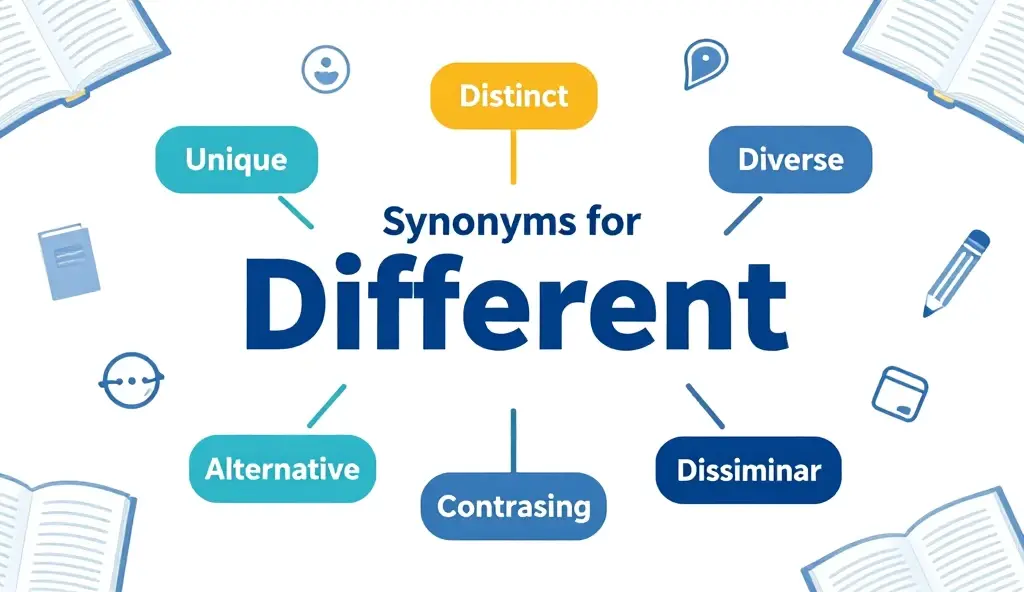
Synonyms for different include distinct, diverse, varied, unlike, dissimilar, separate, other, alternative, unusual, unique, contrasting, and changed. The best choice depends on what you mean. Use distinct for something clearly separate, diverse for a group with many kinds, unlike for a direct comparison, and unusual for something outside the norm.
The word different is useful, simple, and common. Still, it may not always express your exact idea. A new word can show whether two things are separate, opposite, unusual, varied, or simply not the same.
This guide explains the meaning of different, its pronunciation, grammar, synonyms, antonyms, phrases, collocations, and real-life uses. It also helps you choose the right replacement without making your writing sound forced.
What Does Different Mean?
Different means not the same as another person, thing, idea, place, experience, or condition.
You can use it when two or more things do not match in some way.
For example:
- My answer is different from yours.
- We chose different colors.
- Life feels different after moving.
- Each child learns in a different way.
The difference may be small or large. Two shirts can be different only in color. Two plans may be different in cost, purpose, and method.
The word can also describe something new or unusual:
- Let’s try something different tonight.
- Her style is fresh and different.
- This year’s event felt different.
In these examples, different does not only mean “not the same.” It suggests a change from what is normal, expected, or familiar.
Merriam-Webster groups different, diverse, divergent, disparate, and various around the idea of being unlike in kind or character. However, each word adds its own shade of meaning.
Definition of Different
The simplest definition of different is:
Not the same as someone or something else.
It may also mean:
- Separate from another thing
- Changed from an earlier state
- Unusual or unexpected
- Belonging to another type
- Having a separate identity
- Showing a clear contrast
Consider these examples:
Not the same:
The two phones look alike, but their features are different.
Separate:
The twins attend different schools.
Changed:
You seem different today.
Unusual:
That’s a different way to solve the problem.
Another type:
We sell five different kinds of bread.
Context decides which meaning is intended. That is why a synonym must match the sentence, not just the dictionary entry.
For instance, diverse works well for a group containing many kinds. It does not work as naturally when you simply mean that one shoe is not the same size as another.
How to Pronounce Different
The American English pronunciation of different is:
/ˈdɪf.ɚ.ənt/
A simple sound guide is:
DIF-er-uhnt
The stress falls on the first part:
DIF-er-uhnt
Cambridge gives the American pronunciation as /ˈdɪf.ɚ.ənt/ and the British pronunciation as /ˈdɪf.ər.ənt/.
Say it in three light parts:
- Dif — sounds like the start of “difficult.”
- Er — a soft middle sound.
- Ent — a quick final sound.
In fast daily speech, some people make the middle very short. The word may sound close to:
DIF-rent
That natural shortening is common in conversation. Still, learners should first practice the clearer three-part form.
Try these phrases slowly:
- a different idea
- something different
- completely different
- different from mine
- many different ways
Then say them at a normal speaking speed.
Part of Speech and Word Forms
Different is mainly an adjective.
An adjective describes a noun or gives more information about it.
Different Before a Noun
- We need a different plan.
- She wore different shoes.
- They have different goals.
- He asked a different question.
Here, different describes plan, shoes, goals, and question.
Different After a Linking Verb
- The room looks different.
- This soup tastes different.
- Her voice sounds different.
- The result was different.
In these examples, different follows linking verbs such as looks, tastes, sounds, and was.
Related Word Forms
| Word | Part of Speech | Meaning | Example |
| Different | Adjective | Not the same | We chose different routes. |
| Difference | Noun | A point or state of being unlike | I noticed a difference. |
| Differ | Verb | To be unlike | Our views differ. |
| Differently | Adverb | In another way | She handled it differently. |
| Differing | Adjective | Not matching | They shared differing views. |
| Differentiate | Verb | To recognize or create a difference | Children learn to differentiate colors. |
| Differentiation | Noun | The act of making or showing a distinction | Product differentiation helps brands stand out. |
Do not use different as an adverb.
Incorrect:
- She thinks different.
Standard formal English:
- She thinks differently.
However, phrases such as “Think Different” may appear in advertising because slogans often break normal grammar rules for effect.
Complete Synonyms for Different
The following table lists useful synonyms for different. No single word will fit every sentence.
| Word | Meaning | Best Usage | Formality | Example | Difficulty |
| Distinct | Clearly separate or noticeable | Categories, identities, features | Neutral–formal | The plan has three distinct stages. | Easy |
| Diverse | Containing many kinds | Groups, ideas, cultures | Neutral–formal | The city has a diverse population. | Medium |
| Varied | Showing many forms or types | Activities, diets, experiences | Neutral | The program offers varied lessons. | Easy |
| Various | Several different kinds | Reasons, options, items | Neutral | We discussed various solutions. | Easy |
| Unlike | Different from something compared | Direct comparisons | Neutral | Her new book is unlike the first. | Easy |
| Dissimilar | Not alike | Formal comparisons | Formal | The two systems are dissimilar. | Medium |
| Separate | Existing apart | Places, tasks, identities | Neutral | Keep the files in separate folders. | Easy |
| Other | Not this one; another | Choices and groups | Neutral | Do you have other ideas? | Easy |
| Alternative | Offering another choice | Plans, methods, routes | Neutral–formal | We found an alternative route. | Medium |
| Distinctive | Having a recognizable quality | Style, sound, design | Neutral–formal | The singer has a distinctive voice. | Medium |
| Unique | One of a kind or highly unusual | Special features and cases | Neutral | Each print has a unique pattern. | Easy |
| Unusual | Not common or expected | Events, behavior, designs | Neutral | We heard an unusual noise. | Easy |
| Uncommon | Not often found | Traits, names, events | Neutral–formal | That bird is uncommon here. | Medium |
| Contrasting | Showing a strong difference | Colors, opinions, styles | Neutral–formal | The room uses contrasting colors. | Medium |
| Divergent | Moving or developing apart | Views, paths, trends | Formal | The teams followed divergent strategies. | Hard |
| Disparate | So different that comparison is difficult | Data, groups, elements | Formal | The report joins disparate topics. | Hard |
| Opposing | Working against each other | Views, forces, teams | Neutral | The two sides hold opposing views. | Medium |
| Alternate | Used instead of another | Routes, members, schedules | Neutral | Take the alternate road. | Medium |
| Another | One more or a different one | Everyday choices | Informal–neutral | Let’s try another café. | Easy |
| Changed | No longer as before | People, places, conditions | Neutral | The town looks changed. | Easy |
| Modified | Altered in some way | Designs, documents, products | Formal | We tested a modified version. | Medium |
| Novel | New and original | Ideas, methods, research | Formal | They proposed a novel solution. | Medium |
| Peculiar | Strange or special to one thing | Behavior, features, habits | Neutral–formal | The room had a peculiar smell. | Medium |
| Strange | Unfamiliar or hard to explain | Events, feelings, behavior | Informal–neutral | I heard a strange sound. | Easy |
| Odd | Unusual or unexpected | Informal descriptions | Informal | That’s an odd question. | Easy |
| Separate | Not joined or shared | Accounts, rooms, issues | Neutral | They sleep in separate rooms. | Easy |
| Individual | Belonging to one person or item | Needs, choices, parts | Neutral–formal | Each student has individual needs. | Medium |
| Differing | Holding or showing separate forms | Views, rates, accounts | Formal | Experts gave differing opinions. | Medium |
| Distinguishable | Able to be recognized as different | Sounds, signs, objects | Formal | The marks are clearly distinguishable. | Hard |
| Nonidentical | Not exactly the same | Technical comparisons | Formal | The copies are nonidentical. | Hard |
Best Synonyms for Different and How to Use Them
Distinct
Distinct means clearly separate, recognizable, or different from something else.
Use it when the difference is easy to see, hear, understand, or classify.
- The story has three distinct parts.
- Each spice has a distinct smell.
- The two roles are distinct.
Difference from different:
Different is broad. Distinct stresses clear separation or a noticeable identity. Merriam-Webster explains that distinct describes something recognized by the eye or mind as separate from others.
Best situation:
Use distinct for categories, stages, sounds, flavors, identities, or features.
Common mistake:
Do not use distinct simply because something is good or impressive. “A distinct meal” does not normally mean “a great meal.”
Diverse
Diverse means made up of people, things, ideas, or forms that differ from one another.
- The school serves a diverse community.
- We heard a diverse range of opinions.
- The store carries diverse products.
Difference from different:
Different may compare only two things. Diverse usually points to variety within a larger group.
Best situation:
Use diverse for communities, teams, ecosystems, cultures, skills, ideas, or collections.
Common mistake:
Avoid using diverse when you only mean “many.” A box with 20 identical pencils is large, but it is not diverse.
Varied
Varied means containing several types, forms, or experiences.
- Her job is busy but varied.
- A varied diet supports better meal balance.
- The trip included varied activities.
Difference from different:
Varied highlights range and change. Different mainly shows that things are not the same.
Best situation:
Use varied for work, schedules, diets, programs, landscapes, activities, or experiences.
Common mistake:
Do not confuse varied with various. Varied often describes the quality of having variety. Various usually means several different ones.
Various
Various means several different people, things, types, or reasons.
- Various people offered to help.
- The delay happened for various reasons.
- The shop sells bags in various sizes.
Cambridge defines various around the idea of several or many different kinds.
Difference from different:
Different can describe two or more items. Various normally points to several items or types.
Best situation:
Use various when you do not need to name every item separately.
Common mistake:
Various is plural in meaning, so it normally appears before a plural noun: various reasons, not a various reason.
Unlike
Unlike means different from a person or thing being compared.
- Unlike his brother, Sam loves crowds.
- This fabric is unlike anything I’ve seen.
- The second test was unlike the first.
Cambridge lists “different from” as the main comparison meaning of unlike.
Difference from different:
Unlike creates a direct comparison. Different can stand alone.
Best situation:
Use unlike when placing two people, objects, or situations side by side.
Common mistake:
Make sure the comparison is logical. “Unlike the old office, the staff enjoy this one” incorrectly compares an office with staff. Better: “Unlike the old office, this one has more natural light.”
Dissimilar
Dissimilar means not similar or not alike.
- Their backgrounds are dissimilar.
- The samples appear dissimilar.
- The two methods produce dissimilar results.
Difference from different:
Dissimilar is more formal and often appears in careful comparisons, reports, or academic writing.
Best situation:
Use it when comparing data, methods, structures, systems, or characteristics.
Common mistake:
In simple conversation, dissimilar can sound stiff. “Our tastes are different” is more natural than “Our tastes are dissimilar.”
Separate
Separate means not joined, shared, connected, or considered together.
- The children sleep in separate rooms.
- Please send the forms in separate emails.
- These are two separate problems.
Difference from different:
Different focuses on lack of sameness. Separate focuses on lack of connection.
Two cups may be separate but identical. Two cups may also be different but placed together.
Best situation:
Use separate for rooms, accounts, files, tasks, events, identities, or topics.
Common mistake:
Do not assume separate always means unlike. Two separate copies can be exactly the same.
Other
Other refers to a person or thing that is additional, remaining, or not the one already named.
- Do you have any other questions?
- The other door is locked.
- Some students stayed; the others left.
Difference from different:
Other identifies another member or option. Different describes a contrast.
Compare:
- I need another shirt.
This means one more shirt. - I need a different shirt.
This means the current shirt is not suitable.
Best situation:
Use other for everyday choices, additional items, or remaining members of a group.
Common mistake:
Do not write “an other plan” in standard usage. Use another plan or a different plan.
Alternative
Alternative means available as another choice or possible course of action.
- We need an alternative plan.
- Walking is an alternative way to get there.
- The doctor discussed alternative treatments.
Difference from different:
Alternative does not merely mean unlike. It means something can replace or be chosen instead of another option.
Best situation:
Use alternative for plans, methods, routes, energy sources, solutions, or choices.
Common mistake:
Not every different thing is an alternative. A bicycle is different from a sandwich, but neither is an alternative to the other in most situations.
Distinctive
Distinctive means having a quality that makes something easy to recognize.
- The bird has a distinctive call.
- Her paintings have a distinctive style.
- The building has a distinctive roof.
Merriam-Webster describes distinctive as something that marks an item as separate or gives it a recognizable quality.
Difference from different:
Different only marks a lack of sameness. Distinctive points to a special identifying feature.
Best situation:
Use distinctive for voices, styles, designs, shapes, flavors, clothing, or branding.
Common mistake:
Distinctive is often positive or neutral, but it does not automatically mean beautiful.
Unique
Unique traditionally means one of a kind. It can also mean highly unusual or especially notable in common modern use.
- Every fingerprint has a unique pattern.
- The house has a unique shape.
- She faced a unique problem.
Merriam-Webster recognizes both the “only one of its kind” sense and the broader “unusual” sense.
Difference from different:
All unique things are different in some way, but not all different things are unique.
Best situation:
Use unique when a quality is rare, singular, or highly unusual.
Common mistake:
Do not use unique as an empty compliment. Explain what makes the thing unique whenever possible.
Unusual
Unusual means not common, normal, or expected.
- We had unusually warm weather.
- She asked an unusual question.
- The cat has an unusual habit.
Difference from different:
Different only shows contrast. Unusual shows that something stands outside a common pattern.
Best situation:
Use unusual for weather, behavior, events, designs, sounds, symptoms, or experiences.
Common mistake:
Unusual does not always mean bad. An unusual idea may be clever and useful.
Contrasting
Contrasting means showing a strong or clear difference when placed together.
- She used contrasting colors.
- The speakers shared contrasting opinions.
- The twins have contrasting personalities.
Difference from different:
Contrasting emphasizes visible or meaningful opposition.
Best situation:
Use it for colors, styles, views, moods, textures, characters, or results.
Common mistake:
Do not use contrasting when the difference is tiny or unimportant.
Divergent
Divergent means moving, developing, or thinking in different directions.
- The two groups followed divergent paths.
- Researchers reached divergent conclusions.
- Their interests became increasingly divergent.
Difference from different:
Divergent suggests that things began near each other and then moved apart, either literally or figuratively.
Best situation:
Use it for views, trends, paths, strategies, conclusions, or development.
Common mistake:
It is formal. In daily speech, “very different views” may sound more natural.
Disparate
Disparate describes things that are so unlike that they may seem difficult to compare or combine.
- The course brings together disparate subjects.
- The team united people from disparate backgrounds.
- The report draws on disparate data sources.
The word carries a stronger sense of separation than the general word different. Its history is tied to ideas of dividing or setting apart.
Best situation:
Use disparate in formal writing about groups, fields, data, systems, or ideas.
Common mistake:
Do not use disparate when you only mean “several.” The items must be notably unlike.
Synonyms for Different by Meaning
Choosing another word for different becomes easier when you first identify the intended meaning.
When You Mean “Not the Same”
Use:
- Unlike
- Dissimilar
- Distinct
- Nonidentical
- Unalike
Example:
- The two plans are different.
- The two plans are dissimilar.
- The two plans are not identical.
When You Mean “Many Kinds”
Use:
- Diverse
- Varied
- Various
- Mixed
- Wide-ranging
Example:
- The course includes different topics.
- The course includes varied topics.
- The course covers a diverse range of topics.
When You Mean “Another Choice”
Use:
- Alternative
- Other
- Another
- Substitute
- Alternate
Example:
- We need a different route.
- We need an alternative route.
- We should take another route.
When You Mean “Unusual”
Use:
- Unique
- Unusual
- Odd
- Strange
- Peculiar
- Uncommon
- Novel
Example:
- She has a different style.
- She has a distinctive style.
- She has an unusual style.
When You Mean “Clearly Separate”
Use:
- Distinct
- Separate
- Individual
- Independent
- Discrete
Example:
- The program has four different stages.
- The program has four distinct stages.
- The program is divided into four separate stages.
When You Mean “Changed”
Use:
- Altered
- Modified
- Revised
- Changed
- New
- Updated
Example:
- The final version looks different.
- The final version has been modified.
- The revised version has a new layout.
When You Mean “Opposite or Strongly Contrasting”
Use:
- Opposing
- Contrasting
- Contrary
- Divergent
- Conflicting
Example:
- They have different views.
- They have opposing views.
- They reached conflicting conclusions.
Antonyms of Different
Antonyms of different include words that express sameness, likeness, agreement, or consistency.
| Antonym | Meaning | Best Usage | Example |
| Same | Exactly one or not different | General use | We chose the same color. |
| Similar | Alike in important ways | Comparisons | Our jackets are similar. |
| Identical | Exactly alike | Exact matching | The two copies are identical. |
| Alike | Similar in appearance or nature | People and things | The sisters look alike. |
| Matching | Designed or chosen to go together | Clothing and objects | She wore matching shoes. |
| Equal | The same in value, size, amount, or status | Math and comparison | The two shares are equal. |
| Equivalent | Equal in meaning, purpose, value, or effect | Formal comparisons | The two qualifications are equivalent. |
| Uniform | Staying the same throughout | Standards and appearance | The tiles have a uniform size. |
| Consistent | Remaining steady or in agreement | Quality and behavior | His work is consistent. |
| Comparable | Similar enough to compare | Products and results | The two models have comparable features. |
| Related | Connected by subject, type, or origin | Ideas and people | The two issues are related. |
| Common | Shared by several people or things | Features and traits | They share a common goal. |
| Like | Similar to | Everyday comparison | This tastes like lemon. |
| Parallel | Similar in structure or development | Ideas and events | The stories follow parallel paths. |
| Unchanged | Remaining as before | Conditions and versions | The price stayed unchanged. |
Same
Same means not different.
- We arrived at the same time.
- They chose the same answer.
- I still live in the same house.
Use same when the identity, choice, time, or quality matches.
Similar
Similar means alike but not always exact.
- The bags are similar, but one is larger.
- We have similar goals.
- Their voices sound similar.
Merriam-Webster notes that similar things resemble each other closely, sometimes enough to be confused.
Identical
Identical means exactly the same in the relevant details.
- The twins wore identical coats.
- The files are identical.
- Both rooms have identical layouts.
Use identical only when the match is exact or nearly exact.
Alike
Alike usually comes after a verb.
- The children look alike.
- These two recipes taste alike.
- We think alike.
Do not normally place alike directly before a noun. Say similar ideas, not alike ideas.
Equal
Equal means the same in amount, value, level, status, or measurement.
- Divide the cake into equal parts.
- All members have equal rights.
- The scores were equal.
Equal does not always mean identical. Two products can have equal prices but different features.
Equivalent
Equivalent means equal in value, meaning, function, or effect.
- One hour is equivalent to 60 minutes.
- The two certificates are considered equivalent.
- This phrase has no exact English equivalent.
Equivalent is common in academic, legal, technical, and business writing.
Uniform
Uniform means consistent in form, appearance, or quality.
- The boxes are uniform in size.
- Apply a uniform layer of paint.
- The company follows uniform standards.
It is the opposite of varied rather than the opposite of every sense of different.
Different, Distinct, Diverse, and Unique Compared
These words are related, but they do not carry the same meaning.
| Word | Core Meaning | Main Focus | Example |
| Different | Not the same | General contrast | The two plans are different. |
| Distinct | Clearly separate or recognizable | Clear identity | The bird has a distinct call. |
| Diverse | Containing many unlike kinds | Variety in a group | The team has diverse skills. |
| Unique | One of a kind or highly unusual | Singularity | The design has a unique shape. |
| Distinctive | Easy to recognize by a special feature | Identifying quality | She has a distinctive voice. |
| Varied | Containing several forms or experiences | Range | He enjoys a varied routine. |
Different vs. Distinct
Use different for a general lack of sameness.
Use distinct when the separation is clear or meaningful.
- The two ideas are different.
- The theory contains two distinct ideas.
The second sentence suggests that each idea has its own clear identity.
Different vs. Diverse
Use different to compare items.
Use diverse to describe a group containing variety.
- The students gave different answers.
- The class includes students from diverse backgrounds.
Different vs. Unique
Use different when something does not match another thing.
Use unique when it is one of a kind or highly unusual.
- This chair is different from that chair.
- This handmade chair has a unique design.
Different vs. Distinctive
Use distinctive when a feature helps people recognize something.
- Her accent is different from mine.
- Her voice has a distinctive tone.
Different vs. Varied
Use varied when many forms, activities, or types are present.
- We tried different foods.
- The menu is varied.
The first sentence focuses on separate foods. The second focuses on the menu’s overall range.
Different, Other, Another, and Alternative
These four words often confuse English learners.
| Word | Meaning | Example |
| Different | Not the same | I need a different size. |
| Other | Additional or remaining | What other sizes do you have? |
| Another | One more or a different one | Can I try another size? |
| Alternative | A possible replacement or choice | We need an alternative option. |
Different
Use different when the current item does not meet your needs.
- This color is too dark. Show me a different one.
- That plan failed, so we need a different approach.
Other
Use other when asking about additional people or things.
- What other books did she write?
- Are there any other questions?
- Some rooms are full, but the other rooms are open.
Another
Use another before a singular countable noun.
- Can I have another cup?
- Let’s choose another date.
- She found another job.
Another may mean “one more” or “a different one.” Context makes the meaning clear.
Alternative
Use alternative when one thing can replace another.
- We need an alternative source of power.
- The bridge is closed, so take an alternative route.
- Is there a cheaper alternative?
A useful alternative must serve a similar purpose. It is not simply any unrelated item.
Formal and Informal Synonyms for Different
Some alternative words for different sound natural in casual talk. Others fit reports, essays, research papers, or business documents.
Informal and Everyday Words
| Word | Typical Use | Example |
| Other | Additional choices | Let’s try the other café. |
| Another | One more choice | Pick another song. |
| Odd | Something unexpected | That’s an odd smell. |
| Strange | Something unfamiliar | I had a strange dream. |
| New | A changed choice | We need a new plan. |
| Unlike | Direct comparison | He’s unlike his brother. |
| Changed | No longer the same | You’ve changed. |
| Mixed | More than one kind | We had mixed results. |
Neutral Words
| Word | Typical Use | Example |
| Different | General use | We have different views. |
| Separate | Not connected | Use separate folders. |
| Varied | Showing range | She has varied interests. |
| Various | Several kinds | We tested various methods. |
| Unusual | Not common | That is unusual behavior. |
| Distinct | Clearly separate | There are two distinct groups. |
| Alternative | Another option | Try an alternative route. |
Formal and Academic Words
| Word | Typical Use | Example |
| Dissimilar | Careful comparison | The samples were dissimilar. |
| Divergent | Developing apart | The studies reached divergent results. |
| Disparate | Very unlike | We combined disparate data sets. |
| Nonidentical | Not exactly matching | The structures are nonidentical. |
| Differing | Separate opinions or values | Participants reported differing views. |
| Distinguishable | Able to be told apart | The signals were distinguishable. |
| Contrasting | Showing clear opposition | The groups gave contrasting accounts. |
| Heterogeneous | Made of unlike parts | The study used a heterogeneous sample. |
In normal speech, choose the simplest word that expresses your point. In formal writing, use a more exact term only when its added meaning matters.
Academic Usage of Different and Its Synonyms
Academic writing values precision. The word different is acceptable, but a more exact term may explain the relationship between the items being studied.
Use Different for a General Comparison
- The two groups produced different results.
- Participants followed different schedules.
- The studies used different measures.
These sentences are clear, but they do not explain how large or meaningful the differences were.
Use Significantly Different Carefully
In research writing, significantly different may have a statistical meaning. Do not use it only to mean “very different” when discussing statistical results.
Better everyday wording:
- The results were noticeably different.
- The groups showed a large difference.
Statistical wording:
- The difference was statistically significant.
Use Dissimilar for Lack of Resemblance
- The samples had dissimilar chemical profiles.
- The two models rely on dissimilar assumptions.
- Participants came from dissimilar settings.
Use Distinct for Clear Categories
- The responses formed three distinct groups.
- The study examined two distinct processes.
- Each stage serves a distinct function.
Use Diverse for Variety Within a Group
- The sample included participants from diverse backgrounds.
- The team used a diverse set of sources.
- The survey captured diverse viewpoints.
Use Divergent for Movement Apart
- The studies produced divergent conclusions.
- The two regions followed divergent growth patterns.
- Scholars hold divergent views on the issue.
Use Disparate for Strongly Unlike Sources or Elements
- The review combined evidence from disparate fields.
- The system joins disparate data sources.
- These disparate findings require separate analysis.
Use Varied for Range
- Participants reported varied experiences.
- The articles used varied research methods.
- The program produced varied outcomes.
Use Contrasting for Clear Opposition
- The authors offered contrasting explanations.
- The groups showed contrasting behavior.
- The case studies produced contrasting results.
Academic words should make the idea clearer, not merely sound more advanced.
Daily Conversation Examples
In daily speech, different is often the most natural choice.
- I want something different for lunch.
- Your hair looks different.
- We took a different road home.
- My family does things differently.
- This coffee tastes different today.
- They live in different cities.
- Can we talk about something else?
- Let’s try another place.
- Her style is unlike mine.
- That’s an unusual name.
- We need a new plan.
- These shoes don’t match.
- The twins act very differently.
- Pick a separate box for the glass.
- He gave me a strange look.
At a Store
Customer: Do you have this in a different color?
Worker: Yes, we also have blue, green, and black.
Customer: Can I try another size?
Worker: Of course. I’ll bring you a larger one.
At Work
Manager: This method is taking too long.
Employee: We could try an alternative process.
Manager: How is it different?
Employee: It uses fewer steps and needs less manual work.
At School
Student: My answer is different from yours.
Friend: That’s okay. Let’s check both methods.
At Home
Parent: We’ve eaten pasta twice this week.
Child: Can we have something different tonight?
Simple words usually sound best in casual conversation. Use formal synonyms only when they add useful meaning.
Grammar Rules for Different
Different From
Different from is the safest and most widely accepted form in formal American English.
- My opinion is different from yours.
- This year is different from last year.
- The final design is different from the draft.
Different Than
Different than is common in American English, especially before a full clause.
- The event was different than I expected.
- Life here is different than it was before.
- The results were different than we had predicted.
You can often rewrite these with from:
- The event was different from what I expected.
- Life here is different from how it was before.
Different To
Different to appears more often in British English.
- This version is different to the original.
For a broad American audience, different from is usually the clearest choice.
Different From Each Other
Use this phrase for two or more people or things.
- The sisters are different from each other.
- These plans are very different from each other.
- The samples differ from one another.
A Different vs. Different
Use a different before one singular countable noun:
- a different answer
- a different city
- a different reason
Use different without an article before plural or uncountable nouns:
- different answers
- different cities
- different advice
Incorrect:
- a different advice
Correct:
- different advice
- a different piece of advice
Very Different
Very different is correct and natural.
- The new office is very different.
- Our personalities are very different.
Other common intensifiers include:
- completely different
- totally different
- quite different
- slightly different
- noticeably different
- fundamentally different
- entirely different
Differently
Use differently to describe an action.
- She speaks differently.
- We handled the problem differently.
- Try looking at it differently.
Differ vs. Be Different
Both forms can express lack of sameness.
- Their opinions differ.
- Their opinions are different.
Differ often sounds slightly more formal.
Common Collocations With Different
A collocation is a group of words that commonly appear together.
Completely Different
Meaning: not alike in a major way.
- The second book is completely different from the first.
- We grew up in completely different homes.
Totally Different
Meaning: completely unlike; common in conversation.
- That’s a totally different issue.
- The real story was totally different.
Very Different
Meaning: showing a strong difference.
- Their working styles are very different.
- The town looks very different now.
Quite Different
Meaning: noticeably or fairly different.
- The two jobs are quite different.
- Her answer was quite different from mine.
Slightly Different
Meaning: showing a small difference.
- The colors are slightly different.
- This version has a slightly different shape.
Fundamentally Different
Meaning: different at the most basic level.
- The two systems are fundamentally different.
- They hold fundamentally different beliefs.
Entirely Different
Meaning: different in every major way.
- We faced an entirely different problem.
- The final result was entirely different.
Noticeably Different
Meaning: different enough to be easily observed.
- The room feels noticeably different.
- His voice sounded noticeably different.
Different Approach
Meaning: another method of handling something.
- Let’s take a different approach.
- The teacher tried a different approach to reading.
Different Perspective
Meaning: another way of seeing an issue.
- She offered a different perspective.
- Travel can give you a different perspective.
Different Background
Meaning: another personal, social, educational, or cultural history.
- The team includes people from different backgrounds.
- We came from very different backgrounds.
Different Reason
Meaning: a separate cause or purpose.
- Each person left for a different reason.
- I called for a different reason.
Different Kind
Meaning: another type.
- This is a different kind of problem.
- She wanted a different kind of job.
Different Way
Meaning: another method or manner.
- Let me explain it in a different way.
- Every child learns in a different way.
Different Opinion
Meaning: a view that does not match another.
- I have a different opinion.
- It’s fine to hold different opinions.
Different Story
Meaning: another account or a changed situation.
- He told the police a different story.
- With more funding, it would be a different story.
Common Phrases Using Different
Something Different
This means something new, changed, or unlike the usual choice.
- Let’s cook something different.
- I’m ready to try something different.
A Different Story
This phrase means that another situation would produce another result.
- The small room is affordable, but the larger one is a different story.
- With expert help, the outcome may be a different story.
A Different Matter
This means a separate issue that should be considered on its own.
- Choosing a color is easy. Setting the budget is a different matter.
Sing a Different Tune
This idiom means to change your opinion, attitude, or manner of speaking.
- He disliked the plan at first, but he sang a different tune after seeing the results.
A Horse of a Different Color
This phrase means a separate or very different issue.
- Fixing the typo is easy. Rewriting the whole report is a horse of a different color.
The expression is informal and slightly old-fashioned, but many readers still understand it.
Different Strokes for Different Folks
This means that people have different tastes and preferences.
- I don’t enjoy camping, but different strokes for different folks.
It is friendly and informal.
Same Difference
People say same difference when two options seem different but lead to the same result.
- We can leave at six or ten past six. Same difference.
This phrase is informal and sometimes humorous.
Make a Difference
This means to create an effect or improve a situation.
- A kind word can make a difference.
- Small changes make a big difference.
Here, difference is a noun rather than the adjective different.
Tell the Difference
This means to recognize how two things are not the same.
- Can you tell the difference between the copies?
- I can’t tell the difference by taste.
Agree to Disagree
This means accepting that people hold different opinions without continuing an argument.
- We couldn’t settle the issue, so we agreed to disagree.
30 Real-World Examples of Different and Its Synonyms
- The new apartment is smaller but brighter than the old one.
- Each team member brings a distinct skill to the project.
- The restaurant serves a diverse mix of regional dishes.
- Our vacation included varied activities, from hiking to museum visits.
- Unlike her sister, Mia enjoys speaking in public.
- The two software systems have dissimilar security features.
- Keep raw meat and vegetables on separate cutting boards.
- We need an alternative meeting date because Monday is a holiday.
- The singer’s distinctive voice is easy to recognize.
- The artist creates unique patterns by hand.
- An unusual bird appeared in our yard this morning.
- The speakers presented contrasting views on remote work.
- The companies adopted divergent growth strategies.
- The book connects disparate ideas from science, history, and art.
- We tried various ways to repair the door.
- Every child may need an individual learning plan.
- The two medicine bottles look alike but contain different products.
- My phone screen appears slightly different after the update.
- The hotel offered another room when we reported the noise.
- We took the alternate route to avoid traffic.
- Their accounts of the accident were noticeably different.
- The designer submitted a modified version of the logo.
- The professor proposed a novel way to test the theory.
- The soup had a peculiar sweet flavor.
- His behavior seemed strange after the meeting.
- The survey gathered differing opinions from 500 customers.
- The two sound signals became distinguishable through headphones.
- The final document and the saved copy were nonidentical.
- The town looked completely changed after the storm.
- The new schedule gives workers a more varied week.
25 Natural Sentences Using Different
- I expected the room to look different in daylight.
- We may disagree, but I respect your different point of view.
- Every family has a different way of celebrating.
- Her answer was different from what the teacher expected.
- The same word can carry different meanings in different settings.
- I’m looking for a different job, not just a higher salary.
- The twins wear different colors so their teachers can tell them apart.
- This problem needs a completely different approach.
- People react differently when they feel under pressure.
- The second interview felt very different from the first.
- We visited three different stores before finding the right chair.
- Can you explain the rule in a different way?
- His real reason for leaving was quite different.
- The two proposals are different in cost but similar in purpose.
- Moving to a new city gave her a different view of life.
- I thought the film would be funny, but it was something very different.
- The updated app looks slightly different on my phone.
- Each department follows a different approval process.
- Your experience may be different from mine.
- The final painting turned out entirely different from the sketch.
- We chose different meals and shared both.
- It’s okay to be different when your choices are thoughtful and kind.
- The weather feels noticeably different near the coast.
- They reached the same goal through different methods.
- Tomorrow may look different once we have all the facts.
Common Mistakes to Avoid
Using Unique When You Only Mean Different
Weak:
- We sell five unique sizes.
Better:
- We sell five different sizes.
Use unique only when each size has an unusual or one-of-a-kind quality.
Using Diverse for Two Simple Items
Awkward:
- These two cups are diverse.
Natural:
- These two cups are different.
Diverse usually describes a group with several kinds, qualities, backgrounds, or forms.
Confusing Different With Separate
- The files are separate.
This means they are stored or treated apart.
- The files are different.
This means their contents or features do not match.
Using Another With Plural Nouns
Incorrect:
- another shoes
- another ideas
Correct:
- another pair of shoes
- other shoes
- another idea
- other ideas
Using Different Instead of Differently
Incorrect in standard formal writing:
- He speaks different now.
Correct:
- He speaks differently now.
- His speech sounds different now.
Using Disparate as a Fancy Replacement
Awkward:
- I bought two disparate shirts.
Better:
- I bought two different shirts.
Use disparate only when the things are strongly unlike or belong to notably separate categories.
Saying More Different Without a Clear Comparison
Possible but often awkward:
- This version is more different.
Clearer:
- This version differs more from the original.
- This version is much more distinct.
- This version has more changes.
Repeating Different Too Often
Repetitive:
- Different students use different methods for different tasks.
Improved:
- Students use a range of methods depending on the task.
A synonym can improve flow, but it must preserve the intended meaning.
Expert Tips for Choosing the Right Synonym
Identify the Type of Difference
Ask what kind of difference you are describing:
- A clear separation? Use distinct.
- Many kinds in one group? Use diverse.
- A direct comparison? Use unlike.
- Another choice? Use alternative.
- Something rare? Use unique or unusual.
- Strong opposition? Use contrasting or opposing.
- Formal lack of similarity? Use dissimilar.
Check Whether the Word Adds Meaning
A longer or more formal synonym is not always better.
“Different ideas” may be more natural than “disparate conceptual positions.” Choose the second only when the ideas truly come from unrelated areas or are difficult to combine.
Read the Full Sentence Aloud
A synonym may be correct but still sound stiff.
Formal:
- The samples displayed dissimilar properties.
Natural conversation:
- The samples were different.
Reading aloud helps you hear whether the tone fits the situation.
Keep Comparisons Balanced
When using unlike, compare the same kind of thing.
Unclear:
- Unlike the first report, the team wrote this one carefully.
Better:
- Unlike the first report, this report includes verified data.
Or:
- Unlike the first team, this team checked every source.
Choose Strong Words Carefully
Words such as opposing, conflicting, disparate, and fundamentally different make strong claims. Use them only when the evidence supports that strength.
Avoid Empty Variety
Replacing every use of different with a new synonym may make the text less clear. Natural writing often repeats a simple word when it is the most accurate choice.
Match the Reader’s Knowledge
Use easy words for a general audience:
- different
- other
- unlike
- separate
- unusual
Use advanced words when readers need precision:
- divergent
- disparate
- nonidentical
- heterogeneous
- distinguishable
Explain What Is Different
Weak:
- The new model is different.
Stronger:
- The new model is lighter, quieter, and easier to repair.
Specific details help readers understand the real difference.
Frequently Asked Questions About Synonyms for Different
What Is Another Word for Different?
Another word for different may be distinct, unlike, separate, varied, diverse, unusual, other, or alternative. The right choice depends on context. Use distinct for a clear separation, unlike for a direct comparison, diverse for a group containing many kinds, and alternative for another possible choice. In everyday writing, different is often still the clearest word.
What Is the Best Synonym for Different?
There is no single best synonym because different has several meanings. Distinct is often best when things have separate identities. Diverse fits groups with many kinds. Unlike works in comparisons. Alternative means another available choice. Unusual suggests that something is outside the norm. Choose the word that explains the exact relationship.
Is Unique a Synonym for Different?
Unique can be a synonym for different when something is one of a kind or highly unusual. However, the words are not fully interchangeable. Two shirts can be different because they have different colors, but neither shirt may be unique. Use unique when a person, object, feature, or situation has no close match or stands out strongly.
What Is a Formal Word for Different?
Formal alternatives include dissimilar, distinct, divergent, disparate, nonidentical, contrasting, and differing. Dissimilar is useful for careful comparisons. Divergent describes views or paths that move apart. Disparate describes elements that are strongly unlike. Distinct identifies clear categories. Choose based on meaning rather than selecting the most complex word.
What Is an Informal Word for Different?
Informal choices include other, another, odd, strange, new, changed, and not the same. For example, you might say, “Let’s try another place,” “That’s a strange idea,” or “This tastes different.” In casual speech, simple wording usually sounds more natural than formal terms such as dissimilar or disparate.
What Is a Positive Synonym for Different?
Positive synonyms include unique, distinctive, original, fresh, innovative, uncommon, special, and novel. Each one adds a positive idea beyond simple difference. Distinctive suggests a recognizable quality. Original suggests independent creation. Innovative suggests a useful new method. Special suggests personal or emotional value. Use these words only when the positive meaning is truly intended.
What Is a Negative Synonym for Different?
Depending on context, negative alternatives may include odd, strange, abnormal, inconsistent, conflicting, irregular, or peculiar. These words do more than show a difference. They may suggest discomfort, lack of order, or departure from expectations. Be careful when describing people, cultures, or personal traits, since the wording may sound judgmental.
What Is the Difference Between Different and Distinct?
Different means not the same. Distinct means clearly separate, recognizable, or divided into its own category. Two opinions may be different because they do not match. They are distinct when each opinion has a clear identity or position. Distinct often sounds more precise in academic, technical, and business writing.
What Is the Difference Between Different and Diverse?
Different compares people or things that are not the same. Diverse describes a group that contains a meaningful range of types, backgrounds, ideas, or features. You may have two different books, but a diverse library contains books from many subjects, writers, cultures, or styles. Diverse therefore stresses variety within a group.
What Is the Difference Between Different and Various?
Different means not the same. Various means several different kinds or examples. You can say, “The two plans are different,” because you are comparing them. You can say, “We considered various plans,” when several plans were reviewed. Various normally appears before a plural noun and draws attention to number and variety.
Should I Say Different From or Different Than?
Different from is the safest choice in formal American English: “This version is different from the first.” Different than is also common in American speech, especially before a clause: “It was different than I expected.” You can often rewrite that sentence as “It was different from what I expected” for a more traditional structure.
Is Dissimilar the Same as Different?
Dissimilar and different are close in meaning, but dissimilar is more formal and focuses on a lack of resemblance. “The systems are different” is broad and natural. “The systems are dissimilar” sounds more analytical and may suggest that their structures or qualities do not closely match. Different remains better for most everyday situations.
Can Different Mean Unusual?
Yes. Different can describe something that is unusual, fresh, or outside the normal pattern. For example, “That restaurant is different” may suggest that its food, design, or service is unusual. However, the meaning can be unclear without details. Words such as unusual, distinctive, original, or unconventional may express the idea more precisely.
What Synonym for Different Works in Academic Writing?
Useful academic choices include distinct, dissimilar, varied, diverse, divergent, contrasting, disparate, and differing. Use distinct for separate categories, diverse for variety within a sample, divergent for conclusions that move apart, and dissimilar for items that do not resemble one another. The best term depends on the relationship shown by the evidence.
What Is the Opposite of Different?
The most direct opposite of different is same. Other antonyms include similar, identical, alike, matching, equivalent, equal, uniform, and consistent. Same means not different. Similar means alike in important ways but not necessarily exact. Identical means exactly alike. Equal refers mainly to matching value, size, amount, or status.
How Can I Avoid Repeating Different in Writing?
First, explain the exact type of difference. Replace different with distinct for clear categories, varied for a broad range, unlike for direct comparison, alternative for another option, or unusual for something uncommon. You can also rewrite the sentence with details. Instead of “The models are different,” write, “The second model is lighter and faster.”
Conclusion:
The most useful synonyms for different are distinct, diverse, varied, various, unlike, dissimilar, separate, other, alternative, distinctive, unique, unusual, contrasting, divergent, and disparate.
The right word depends on the idea behind the difference.
Use distinct when things have clear identities. Choose diverse when a group contains many kinds. Use varied for a broad range, unlike for direct comparison, and alternative for another available choice. Choose unique or unusual when something stands outside the normal pattern.
Strong writing does not replace simple words merely to sound advanced. It uses the most accurate word for the situation. When different already expresses the point clearly, keep it. When the sentence needs more detail, choose a synonym that tells readers exactly how the people, things, ideas, or experiences differ.

Megan Stewart is dedicated to producing reliable English language resources that support vocabulary growth and better writing habits.