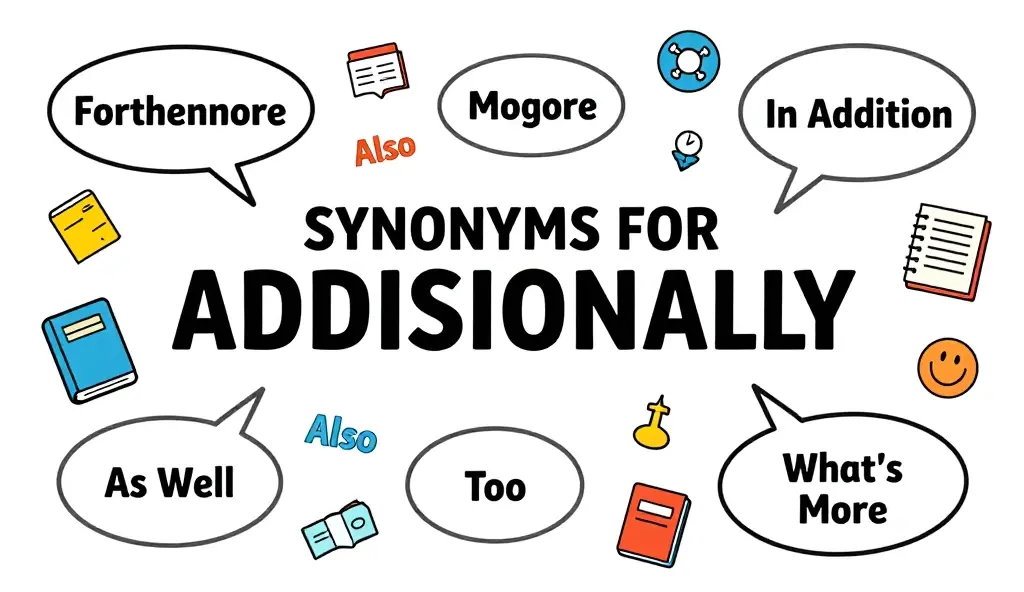
Looking for the best synonyms for additionally? Some of the most effective alternatives include furthermore, moreover, also, besides, in addition, as well, too, what’s more, plus, and on top of that.
These words and phrases help connect ideas, add information, and make your writing more natural.
Choosing the right synonym depends on your sentence, writing style, and level of formality.
What Does “Additionally” Mean?
The word additionally is an adverb used to introduce extra information or another supporting point. It tells the reader or listener that something more is being added to what has already been said.
People search for synonyms for additionally because they want to:
- Avoid repeating the same transition word
- Improve essays and reports
- Write more naturally
- Make blog posts easier to read
- Expand their English vocabulary
- Use different linking words in formal and informal writing
For example:
- The software is easy to use. Additionally, it’s affordable.
- The software is easy to use. Furthermore, it’s affordable.
- The software is easy to use. Moreover, it’s affordable.
Each sentence adds another idea while maintaining a smooth flow.
Meaning of Additionally
Definition
Additionally means:
- In addition
- Also
- Besides
- As another point
- Furthermore
- Moreover
It is commonly used to connect related ideas in writing and speech.
Examples
- Additionally, the course includes free resources.
- The hotel is affordable. Additionally, it’s close to the airport.
- She speaks English well. Additionally, she knows French.
- Additionally, customers receive free shipping.
- The update fixed several bugs. Additionally, it improved performance.
Pronunciation
Phonetic Pronunciation (American English)
additionally
/əˈdɪʃ.ə.nəl.i/
How to Pronounce It Naturally
Break it into five parts:
uh – DISH – uh – nuh – lee
The main stress falls on DISH.
Practice naturally:
“Additionally, we’d like to thank everyone for their support.”
Say it smoothly without pausing between the syllables.
Part of Speech
Additionally is an adverb.
It modifies a sentence by introducing extra information or another supporting idea.
Examples
- Additionally, we reduced costs.
- Additionally, the package includes a warranty.
- Additionally, students receive online support.
Synonyms for Additionally
| Word/Phrase | Meaning | Usage | Formality | Example | Difficulty |
| furthermore | adds another important point | Academic | Formal | Furthermore, the study confirmed the results. | Medium |
| moreover | in addition to that | Professional | Formal | Moreover, the service is affordable. | Medium |
| also | in addition | Everyday | Neutral | She also enjoys reading. | Easy |
| besides | in addition to | Daily | Neutral | Besides, we have enough time. | Easy |
| in addition | as another point | Business | Formal | In addition, customers receive support. | Easy |
| as well | also | Conversation | Informal | She speaks Spanish as well. | Easy |
| too | also | Everyday | Informal | I’d like one too. | Easy |
| what’s more | introducing extra information | Conversation | Informal | What’s more, it’s free. | Medium |
| plus | added benefit | Casual | Informal | Plus, it’s easy to install. | Easy |
| on top of that | another added point | Conversation | Informal | On top of that, delivery is free. | Medium |
| equally important | another significant point | Academic | Formal | Equally important, safety improved. | Medium |
| further | to continue adding information | Formal | Neutral | Further, several changes were made. | Medium |
| likewise | in a similar way | Academic | Formal | Likewise, other studies agree. | Medium |
| not only that | adds emphasis | Conversation | Informal | Not only that, it saves money. | Easy |
| along with that | together with another point | Daily | Informal | Along with that, you’ll receive updates. | Easy |
Best Synonyms for Additionally
Furthermore
Meaning
Furthermore introduces another important point that strengthens the previous statement.
Difference
While additionally simply adds information, furthermore often adds stronger supporting evidence.
Examples
- Furthermore, the new policy reduced costs.
- Furthermore, customer satisfaction increased.
- Furthermore, the product includes a lifetime warranty.
Best Situation
Use furthermore in:
- Academic writing
- Research papers
- Business reports
- Professional emails
- Formal essays
Common Mistake
Don’t overuse furthermore in casual conversations.
Less natural:
Furthermore, I’m going to the store.
Better:
Also, I’m going to the store.
Moreover
Meaning
Moreover means “in addition to that” and introduces another important fact.
Difference
It sounds slightly more formal than additionally and is often used in professional or academic writing.
Examples
- Moreover, the company increased profits.
- Moreover, the results exceeded expectations.
- Moreover, the software is easy to maintain.
Best Situation
Perfect for:
- Formal reports
- Business writing
- Academic essays
- Research articles
- Professional presentations
Common Mistake
Avoid using moreover repeatedly in the same paragraph. Alternate with furthermore, in addition, or also for better readability.
Also
Meaning
Also is the most common synonym for additionally. It simply means “in addition.”
Difference
Unlike additionally, also works naturally in both spoken and written English.
Examples
- She also speaks German.
- We also offer free shipping.
- He also enjoys hiking.
Best Situation
Use also in:
- Daily conversations
- Emails
- Articles
- Blog posts
- General writing
Common Mistake
Place also in the correct position within the sentence.
Correct:
- She also works on weekends.
Incorrect:
- She works also on weekends. (Less natural in American English.)
Besides
Meaning
Besides means “in addition to” or “apart from that.”
Difference
It often introduces another reason or supporting argument rather than simply adding information.
Examples
- Besides, we already have enough volunteers.
- Besides, it’s the most affordable option.
- Besides, the weather might change.
Best Situation
Use besides in:
- Conversations
- Opinion writing
- Informal emails
- Friendly discussions
Common Mistake
Don’t confuse besides with beside.
- Beside = next to something.
- Besides = in addition.
In Addition
Meaning
In addition is a formal phrase that introduces another piece of information.
Difference
Unlike also, in addition often appears at the beginning of a sentence to connect ideas smoothly.
Examples
- In addition, the company expanded internationally.
- In addition, students receive free study materials.
- In addition, all purchases include free returns.
Best Situation
Perfect for:
- Essays
- Business reports
- Professional emails
- Academic writing
- Government documents
Common Mistake
Use a comma after In addition when it starts a sentence.
Correct:
In addition, the software is easier to use.
As Well
Meaning
As well means “also” or “too.”
Difference
It usually appears at the end of a sentence, unlike also, which often appears before the main verb.
Examples
- She speaks French as well.
- We’d like to join as well.
- The package includes a charger as well.
Best Situation
Ideal for:
- Everyday conversations
- Friendly emails
- Informal writing
Common Mistake
Don’t place as well at the beginning of a sentence in most cases. It sounds more natural at the end.
Too
Meaning
Too is a simple, everyday synonym meaning “also.”
Difference
It is more conversational than additionally and works best in informal contexts.
Examples
- I’d like to come too.
- She enjoys reading too.
- We watched the movie too.
Best Situation
Use it in:
- Casual conversations
- Text messages
- Friendly emails
- Informal writing
Common Mistake
Avoid using too repeatedly in formal documents where additionally, moreover, or furthermore are more appropriate.
More Best Synonyms for Additionally
What’s More
Meaning
What’s more introduces another important fact that strengthens the previous statement.
Difference
Unlike additionally, what’s more sounds more conversational and often adds emphasis.
Examples
- What’s more, the service is completely free.
- What’s more, you’ll receive lifetime updates.
- The hotel is affordable. What’s more, it’s close to the beach.
Best Situation
Use what’s more in:
- Blog posts
- Friendly emails
- Conversations
- Opinion articles
- Informal presentations
Common Mistake
Avoid using what’s more in highly formal or academic papers. Use furthermore or moreover instead.
Plus
Meaning
Plus means “also” or “in addition.”
Difference
Plus is shorter and much more casual than additionally.
Examples
- Plus, shipping is free.
- The phone is fast. Plus, it’s affordable.
- Plus, you don’t need to sign up.
Best Situation
Perfect for:
- Casual conversations
- Marketing copy
- Blog posts
- Product descriptions
- Social media
Common Mistake
Don’t begin every sentence with plus in professional writing.
On Top of That
Meaning
On top of that introduces another benefit, reason, or piece of information.
Difference
It usually adds emphasis more than additionally.
Examples
- On top of that, customer support is available 24/7.
- She finished early. On top of that, she helped her teammates.
- The software is easy to use. On top of that, it’s inexpensive.
Best Situation
Use it in:
- Storytelling
- Conversations
- Blog posts
- Opinion writing
Common Mistake
Avoid overusing it in formal reports.
Likewise
Meaning
Likewise means “in the same way” or “similarly.”
Difference
Unlike additionally, likewise emphasizes similarity rather than simply adding information.
Examples
- Likewise, other researchers reached the same conclusion.
- Parents should participate. Likewise, teachers should stay involved.
- The first strategy worked well. Likewise, the second strategy proved effective.
Best Situation
Ideal for:
- Academic writing
- Research papers
- Formal reports
- Professional communication
Common Mistake
Don’t use likewise unless the second idea closely matches the first.
Further
Meaning
Further can introduce another supporting point.
Difference
It is shorter than furthermore and is mostly found in formal writing.
Examples
- Further, additional testing is required.
- Further, the company plans to expand internationally.
- Further, customer feedback was positive.
Best Situation
Use in:
- Legal writing
- Research
- Academic papers
- Professional reports
Common Mistake
In everyday conversation, also or besides usually sounds more natural.
Equally Important
Meaning
Equally important introduces another point that deserves the same level of attention.
Difference
Instead of simply adding information, it highlights equal significance.
Examples
- Equally important, customer satisfaction improved.
- Equally important, employee safety increased.
- Equally important, data security remained strong.
Best Situation
Perfect for:
- Business writing
- Essays
- Reports
- Presentations
Common Mistake
Use it only when both ideas deserve equal emphasis.
Not Only That
Meaning
Not only that introduces another surprising or helpful fact.
Difference
It is more conversational and expressive than additionally.
Examples
- Not only that, delivery is free.
- She finished first. Not only that, she broke the record.
- The course is affordable. Not only that, it’s beginner-friendly.
Best Situation
Use in:
- Blog posts
- Casual writing
- Friendly conversations
- Reviews
Common Mistake
Avoid repeating not only that too often because it can sound repetitive.
Along With That
Meaning
Along with that means “together with the previous point.”
Difference
It connects related ideas smoothly without sounding too formal.
Examples
- Along with that, you’ll receive free updates.
- Along with that, customers get priority support.
- We improved speed. Along with that, we reduced costs.
Best Situation
Best for:
- Articles
- Blog posts
- Everyday writing
- Emails
Common Mistake
Don’t use it when the second idea is unrelated to the first.
Antonyms for Additionally
Although additionally means adding more information, its opposites introduce contrast, limitation, or an alternative idea.
| Word/Phrase | Meaning | Common Usage | Formality | Example |
| however | introduces contrast | Everyday | Neutral | However, the results were different. |
| instead | introduces an alternative | Daily | Neutral | Instead, we stayed home. |
| nevertheless | despite that | Academic | Formal | Nevertheless, the project succeeded. |
| nonetheless | even so | Professional | Formal | Nonetheless, they continued working. |
| alternatively | offers another choice | Business | Formal | Alternatively, you can pay online. |
| conversely | shows the opposite idea | Academic | Formal | Conversely, sales declined overseas. |
| on the contrary | expresses the opposite | Formal | Formal | On the contrary, demand increased. |
| rather | instead of | Everyday | Neutral | I’d rather stay home. |
| yet | despite that | Writing | Neutral | The task was difficult, yet we finished. |
| but | introduces contrast | Everyday | Informal | She tried, but she failed. |
Understanding the Antonyms
However
Meaning
However introduces an idea that contrasts with the previous statement.
Examples
- The software is affordable. However, it lacks advanced features.
- He studied hard. However, he missed the exam.
- Sales increased. However, profits remained flat.
Tip: Use a comma after However when it begins a sentence.
Instead
Meaning
Instead introduces another option or replacement.
Examples
- We stayed home instead.
- Instead, try restarting the device.
- She chose tea instead of coffee.
Nevertheless
Meaning
Nevertheless means “despite that.”
Examples
- The weather was terrible. Nevertheless, the event continued.
- The task was difficult. Nevertheless, they finished it.
- Costs increased. Nevertheless, profits improved.
Nonetheless
Meaning
Nonetheless is very similar to nevertheless and is common in formal writing.
Examples
- The proposal had risks. Nonetheless, it was approved.
- The road was closed. Nonetheless, we found another route.
- She was tired. Nonetheless, she completed the project.
Alternatively
Meaning
Alternatively introduces another possible choice or solution.
Examples
- Alternatively, you can download the PDF.
- We could drive. Alternatively, we could take the train.
- Alternatively, contact customer support.
Conversely
Meaning
Conversely introduces the opposite viewpoint or result.
Examples
- Urban populations increased. Conversely, rural populations declined.
- Some people prefer mornings. Conversely, others work better at night.
- Prices rose locally. Conversely, they fell overseas.
But
Meaning
But is the most common word for introducing contrast.
Examples
- I wanted to go, but I was busy.
- The phone is fast, but it’s expensive.
- She tried hard, but she didn’t win.
30 Real-World Examples of “Additionally”
- Additionally, the package includes free shipping.
- Additionally, all members receive priority support.
- Additionally, the course offers downloadable resources.
- Additionally, the software works offline.
- Additionally, customers can cancel anytime.
- Additionally, the report includes detailed charts.
- Additionally, students receive practice exercises.
- Additionally, the update improves security.
- Additionally, the app supports multiple languages.
- Additionally, every purchase comes with a warranty.
- Additionally, the company reduced delivery times.
- Additionally, the product is environmentally friendly.
- Additionally, the service is available worldwide.
- Additionally, users can customize their settings.
- Additionally, the library provides free internet access.
- Additionally, volunteers receive training.
- Additionally, the website loads much faster.
- Additionally, the system reduces operating costs.
- Additionally, all documents are stored securely.
- Additionally, the team expanded customer support hours.
- Additionally, the guide includes step-by-step instructions.
- Additionally, parents receive weekly progress reports.
- Additionally, the phone has a longer battery life.
- Additionally, employees receive flexible work options.
- Additionally, visitors can book tickets online.
- Additionally, regular updates improve stability.
- Additionally, the policy covers accidental damage.
- Additionally, the hotel offers complimentary breakfast.
- Additionally, the platform integrates with popular tools.
- Additionally, every lesson includes a short quiz.
25 Naturally Written Sentences Using Additionally
These examples show how additionally is used in business, education, everyday writing, and professional communication.
- Additionally, the company offers free technical support.
- The phone has a long battery life. Additionally, it’s water-resistant.
- Additionally, students receive online study materials.
- We improved website speed. Additionally, we enhanced security.
- Additionally, every customer gets a 30-day money-back guarantee.
- The software is easy to install. Additionally, it’s simple to update.
- Additionally, the report includes detailed statistics.
- She speaks English fluently. Additionally, she knows Spanish.
- Additionally, the hotel provides free breakfast.
- The project finished on time. Additionally, it stayed within budget.
- Additionally, users can access the platform from any device.
- The team exceeded its sales target. Additionally, customer satisfaction increased.
- Additionally, the package includes a user guide.
- The museum is free to visit. Additionally, guided tours are available.
- Additionally, all employees receive annual training.
- The app works offline. Additionally, it syncs automatically.
- Additionally, the school offers after-class tutoring.
- We reduced costs. Additionally, we improved efficiency.
- Additionally, customers can track their orders in real time.
- The book is easy to read. Additionally, it includes practical examples.
- Additionally, the service is available around the clock.
- She completed the project early. Additionally, she helped her teammates.
- Additionally, every lesson ends with a quiz.
- The laptop is lightweight. Additionally, it has excellent battery life.
- Additionally, regular practice improves your confidence.
Formal vs. Informal Usage
The word additionally is appropriate in both professional and academic writing. However, native English speakers often choose different alternatives depending on the situation.
| Situation | Better Word | Example |
| Everyday conversation | also | I also like coffee. |
| Friendly email | plus | Plus, it’s free. |
| Blog writing | what’s more | What’s more, it’s easy to use. |
| Business email | in addition | In addition, we’ll provide training. |
| Academic writing | furthermore | Furthermore, the study supports this conclusion. |
| Research paper | moreover | Moreover, the evidence confirms the hypothesis. |
| Professional report | additionally | Additionally, operating costs decreased. |
Informal Examples
These sound natural in everyday American English.
- I also want to go.
- Plus, it’s cheaper.
- We can come too.
- What’s more, it’s really fun.
- On top of that, parking is free.
These expressions are common in conversations, text messages, and casual emails.
Formal Examples
Professional and academic writing often uses stronger transition words.
- Additionally, the company expanded into new markets.
- Furthermore, the research supports previous findings.
- Moreover, customer satisfaction increased significantly.
- In addition, employees completed advanced training.
- Equally important, safety procedures were updated.
Formal vs. Informal Comparison
| Informal | Formal |
| Also | Additionally |
| Plus | Furthermore |
| Too | Moreover |
| What’s more | In addition |
| On top of that | Equally important |
Which Should You Use?
Choose the transition word based on your audience.
- Friends: also
- Family: too
- Blogs: what’s more
- Teachers: furthermore
- Managers: additionally
- Researchers: moreover
Academic Usage
In academic writing, additionally helps connect supporting evidence, explanations, and research findings.
Common alternatives include:
- furthermore
- moreover
- in addition
- likewise
- equally important
- further
Examples
- Additionally, the researchers collected data from multiple sources.
- Furthermore, the results remained consistent across all groups.
- In addition, the experiment was repeated three times.
- Moreover, previous studies reached similar conclusions.
- Likewise, later research confirmed these findings.
Academic Writing Tips
Instead of repeating additionally, vary your transitions.
For example:
- furthermore
- moreover
- in addition
- likewise
- equally important
- further
This improves readability and gives your writing a more polished, professional tone.
Daily Conversation
Although additionally is correct in conversation, native speakers usually prefer shorter alternatives.
At Home
- We need milk. Also, buy some bread.
- Plus, don’t forget the eggs.
- We should clean the kitchen too.
At School
- Additionally, students should review their notes.
- Also, remember to complete your homework.
- Furthermore, read the next chapter.
At Work
- Additionally, we’ll review the budget tomorrow.
- In addition, the team will discuss new ideas.
- Moreover, customer feedback will be analyzed.
Shopping
- The jacket is on sale. Plus, shipping is free.
- Also, you can return it within 30 days.
- What’s more, there’s an extra discount today.
Travel
- Additionally, the hotel offers airport transportation.
- Also, breakfast is included.
- On top of that, the location is excellent.
Grammar Tips
Using additionally correctly makes your writing smoother and easier to follow.
1. Additionally Is an Adverb
It introduces extra information.
Correct:
- Additionally, the software is secure.
- Additionally, we reduced costs.
Incorrect:
- An additionally feature.
- The additionally report.
2. Use a Comma After “Additionally”
When additionally begins a sentence, place a comma after it.
Correct:
- Additionally, the company hired more staff.
- Additionally, students received free materials.
Incorrect:
- Additionally the company hired more staff.
3. Place It Naturally Within a Sentence
Additionally can appear in the middle of a sentence if it reads smoothly.
Examples:
- The software additionally supports offline access.
- Our team additionally reviewed customer feedback.
However, beginning a sentence with Additionally, is more common in formal writing.
4. Don’t Overuse It
Repeating additionally in every paragraph makes writing feel repetitive.
Instead, alternate with:
- also
- furthermore
- moreover
- in addition
- besides
- likewise
5. Match the Tone
Use additionally for professional and academic writing.
For casual conversations, choose:
- also
- too
- plus
- what’s more
Common Grammar Mistakes
Incorrect
Additionally the report includes charts.
Correct
Additionally, the report includes charts.
Incorrect
She additionally also completed the project.
Correct
She additionally completed the project.
or
She also completed the project.
Incorrect
Additionally we improved sales.
Correct
Additionally, we improved sales.
Incorrect
The app is fast. Additionally too it is secure.
Correct
The app is fast. Additionally, it is secure.
Common Collocations with Additionally
Collocations are words that naturally appear together. Learning them makes your writing sound more fluent.
| Collocation | Meaning | Example |
| additionally provides | offers extra information or benefits | The program additionally provides free support. |
| additionally includes | contains something extra | The package additionally includes a charger. |
| additionally offers | gives another benefit | The company additionally offers training. |
| additionally supports | helps or allows something extra | The app additionally supports cloud storage. |
| additionally improves | makes something even better | The update additionally improves security. |
| additionally requires | needs something more | The process additionally requires approval. |
| additionally recommends | suggests something extra | The guide additionally recommends daily practice. |
| additionally features | contains another feature | The device additionally features wireless charging. |
| additionally allows | makes another action possible | The software additionally allows offline access. |
| additionally reduces | lowers something further | The new design additionally reduces energy use. |
| additionally explains | gives extra explanation | The article additionally explains common mistakes. |
| additionally helps | gives extra support | The tutorial additionally helps beginners. |
Explaining Common Collocations
Additionally Provides
Used when introducing another service, feature, or benefit.
Example
Additionally Includes
Shows that something comes with extra items or features.
Example
- The course additionally includes downloadable worksheets.
Additionally Offer
Used to introduce another advantage.
Example
- The hotel additionally offers free airport transportation.
Additionally Supports
Common in technology and business writing.
Example
- The application additionally supports multiple languages.
Additionally Improves
Describes another positive effect.
Example
- The update additionally improves system stability.
Additionally Allows
Explains another capability.
Example
- The platform additionally allows users to schedule appointments online.
Common Phrases Using Additionally
Although additionally is mainly used as a transition word, it commonly appears in several sentence patterns that make writing flow smoothly.
| Phrase | Meaning | Example |
| additionally, | introduces another point | Additionally, the software is free. |
| additionally includes | contains something extra | The package additionally includes a carrying case. |
| additionally offers | provides another benefit | The company additionally offers free training. |
| additionally provides | gives extra support or features | The service additionally provides cloud backup. |
| additionally supports | allows another function | The app additionally supports multiple devices. |
| additionally requires | needs something more | The process additionally requires approval. |
| additionally recommends | suggests another action | The guide additionally recommends regular practice. |
| additionally explains | gives more information | The article additionally explains grammar rules. |
| additionally helps | gives extra assistance | The tutorial additionally helps beginners. |
| additionally improves | makes something even better | The update additionally improves performance. |
| in addition | adds another point | In addition, all members receive discounts. |
| as an added bonus | introduces an extra advantage | As an added bonus, shipping is free. |
Explaining Common Phrases
Additionally,
This is the most common way to use additionally.
Examples
- Additionally, the website loads faster.
- Additionally, customers receive free support.
- Additionally, every purchase includes a warranty.
Best Use
- Reports
- Articles
- Essays
- Professional emails
- Business documents
Additionally Includes
Used when introducing another feature or item.
Examples
- The package additionally includes a user manual.
- The membership additionally includes premium access.
- The subscription additionally includes weekly newsletters.
Additionally Offers
Shows another benefit provided by a company, product, or service.
Examples
- The bank additionally offers mobile banking.
- Our company additionally offers free consultations.
- The hotel additionally offers airport transportation.
Additionally Provides
Introduces another service, feature, or benefit.
Examples
- The software additionally provides automatic backups.
- The program additionally provides detailed reports.
- The website additionally provides learning resources.
Additionally Supports
Often used in technology, software, and business writing.
Examples
- The application additionally supports voice commands.
- The platform additionally supports multiple languages.
- The device additionally supports wireless charging.
In Addition
Although it’s not exactly the same word, in addition is one of the closest alternatives to additionally.
Examples
- In addition, the course includes video lessons.
- In addition, every customer receives technical support.
- In addition, refunds are available within 30 days.
Idioms Related to Adding Information
There are very few true idioms built around additionally, but these expressions naturally add emphasis or introduce another idea.
| Expression | Meaning | Example |
| on top of that | adds another point | On top of that, it’s free. |
| what’s more | introduces extra information | What’s more, the warranty lasts two years. |
| not only that | emphasizes another fact | Not only that, shipping is included. |
| to top it all off | adds a final surprising point | To top it all off, we received a bonus. |
| as an added bonus | introduces an extra benefit | As an added bonus, members get discounts. |
| over and above | beyond what is expected | The company offered support over and above expectations. |
| into the bargain | besides that (mainly British English) | It was affordable and reliable into the bargain. |
| for good measure | as an extra addition | She added another example for good measure. |
Understanding These Expressions
On Top of That
Meaning
Adds another important point or advantage.
Example
- The laptop is lightweight. On top of that, it has excellent battery life.
What’s More
Meaning
Introduces another supporting fact.
Example
- The course is affordable. What’s more, it includes lifetime access.
Not Only That
Meaning
Adds emphasis while introducing another benefit.
Example
- The app is free. Not only that, it works offline.
To Top It All Off
Meaning
Introduces the final and often most surprising point.
Example
- We finished the project early. To top it all off, we came in under budget.
Similar Words to Additionally
Many transition words have meanings similar to additionally, but each one fits different writing styles and situations.
| Word | Meaning | Main Difference | Example |
| Additionally | Adds another point | Neutral and formal | Additionally, sales increased. |
| Furthermore | Adds stronger supporting evidence | Very formal | Furthermore, the study confirmed the findings. |
| Moreover | Adds an important point | Formal | Moreover, profits increased. |
| Also | Adds information | Everyday English | She also enjoys reading. |
| Besides | Adds another reason | Conversational | Besides, it’s affordable. |
| In Addition | Introduces another point | Formal writing | In addition, training is provided. |
| Plus | Adds another benefit | Informal | Plus, delivery is free. |
| Too | Also | Casual conversation | I’d like one too. |
| As Well | Also | Usually at the end of a sentence | She joined us as well. |
| Likewise | In the same way | Focuses on similarity | Likewise, other teams improved. |
| Further | Adds another supporting point | Formal | Further, more testing is required. |
Word Comparison
Additionally vs. Also
| Additionally | Also |
| More formal | More conversational |
| Often begins a sentence | Can appear before the main verb |
| Common in reports | Common in speech and writing |
Example
- Additionally, the report includes charts.
- The report also includes charts.
Additionally vs. Furthermore
| Additionally | Furthermore |
| Adds another point | Adds stronger supporting evidence |
| Neutral tone | More formal and persuasive |
Example
- Additionally, the company hired new staff.
- Furthermore, employee satisfaction improved.
Additionally vs. Moreover
| Additionally | Moreover |
| Neutral formality | More formal and academic |
| Simply adds information | Adds information with emphasis |
Example
- Additionally, the software is secure.
- Moreover, it requires very little maintenance.
Additionally vs. Besides
| Additionally | Besides |
| Formal | Informal |
| Common in professional writing | Common in conversation |
Example
- Additionally, training is available.
- Besides, it’s completely free.
Additionally vs. In Addition
| Additionally | In Addition |
| Single adverb | Prepositional phrase |
| Slightly more concise | Often used at the start of a sentence |
Example
- Additionally, support is available.
- In addition, support is available.
Additionally vs. Plus
| Additionally | Plus |
| Professional | Casual |
| Suitable for reports | Suitable for conversations and marketing |
Example
- Additionally, all users receive updates.
- Plus, updates are free.
Additionally vs. Likewise
| Additionally | Likewise |
| Adds new information | Adds a similar idea |
| General addition | Focuses on similarity |
Example
- Additionally, customer satisfaction increased.
- Likewise, employee satisfaction improved.
Expert Tips for Choosing the Best Synonym
Choosing the right synonym depends on your audience and writing style.
- Use additionally in business reports, articles, and formal emails.
- Choose also for everyday conversations and simple writing.
- Use furthermore when adding strong supporting evidence in essays or research papers.
- Select moreover for academic and professional documents that require a formal tone.
- Use in addition when you want a smooth, clear transition between ideas.
- Choose besides when adding another reason in conversational writing.
- Use plus in blog posts, product descriptions, and casual communication.
- Pick likewise when comparing two similar ideas rather than simply adding another point.
- Avoid repeating the same transition word throughout a document. Mixing suitable alternatives improves readability.
- Always match the transition word to your audience. Simpler alternatives work better for general readers, while formal transitions suit academic and business writing.
FAQs
Q1. What are the best synonyms for “additionally”?
A: Some of the best synonyms for additionally include furthermore, moreover, also, besides, in addition, as well, too, plus, what’s more, and on top of that. The best choice depends on your audience, tone, and whether you’re writing formally or informally.
Q2. Is “additionally” a formal word?
A: Yes. Additionally is generally considered a formal or neutral transition word. It is widely used in business reports, academic papers, professional emails, and articles. In casual conversations, people usually prefer words like also, too, or plus.
Q3. Can I use “also” instead of “additionally”?
A: Yes. In many sentences, also can replace additionally without changing the meaning.
Example:
- Additionally, the software is free.
- The software is also free.
However, additionally sounds more formal and is often a better choice for professional or academic writing.
Q4. What is the difference between “additionally” and “furthermore”?
A: Both words introduce extra information, but furthermore often adds stronger supporting evidence or emphasizes a more important point. Additionally simply introduces another related idea.
Example:
- Additionally, the report includes charts.
- Furthermore, the data confirms our original findings.
Q5. What is the difference between “additionally” and “moreover”?
A: Moreover is generally more formal and gives greater emphasis to the information that follows. Additionally has a more neutral tone and simply introduces another supporting point.
Q6. Should I put a comma after “additionally”?
A: Yes. When additionally begins a sentence, it should normally be followed by a comma.
Correct: Additionally, the company expanded overseas.
Incorrect: Additionally the company expanded overseas.
Q7. Can “additionally” be used in academic writing?
A: Absolutely. Additionally is commonly used in essays, research papers, reports, and academic articles because it helps connect supporting ideas clearly and logically.
Q8. Is “plus” a good replacement for “additionally”?
A: Yes, but only in informal writing or conversation. Plus sounds friendly and conversational, while additionally is more appropriate for professional, business, and academic contexts.
Q9. Is “in addition” the same as “additionally”?
A: Almost. Both expressions introduce extra information. The main difference is that in addition is a phrase, while additionally is a single adverb. In most situations, they can be used interchangeably.
Q10. Which synonym for “additionally” is best for business writing?
A: Professional alternatives include additionally, furthermore, moreover, in addition, and equally important. These transition words help create a clear, polished, and professional tone.
Q11. Which synonym for “additionally” is best for everyday conversation?
A: In casual English, native speakers commonly use also, too, plus, as well, and besides. These alternatives sound more natural in everyday conversations.
Q12. Why should I use synonyms for “additionally”?
A: Using different transition words prevents repetition, improves readability, and makes your writing sound more natural. It also helps match the tone of your audience, whether you’re writing a business report, academic paper, blog post, or email.
Q13. Can I start a sentence with “additionally”?
A: Yes. Starting a sentence with Additionally, is grammatically correct and very common in formal writing. It introduces another supporting point smoothly and improves the logical flow between ideas.
Q14. How do I choose the right synonym for “additionally”?
A: Choose a synonym based on your audience and purpose. For formal writing, use additionally, furthermore, moreover, or in addition. For everyday conversation, also, too, plus, or as well usually sound more natural. Always choose the transition word that best matches your tone and the relationship between your ideas.se also or too for everyday conversations, plus for casual writing, furthermore and moreover for academic work, and additionally or in addition for business and professional communication.
Expert Writing Tips
Using transition words effectively can make your writing easier to read and more persuasive. Keep these practical tips in mind:
- Use additionally in reports, articles, and professional emails.
- Replace repeated uses of additionally with furthermore, moreover, also, or in addition to improve variety.
- Match the transition word to your audience and writing style.
- Keep your sentences concise so transition words support the message instead of distracting from it.
- Use also, too, or as well in everyday conversations for a more natural tone.
- Reserve moreover and furthermore for situations where you want to emphasize a supporting point.
- Don’t overuse transition words. Sometimes a simple sentence without one is clearer.
- Read your writing aloud to check whether the transition sounds natural.
- Vary sentence openings to keep your writing engaging and avoid repetitive patterns.
- Practice using different linking words in essays, emails, and blog posts to strengthen your writing skills.
Conclusion:
Additionally is a valuable transition word that helps connect ideas and introduce supporting information.
It is especially common in academic, business, and professional writing because it creates a clear and logical flow between sentences.
While additionally is an excellent choice, using it repeatedly can make your writing feel repetitive.
Expanding your vocabulary with alternatives such as furthermore, moreover, also, besides, in addition, plus, what’s more, as well, and likewise allows you to express ideas more naturally and match the tone of your audience.
The key is understanding the subtle differences between these words.
Furthermore adds emphasis in formal writing; also and too are ideal for everyday conversation; plus creates a friendly tone, and in addition works well in professional communication.
By choosing the right synonym in the right context, you’ll improve the clarity, variety, and overall quality of your English writing.

Abigail Hughes enjoys creating educational resources that make English vocabulary simple, practical, and enjoyable to learn.