
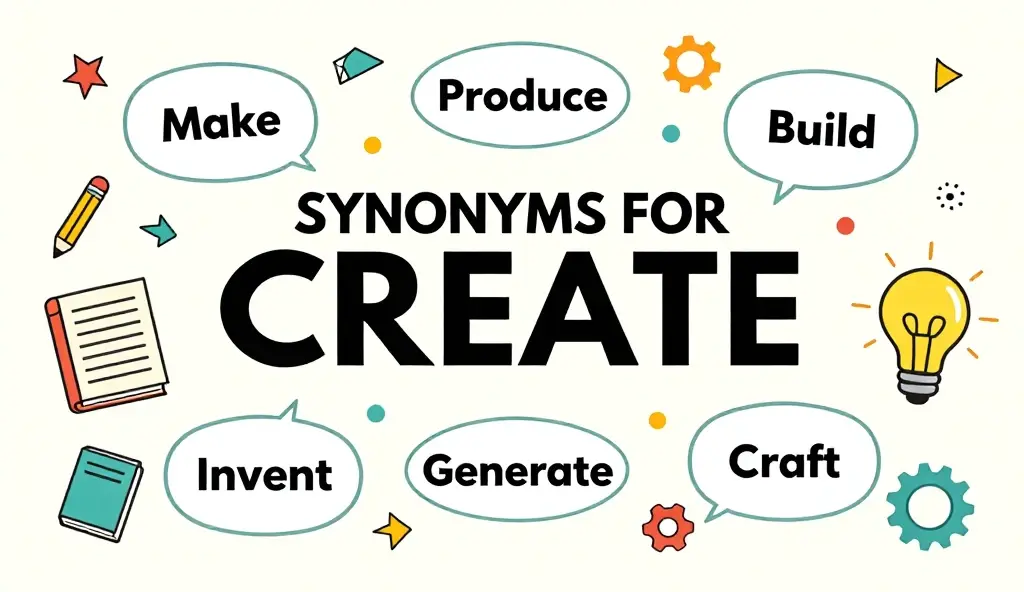
Looking for the best synonyms for create? Some of the most common alternatives include make, build, develop, produce, generate, design, craft, establish, invent, and form.
Each synonym has a slightly different meaning and is best suited for specific situations, such as writing, business, technology, art, or everyday conversation.
Choosing the right synonym helps make your communication clearer, stronger, and more engaging.
What Does “Create” Mean?
The word create is a verb that means to bring something new into existence. It can refer to making a physical object, developing an idea, producing digital content, inventing something original, or causing a new situation to happen.
People search for synonyms for create because they want to:
- Improve their vocabulary
- Avoid repeating the word create
- Write better essays and articles
- Use stronger words in business writing
- Improve SEO content
- Sound more natural in English
For example:
- We need to create a new website.
- We need to build a new website.
- We need to develop a new website.
Each sentence communicates a similar idea but with a different emphasis.
Meaning of Create
Definition
Create means:
- To make something new
- To bring into existence
- To produce something original
- To invent
- To design or build
- To cause something to happen
The exact meaning depends on the context.
Examples
- She wants to create a mobile app.
- Artists create beautiful paintings.
- The company created a new product.
- Reading helps create good habits.
- Teachers create positive learning environments.
Pronunciation
Phonetic Pronunciation (American English)
create
/kriˈeɪt/
How to Pronounce It Naturally
Break it into two parts:
cree – ATE
The stress falls on the second syllable.
Practice saying it naturally:
“We plan to create a better solution.”
Say it smoothly without pausing between the syllables.
Part of Speech
Create is primarily a verb.
It describes the action of making, producing, inventing, or causing something.
Examples
- They create educational videos.
- Engineers create innovative products.
- Writers create interesting stories.
Word Forms
| Form | Word |
| Base Verb | create |
| Third Person | creates |
| Present Participle | creating |
| Past Tense | created |
| Past Participle | created |
| Noun | creation |
| Adjective | creative |
| Adverb | creatively |
| Noun (Person) | creator |
Synonyms for Create
| Word | Meaning | Usage | Formality | Example | Difficulty |
| make | produce something | Everyday | Neutral | She made a cake. | Easy |
| build | construct or develop | Business | Neutral | They built a website. | Easy |
| develop | improve or create over time | Professional | Formal | The company developed new software. | Medium |
| produce | manufacture or generate | Business | Formal | The factory produces cars. | Medium |
| generate | cause or produce | Technical | Formal | Solar panels generate electricity. | Medium |
| design | plan and create | Creative | Neutral | She designed a new logo. | Easy |
| craft | make with skill | Creative | Neutral | He crafted a wooden table. | Medium |
| establish | bring into existence | Business | Formal | They established a nonprofit organization. | Medium |
| invent | create something original | Science | Formal | Edison invented many devices. | Medium |
| form | bring together | General | Neutral | Volunteers formed a committee. | Easy |
| compose | create written or musical work | Arts | Formal | She composed a beautiful song. | Medium |
| manufacture | produce goods | Industry | Formal | The company manufactures electronics. | Medium |
| construct | build something | Engineering | Formal | Workers constructed a bridge. | Medium |
| originate | begin or create | Academic | Formal | The idea originated in Europe. | Hard |
| fabricate | make or manufacture | Industry | Formal | The factory fabricates metal parts. | Hard |
Best Synonyms for Create
Make
Meaning
Make means to produce, build, or bring something into existence.
Difference
Make is the most common everyday synonym for create. It works in almost any informal situation.
Examples
- She made a birthday cake.
- We need to make a plan.
- He made a short video.
Best Situation
Use make for:
- Daily conversations
- School writing
- Simple instructions
- Everyday activities
Common Mistake
Don’t use make when a more specific verb would sound stronger.
Less specific:
They made a software program.
More precise:
They developed a software program.
Build
Meaning
Build means to construct or develop something step by step.
Difference
Unlike create, build often suggests a process that takes time and effort.
Examples
- They built a successful business.
- Engineers built a new bridge.
- She built a strong reputation.
Best Situation
Perfect for:
- Construction
- Business
- Websites
- Teams
- Relationships
Common Mistake
Don’t use build for artistic works like poems or paintings.
Develop
Meaning
Develop means to create or improve something gradually.
Difference
It emphasizes growth and progress rather than simply making something.
Examples
- The company developed a new app.
- Scientists developed a vaccine.
- She developed a useful habit.
Best Situation
Use develop for:
- Software
- Technology
- Business
- Skills
- Products
- Research
Common Mistake
Remember that develop often implies ongoing improvement, not instant creation.
Produce
Meaning
Produce means to make or manufacture something.
Difference
It usually refers to creating goods, media, or measurable results.
Examples
- The factory produces furniture.
- The studio produced a documentary.
- Healthy soil produces better crops.
Best Situation
Ideal for:
- Manufacturing
- Agriculture
- Film production
- Business
- Industry
Common Mistake
Avoid using produce when discussing highly creative or artistic ideas where create or design sounds more natural.
Generate
Meaning
Generate means to produce, cause, or bring about something.
Difference
Unlike create, generate often refers to automatic production or measurable output.
Examples
- Wind turbines generate electricity.
- The campaign generated thousands of leads.
- The report generated new ideas.
Best Situation
Best for:
- Technology
- Marketing
- Finance
- Energy
- Data
- Artificial intelligence
Common Mistake
Don’t use generate for handmade objects or artistic creations.
Design
Meaning
Design means to plan and create something with purpose.
Difference
Design focuses on planning, appearance, and functionality before the final product is made.
Examples
- She designed a modern website.
- Architects design buildings.
- They designed a new company logo.
Best Situation
Use design for:
- Graphics
- Architecture
- Websites
- Fashion
- User interfaces
- Product development
Common Mistake
Don’t confuse design (planning) with build (constructing).
Craft
Meaning
Craft means to create something carefully using skill, creativity, and attention to detail.
Difference
It emphasizes quality, precision, and creativity more than create.
Examples
- The writer crafted a compelling story.
- He crafted a handmade chair.
- She carefully crafted her presentation.
Best Situation
Perfect for:
- Writing
- Art
- Furniture
- Marketing copy
- Handmade products
- Speeches
Common Mistake
Avoid using craft for mass production or automated processes.
More Best Synonyms for Create
Establish
Meaning
Establish means to set up, found, or bring something into existence so it can continue over time.
Difference
Unlike create, establish emphasizes starting something permanent, such as an organization, business, or system.
Examples
- They established a nonprofit organization.
- The company established a new office in Texas.
- She established clear rules for the team.
Best Situation
Use establish for:
- Businesses
- Organizations
- Schools
- Policies
- Systems
- Partnerships
Common Mistake
Don’t use establish when talking about creating physical objects.
Incorrect:
He established a painting.
Correct:
He created a painting.
Invent
Meaning
Invent means to create something completely new that has never existed before.
Difference
While create is a broad term, invent focuses on originality and innovation.
Examples
- Alexander Graham Bell invented the telephone.
- She invented a new kitchen tool.
- Scientists hope to invent cleaner energy solutions.
Best Situation
Perfect for:
- Science
- Technology
- Engineering
- Research
- New products
Common Mistake
Don’t use invent for improving something that already exists.
Form
Meaning
Form means to bring people or things together to create a group, structure, or shape.
Difference
It usually focuses on arranging or organizing rather than producing something from nothing.
Examples
- Volunteers formed a committee.
- Clouds formed over the mountains.
- They formed a successful partnership.
Best Situation
Use form for:
- Teams
- Groups
- Organizations
- Shapes
- Relationships
Common Mistake
Avoid using form when talking about designing artwork or products.
Compose
Meaning
Compose means to create written, musical, or artistic works.
Difference
Unlike create, compose is mainly used for music, literature, and formal writing.
Examples
- Mozart composed many famous works.
- She composed a heartfelt email.
- The poet composed a beautiful poem.
Best Situation
Ideal for:
- Music
- Poetry
- Literature
- Formal writing
- Emails
Common Mistake
Don’t use compose for buildings, software, or machines.
Manufacture
Meaning
Manufacture means to produce goods in large quantities using machines or factories.
Difference
It refers specifically to industrial production.
Examples
- The company manufactures smartphones.
- The factory manufactures furniture.
- They manufacture medical equipment.
Best Situation
Use manufacture for:
- Factories
- Industry
- Products
- Large-scale production
Common Mistake
Don’t use manufacture for creative works like books or paintings.
Construct
Meaning
Construct means to build something by putting parts together.
Difference
It is more formal than build and commonly appears in engineering or construction.
Examples
- Workers constructed a new highway.
- Engineers constructed a suspension bridge.
- The company constructed a modern office building.
Best Situation
Perfect for:
- Construction
- Engineering
- Architecture
- Infrastructure
Common Mistake
Avoid using construct for writing stories or creating artwork.
Originate
Meaning
Originate means to begin, start, or come into existence.
Difference
Unlike create, originate focuses on the source or origin of an idea.
Examples
- The tradition originated centuries ago.
- The idea originated during a meeting.
- Many innovations originate from research.
Best Situation
Use it for:
- Ideas
- Traditions
- Research
- History
- Business concepts
Common Mistake
Don’t use originate when referring to building physical objects.
Fabricate
Meaning
Fabricate means to manufacture or construct something, usually from raw materials.
Difference
In everyday English, fabricate can also mean to invent a false story, so context matters.
Examples
- The company fabricates metal parts.
- Engineers fabricated a prototype.
- He fabricated a false excuse. (Different meaning.)
Best Situation
Use fabricate for:
- Manufacturing
- Engineering
- Industrial production
Common Mistake
Be careful because fabricate may suggest dishonesty if used without context.
Antonyms for Create
The opposite of create depends on the context. These words generally describe destroying, ending, or removing something instead of making it.
| Word | Meaning | Common Usage | Formality | Example |
| destroy | completely ruin | Everyday | Neutral | The fire destroyed the house. |
| demolish | tear down completely | Construction | Formal | Workers demolished the old building. |
| eliminate | remove completely | Business | Formal | The update eliminated several bugs. |
| erase | remove writing or data | Everyday | Neutral | Please erase the whiteboard. |
| abolish | officially end | Government | Formal | The law was abolished. |
| dismantle | take apart | Engineering | Formal | They dismantled the machine. |
| remove | take away | Daily | Neutral | Remove the old files. |
| ruin | damage badly | Everyday | Neutral | Rain ruined the picnic. |
| terminate | bring to an end | Business | Formal | The contract was terminated. |
| cancel | stop before completion | Everyday | Neutral | They canceled the event. |
Understanding the Antonyms
Destroy
Meaning
Destroy means to completely damage or ruin something so it no longer exists or works.
Examples
Demolish
Meaning
Demolish means to intentionally tear down a building or structure.
Examples
- Workers demolished the old stadium.
- The city demolished unsafe buildings.
- They demolished the bridge before rebuilding it.
Eliminate
Meaning
Eliminate means to remove or get rid of something completely.
Examples
- The update eliminated security issues.
- We eliminated unnecessary expenses.
- Exercise helps eliminate stress.
Erase
Meaning
Erase means to remove writing, drawings, or digital information.
Examples
- Erase the incorrect answer.
- He accidentally erased the document.
- Please erase the board after class.
Dismantle
Meaning
Dismantle means to take something apart piece by piece.
Examples
- Mechanics dismantled the engine.
- They dismantled the old equipment.
- The workers dismantled the temporary stage.
Cancel
Meaning
Cancel means to stop something before it happens or is completed.
Examples
- They canceled the meeting.
- The airline canceled the flight.
- We had to cancel our reservation.
30 Real-World Examples of “Create”
- Artists create beautiful paintings.
- Teachers create engaging lesson plans.
- Engineers create innovative technology.
- Writers create memorable characters.
- Parents create a safe home environment.
- Designers create attractive websites.
- Businesses create new jobs every year.
- Developers create mobile applications.
- Scientists create new research methods.
- Musicians create original songs.
- Chefs create delicious recipes.
- Volunteers create stronger communities.
- Photographers create lasting memories.
- Companies create valuable products.
- Students create science projects.
- Entrepreneurs create successful startups.
- Architects create modern buildings.
- Marketing teams create advertising campaigns.
- Programmers create useful software.
- Friends create unforgettable memories together.
- Leaders create positive workplace cultures.
- Artists create digital illustrations.
- Researchers create new medical treatments.
- Gardeners create beautiful landscapes.
- Filmmakers create inspiring documentaries.
- Content creators create educational videos.
- Authors create fictional worlds.
- Small habits create long-term success.
- Teamwork helps create better results.
- Daily practice creates lasting improvement.
25 Naturally Written Sentences Using Create
These examples show how create is used naturally in everyday English, business, education, technology, and creative fields.
- Artists create beautiful works of art.
- The company created a new marketing strategy.
- She created a website for her small business.
- Good communication creates stronger relationships.
- Teachers create a positive learning environment.
- The app was created to help students study.
- They created a plan to solve the problem.
- The chef created a unique recipe.
- Scientists create new solutions through research.
- The designer created a modern logo.
- The team created an effective workflow.
- Writers create stories that inspire people.
- The organization created new opportunities for young people.
- Technology continues to create new possibilities.
- The filmmaker created an emotional documentary.
- The company created thousands of jobs.
- She created a beautiful presentation for the meeting.
- Engineers created a safer transportation system.
- Small actions can create big changes.
- The photographer created amazing memories.
- The developers created a useful mobile application.
- The government created new policies.
- The artist created a unique style.
- Reading helps create a better understanding of the world.
- Hard work can create success over time.
Formal vs. Informal Usage
The word create is flexible and works in both casual and professional English. However, different synonyms may sound more suitable depending on the situation.
| Situation | Better Word | Example |
| Everyday conversation | make | She made a cake. |
| Business writing | develop | The company developed a new product. |
| Academic writing | establish | Researchers established a new framework. |
| Technology | design / develop | Engineers developed new software. |
| Manufacturing | produce | The factory produces equipment. |
| Art and writing | craft / compose | She crafted a powerful story. |
| Innovation | invent | Scientists invented a new device. |
Informal Examples
In daily conversations, people usually choose simple words instead of create.
Examples:
- I made dinner.
- She made a video.
- We made a plan.
- He built a website.
- They made something amazing.
These sound natural in everyday American English.
Formal Examples
Professional writing often uses more specific alternatives.
Examples:
- The company developed a new business model.
- Researchers established a new method.
- Engineers designed an advanced system.
- The organization created a strategic plan.
- The team produced detailed reports.
Formal vs. Informal Comparison
| Informal | Formal |
| Make a website | Develop a website |
| Make a plan | Create a strategy |
| Make a product | Manufacture a product |
| Make a song | Compose a song |
| Make a building | Construct a building |
| Make a new idea | Develop an innovative concept |
Which Synonym Should You Use?
Choosing the right synonym depends on what you are creating.
| What You Create | Best Synonym |
| Food | make, prepare |
| Website | build, develop, design |
| Software | develop, program |
| Building | construct, build |
| Business | establish, build |
| Song | compose, create |
| Painting | craft, create |
| Product | manufacture, produce |
| Idea | develop, invent |
| Organization | establish, form |
Academic Usage
In academic writing, create is often replaced with more precise words depending on the research context.
Common academic alternatives:
- develop
- establish
- formulate
- construct
- generate
- produce
- design
Examples
- Researchers created a new theory.
- Researchers developed a new theoretical framework.
- Scientists created a new method.
- Scientists developed a new research method.
- The study created new knowledge.
- The study generated new insights.
Academic Writing Tips
Avoid using create repeatedly in research papers.
Instead of:
The researchers created a model. The model created new results.
Use:
The researchers developed a model. The model generated new results.
This creates more precise and professional writing.
Daily Conversation
Native English speakers use create less often in casual speech. They usually choose simpler words.
At Home
Instead of:
I created dinner.
More natural:
I made dinner.
At Work
Natural examples:
- We created a new plan.
- She created a presentation.
- They built a new system.
- He developed a new idea.
Technology
Common expressions:
- Create an account.
- Create a password.
- Create a profile.
- Create a file.
- Create a website.
Art and Creativity
Examples:
- She creates beautiful paintings.
- He creates amazing videos.
- Artists create new experiences.
- Writers create fictional worlds.
Grammar Tips
Using create correctly helps your English sound more natural.
1. Create Is a Regular Verb
Verb forms:
| Form | Example |
| Base | create |
| Past | created |
| Present participle | creating |
| Third person | creates |
Examples:
- They create websites.
- She created a logo.
- He is creating a new project.
2. Create + Object
Create usually needs something that is being made.
Correct:
- She created a painting.
- They created a business plan.
Incorrect:
- She created.
(Unless the object is understood from context.)
3. Create Can Be Followed by Different Nouns
Examples:
- Create opportunities
- Create solutions
- Create problems
- Create memories
- Create relationships
- Create content
- Create change
4. Create vs. Make
Both words are similar, but they are not always interchangeable.
Create
Usually suggests originality or imagination.
Example:
- She created a new design.
Make
More common for everyday actions.
Example:
- She made breakfast.
5. Create vs. Build
Create
Focuses on bringing something into existence.
Example:
- He created a new idea.
Build
Focuses on developing something step by step.
Example:
- He built a successful company.
Common Grammar Mistakes
Incorrect:
She created a new invention.
Better:
She invented a new device.
Why?
An invention is usually something that is already new, so invented is more precise.
Incorrect:
The factory creates cars.
Better:
The factory manufactures cars.
Why?
Factories usually produce or manufacture goods.
Incorrect:
He created a house.
Better:
He built a house.
Why?
Buildings are usually built or constructed.
Common Collocations with Create
| Collocation | Meaning | Example |
| create opportunities | make chances available | Education creates opportunities. |
| create content | produce media or information | She creates content online. |
| create a plan | develop a strategy | We created a plan for success. |
| create solutions | develop answers | Engineers create solutions to problems. |
| create memories | make meaningful experiences | Travel creates memories. |
| create change | cause improvement | Leaders create change. |
| create awareness | help people understand something | Campaigns create awareness. |
| create value | provide benefits | Businesses create value for customers. |
| create relationships | build connections | Networking creates relationships. |
| create impact | produce an effect | The project created a positive impact. |
| create a brand | develop an identity | They created a strong brand. |
| create a system | develop an organized process | The company created a new system. |
Explaining Common Collocations
Create Opportunities
Meaning
To make new chances available.
Example
- Scholarships create opportunities for students.
Create Content
Meaning
To produce videos, articles, images, or other media.
Example
- Many creators create content for social media.
Create Solutions
Meaning
To develop answers to problems.
Example
- Engineers create solutions that improve daily life.
Create Awareness
Meaning
To help people learn about an issue.
Example
- The campaign created awareness about climate change.
Create Value
Meaning
To provide usefulness or benefits.
Example
- Good businesses create value for customers.
Create Impact
Meaning
To cause a meaningful effect.
Example
- Small actions can create a positive impact.
Common Phrases Using Create
The word create appears in many common English phrases used in business, education, technology, art, and everyday communication. Learning these phrases helps you use create more naturally.
| Phrase | Meaning | Example |
| create an account | make a new user profile | Please create an account to continue. |
| create a plan | develop a strategy | We need to create a plan for the project. |
| create opportunities | make chances available | Education can create opportunities. |
| create a solution | develop an answer to a problem | Engineers create solutions for challenges. |
| create content | produce digital material | She creates content for her website. |
| create awareness | help people understand an issue | The campaign created awareness about safety. |
| create value | provide benefits or usefulness | Companies create value for customers. |
| create memories | make meaningful experiences | Family trips create lasting memories. |
| create change | cause improvement | Leaders create positive change. |
| create an impact | produce a strong effect | The program created a huge impact. |
| create a brand | develop a business identity | They created a successful brand. |
| create a system | build an organized process | The team created a new system. |
| create a strategy | develop a method for success | The company created a marketing strategy. |
| create a relationship | build a connection | Trust helps create strong relationships. |
| create a difference | make something better | Small actions can create a difference. |
Explaining Common Phrases
Create an Account
Meaning
To make a new profile or registration on a website, app, or service.
Examples
- You need to create an account before buying products.
- Users can create an account in less than a minute.
- Students create accounts to access online courses.
Common Use
Mostly used in:
- Websites
- Apps
- Online services
- Technology
Create Opportunities
Meaning
To make new possibilities or chances available.
Examples
- Education creates opportunities for young people.
- Businesses create opportunities through innovation.
- Learning new skills creates career opportunities.
Common Use
Used in:
- Education
- Career discussions
- Business
- Personal development
Create Content
Meaning
To produce videos, articles, images, podcasts, or other digital materials.
Examples
- Many creators create content for social media.
- Writers create content for blogs.
- Brands create content to connect with customers.
Common Use
Used in:
- Digital marketing
- Blogging
- Social media
- Online business
Create Awareness
Meaning
To help people understand or notice an important topic.
Examples
- The campaign created awareness about health issues.
- Schools create awareness about safety.
- Organizations create awareness through education.
Common Use
Used in:
- Marketing
- Social causes
- Education
- Public campaigns
Create Value
Meaning
To provide benefits, usefulness, or importance.
Examples
- Good products create value for customers.
- Businesses must create value to grow.
- Knowledge creates value in every industry.
Common Use
Used in:
- Business
- Economics
- Marketing
- Entrepreneurship
Related Expressions to Create
These expressions have similar meanings and are often used when talking about making or developing something.
| Expression | Meaning | Example |
| bring to life | make an idea real | The artist brought the character to life. |
| come up with | think of an idea | She came up with a creative solution. |
| make happen | cause something to occur | Hard work makes success happen. |
| put together | combine parts to make something | They put together a presentation. |
| build from scratch | create from the beginning | He built the website from scratch. |
| turn into reality | make an idea real | She turned her dream into reality. |
| shape the future | influence what happens later | Technology shapes the future. |
| lay the foundation | create a starting point | Education lays the foundation for success. |
| make a difference | create positive change | Small actions make a difference. |
| spark an idea | create inspiration | The book sparked an idea. |
Understanding Related Expressions
Bring to Life
Meaning
To make something imaginary or planned become real.
Examples
- The director brought the story to life.
- The designer brought the idea to life.
- The artist brought the painting to life.
Best Situation
Use for:
- Art
- Movies
- Designs
- Creative projects
Come Up With
Meaning
To think of or create an idea.
Examples
- She came up with a new business idea.
- We need to come up with a better solution.
- He came up with a creative name.
Best Situation
Use in:
- Conversations
- Brainstorming
- Problem-solving
Build From Scratch
Meaning
To create something completely from the beginning.
Examples
- They built the company from scratch.
- He created the website from scratch.
- She learned how to build a business from scratch.
Best Situation
Use for:
- Businesses
- Websites
- Projects
- Skills
Turn Into Reality
Meaning
To make a dream, goal, or idea actually happen.
Examples
- She turned her idea into reality.
- Hard work helps people turn dreams into reality.
- The team turned the concept into reality.
Similar Words to Create
| Word | Meaning | Main Difference | Example |
| create | bring something into existence | General word | She created a painting. |
| make | produce something | Everyday usage | He made dinner. |
| build | develop step by step | Focuses on growth | They built a company. |
| develop | create and improve | Focuses on progress | They developed software. |
| produce | manufacture or generate | Focuses on output | The factory produces cars. |
| design | plan and create | Focuses on structure | She designed a website. |
| invent | create something new | Focuses on originality | Scientists invented a device. |
| establish | create something permanent | Focuses on starting | They established a company. |
| form | organize into a structure | Focuses on arrangement | They formed a team. |
| craft | create skillfully | Focuses on quality | He crafted a story. |
Word Comparison
Create vs. Make
| Create | Make |
| More creative or formal | More common in daily speech |
| Suggests originality | Suggests production |
| Used for ideas, art, products | Used for everyday activities |
Examples
Create:
- She created a new design.
Make:
- She made breakfast.
Create vs. Build
| Create | Build |
| General act of making | Development over time |
| Can be ideas or objects | Usually something that grows or develops |
Examples
Create:
- He created a new concept.
Build:
- He built a successful company.
Create vs. Develop
| Create | Develop |
| Bring something new into existence | Improve or grow something |
| Focuses on beginning | Focuses on progress |
Examples
Create:
- They created a new product idea.
Develop:
- They developed the product over two years.
Create vs. Produce
| Create | Produce |
| More creative | More manufacturing-focused |
| Used for ideas and art | Used for goods and results |
Examples
Create:
- Writers create stories.
Produce:
- Factories produce machines.
Create vs. Invent
| Create | Invent |
| General creation | Original discovery or innovation |
| Many things can be created | Only new things are invented |
Examples
Create:
- She created a painting.
Invent:
- Scientists invented a new device.
Create vs. Design
| Create | Design |
| Focuses on making | Focuses on planning |
| Broader meaning | More specific |
Examples
Create:
- He created a website.
Design:
- He designed the website layout.
Expert Tips for Choosing the Right Synonym
- Use make for simple everyday actions.
- Use create when something involves originality or creativity.
- Use build when something develops over time.
- Use develop when improving an idea, product, or skill.
- Use design when planning appearance or structure.
- Use produce for manufacturing or measurable results.
- Use invent for completely new discoveries.
- Use establish for organizations, systems, or long-term structures.
- Use craft when skill and attention to detail matter.
- Choose the most specific word instead of always using create.
FAQs
Q1. What are the best synonyms for “create”?
A: Some of the best synonyms for create are make, build, develop, produce, generate, design, craft, establish, invent, form, compose, and construct. The best choice depends on what you’re creating. For example, you design a website, build a business, compose music, or invent a new device.
Q2. What is another word for “create”?
A: Common alternatives to create include make, develop, build, produce, form, generate, establish, and design. Make is the most natural choice in everyday English, while develop, establish, and produce are more common in professional or academic writing.
Q3. Is “create” a formal word?
A: Yes. Create is a neutral word that works well in both formal and informal English. It is widely used in business documents, academic writing, creative industries, and everyday conversations. However, more specific words like develop, construct, or manufacture may be more appropriate in certain professional contexts.
Q4. What is the difference between “create” and “make”?
A: Create usually suggests originality, imagination, or bringing something new into existence, while make is a broader everyday verb for producing or preparing something.
Examples:
- She created a new artwork.
- She made dinner.
The first example emphasizes creativity, while the second refers to a routine action.
Q5. What is the difference between “create” and “develop”?
A: Create means to bring something into existence, whereas develop means to improve, expand, or refine something over time.
Examples:
- The team created a new idea.
- The team developed the idea into a successful product.
Q6. Can “build” be used as a synonym for “create”?
A: Yes, but only in certain contexts. Build is appropriate when something is constructed or grows step by step.
Examples:
- They built a successful company.
- Engineers built a bridge.
However, you would normally say someone created or crafted a poem or painting rather than built one.
Q7. What is the difference between “create” and “invent”?
A: Invent is a more specific form of creating. It refers to making something completely new that did not exist before, while create has a broader meaning.
Examples:
- Scientists invented a new technology.
- The author created a fictional world.
Every invention is created, but not everything created is an invention.
Q8. Which synonym for “create” is best for academic writing?
A: In academic writing, strong alternatives include develop, establish, generate, formulate, construct, and produce. These words sound more precise and professional when discussing research, theories, or analytical work.
Q9. Which synonym for “create” is best for business writing?
A: For business writing, common alternatives include develop, establish, build, generate, and produce.
Examples:
- The company developed a new strategy.
- The organization established a new department.
- The team generated innovative ideas.
These words sound polished and are widely used in professional communication.
Q10. Can I use “create” for digital products?
A: Yes. Create is commonly used for digital products and online content, including websites, apps, videos, user accounts, graphics, and software.
Examples:
- Create an account.
- Create a website.
- Create digital content.
- Create a mobile application.
For technology, develop, design, and build are also excellent alternatives.
Q11. What is the noun form of “create”?
A: The noun form of create is creation.
Examples:
- The creation of the website took six months.
- The artist’s creation became famous.
Related word forms include:
- Creator – a person who creates something
- Creative – showing imagination or originality
- Creativity – the ability to create new ideas or things
Q12. What is the opposite of “create”?
A: Common antonyms of create include destroy, demolish, eliminate, erase, dismantle, remove, and cancel. The best opposite depends on the context.
Examples:
- Create a building → Demolish a building.
- Create a file → Erase a file.
- Create a system → Dismantle a system.
Q13. How can I avoid repeating the word “create”?
A: Replace create with more specific verbs based on the context:
- Create a business → establish or build a business
- Create software → develop software
- Create a design → design or craft a concept
- Create a product → produce or manufacture a product
- Create an idea → develop or generate an idea
Using precise alternatives makes your writing more engaging, professional, and easier to read.
Q14. What are common phrases with “create”?
A: Frequently used phrases with create include:
- create opportunities
- create content
- create awareness
- create value
- create solutions
- create change
- create memories
- create an impact
- create a strategy
- create a plan
These expressions are widely used in business, education, marketing, technology, and everyday English.
Expert Writing Advice
Using create correctly can make your writing clearer and more powerful. Here are practical tips:
- Choose specific synonyms instead of using create for everything.
- Use develop when something improves over time.
- Use build when something grows gradually.
- Use design when planning structure or appearance.
- Use invent when something is completely new.
- Use produce when talking about manufacturing or results.
- Use craft when creativity and skill are important.
- Use establish when starting organizations, systems, or traditions.
- Use simple words like make when writing for general audiences.
- Always consider your reader and the purpose of your sentence.
A strong writer does not just know many synonyms; they understand the small differences between them. The best word is the one that communicates your exact meaning.
Conclusion:
The word create is one of the most useful verbs in English because it describes the process of bringing something new into existence.
It can be used for ideas, products, businesses, artwork, technology, relationships, and many other areas of life.
However, repeating create too often can make writing feel less precise.
Using alternatives like make, build, develop, produce, generate, design, craft, establish, and invent allows you to communicate your ideas more clearly.
The best synonym depends on the situation.
Use make for everyday actions, develop for growth and improvement, build for long-term progress and planning, design for manufacturing, produce for manufacturing, and invent for discoveries.
By understanding these differences, you can make your writing more natural, professional, and engaging.

Christopher Ward writes practical guides on word usage, synonyms, and effective written communication for a global audience.