
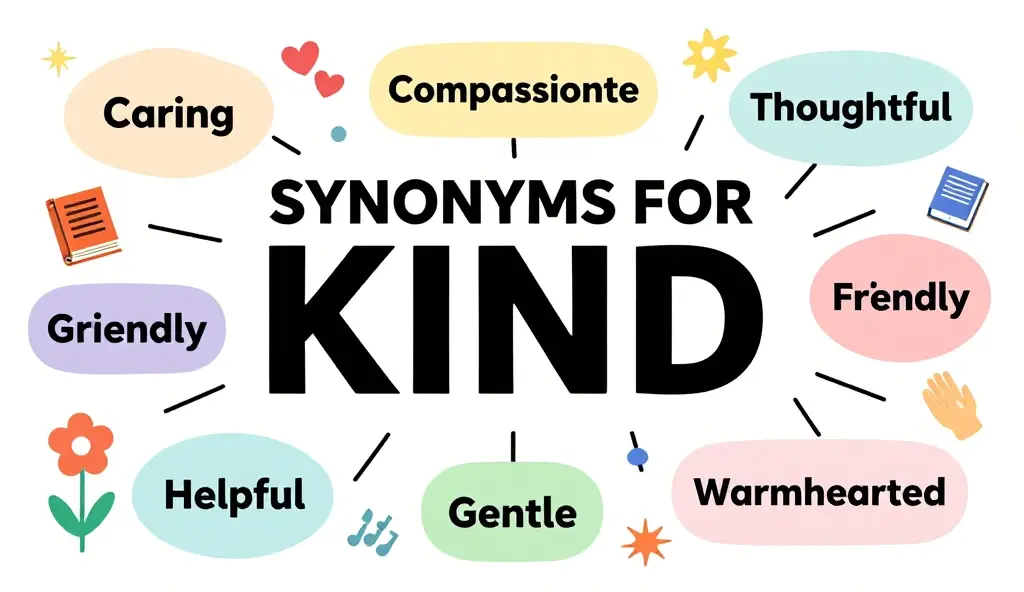
The word kind is one of the most positive and commonly used words in English.
It describes someone who is caring, helpful, and considerate toward others.
Because it appears so often in conversations, essays, emails, and stories, many people look for synonyms for “kind” to improve their vocabulary and avoid repeating the same word.
Although many words share a similar meaning to “kind,” each has a slightly different tone.
For example, compassionate emphasizes empathy, generous highlights giving, while thoughtful focuses on paying attention to other people’s needs.
Choosing the right synonym helps your writing sound more natural and precise.
This guide explains the meaning of kind, its pronunciation, part of speech, the best synonyms, antonyms, examples, grammar tips, and practical advice for using each word correctly.
Meaning of “Kind”
Definition
Kind describes a person who is caring, friendly, helpful, generous, or considerate toward others.
Common Usage
People commonly use kind to describe:
- A caring person
- Helpful actions
- Friendly behavior
- Generous gestures
- Respectful communication
- Compassion toward others
Examples
- She is always kind to her neighbors.
- Thank you for your kind words.
- He made a kind gesture by helping the elderly woman.
- Our teacher is patient and kind.
Pronunciation
Phonetic Pronunciation (IPA):
/kaɪnd/
Natural pronunciation:
kind → sounds like kynd
It rhymes with:
- mind
- find
- blind
- behind
Natural Pronunciation Tips
Pronounce the long “i” sound clearly:
k-eye-nd
Native English speakers usually say it smoothly with one syllable.
Part of Speech
Adjective (Most Common)
Kind is most often used as an adjective to describe someone’s personality or behavior.
Examples
- She’s a kind person.
- They were kind to everyone.
- That was a kind thing to do.
Noun
Kind can also mean a type, sort, or category.
Examples
- What kind of music do you like?
- This kind of flower grows quickly.
- That’s my favorite kind of dessert.
Common Expressions
- Kind heart
- Kind words
- Kind gesture
- Kind person
- Kind soul
- Kind act
Synonyms for Kind
| Word | Meaning | Best Usage | Formality | Example | Difficulty |
| Compassionate | Showing deep care | Healthcare, emotions | Formal | A compassionate doctor | Medium |
| Caring | Looking after others | Everyday English | Neutral | A caring mother | Easy |
| Thoughtful | Showing consideration | Daily life | Neutral | A thoughtful gift | Easy |
| Considerate | Respecting others’ feelings | Professional & personal | Neutral | A considerate neighbor | Medium |
| Gentle | Soft and kind | Personality | Neutral | A gentle voice | Easy |
| Generous | Willing to give | Charity, kindness | Neutral | A generous donation | Easy |
| Friendly | Pleasant and welcoming | Conversation | Neutral | A friendly smile | Easy |
| Helpful | Ready to assist | Work and school | Neutral | A helpful colleague | Easy |
| Warmhearted | Full of kindness | Personal descriptions | Neutral | A warmhearted teacher | Medium |
| Sympathetic | Understanding others’ feelings | Emotional situations | Formal | A sympathetic listener | Medium |
| Benevolent | Kind and charitable | Formal writing | Formal | A benevolent leader | Hard |
| Gracious | Polite and kind | Formal situations | Formal | A gracious host | Medium |
| Humane | Showing compassion | Animal welfare, ethics | Formal | Humane treatment | Medium |
| Understanding | Patient and empathetic | Relationships | Neutral | An understanding friend | Easy |
Best Synonyms for Kind
1. Compassionate
Meaning
Compassionate describes someone who understands another person’s pain and genuinely wants to help.
Difference
While kind refers to general goodness, compassionate emphasizes empathy and emotional support.
Examples
- The nurse was compassionate with every patient.
- He’s known for his compassionate leadership.
- A compassionate friend listens without judging.
Best Situation
Use compassionate for:
- Healthcare
- Charity
- Counseling
- Emotional support
- Community service
Common Mistakes
Don’t confuse compassionate with sympathetic. Compassion often includes a desire to help, while sympathy mainly expresses understanding.
2. Caring
Meaning
Caring means showing concern for the health, happiness, or well-being of others.
Difference
Caring focuses more on consistent actions than feelings.
Examples
- She is a caring mother.
- Our teacher is caring and patient.
- He has always been caring toward his family.
Best Situation
Perfect for:
- Family relationships
- Education
- Healthcare
- Friendships
- Everyday conversation
Common Mistakes
Being caring involves actions, not just kind words.
3. Thoughtful
Meaning
Thoughtful means paying attention to other people’s needs and feelings.
Difference
A thoughtful person carefully considers how their actions affect others.
Examples
- That was a thoughtful birthday gift.
- She wrote a thoughtful thank-you note.
- His thoughtful advice helped me.
Best Situation
Ideal for:
- Gifts
- Letters
- Friendships
- Professional relationships
Common Mistakes
Don’t confuse thoughtful (considerate) with thoughtful meaning “deep in thought.” The meaning depends on context.
4. Considerate
Meaning
Considerate means showing respect for other people’s comfort, time, and feelings.
Difference
While kind is general, considerate highlights respect and awareness of others.
Examples
- Our neighbors are very considerate.
- She was considerate enough to call ahead.
- He’s always considerate of other people’s opinions.
Best Situation
Use considerate in:
- Workplaces
- Relationships
- Public behavior
- Customer service
Common Mistakes
Being considerate often involves thinking ahead to avoid inconveniencing others.
5. Gentle
Meaning
Gentle describes someone who is kind, calm, and soft in words or actions.
Difference
Unlike kind, gentle often emphasizes a person’s manner rather than their intentions.
Examples
- She has a gentle voice.
- Be gentle with the puppy.
- The teacher spoke in a gentle tone.
Best Situation
Best for:
- Parenting
- Healthcare
- Animal care
- Personal relationships
Common Mistakes
Gentle doesn’t always mean generous or helpful—it usually refers to softness and calm behavior.
Best Synonyms for Kind (Continued)
6. Generous
Meaning
Generous means willingly giving time, money, help, or resources to others without expecting anything in return.
Difference
While kind refers to general goodness, generous specifically highlights giving and sharing.
Examples
- She made a generous donation to the charity.
- Our neighbors were generous with their time.
- He is always generous when helping friends.
Best Situation
Use generous for:
- Charity
- Donations
- Gifts
- Helping others
- Community service
Common Mistakes
Generosity isn’t only about money. You can also be generous with your time, attention, or encouragement.
7. Friendly
Meaning
Friendly describes someone pleasant, welcoming, and easy to talk to.
Difference
A friendly person is approachable, while a kind person focuses more on caring and helping.
Examples
- The hotel staff were very friendly.
- She gave everyone a friendly smile.
- He’s always friendly to new coworkers.
Best Situation
Perfect for:
- Customer service
- Schools
- Workplaces
- Travel
- Daily conversations
Common Mistakes
Being friendly doesn’t always mean someone is deeply caring. It mainly refers to warm social behavior.
8. Helpful
Meaning
Helpful means willing to assist or support other people.
Difference
Someone can be kind without helping directly, but a helpful person actively assists.
Examples
- The librarian was very helpful.
- Thank you for your helpful advice.
- My coworkers are always helpful.
Best Situation
Ideal for:
- Offices
- Schools
- Customer support
- Teamwork
- Family life
Common Mistakes
Helpful actions should solve a problem or make a task easier.
9. Warmhearted
Meaning
Warmhearted describes someone who is naturally affectionate, caring, and sincere.
Difference
Warmhearted suggests genuine emotional warmth, while kind can refer to both actions and personality.
Examples
- She’s a warmhearted volunteer.
- Everyone remembers his warmhearted nature.
- The family welcomed us with warmhearted hospitality.
Best Situation
Best for:
- Personal descriptions
- Biographies
- Community work
- Character references
Common Mistakes
Don’t confuse warmhearted with warm when describing temperature.
10. Sympathetic
Meaning
Sympathetic means understanding another person’s sadness, pain, or difficulties.
Difference
A sympathetic person understands suffering, while a compassionate person often takes action to help.
Examples
- The manager was sympathetic after hearing the news.
- She gave him a sympathetic smile.
- Thank you for being so sympathetic.
Best Situation
Use sympathetic for:
- Difficult situations
- Counseling
- Healthcare
- Personal conversations
Common Mistakes
Sympathetic doesn’t always mean agreeing with someone—it means understanding their feelings.
11. Benevolent
Meaning
Benevolent means showing kindness, generosity, and a desire to improve other people’s lives.
Difference
Benevolent is more formal than kind and often describes leaders, organizations, or charitable individuals.
Examples
- The foundation supports benevolent projects.
- He was known as a benevolent leader.
- The donor remained anonymous despite his benevolent gifts.
Best Situation
Ideal for:
- Formal writing
- Charity organizations
- History
- Leadership
- Academic essays
Common Mistakes
Avoid using benevolent in casual conversations because it sounds formal.
12. Gracious
Meaning
Gracious means polite, courteous, and kind, especially toward guests or other people.
Difference
Gracious emphasizes good manners along with kindness.
Examples
- She was a gracious host.
- Thank you for your gracious response.
- The winner gave a gracious acceptance speech.
Best Situation
Best for:
- Hospitality
- Business communication
- Public speaking
- Formal events
Common Mistakes
Gracious is more about politeness than generosity.
13. Humane
Meaning
Humane means treating people and animals with compassion and kindness.
Difference
Humane is commonly used when discussing ethics, healthcare, or animal welfare.
Examples
- The organization promotes humane treatment of animals.
- Humane policies protect vulnerable people.
- The rescue center follows humane practices.
Best Situation
Use humane for:
- Animal care
- Human rights
- Healthcare
- Ethics
- Social issues
Common Mistakes
Don’t confuse humane with human. Humane describes compassionate behavior.
14. Understanding
Meaning
Understanding means being patient, tolerant, and able to appreciate another person’s feelings or situation.
Difference
Understanding focuses on empathy and patience, while kind refers to overall caring behavior.
Examples
- My teacher is very understanding.
- She remained understanding during the difficult conversation.
- Thank you for being so understanding.
Best Situation
Perfect for:
- Friendships
- Relationships
- Parenting
- Education
- Workplace communication
Common Mistakes
Being understanding doesn’t always mean agreeing—it means listening fairly and showing empathy.
Antonyms for Kind
The opposite of kind depends on the context. Common antonyms describe people who are unkind, unfriendly, selfish, or inconsiderate.
| Word | Meaning | Common Usage | Formality | Example |
| Mean | Unkind or cruel | Everyday English | Neutral | He was mean to the new student. |
| Cruel | Intentionally causing pain | General | Neutral | It was a cruel joke. |
| Rude | Impolite | Daily conversation | Neutral | The customer was rude. |
| Unfriendly | Not welcoming | Social situations | Neutral | The receptionist seemed unfriendly. |
| Selfish | Caring only about yourself | Personality | Neutral | Sharing helps us avoid being selfish. |
| Inconsiderate | Not thinking about others | Work and home | Neutral | Leaving trash behind is inconsiderate. |
| Harsh | Severe or unpleasant | Feedback, speech | Neutral | His harsh words hurt her feelings. |
| Cold-hearted | Lacking sympathy | Personality | Informal | The villain was cold-hearted. |
| Hostile | Aggressive or unfriendly | Formal writing | Formal | The meeting became hostile. |
| Thoughtless | Showing little care | Everyday English | Neutral | Forgetting her birthday was thoughtless. |
Understanding Each Antonym
1. Mean
Meaning
Mean describes someone who is intentionally unkind or unpleasant.
Examples
- Don’t be mean to your classmates.
- His mean comments upset everyone.
- The bully was mean to younger children.
Best Situation
Use mean in everyday conversations when describing unkind behavior.
Meaning
2. Cruel
Cruel means causing pain or suffering without concern for others.
Examples
- It was cruel to laugh at someone else’s mistake.
- The movie showed a cruel ruler.
- Cruel treatment of animals is unacceptable.
3. Rude
Meaning
Rude means impolite or disrespectful.
Examples
- Interrupting people is rude.
- He gave a rude reply.
- Please don’t be rude to the waiter.
4. Unfriendly
Meaning
Unfriendly describes someone who isn’t warm or welcoming.
Examples
- The cashier seemed unfriendly.
- Their neighbors were unfriendly at first.
- His unfriendly attitude made conversation difficult.
5. Selfish
Meaning
Selfish means putting your own needs before others.
Examples
- Sharing toys teaches children not to be selfish.
- It was selfish to ignore the team’s needs.
- She apologized for her selfish decision.
6. Inconsiderate
Meaning
Inconsiderate means failing to think about how your actions affect other people.
Examples
- Playing loud music late at night is inconsiderate.
- He made an inconsiderate remark.
- Please be considerate instead of inconsiderate.
7. Harsh
Meaning
Harsh describes words or actions that are severe, strict, or hurtful.
Examples
- The criticism sounded harsh.
- Avoid using harsh language.
- His harsh tone surprised everyone.
8. Cold-hearted
Meaning
Cold-hearted means lacking kindness, sympathy, or compassion.
Examples
- The villain appeared cold-hearted.
- Ignoring people in need seems cold-hearted.
- She wasn’t cold-hearted; she was simply overwhelmed.
9. Hostile
Meaning
Hostile means openly unfriendly or aggressive.
Examples
- The discussion became hostile.
- They faced a hostile crowd.
- A hostile response ended the meeting.
10. Thoughtless
Meaning
Thoughtless means not considering how your actions affect others.
Examples
- Forgetting to thank someone can seem thoughtless.
- His thoughtless joke offended several people.
- A thoughtful person avoids being thoughtless.
Real-World Examples of Kind
The following examples show how the word kind is naturally used in everyday life, workplaces, schools, and social situations.
- My neighbor is always kind to elderly people.
- She offered kind words after hearing the bad news.
- The teacher was kind to every student in the class.
- He gave up his seat for an older passenger, which was very kind.
- Our doctor was patient and kind throughout the appointment.
- A kind stranger helped me find my lost wallet.
- Thank you for your kind support during a difficult time.
- The manager treated every employee with kindness and respect.
- My grandmother has always had a kind heart.
- The volunteers were kind to families affected by the storm.
- She smiled kindly at the nervous child.
- A kind gesture can brighten someone’s day.
- The nurse spoke in a kind and gentle voice.
- He showed kindness by donating food to the shelter.
- My coach was kind even after we lost the game.
- The new student received a kind welcome from classmates.
- Kind words helped her regain confidence.
- They thanked the firefighters for their kind service.
- The community is known for its kind people.
- A kind message made my morning better.
- Parents teach children to be kind to animals.
- His kind attitude earned everyone’s respect.
- She always writes kind comments online.
- Being kind costs nothing but means a lot.
- Our host was incredibly kind and welcoming.
- He made a kind donation to the local charity.
- The customer thanked the helpful and kind cashier.
- The company encourages employees to be kind and respectful.
- Even a small kind act can make a big difference.
- Everyone remembered her as a truly kind person.
25 Example Sentences Using Kind
These examples demonstrate different ways to use kind in formal and informal English.
- She is one of the kindest people I know.
- Thank you for your kind words.
- It was kind of you to help us.
- Please be kind to your classmates.
- He’s always kind to animals.
- A kind smile can make someone feel welcome.
- They appreciated her kind gesture.
- The doctor gave kind advice.
- We received a kind invitation to dinner.
- Her kind nature inspires everyone around her.
- He showed kind leadership during the crisis.
- My parents taught me to be kind to others.
- The volunteer remained kind despite the challenges.
- A kind response solved the misunderstanding.
- She has a kind heart and a generous spirit.
- The principal thanked students for their kind behavior.
- His kind personality makes him easy to trust.
- They shared kind messages with the family.
- The receptionist greeted every visitor with a kind smile.
- Our neighbors have always been kind and helpful.
- Showing kindness builds stronger relationships.
- Her kind actions spoke louder than her words.
- Even small acts of kindness matter.
- We should all try to be a little kinder every day.
- His kind example encouraged others to help.
Formal vs. Informal Usage
The word kind works well in both casual and professional English, but some synonyms are better suited for formal writing.
| Informal Usage | Formal Alternative | Best Context |
| Kind | Compassionate | Healthcare, leadership |
| Kind | Considerate | Professional communication |
| Kind | Benevolent | Charity, history |
| Kind | Gracious | Hospitality, speeches |
| Kind | Humane | Ethics, law |
| Kind | Understanding | Relationships, education |
| Kind | Thoughtful | Gifts, letters |
| Kind | Caring | Family, healthcare |
Informal Examples
- She’s really kind.
- Thanks for being so kind.
- He’s kind to everyone.
- That was a kind thing to do.
- You’re always kind to me.
Formal Examples
- The organization is known for its compassionate approach.
- She demonstrated considerate leadership.
- The charity supports humane initiatives.
- The ambassador gave a gracious response.
- The professor remained understanding throughout the discussion.
Which Should You Choose?
Use kind in:
- Daily conversations
- Friendly emails
- Personal messages
- Social media posts
- Children’s writing
Choose alternatives like compassionate, benevolent, or gracious in:
- Academic essays
- Business communication
- Professional reports
- Public speeches
- Formal letters
Academic Usage of Kind
In academic and professional writing, kind is often replaced with more precise words depending on the context.
Examples
Instead of:
The teacher was kind to the students.
Use:
The teacher showed a compassionate attitude toward the students.
Instead of:
The organization is kind to homeless families.
Use:
The organization provides humanitarian or compassionate support to homeless families.
Instead of:
The manager was kind.
Use:
The manager demonstrated considerate leadership.
Academic Examples
- Researchers highlighted the importance of compassionate healthcare.
- Effective leaders show considerate decision-making.
- Schools encourage respectful and kind behavior among students.
- Volunteer organizations promote humane treatment of all people.
- Teachers create supportive classrooms through thoughtful communication.
Better Academic Alternatives
| Instead of Kind | Better Academic Choice |
| Kind person | Compassionate individual |
| Kind leader | Considerate leader |
| Kind support | Humanitarian support |
| Kind words | Encouraging remarks |
| Kind action | Benevolent act |
| Kind behavior | Respectful conduct |
| Kind treatment | Humane treatment |
| Kind decision | Thoughtful decision |
Daily Conversation Usage
In everyday English, kind is one of the most natural ways to describe a caring or helpful person.
Examples
Friend:
“She’s always so kind to everyone.”
School:
“Our teacher is really kind.”
Family:
“My grandparents are the kindest people I know.”
Work:
“Our manager is kind and supportive.”
Hospital:
“The nurses were very kind.”
Restaurant:
“The waiter was kind and helpful.”
Neighborhood:
“Our neighbors are always kind.”
Travel:
“A kind stranger helped us with directions.”
Online:
“Please leave kind comments.”
Community:
“Small acts of kindness make a big difference.”
Conversation Tips
- Use kind to describe both people and actions.
- Say kind to someone, not kind with someone.
- Use kindness when referring to the quality or act of being kind.
- Replace repeated uses of kind with synonyms like caring, thoughtful, considerate, or compassionate to make your writing more varied.
- Remember that genuine kindness is shown through actions as well as words.
Grammar Tips for Kind
The word kind is simple to use, but understanding its grammar helps you speak and write more naturally.
1. Use Kind as an Adjective
The most common use of kind is as an adjective that describes a person, action, or behavior.
Correct
- She is a kind teacher.
- He has a kind heart.
- They were kind to everyone.
Incorrect
- She is kindly teacher.
Here, kindly is an adverb or adjective in limited contexts, so kind is the correct choice.
2. Use indness as a Noun
When talking about the quality or act of being kind, use kindness.
Examples
- Her kindness inspired everyone.
- Thank you for your kindness.
- Small acts of kindness matter.
3. Use Kindly Correctly
Kindly usually functions as an adverb or as a polite word in formal requests.
Examples
- She smiled kindly.
- Kindly reply by Friday.
- He spoke kindly to the children.
4. Use the Correct Preposition
The most common pattern is:
Kind to + person
Examples
- Be kind to your parents.
- She was kind to the new employee.
- Always be kind to animals.
Avoid saying:
- Kind with someone
- Kind for someone (unless the sentence requires it for another reason)
5. Comparative and Superlative Forms
| Form | Example |
| Kind | She is kind. |
| Kinder | My sister is kinder than I am. |
| Kindest | He is the kindest person in our family. |
Examples
- Today she seemed kinder than usual.
- Our grandmother is the kindest person we know.
- Being kinder creates stronger relationships.
6. Avoid Repetition
Instead of repeating kind, use suitable alternatives.
Less Effective
- She is kind, kind, and very kind.
Better
- She is kind, thoughtful, and compassionate.
7. Match the Context
Choose the synonym that best fits the situation.
| Situation | Better Word |
| Hospital | Compassionate |
| School | Caring |
| Business | Considerate |
| Charity | Benevolent |
| Friendship | Thoughtful |
| Parenting | Gentle |
| Leadership | Understanding |
| Hospitality | Gracious |
Common Collocations with Kind
Collocations are words that naturally appear together with kind.
| Collocation | Meaning | Example |
| Kind person | Caring individual | She is a kind person. |
| Kind heart | Loving nature | He has a kind heart. |
| Kind gesture | Helpful action | That was a kind gesture. |
| Kind words | Encouraging speech | Thank you for your kind words. |
| Kind smile | Friendly expression | She gave a kind smile. |
| Kind face | Warm appearance | He has a kind face. |
| Kind attitude | Caring behavior | Her kind attitude impressed everyone. |
| Kind nature | Gentle personality | His kind nature inspires others. |
| Kind soul | Loving person | Everyone knew her as a kind soul. |
| Kind treatment | Compassionate care | Patients deserve kind treatment. |
| Kind invitation | Friendly invitation | Thank you for the kind invitation. |
| Kind support | Helpful assistance | We appreciate your kind support. |
| Kind letter | Friendly message | I received a kind letter. |
| Kind advice | Helpful guidance | She gave me kind advice. |
| Kind act | Caring action | Every kind act matters. |
Common English Phrases Using Kind
These expressions are common in everyday English.
- Be kind
- Be kind to others
- Kind of you
- So kind of you
- Kind words
- Kind heart
- Random act of kindness
- With kindness
- Treat people with kindness
- Kill them with kindness
- Out of kindness
- A kind gesture
- Kind enough to help
- Show kindness
- Return the kindness
Example Sentences
- Please be kind to everyone.
- It was kind of you to visit.
- She has a kind heart.
- Always treat people with kindness.
- He helped us out of kindness.
- Thank you for your kind words.
Idioms Related to Kind
Although kind itself appears in only a few idioms, many English expressions focus on kindness.
| Idiom | Meaning | Example |
| Kill them with kindness | Respond to negativity with kindness | She killed them with kindness during the argument. |
| A heart of gold | Extremely kind person | My grandmother has a heart of gold. |
| Lend a helping hand | Offer assistance | Our neighbors lent a helping hand. |
| Go out of your way | Make extra effort to help | He went out of his way to help us. |
| Do someone a good turn | Perform a kind act | She did me a good turn. |
| Give the shirt off your back | Be extremely generous | He’d give you the shirt off his back. |
| Pay it forward | Return kindness by helping others | She paid it forward after receiving help. |
| Extend a helping hand | Provide support | The charity extended a helping hand. |
| Open your heart | Show compassion | Open your heart to those in need. |
| Actions speak louder than words | Kind actions matter more than promises | His actions spoke louder than words. |
Similar Words Comparison
| Word | Meaning | Difference from Kind | Example |
| Kind | Caring and helpful | General term | She is kind to everyone. |
| Caring | Looks after others | Focuses on ongoing care | A caring nurse. |
| Compassionate | Feels and responds to suffering | Strong emotional empathy | A compassionate doctor. |
| Considerate | Thinks about others’ needs | Focuses on respect | A considerate neighbor. |
| Thoughtful | Shows careful attention | Focuses on meaningful actions | A thoughtful gift. |
| Gentle | Calm and soft | Refers to behavior | A gentle voice. |
| Friendly | Pleasant and welcoming | Social warmth | A friendly smile. |
| Helpful | Willing to assist | Action-oriented | A helpful coworker. |
| Generous | Gives freely | Focuses on sharing | A generous donor. |
| Gracious | Polite and kind | Formal and courteous | A gracious host. |
FAQs
Q1. What are the best synonyms for kind?
A: Common synonyms include compassionate, caring, thoughtful, considerate, gentle, helpful, friendly, and generous.
Q2. Is kind an adjective?
A: Yes. It is most commonly used as an adjective.
Q3. Can kind also be a noun?
A: Yes. As a noun, it means a type or category.
Q4. What’s the difference between kind and nice?
A: Kind emphasizes caring actions, while nice is more general.
Q5. Is compassionate stronger than kind?
A: Yes. Compassionate suggests deeper empathy and concern.
Q6. Can I use kind in formal writing?
A: Yes. Formal alternatives include compassionate and considerate.
Q7. What’s the opposite of kind?
A: Common opposites include mean, cruel, rude, and selfish.
Q8. How do I use kind correctly?
A: The usual pattern is kind to someone.
Q9. What’s the noun form of kind?
A: The noun is kindness.
Q10. What’s the adverb form of kind?
A: The adverb is kindly.
Q11. Can kind describe actions?
A: Yes. For example, kind words or a kind gesture.
Q12. Is friendly the same as kind?
A: No. Friendly means approachable, while kind means caring.
Q13. Why is kindness important?
A: It strengthens relationships and creates a positive environment.
Q14. How can I avoid repeating kind?
A: Use synonyms like caring, thoughtful, considerate, or compassionate.
Expert Tips
- Choose the synonym that matches the context, not just the dictionary meaning.
- Use compassionate when discussing empathy or healthcare.
- Use considerate for respectful behavior.
- Use generous when talking about giving.
- Use gracious in formal or hospitality settings.
- Avoid repeating kind several times in the same paragraph.
- Read your sentence aloud to ensure the synonym sounds natural.
- Remember that genuine kindness is shown through both words and actions.
Conclusion:
The word kind is one of the most meaningful words in English because it describes empathy, generosity, respect, and compassion.
While kind works well in almost every situation, using synonyms such as caring, thoughtful, considerate, compassionate, helpful, or gracious can make your writing richer and more precise.
Understanding the subtle differences between these words allows you to express yourself clearly, whether you’re writing an essay, sending a professional email, or having an everyday conversation.

Abigail Hughes enjoys creating educational resources that make English vocabulary simple, practical, and enjoyable to learn.