
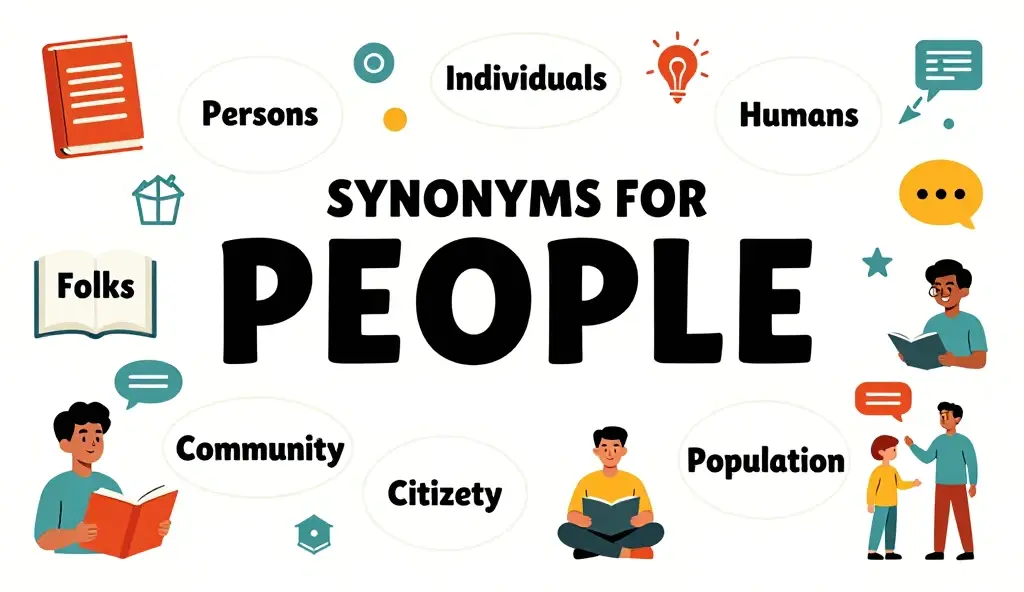
The word people is one of the most common words in English.
We use it every day to talk about groups, communities, individuals, and human beings.
Because it appears so frequently in conversations, articles, reports, and academic writing, many writers search for synonyms for people to make their vocabulary more varied and accurate.
However, not every replacement word has the exact same meaning.
A word like individuals focuses on separate persons, while population refers to a large group living in a specific area.
Similarly, citizens has a legal meaning, and folks creates a friendly, informal tone.
Choosing the right synonym helps your writing sound more natural, professional, and clear.
If you are writing a blog post, essay, business report, or everyday message, understanding these alternatives can improve your communication.
Meaning of People
Definition
People means human beings considered individually or as a group.
It can refer to:
- Men, women, and children
- Members of a community
- A group of individuals
- The human race
- Citizens of a country
Examples
- Many people enjoy traveling.
- The people of this city are friendly.
- Young people use technology every day.
- These people helped during the emergency.
Pronunciation
People
IPA:
/ˈpiːpəl/
Natural pronunciation:
PEE-puhl
Pronunciation Tips
- The first syllable sounds like “pee”.
- The second syllable is soft and quick.
- Native speakers usually pronounce it smoothly in two syllables.
Examples:
- People are waiting.
- Many people agree.
Part of Speech
Noun
People is mainly used as a noun.
Examples
- People need connection.
- The people voted for change.
- Many people attended the event.
Singular Form
The singular form is usually:
- Person
Examples:
- One person arrived early.
- Many people arrived early.
Related Forms
| Word | Part of Speech | Example |
| Person | Noun | One person called me. |
| People | Noun | Many people came. |
| People’s | Possessive noun | People’s opinions matter. |
| Human | Noun/Adjective | Human behavior is complex. |
| Population | Noun | The population is growing. |
Synonyms for People
| Word | Meaning | Usage | Formality | Example | Difficulty |
| Individuals | Separate persons | Formal writing | Formal | Individuals have different needs. | Medium |
| Persons | Human beings | Legal writing | Formal | Authorized persons only. | Medium |
| Humans | Members of the human race | Science/general | Neutral | Humans need water to survive. | Easy |
| Human beings | People as living creatures | Academic | Formal | Human beings create cultures. | Easy |
| Folks | People in a friendly way | Conversation | Informal | Folks are enjoying the event. | Easy |
| Citizens | Members of a country | Government | Formal | Citizens voted today. | Medium |
| Residents | People living in an area | Local topics | Neutral | Residents opposed the plan. | Medium |
| Community members | People in a group | Social topics | Neutral | Community members helped. | Medium |
| Population | A large group of people | Statistics | Formal | The population increased. | Medium |
| Society | People viewed as a whole | Social studies | Formal | Society changes over time. | Medium |
| Crowd | Large group gathered together | Events | Neutral | A crowd watched the game. | Easy |
| Group | Collection of people | General | Neutral | A group joined the meeting. | Easy |
| Public | People in general | Media/government | Formal | The public responded. | Easy |
| Individuals | Specific people | Research | Formal | Individuals make choices. | Medium |
Best Synonyms for People
1. Individuals
Meaning
Individuals refers to separate people considered one by one.
Difference
While people usually describes a group, individuals focuses on each person separately.
Examples
- Every individual has unique skills.
- Individuals make their own decisions.
- Researchers studied 500 individuals.
Best Situation
Use individuals in:
- Research
- Business reports
- Academic writing
- Professional communication
Common Mistakes
Do not use individuals when talking about a group casually.
Less natural:
- Individuals at the party were dancing.
Better:
- People at the party were dancing.
2. Persons
Meaning
Persons means human beings, especially in official or legal situations.
Difference
Persons sounds more formal than people.
Examples
- Only authorized persons may enter.
- Missing persons were reported.
- Three persons were injured.
Best Situation
Use in:
- Legal documents
- Rules
- Regulations
- Official notices
Common Mistakes
In normal conversation, people is usually more natural.
3. Humans
Meaning
Humans refers to members of the human species.
Difference
Unlike people, humans often emphasizes biology or human nature.
Examples
- Humans need food and water.
- Humans have developed advanced technology.
- Human behavior is fascinating.
Best Situation
Use for:
- Science
- History
- Philosophy
- Psychology
Common Mistakes
Don’t use humans when talking about a small everyday group.
4. Human Beings
Meaning
Human beings means people as living creatures.
Difference
It sounds more thoughtful or philosophical than simply saying people.
Examples
- Human beings create art and culture.
- All human beings deserve respect.
- Human beings learn from experience.
Best Situation
Use in:
- Academic writing
- Philosophy
- Social discussions
Common Mistakes
It is often too formal for casual conversation.
5. Folks
Meaning
Folks is an informal and friendly word for people.
Difference
It creates a warm, conversational feeling.
Examples
- Hi folks, welcome!
- Folks around here are very friendly.
- Young folks enjoy new technology.
Best Situation
Use in:
- Conversations
- Blogs
- Friendly messages
- Speeches
Common Mistakes
Avoid using folks in formal reports.
Best Synonyms for People (Continued)
6. Citizens
Meaning
Citizens are people who legally belong to a particular country and have rights and responsibilities there.
Difference
While people refers to humans generally, citizens specifically refers to members of a nation or state.
Examples
- Citizens have the right to vote.
- The government protects its citizens.
- Responsible citizens help their communities.
Best Situation
Use citizens for:
- Government topics
- Politics
- Law
- Public services
- National issues
Common Mistakes
Not every person living in a country is necessarily a citizen. Some may be visitors, immigrants, or temporary residents.
7. Residents
Meaning
Residents are people who live in a particular place, such as a city, neighborhood, building, or country.
Difference
A resident is defined by where they live, while a person or people is a broader term.
Examples
- Local residents complained about the noise.
- The apartment building has many residents.
- Residents received a notice from the city.
Best Situation
Use residents for:
- Local news
- Housing
- Communities
- Cities
- Neighborhood discussions
Common Mistakes
A resident does not always have citizenship in that location.
8. Community Members
Meaning
Community members are people who belong to or participate in a particular community.
Difference
This phrase emphasizes connection, cooperation, and belonging.
Examples
- Community members organized a cleanup event.
- Local community members helped families after the storm.
- Community members shared their ideas.
Best Situation
Use for:
- Social projects
- Organizations
- Neighborhoods
- Volunteer work
Common Mistakes
It is not usually used for random groups of strangers.
9. Population
Meaning
Population refers to all the people living in a particular area or belonging to a specific group.
Difference
Unlike people, population usually describes a large number of individuals in statistics or research.
Examples
- The city’s population is growing.
- The population of young adults is increasing.
- Researchers studied the population of the region.
Best Situation
Use in:
- Statistics
- Geography
- Research
- Science
- Government reports
Common Mistakes
Do not use population for a small casual group.
Incorrect:
- Five people came to my house.
Not:
- Five population came to my house.
10. Society
Meaning
Society refers to people living together as an organized community with shared systems, values, and cultures.
Difference
People refers to individuals or groups, while society refers to humans as a collective system.
Examples
- Technology has changed society.
- Society influences human behavior.
- Modern society faces many challenges.
Best Situation
Use for:
- Sociology
- Culture
- History
- Academic writing
Common Mistakes
Society is not usually used to describe a small number of people.
11. Crowd
Meaning
A crowd is a large group of people gathered in one place.
Difference
Unlike people, a crowd focuses on physical gathering.
Examples
- A crowd gathered outside the stadium.
- The crowd cheered loudly.
- Police controlled the crowd.
Best Situation
Use for:
- Events
- Sports
- Concerts
- Public gatherings
Common Mistakes
A crowd does not always mean a community or organized group.
12. Group
Meaning
A group is a collection of people who are together for a reason or purpose.
Difference
A group can be small or large, while people is a general word.
Examples
- A group of students joined the competition.
- Our group discussed the project.
- The group worked together.
Best Situation
Use for:
- Teams
- Classes
- Meetings
- Activities
Common Mistakes
A group usually suggests some connection between members.
13. Public
Meaning
Public refers to people in general, especially a large population or audience.
Difference
Public focuses on people as a collective audience rather than individual persons.
Examples
- The public supports the decision.
- The news attracted public attention.
- Public opinion can influence leaders.
Best Situation
Use for:
- Media
- Government
- Social discussions
- Communication
Common Mistakes
Do not use public when referring to specific individuals.
Antonyms of People
The word people does not have a direct opposite because it refers to humans. However, depending on the context, opposite concepts may include non-human things, isolation, or absence of groups.
| Word | Meaning | Usage | Example |
| Animals | Living creatures other than humans | Biology | Animals and people share ecosystems. |
| Objects | Non-living things | General | People use objects every day. |
| Machines | Artificial devices | Technology | Machines cannot replace all human actions. |
| Robots | Artificial intelligent devices | Technology | Robots are different from people. |
| Solitude | Being alone | Lifestyle | He enjoys solitude. |
| Individual | One person instead of a group | Comparison | An individual differs from a crowd. |
| Nobody | No person | Conversation | Nobody was there. |
| Nothing | No thing | General | Nothing replaced human connection. |
| Isolation | Separation from others | Social topics | Isolation affects people. |
| Wilderness | Natural areas without society | Geography | Few people live in the wilderness. |
Understanding Each Opposite Concept
1. Animals
Meaning
Animals are living creatures that are not humans.
Examples
- People study animals in nature.
- Animals and humans interact in many ways.
Best Situation
Used in:
- Science
- Biology
- Nature discussions
2. Objects
Meaning
Objects are physical things that are not living beings.
Examples
- People create objects.
- Objects do not have emotions like humans.
3. Machines
Meaning
Machines are devices created by humans to perform tasks.
Examples
- Machines help people work faster.
- Modern machines support human activities.
4. Robots
Meaning
Robots are programmed machines that perform tasks automatically.
Examples
- Robots can assist people in factories.
- Robots are different from human workers.
5. Solitude
Meaning
Solitude means being alone or separated from others.
Examples
- She enjoys solitude after a busy week.
- Too much solitude can feel lonely.
6. Individual
Meaning
An individual refers to one person rather than a group.
Examples
- The team includes many individuals.
- Each individual has different goals.
7. Nobody
Meaning
Nobody means no person.
Examples
- Nobody answered the phone.
- Nobody knew the answer.
8. Isolation
Meaning
Isolation means separation from other people.
Examples
- Social isolation can affect mental well-being.
- The village experienced isolation for years.
Real-World Examples of Using Synonyms for People
The following examples show how different synonyms for people fit naturally into real-life situations.
- Many people enjoy spending time with family and friends.
- Researchers interviewed 500 individuals for the study.
- All citizens have the right to participate in elections.
- Local residents supported the new community project.
- The city’s population has increased over the last decade.
- The community members worked together to clean the park.
- Many humans depend on technology in daily life.
- The teacher asked the students to complete the assignment.
- A large crowd gathered outside the stadium.
- The government listened to the concerns of the public.
- Young folks often learn quickly from new experiences.
- The organization helps human beings affected by natural disasters.
- The company values its employees and their ideas.
- Several persons were invited to attend the official meeting.
- Different groups have different opinions about the issue.
- Modern society faces challenges related to technology.
- The charity provides support to vulnerable individuals.
- Many residents attended the neighborhood meeting.
- The program benefits millions of people worldwide.
- The research examines how humans make decisions.
- Local citizens participated in the public discussion.
- The event attracted a huge crowd of visitors.
- The survey collected responses from different groups.
- The company wants to understand its customers better.
- The school encourages students to respect others.
- Community members volunteered during the emergency.
- The government created policies to protect its population.
- The museum welcomes visitors from around the world.
- Online platforms connect people across different countries.
- Every individual has unique talents and experiences.
25 Example Sentences Using Synonyms for People
These sentences show how different alternatives can replace the word people naturally.
- Many individuals choose to work from home today.
- The local residents welcomed the new store.
- Responsible citizens follow the laws of their country.
- The entire population was affected by the weather event.
- The community members organized a fundraising event.
- Humans have explored space for many years.
- The public deserves accurate information.
- A large crowd gathered for the concert.
- The company interviewed several persons for the position.
- Different groups shared their opinions during the discussion.
- Modern society continues to change rapidly.
- Friendly folks in the village helped us.
- Every human being deserves respect and dignity.
- The researcher studied how individuals behave.
- Local citizens voted on the important issue.
- The neighborhood residents planted trees together.
- Many people attended the educational event.
- The organization supports vulnerable populations.
- The conference attracted professionals from many communities.
- The online platform connects millions of users.
- Different generations have different experiences.
- The charity provides resources to needy families.
- The teacher encouraged all students to participate.
- The company listens carefully to its customers.
- Every person has a unique story.
Formal vs. Informal Usage
The word people is suitable for most situations, but some synonyms create different tones.
| Informal Word | Formal Alternative | Best Used In |
| People | Individuals | Research and reports |
| People | Persons | Legal documents |
| People | Citizens | Government topics |
| People | Residents | Local issues |
| People | Population | Statistics |
| People | Human beings | Academic writing |
| People | Folks | Casual conversations |
| People | Community members | Social projects |
Informal Examples
- A lot of people like this movie.
- Hey folks, welcome to the event.
- Some people are waiting outside.
- Young people enjoy social media.
- Many people helped after the accident.
Formal Examples
- The study analyzed 1,000 individuals.
- The rights of citizens must be protected.
- The local population has increased.
- Human beings have complex emotions.
- The organization supports vulnerable communities.
Which Word Should You Choose?
Use people when:
- Speaking generally
- Writing simple content
- Having everyday conversations
Example:
“Many people enjoy reading.”
Use individuals when:
- You want to emphasize separate persons
- Writing academically
- Discussing research
Example:
“The study examined individual behaviors.”
Use citizens when:
- Talking about a country
- Discussing legal rights
Example:
“Citizens voted in the election.”
Use residents when:
- Talking about a location
Example:
“Residents complained about traffic.”
Use population when:
- Discussing statistics
Example:
“The population increased by 10%.”
Academic Usage of Synonyms for People
Academic writing often requires precise vocabulary. Instead of repeating people, writers choose words based on the exact meaning.
Examples
General Statement
Basic:
People use technology every day.
Academic:
Individuals use technology for communication, education, and professional activities.
Research Context
Basic:
Researchers studied people with different backgrounds.
Academic:
Researchers studied individuals from diverse backgrounds.
Social Studies
Basic:
People create cultures.
Academic:
Human beings create complex cultures and social systems.
Government Context
Basic:
People deserve equal opportunities.
Academic:
Citizens deserve equal opportunities within a democratic society.
Academic Alternatives Table
| Common Word | Academic Alternative | Example |
| People | Individuals | Individuals responded differently. |
| People | Human beings | Human beings adapt to change. |
| People | Population | The population was surveyed. |
| People | Society | Society influences behavior. |
| People | Citizens | Citizens have legal rights. |
| People | Participants | Participants completed the study. |
| People | Respondents | Respondents answered questions. |
| People | Communities | Communities experience shared challenges. |
Daily Conversation Usage
In everyday speech, simple words usually sound more natural.
Examples
Friends:
- “Many people are coming tonight.”
- “Hey folks, how are you?”
Family:
- “Older people need respect.”
- “Young people learn quickly.”
Work:
- “The team has many talented people.”
- “Our employees are doing great work.”
Travel:
- “Local people were very friendly.”
- “The residents showed us the area.”
Online:
- “Many users shared their opinions.”
- “People are talking about this trend.”
Community:
- “Community members joined the event.”
- “Citizens supported the project.”
Conversation Tips
- Use people for normal conversations because it sounds natural.
- Use folks when you want a friendly tone.
- Use individuals when accuracy matters.
- Use citizens only when discussing legal membership in a country.
- Use residents when location matters.
- Avoid using overly formal words in casual speech.
Grammar Tips for Using Synonyms for People
Choosing the correct synonym for people depends on meaning, grammar, and context. These tips will help you use alternatives naturally.
1. Understand Singular and Plural Forms
The word people is already plural.
Correct:
- Many people attended the event.
- Several individuals joined the meeting.
- Three persons were selected.
Incorrect:
- A people came to my house.
Use:
- A person came to my house.
2. Use “Person” for One Individual
When talking about one human, use person.
Examples:
- One person called me.
- Every person has different goals.
- That person helped me.
For multiple humans:
- Many people called me.
- Several individuals helped.
3. Match the Meaning With the Situation
Different synonyms carry different meanings.
| Situation | Best Word |
| General humans | People |
| Research | Individuals |
| Legal documents | Persons |
| Country membership | Citizens |
| Local area | Residents |
| Statistics | Population |
| Science | Humans |
| Friendly speech | Folks |
| Social groups | Community members |
4. Avoid Overusing Formal Words
Some words sound unnatural in casual conversations.
Less Natural:
- Many individuals are waiting for the bus.
Better:
- Many people are waiting for the bus.
Formal writing:
- The study examined several individuals.
5. Use Collective Words Correctly
Some synonyms refer to groups, not separate people.
Population
Correct:
- The population of the city is growing.
Incorrect:
- Five populations came to the meeting.
Society
Correct:
- Society changes over time.
Incorrect:
- Ten societies came to my house.
6. Understand “People” vs “Persons”
Both are correct, but the usage differs.
| Word | Usage |
| People | Everyday English |
| Persons | Legal or official English |
Examples:
Everyday:
- Many people attended.
Official:
- Authorized persons only.
7. Use Possessive Forms Correctly
People’s
Means belonging to people.
Examples:
- People’s opinions matter.
- People’s choices affect society.
- People’s needs are important.
8. Avoid Repetition in Writing
Instead of:
People help people because people care about people.
Use:
Individuals help others because communities care about their members.
Common Collocations With People
Collocations are word combinations that native speakers commonly use.
| Collocation | Meaning | Example |
| Young people | Younger generation | Young people use technology often. |
| Older people | Elder generation | Older people share valuable wisdom. |
| Many people | Large number | Many people enjoy music. |
| Some people | Part of a group | Some people prefer quiet places. |
| Different people | Various individuals | Different people have different views. |
| Poor people | People with limited money | Organizations help poor people. |
| Rich people | Wealthy individuals | Rich people often invest money. |
| Local people | People from an area | Local people guided tourists. |
| Common people | Ordinary individuals | The policy affects common people. |
| Business people | People involved in business | Business people attend conferences. |
| People skills | Ability to interact well | Good people skills help careers. |
| People power | Influence of groups | People power can create change. |
| People behavior | Human actions | People behavior changes online. |
| People management | Managing workers | Good people management builds teams. |
| People-oriented | Focused on human needs | She has a people-oriented approach. |
Common Phrases Using People
1. People Around the World
Meaning: Humans in different countries.
Example:
- People around the world celebrate different traditions.
2. Ordinary People
Meaning: Regular individuals, not famous or powerful people.
Example:
- Ordinary people can create meaningful change.
3. Like-Minded People
Meaning: People who share similar opinions or interests.
Example:
- She enjoys meeting like-minded people.
4. People in General
Meaning: Humans broadly.
Example:
- People in general enjoy feeling appreciated.
5. Good People
Meaning: Kind or morally positive individuals.
Example:
- Good people often help others.
6. Different Types of People
Meaning: Various kinds of personalities or groups.
Example:
- You meet different types of people throughout life.
7. People Person
Meaning: Someone who enjoys interacting with others.
Example:
- She is a natural people person.
8. People Skills
Meaning: Communication and relationship abilities.
Example:
- Strong people skills help in customer service.
Idioms Related to People
| Idiom | Meaning | Example |
| People person | Someone social and friendly | My brother is a real people person. |
| Man of the people | Someone connected to ordinary citizens | The leader was seen as a man of the people. |
| People power | Influence of ordinary citizens | People power changed the situation. |
| Keep up with the Joneses | Try to match others socially | Some people try to keep up with the Joneses. |
| Birds of a feather flock together | Similar people spend time together | They became friends because birds of a feather flock together. |
| A people pleaser | Someone who wants everyone to like them | She is sometimes too much of a people pleaser. |
| Put yourself in someone else’s shoes | Understand another person’s feelings | Try to put yourself in their shoes. |
| Walk a mile in someone’s shoes | Understand someone’s experience | You should walk a mile in their shoes. |
| It takes all sorts | Different kinds of people exist | It takes all sorts to make a world. |
| No man is an island | People need connections | No man is an island; everyone needs support. |
Similar Words Comparison
| Word | Meaning | Difference | Example |
| People | Humans generally | Most common word | People enjoy stories. |
| Persons | Individual humans | Formal/legal | Authorized persons only. |
| Individuals | Separate people | Focuses on uniqueness | Individuals make choices. |
| Humans | Human species | Scientific meaning | Humans need resources. |
| Citizens | Legal members of a country | Government context | Citizens vote. |
| Residents | People living somewhere | Location focus | Residents complained. |
| Population | Total number of people | Statistical meaning | Population growth increased. |
| Society | People as a system | Cultural meaning | Society changes. |
| Crowd | Group gathered together | Physical gathering | Crowd cheered. |
| Community | Connected group | Shared identity | Community helped families. |
FAQs
Q1. What are the best synonyms for people?
A: Common synonyms include individuals, persons, humans, citizens, residents, folks, population, and community.
Q2. Is individuals a synonym for people?
A: Yes. It is a common formal alternative.
Q3. What is a formal synonym for people?
A: Individuals, persons, citizens, and population are common formal choices.
Q4. What is an informal synonym for people?
A: Folks, guys, everyone, and crowd are informal alternatives.
Q5. What is the difference between people and persons?
A: People is general, while persons is mainly used in legal or formal contexts.
Q6. Can humans replace people?
A: Sometimes. It works best in scientific or biological contexts.
Q7. What is the difference between people and population?
A: People refers to humans generally, while population refers to the number of people in a place.
Q8. Are citizens and people the same?
A: No. Citizens belong to a specific country, while people is broader.
Q9. Which synonym is best for essays?
A: Individuals, human beings, citizens, and population are good formal options.
Q10. Which synonym is best for SEO writing?
A: Use natural terms like people, individuals, users, or customers, depending on the topic.
Q11. What is the difference between people and society?
A: People means humans, while society refers to an organized community.
Q12. Can I use folks instead of people?
A: Yes. Folks is a friendly, informal alternative.
Q13. What is another word for a group of people?
A: Common alternatives include crowd, community, team, audience, and group.
Q14. What is the singular of people?
A: The singular form is person.
Expert Tips for Using Synonyms for People
Using the right synonym for people can make your writing clearer, more professional, and more natural. These expert tips will help you choose the best word for every situation.
1. Choose Meaning Over Variety
Do not replace people just to avoid repetition. Choose a synonym that adds the exact meaning you need.
Example:
❌ Incorrect:
- Many citizens enjoy music.
(Only true if they belong to a country.)
✅ Better:
- Many people enjoy music.
2. Use “Individuals” for Research and Formal Writing
The word individuals works well when focusing on separate people.
Examples:
- Researchers studied individuals with different experiences.
- The program helps individuals develop new skills.
Best for:
- Academic papers
- Surveys
- Reports
- Professional documents
3. Use “Citizens” Only for National Contexts
Use citizens when discussing rights, laws, or government.
Examples:
- Citizens have voting rights.
- The government protects its citizens.
Avoid:
- Citizens enjoy this movie.
Better:
- People enjoy this movie.
4. Use “Residents” When Location Matters
The word residents highlights where people live.
Examples:
- Local residents supported the project.
- Residents of the neighborhood attended the meeting.
Good for:
- Cities
- Housing
- Local news
- Community topics
5. Avoid Overly Formal Language in Conversations
Some words sound unnatural in everyday speech.
Too formal:
- Several persons attended my birthday party.
Natural:
- Several people attended my birthday party.
6. Match the Audience
Different audiences require different vocabulary.
| Audience | Better Word |
| Friends | People, folks |
| Students | People, individuals |
| Scientists | Humans, population |
| Government | Citizens, residents |
| Researchers | Individuals, participants |
| Businesses | Customers, users, employees |
7. Use Specific Words When Possible
Specific words often create stronger writing.
Weak:
- People visited the website.
Better:
- Visitors explored the website.
Weak:
- People bought products.
Better:
- Customers purchased products.
8. Avoid Keyword Repetition in Content Writing
For SEO writing, repeating people too often can make content feel unnatural.
Use related terms when appropriate:
- Individuals
- Users
- Readers
- Customers
- Communities
- Audiences
- Residents
- Consumers
Always make sure the replacement keeps the same meaning.
9. Remember That Context Controls Meaning
A synonym may work in one sentence but fail in another.
Example:
✅ Correct:
- The population of the city increased.
❌ Incorrect:
- The population at my dinner was five.
Better:
- Five people attended my dinner.
10. Read Your Sentence Naturally
The best synonym is the one that sounds like something a native speaker would naturally say.
Example:
Formal:
- The research examined 1,000 individuals.
Conversation:
- The study looked at 1,000 people.
Both are correct, but the situation decides the choice.
Conclusion:
The word people is one of the most useful words in English because it can describe humans, communities, and groups in many situations.
However, using the right synonyms for people can make your writing more accurate, engaging, and professional.
Words like individuals, persons, citizens, residents, humans, community members, and population each have their own meaning and purpose.
While individuals is excellent for research, citizens fits government topics, residents works for locations, and folks creates a friendly conversational tone.
The key to choosing the best synonym is understanding the context.
Good word choice is not about using complicated vocabulary; it is about selecting the word that communicates your exact meaning clearly.

Christopher Ward writes practical guides on word usage, synonyms, and effective written communication for a global audience.