
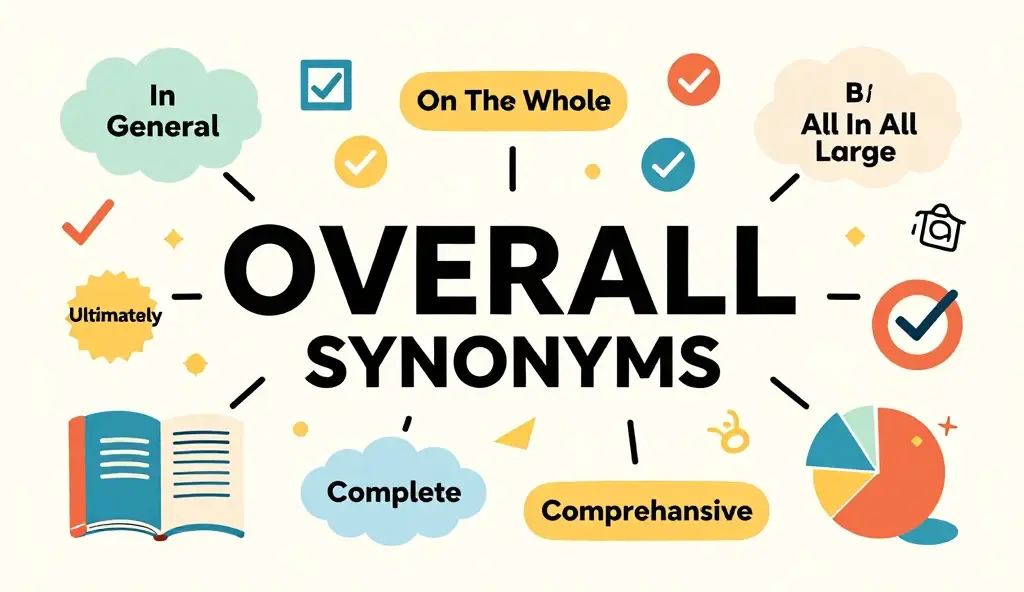
Why search for synonyms for overall? Overusing “overall” in executive summaries, research papers, performance reviews, and essays leads to repetitive, generic writing.
We frequently rely on “overall” to cover everything from total sales (overall revenue) to general sentiment (overall feeling) to full evaluations (overall score).
Swapping out this default word for precise alternatives brings clarity, professionalism, and nuance to your conclusions.
Meaning
The word overall functions as an adjective, adverb, or noun, with three primary meanings in English:
- Including Everything (Adjective): Taking everything into account; comprehensive or total (e.g., “the overall cost”).
- In General / On the Whole (Adverb): Considering everything as a whole; generally speaking (e.g., “Overall, the event went well”).
- Protective Garment (Noun – Usually Plural): Heavy-duty protective clothing worn over normal clothes (e.g., “a pair of overalls”).
Pronunciation
How to Pronounce “Overall”
- 🗣️ Phonetic Spelling: /ˈoʊ.vɚ.ɑːl/
- 🎵 Rhymes with: Cover all (near rhyme).
- 💡 Natural Sounding Guide: Starts with a clear “oh-ver” sound, followed by a stressed “all”.
Part of Speech
1. Adjective
Modifies a noun to indicate a complete sum, full scope, or general state:
- 📝 Example: “The overall performance of the team exceeded expectations.” (Total / General)
2. Adverb
Modifies an entire sentence or clause to provide a summary judgment:
- 📝 Example: “Overall, the campaign was a resounding success.” (In summary / Generally)
3. Noun (Plural: Overalls)
Refers to protective denim or heavy cloth trousers with a bib and shoulder straps:
- 📝 Example: “The mechanic put on his overalls before repairing the engine.” (Workwear)
Synonyms Table
| Word | Meaning | Usage Context | Formality | Example Sentence | Difficulty Level |
| Comprehensive | Including or dealing with all or nearly all elements | Reports / Strategy | Formal | We conducted a comprehensive review of the safety protocols. | Intermediate |
| Aggregate | Formed or calculated by the combination of many items | Finance / Data | Formal | The aggregate income exceeded initial fiscal projections. | Advanced |
| Holistic | Characterized by the belief that parts are interconnected | Health / Strategy | Formal | The firm takes a holistic approach to employee wellness. | Advanced |
| Overarching | Comprehensive; all-encompassing in scope | Policy / Architecture | Formal | The overarching goal is to reduce carbon emissions. | Advanced |
| Gross | Total before any deductions (taxes, costs) | Accounting / Business | Formal | The company reported a gross profit of five million dollars. | Intermediate |
| Inclusive | Including all the expected or stated services/items | Pricing / Packages | Neutral | The resort offers an all-inclusive vacation package. | Easy |
| Global | Operating or applying across a whole system or world | Strategy / Tech | Neutral | We need a global strategy to handle data privacy. | Intermediate |
| General | Affecting or concerning all or most people/parts | Daily / Summary | Easy | The general consensus was in favor of the proposal. | Easy |
| Pervasive | Spreading widely throughout an area or group | Analysis / Trends | Formal | High inflation created a pervasive sense of caution. | Advanced |
| Sweeping | Wide in range or effect; far-reaching | Policy / Reforms | Neutral | The new manager introduced sweeping organizational changes. | Intermediate |
| Thorough | Complete with regard to every detail; painstaking | Research / Audits | Neutral | She gave the financial audit a thorough examination. | Easy |
Best Synonyms for “Overall” (Explained)
1. Comprehensive
- 🔍 Meaning: Covering completely or broadly; including all essential elements.
- 🔄 Difference from Overall: “Comprehensive” emphasizes thoroughness, completeness, and meticulous coverage rather than just a total sum.
- 💬 Example: “The report provides a comprehensive overview of market trends.”
- 🎯 Best Situation: Research summaries, strategic plans, audit reports, and textbook titles.
- ⚠️ Common Mistake: Avoid using “comprehensive” as an adverb at the start of a sentence (use “comprehensively” instead).
2. Aggregate
- 🔍 Meaning: Formed by adding together several different amounts or items to form a single total.
- 🔄 Difference from Overall: “Aggregate” is a precise mathematical and financial term for combining individual sub-totals.
- 💬 Example: “The aggregate score determined which team advanced to the finals.”
- 🎯 Best Situation: Data science, economics, financial accounting, and sports tournament scoring.
- ⚠️ Common Mistake: Do not use “aggregate” to describe qualitative feelings or moods.
3. Holistic
- 🔍 Meaning: Viewing a system as an integrated whole rather than a collection of separate parts.
- 🔄 Difference from Overall: “Holistic” implies that the parts interact dynamically and cannot be understood in isolation.
- 💬 Example: “Medical professionals favor a holistic treatment plan for chronic illness.”
- 🎯 Best Situation: Healthcare, business strategy, educational philosophy, and environmental studies.
- ⚠️ Common Mistake: Avoid overusing “holistic” in simple arithmetic contexts where a simple “total” is meant.
4. Overarching
- 🔍 Meaning: Forming an arch over; dominating or embracing everything beneath it.
- 🔄 Difference from Overall: “Overarching” highlights a central, guiding theme, vision, or goal that governs all smaller elements.
- 💬 Example: “Customer satisfaction remains the overarching theme of our mission.”
- 🎯 Best Situation: Corporate vision statements, research hypotheses, literary themes, and policy frameworks.
- ⚠️ Common Mistake: Ensure there are actually sub-elements beneath the main theme before calling it “overarching.”
Antonyms
| Word | Meaning | Usage Context | Example Sentence |
| ✨ Specific | Clearly defined or identified; particular | General | She gave specific instructions for completing the task. |
| ✨ Partial | Existing only in part; incomplete | Business / Reports | The project was only a partial success due to budget cuts. |
| ✨ Individual | Single or separate; considered apart from others | Data / People | We analyzed the individual performance of each sales rep. |
| ✨ Segmented | Divided into separate parts or sections | Marketing / Tech | Market research revealed segmented consumer preferences. |
| ✨ Itemized | Broken down into individual items or details | Accounting / Invoices | The vendor provided an itemized list of expenses. |
30 Real-World Examples
🎯 Bullet Points of Contextual Usage
- The team conducted a comprehensive assessment of risk factors.
- Aggregate consumer spending rose by two percent this quarter.
- Management adopted a holistic framework for employee wellness.
- The overarching objective is to improve customer retention.
- The company reported an increase in gross revenue.
- The fee is all-inclusive of taxes and maintenance charges.
- The software update implements global security fixes.
- The general sentiment among voters remained positive.
- Economic uncertainty caused a pervasive slowdown in hiring.
- The government announced sweeping reforms in tax policy.
- The auditor performed a thorough inspection of the books.
- On the whole, the project met its primary milestones.
- In summary, the new policy streamlines internal communication.
- The cumulative effect of daily training resulted in a record time.
- The total cost of the renovation exceeded the initial budget.
- The broad consensus favored expanding into new markets.
- The entire system underwent routine maintenance.
- All things considered, the product launch went smoothly.
- The study gives a macro perspective on global trade shifts.
- Her encapsulating analysis clarified the complex data.
- The full picture will emerge after the final audit.
- By and large, customer feedback has been enthusiastic.
- The strategy aligns with our long-term growth goals.
- In aggregate, small improvements led to major cost savings.
- The complete package includes training and software support.
- The policy applies universally across all global branches.
- The main trend indicates a shift toward mobile usage.
- Taking everything into account, the decision was justified.
- The document offers an exhaustive directory of services.
- The chief concern for investors remains supply chain stability.
25 Naturally Written Sentences
Formal Styles
- 🔹 The board approved a comprehensive strategy to increase market share.
- 🔹 The aggregate statistical data validates the researchers’ initial hypothesis.
- 🔹 Diversity and inclusion form an overarching priority for our leadership team.
- 🔹 The report presents a holistic evaluation of corporate governance.
- 🔹 In conclusion, the enterprise achieved sustainable profit margins this fiscal year.
Informal Styles
- 🔹 All in all, it was a really great weekend trip.
- 🔹 When you look at the big picture, we got a lot done this month.
- 🔹 At the end of the day, we just want what’s best for the team.
- 🔹 Generally speaking, most people seem to like the new design.
- 🔹 The total came out to a lot less than I expected.
Academic Styles
- 🔹 The literature review provides a comprehensive synthesis of prior studies.
- 🔹 Cumulative evidence points toward a significant correlation between variables.
- 🔹 The study offers a macro perspective on regional climate patterns.
- 🔹 Researchers observed a pervasive trend toward digitized data collection.
- 🔹 In summary, the empirical data supports the primary thesis.
Formal vs. Informal Usage
| Usage Category | Formal Option | Informal Option | Practical Context |
| 🏷️ Data & Numbers | Aggregate / Gross | Total / Full amount | “Aggregate sales” vs “Full total” |
| 🏷️ Broad Scope | Comprehensive / Overarching | Big picture / Whole thing | “Comprehensive plan” vs “Big picture view” |
| 🏷️ Sentence Transitions | In conclusion / In summary | All in all / At the end of the day | “In summary, we won” vs “All in all, we won” |
| 🏷️ System Views | Holistic / Global | All-around / General | “Holistic health” vs “All-around health” |
Academic Usage
In academic writing, relying on “overall” can make conclusions sound casual or imprecise. Opt for academic signal words that specify how the summary was derived:
- 🎓 Use in summary, in conclusion, or synthesizing these findings as transitional adverbs.
- 🎓 Use comprehensive, exhaustive, or systematic when describing methodologies, reviews, or literature scope.
- 🎓 Use aggregate, cumulative, or macro when discussing combined data sets, population statistics, or trend lines.
Daily Conversation
In everyday speech, overusing “overall” can sound overly formal or robotic:
- 🗣️ “Overall, I liked the movie.”
- 🗣️ “The overall trip was good.”
- 🗣️ “Overall, we need to buy more groceries.”
Upgrade your daily speech to sound natural and fluid:
- ✨ Replace “Overall, I liked the movie” with “All in all, I liked the movie” or “On the whole, it was great.”
- ✨ Replace “The overall trip was good” with “The whole trip was great.”
- ✨ Replace “Overall, we need to…” with “Basically, we need to…” or “Bottom line, we need to…”
Grammar Tips
💡 Essential Rules for “Overall”
- Adverb Placement (Comma Rule): When starting a sentence with “Overall” as an introductory adverb, always follow it with a comma (“Overall, the results were positive”).
- Single Word vs. Two Words: “Overall” is a single word when acting as an adjective, adverb, or noun. Do not write it as two words (“over all”) unless using traditional prepositional phrases (“peace over all the earth”).
- Avoid Redundancy: Phrases like “total overall sum” or “comprehensive overall review” are redundant. Use either “overall” or “comprehensive,” but not both together.
Collocations
🔗 Common Word Pairings with “Overall”
- Overall impact: The full effect or consequence of an action or event. (e.g., “The overall impact of the policy will take years to measure.”)
- Overall performance: The total effectiveness or achievement across all metric areas. (e.g., “Her overall performance earned her a promotion.”)
- Overall strategy: The high-level, comprehensive plan guiding an organization. (e.g., “Digital transformation is key to our overall strategy.”)
- Overall health: The complete physical, mental, and social well-being of a person. (e.g., “Regular exercise benefits your overall health.”)
Phrases and Idioms
💬 Popular Expressions
- All in all: Considering everything that has happened; overall. (e.g., “All in all, it was a productive week.”)
- On the whole: Taking everything into consideration; generally speaking. (e.g., “On the whole, the team worked well under pressure.”)
- The big picture: The entire perspective or situation, as opposed to small details. (e.g., “Don’t get bogged down in details—focus on the big picture.”)
- At the end of the day: Ultimate conclusion or most important consideration. (e.g., “At the end of the day, customer satisfaction is what matters.”)
Similar Words & Word Comparison
📊 Comparing Summary Words
| Word | Primary Meaning | Subtle Difference | Best Example |
| 🔸 Overall | Including everything; general | Broad, multi-purpose summary term | The overall result. |
| 🔸 Comprehensive | Covering all aspects completely | Emphasizes thoroughness and detail | A comprehensive audit. |
| 🔸 Aggregate | Combined total of separate parts | Focuses on mathematical/data addition | Aggregate sales figures. |
| 🔸 Holistic | Viewing parts as an interconnected whole | Emphasizes system balance and relationships | Holistic healthcare. |
FAQs
Q1. What is the best overall synonym for overall?
A: The best choice depends on context. Use comprehensive for scope, aggregate for totals, holistic for systems, and all in all for summaries.
Q2. What is a formal word for overall?
A: Formal alternatives include comprehensive, aggregate, overarching, holistic, and macro.
Q3. What is a resume synonym for overall?
A: Use professional phrases like comprehensive oversight, cross-functional leadership, end-to-end management, or enterprise-wide management.
Q4. What is a synonym for overall goal?
A: Good alternatives include overarching objective, primary target, chief aim, ultimate outcome, and master strategy.
Q5. What can I use instead of overall at the start of a sentence?
A: Try in summary, on the whole, all in all, in conclusion, or taking everything into account.
Q6. What is an academic synonym for overall?
A: In academic writing, use in aggregate, cumulatively, comprehensively, systematically, or in summary.
Q7. Is over all one word or two?
A: When meaning general, total, or summary, it is written as one word: overall.
Q8. What is the primary antonym for overall?
A: Common opposites include specific, partial, individual, segmented, and itemized.
Expert Tips for Choosing the Right Synonym
- 💡 Match your data type: Use aggregate when adding up numerical data, gross for financial totals before deductions, and cumulative for gains accrued over time.
- 💡 Avoid introductory repetition: If you have already used “Overall,” vary your transitional phrases in executive summaries by using In summary, On the whole, or All things considered.
- 💡 Precision over hype: Claiming a “comprehensive plan” sounds far more professional and authoritative than simply calling it an “overall plan.”
Conclusion
Expanding your vocabulary beyond overall transforms how you present summaries, total metrics, and overarching conclusions.
Whether you choose comprehensive for a detailed review, aggregate for financial figures, or holistic for integrated strategy, selecting the exact word adds clarity, structure, and authority to your writing.

Natalie Phillips is an experienced content writer with expertise in vocabulary education and language-learning resources.