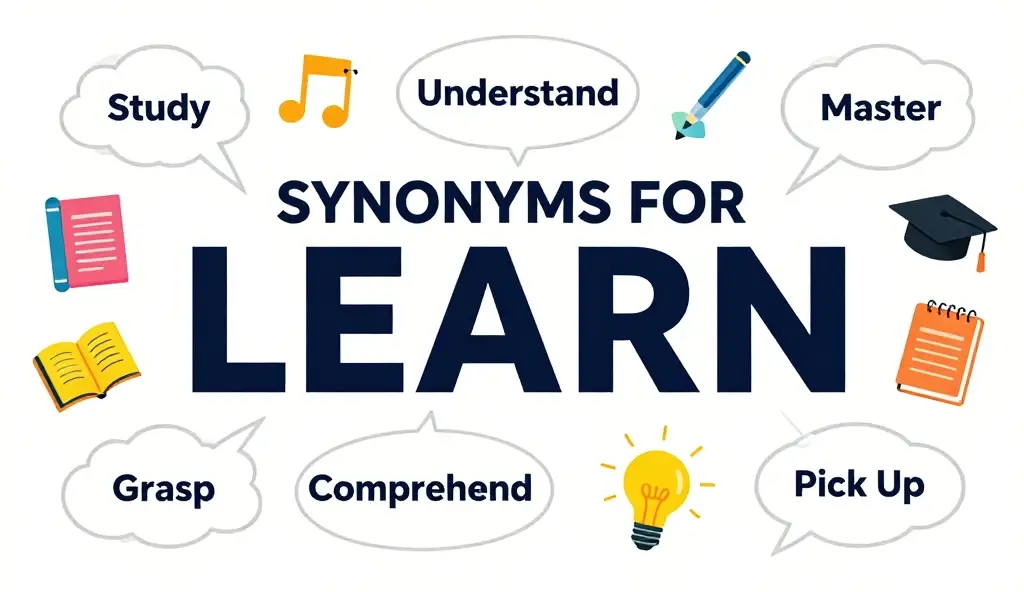
The verb learn is one of the most frequently searched English vocabulary terms.
People search for synonyms for learn because repeating the same verb in cover letters, lesson plans, research papers, or personal goals makes writing feel monotonous and simplistic.
What Learn Means
At its core, to learn means to gain knowledge, understanding, or a skill through study, experience, or being taught. It ranges from simple memorization to deep conceptual mastery and practical application.
Why People Search for Synonyms for Learn
- Resume Building: Job seekers need active, descriptive verbs like acquire, master, or assimilate to highlight professional development without overusing “learned.”
- Academic & Educational Writing: Educators and students need precise verbs to distinguish between basic recall, active studying, and high-level critical understanding.
- Professional Growth Plans: Employees framing performance goals benefit from specific verbs that indicate measurable learning outcomes.
- Daily Writing & Content Creation: Content creators, copywriters, and authors seek expressive vocabulary that accurately describes human discovery and skill-building.
When to Use Different Synonyms
Not all synonyms fit every sentence. You would not say you “studied” how to ride a bicycle if you meant you mastered physical balance, nor would you claim to have “discovered” a subject when you simply memorized test facts. Matching the tone, intensity, and setting produces clear, compelling communication.
Meaning and Pronunciation
Definition and Context
Learn means to acquire knowledge of or skill in something by study, instruction, or experience. It also means to become aware of a fact or information.
- Context: Learning can be formal (classroom study), practical (hands-on experience), cognitive (understanding concepts), or intuitive (discovering insights).
- Common Usage: Used widely across education, career development, science, psychology, and personal life.
Phonetic Pronunciation
How to pronounce learn:
- IPA: /lɜːrn/
- Phonetic Spelling: LURN
To pronounce it naturally, create a continuous “er” vowel sound followed by a quick nasal “n,” rhyming with burn, turn, and earn.
Part of Speech and Word Family
Learn is primarily a verb. It belongs to a larger word family that functions across multiple parts of speech.
| Part of Speech | Word | Example Sentence |
| Verb | Learn | She wants to learn conversational French. |
| Noun | Learner / Learning | Active learning improves long-term memory. |
| Adjective | Learned / Learnable | He shared insights with a learned audience. |
| Adverb | Learnable (modifying) | The technique is easily learnable. |
Master Table of Synonyms for Learn
Below is a comprehensive guide to the top synonyms for learn, organized by meaning, formality, and difficulty level.
| Word | Meaning | Formality | Example | Difficulty |
| Acquire | To gain a skill or knowledge over time | Formal | She managed to acquire basic coding skills. | Easy |
| Master | To gain complete skill or command | Medium / High | He spent years working to master the violin. | Easy |
| Grasp | To mentally understand a complex idea | Medium | The student quickly began to grasp calculus. | Easy |
| Absorb | To take in information naturally | Informal / Medium | Young children absorb languages very easily. | Easy |
| Study | To apply mind and time to acquire facts | Medium | They plan to study local environmental laws. | Easy |
| Assimilate | To absorb and integrate new information | Formal | Employees must assimilate the new policy. | Medium |
| Discover | To find or learn something for the first time | Medium | She was thrilled to discover a new technique. | Easy |
| Internalize | To make an idea or skill an innate part of yourself | Formal | Practice helps drivers internalize road safety. | Medium |
| Comprehend | To understand the nature or meaning of something | Formal | Readers struggle to comprehend dense legal text. | Medium |
| Pick up | To learn something informally or casually | Informal | He managed to pick up Spanish while traveling. | Easy |
| Glean | To gather information slowly or bit by bit | Formal | Analysts glean insights from raw survey data. | Hard |
| Memorize | To commit information to memory exact word-for-word | Medium | Students must memorize the periodic table. | Easy |
Deep Dive into the Best Synonyms for Learn
1. Acquire
- Meaning: To gain a skill, habit, or body of knowledge through effort or experience.
- Difference from Learn: Acquire sounds more formal and often implies a gradual, permanent accumulation of skills or knowledge over time.
- Example: During her internship, she was able to acquire valuable project management skills.
- Best Situation: Resumes, professional biographies, academic credentials, and corporate training logs.
- Common Mistakes: Do not use “acquire” for quick, trivial facts (e.g., avoid “I acquired his phone number”).
2. Master
- Meaning: To gain thorough, comprehensive skill in or command of a subject or activity.
- Difference from Learn: Learning is the beginning or ongoing process, whereas mastering represents reaching expert-level proficiency.
- Example: It takes thousands of practice hours to master classical chess.
- Best Situation: Senior resumes, skill certifications, performance appraisals, and expert tutorials.
- Common Mistakes: Claiming to “master” a massive field after a short workshop or introductory class.
3. Grasp
- Meaning: To get a firm mental hold on an idea; to comprehend fully.
- Difference from Learn: Grasp focuses specifically on the moment of mental understanding, especially regarding challenging or abstract concepts.
- Example: Once he began to grasp the core principles of physics, his test scores improved.
- Best Situation: Classroom feedback, technical training, academic evaluations, and troubleshooting.
- Common Mistakes: Using “grasp” for simple mechanical memorization that requires no deep understanding.
4. Absorb
- Meaning: To take in and retain information, ideas, or knowledge effortlessly or thoroughly.
- Difference from Learn: Absorb suggests a passive or highly receptive process, like a sponge taking in water.
- Example: Sitting in the front row helped her absorb every detail of the lecture.
- Best Situation: Early childhood education, immersion learning, language acquisition, and creative pursuits.
- Common Mistakes: Using “absorb” when active, grueling practice or physical effort is required.
5. Study
- Meaning: To devote time and attention to acquiring knowledge on an academic subject.
- Difference from Learn: Study is the action or method you perform; learning is the result you achieve. You can study without learning if you lack focus.
- Example: She decided to study marine biology at the state university.
- Best Situation: Academic schedules, research proposals, exam preparation, and library research.
- Common Mistakes: Using “study” when you mean you have already successfully gained the skill.
6. Assimilate
- Meaning: To absorb information, ideas, or culture and integrate them fully into your existing knowledge base.
- Difference from Learn: Assimilate is far more complex than learn. It means blending new facts seamlessly into how you think and act.
- Example: It takes time for new team members to assimilate corporate culture and practices.
- Best Situation: Organizational onboarding, sociology papers, high-level professional training, and cultural research.
- Common Mistakes: Using “assimilate” for brief, isolated pieces of information.
7. Internalize
- Meaning: To incorporate values, facts, or skills so deeply that they become second nature.
- Difference from Learn: Internalizing goes beyond head knowledge; it alters behavior automatically without conscious thought.
- Example: Good pilots internalize safety protocols until reactions become automatic.
- Best Situation: Safety training, behavioral psychology, ethics courses, and athletic coaching.
- Common Mistakes: Confusing internalizing with simple short-term memorization.
8. Glean
- Meaning: To collect information, news, or facts slowly, carefully, and from various scattered sources.
- Difference from Learn: Gleaning implies that information was hidden, fragmented, or difficult to collect.
- Example: Investigators worked carefully to glean details from old court records.
- Best Situation: Data analysis, historical research, investigative journalism, and market intelligence.
- Common Mistakes: Using “glean” when receiving straightforward, well-structured textbook instruction.
Antonyms for Learn
Understanding opposite words helps establish clear boundaries of meaning.
| Antonym | Meaning | Context | Example |
| Forget | To fail to remember or recall information | Memory | She began to forget formulas after the exam. |
| Unlearn | To discard an established habit or false belief | Habit / Mindset | Athletes must unlearn bad form to improve. |
| Ignore | To intentionally refuse to notice or take in facts | Attention | Disregard warnings and ignore basic safety guidelines. |
| Teach | To impart knowledge or skill to another person | Instruction | Experienced staff teach new employees daily. |
| Overlook | To fail to notice or consider something | Cognitive | Analysts can easily overlook vital clues. |
| Misunderstand | To interpret facts or ideas incorrectly | Understanding | Without clear context, readers misunderstand key points. |
30 Real-World Examples
Here are 30 natural, real-world examples demonstrating how to use synonyms for learn across career, academic, and daily settings.
- Interns quickly acquire foundational office software skills during orientation.
- It took her several months to master the new inventory management software.
- Students must grasp basic arithmetic before moving on to algebra.
- Children absorb new vocabulary rapidly when surrounded by active speakers.
- He decided to study sustainable agriculture during his semester abroad.
- New employees need time to assimilate complex compliance regulations.
- Scientists were eager to discover how the compound reacted under high pressure.
- Repetitive drills help athletes internalize proper defensive footwork.
- It was difficult for beginners to comprehend the full scope of the contract.
- She managed to pick up conversational Italian during her summer vacation.
- Market analysts attempt to glean consumer trends from social media data.
- Medical students have to memorize hundreds of anatomical terms.
- Workshops allow professionals to adopt modern leadership techniques.
- She attended workshops to flesh out her understanding of digital marketing.
- Observation allowed the apprentice to gather essential trade secrets.
- Broad reading helps students expand their general world knowledge.
- Hands-on labs help students digest challenging chemistry concepts.
- The research team aims to uncover new historical facts about the settlement.
- Regular coaching helps managers develop better conflict resolution habits.
- Dedicated practice allowed him to perfect his public speaking delivery.
- Interactive simulations help pilots familiarize themselves with emergency rules.
- Attending seminars helps educators catch on to modern teaching models.
- Reading original sources helps historians ascertain true event timelines.
- Gamified lessons help young pupils retain mathematics facts longer.
- Direct experience allowed her to understand the hardships of small business owners.
- Study groups help students master complex literature themes together.
- Software updates require engineers to re-educate themselves on security rules.
- Careful listening allowed the detective to deduce key timeline details.
- Onboarding modules help staff absorb essential company values.
- Repeated practice helps musicians internalize rhythm patterns naturally.
25 Naturally Written Sentences Across Different Styles
Formal Style
- Candidates are expected to acquire advanced data analysis capabilities prior to employment.
- The curriculum is engineered to help scholars assimilate interdisciplinary methodologies.
- Researchers conducted extensive surveys to glean meaningful conclusions regarding public health.
- The primary goal of the seminar is to assist executives in internalizing ethical governance practices.
- Students must demonstrate complete academic mastery of organic chemistry fundamentals.
Business & Professional Style
- Our onboarding pathway helps technical hires pick up internal tools within two weeks.
- Managers should actively study quarterly feedback to optimize workflow efficiency.
- Our team was able to grasp client requirements after a single briefing session.
- Staff members are encouraged to absorb industry insights from attending annual expos.
- Employees who master the new automation suite will lead upcoming client initiatives.
Casual Style
- I managed to pick up a few guitar chords over the weekend.
- It took me a while to catch on to how the new app works.
- Kids seem to absorb technology skills way faster than adults.
- She loved watching cooking videos to discover easy weeknight dinner ideas.
- I need to study my driver’s manual before taking the practice quiz.
Creative Style
- She sat quietly by the river, allowing her senses to absorb the quiet rhythms of the forest.
- Through quiet observation, the young painter began to master the subtle interplay of light and shadow.
- The traveller sought to uncover ancient stories forgotten by modern guidebooks.
- His mind worked continuously, striving to grasp the elusive nature of time.
- She gathered old letters, hoping to glean a single memory of her grandmother’s youth.
Academic Style
- Cognitive psychology explores how human brains process and retain novel spatial information.
- The study analyzes the rate at which adult language learners acquire syntactic structures.
- Longitudinal data allows researchers to comprehend socioeconomic impacts on literacy rates.
- Students who actively internalize self-assessment frameworks show higher academic autonomy.
- The publication examines how modern institutions assimilate rapid technological advancements.
Formal vs. Informal Usage
Selecting between formal and informal synonyms ensures your tone matches your intended audience.
| Context | Recommended Synonyms | Words to Avoid |
| Resumes & Cover Letters | Acquire, Master, Internalize, Assimilate | Pick up, Get the hang of, Catch on |
| Academic Papers | Comprehend, Assimilate, Glean, Acquire | Pick up, Figure out, Learn up |
| Corporate Reports | Master, Adopt, Internalize, Grasp | Catch on, Pick up, Mess with |
| Casual Conversation | Pick up, Get, Catch on, Learn | Assimilate, Internalize, Glean |
Academic Usage
Academic environments require elevated precision to specify how information is processed rather than using generic verbs like “learn.”
Key Academic Synonyms
- Assimilate: Used when discussing how learners integrate new knowledge into existing cognitive schemas.
- Comprehend: Used when measuring a student’s depth of intellectual understanding rather than mere recall.
- Glean: Used when describing synthesis of insights from multiple secondary sources or qualitative data.
Example Sentences in Academic Contexts
- The study examines how secondary students assimilate complex biological concepts during inquiry-based labs.
- Evaluations are structured to test whether pupils truly comprehend theoretical principles or simply memorize definitions.
Daily Conversation
In everyday speech, native speakers prefer brief, expressive phrasal verbs or informal idioms when discussing learning.
Common Casual Synonyms
- Pick up: “I picked up a little French while living in Paris.”
- Catch on: “Don’t worry, you will catch on to the software layout quickly.”
- Get the hang of: “It took me a few days to get the hang of driving a manual transmission car.”
Grammar Rules and Tips for Using Learn
1. Learned vs. Learnt
Both spelling variations are grammatically correct, but usage depends on geographic preference.
- American English: Learned is used exclusively for both past tense and past participle (He learned a lot yesterday).
- British / Commonwealth English: Both learned and learnt are acceptable (He learnt/learned a lot yesterday).
- Adjective Form: When used as an adjective meaning scholarly or educated, learned is always used globally and pronounced with two syllables (LUR-ned). Example: a learned professor.
2. Preposition Pairings with Learn
Choosing the correct preposition alters the sentence structure.
| Preposition | Usage | Correct Example |
| Learn about | Followed by a general subject or topic | She wants to learn about economics. |
| Learn from | Followed by a teacher, source, or mistake | We must learn from our past mistakes. |
| Learn to | Followed by an infinitive verb (action) | He is attempting to learn to swim. |
| Learn of | Meaning to become aware of news or facts | We were saddened to learn of his passing. |
Common Collocations with Learn
Collocations are natural word pairings used frequently by native English speakers.
- Learn the ropes: To learn the basics of a new job, system, or task.
- Example: Give the new employee a week to learn the ropes.
- Learn the hard way: To learn through personal trial, failure, or painful experience.
- Example: He didn’t take advice and had to learn the hard way.
- Eager to learn: Possessing high motivation to acquire knowledge.
- Example: She stood out during interviews because she was eager to learn.
- Quick to learn: Capable of understanding new ideas rapidly.
- Example: The new apprentice is bright and quick to learn.
- Learn by heart: To memorize something completely so it can be recalled without looking.
- Example: Actors must learn their lines by heart before dress rehearsal.
English Phrases and Idioms for Learn
English contains many colorful idioms that express the act of gaining knowledge or understanding.
| Idiom | Meaning | Example |
| Get the hang of | To gain skill or comfort with a task | Once you get the hang of this tool, it is easy. |
| Live and learn | Acknowledging a mistake as a lesson | I shouldn’t have bought that cheap lock—live and learn! |
| Learn by trial and error | Solving problems through repeated attempts | He built the wooden bench through trial and error. |
| Know inside out | To have complete, expert knowledge of something | She has been here ten years and knows the code inside out. |
| Hit the books | To begin studying intensively | Exams start next week, so it is time to hit the books. |
Word Comparison: Similar Words Disambiguated
Learn vs. Study
- Study is the process or action (reading books, reviewing notes, attending lectures).
- Learn is the successful outcome or result (gaining knowledge or possessing the skill).
- Example: I studied all weekend, but I didn’t learn enough to pass the test.
Learn vs. Memorize
- Memorize means committing exact data to short or long-term memory, often without understanding.
- Learn requires comprehending how concepts work and how to apply them.
- Example: You can memorize a poem without learning what the metaphor means.
Learning Synonyms Comparison Table
| Word | Primary Focus | Active or Passive? | Measured By |
| Learn | Gaining overall knowledge/skill | Active | Understanding and application |
| Acquire | Gaining a lasting capability | Active | Skill retention over time |
| Absorb | Taking in facts environment | Passive / Receptive | Exposure and immersion |
| Master | Reaching top-tier expertise | Highly Active | Complete proficiency |
FAQs
Q1. What is the best formal synonym for learn on a resume?
A: Strong resume alternatives include acquire, master, assimilate, and develop.
Q2. What is the difference between learn and study?
A: Study is the process of gaining knowledge, while learn is the result of understanding or acquiring a skill.
Q3. Can acquire be used instead of learn?
A: Yes. Acquire is commonly used for skills, knowledge, and professional abilities.
Q4. What is an informal phrase that means learn?
A: Common phrases include pick up, catch on, and get the hang of.
Q5. Is learnt a correct word?
A: Yes. Learnt is standard in British English, while learned is preferred in American English.
Q6. What is the adjective form of learn?
A: Common adjective forms are learned and learnable.
Q7. What is a good synonym for learning quickly?
A: Use grasping, absorbing, picking up, or quick-witted, depending on the context.
Q8. What does unlearn mean?
A: It means letting go of outdated knowledge, habits, or beliefs.
Q9. What is the opposite of learn?
A: Common opposites include forget, ignore, misunderstand, and overlook.
Q10. How do I use assimilate as a synonym for learn?
A: Use assimilate when deeply absorbing information or adapting to new knowledge.
Q11. What are common collocations with learn?
A: Examples include learn the ropes, learn by heart, learn the hard way, and quick to learn.
Q12. What is an idiom for learning something by heart?
A: Common idioms include learn by heart, know inside out, and know like the back of your hand.
Q13. What is the difference between grasp and master?
A: Grasp means understand, while master means become highly skilled.
Q14. How do I choose the right synonym for learn?
A: Pick a synonym based on the context, audience, and level of formality.
Expert Tips for Using Synonyms for Learn
Tip 1: Match the Verb to the Depth of Learning
Select verbs that accurately reflect the level of proficiency gained. Use grasp when you mean basic understanding, acquire for working competence, and master only when complete proficiency is reached.
Tip 2: Choose Action Verbs for Resume Bullets
Replace passive phrases like “learned how to use software” with powerful action verbs like “acquired proficiency in software” or “mastered corporate software applications.”
Tip 3: Consider American vs. British Spelling Preferences
If you are writing for an American audience or platform, consistently use learned. If writing for British, Australian, or Canadian audiences, learnt is widely accepted alongside learnt.
Conclusion:
Selecting the right synonym for learn depends on context, setting, and desired precision.
If you choose acquire for formal skills, master for high expertise, grasp for mental comprehension, or pick up for casual discovery, using exact terminology enriches your vocabulary and communicates your ideas with clarity.

Christopher Ward writes practical guides on word usage, synonyms, and effective written communication for a global audience.