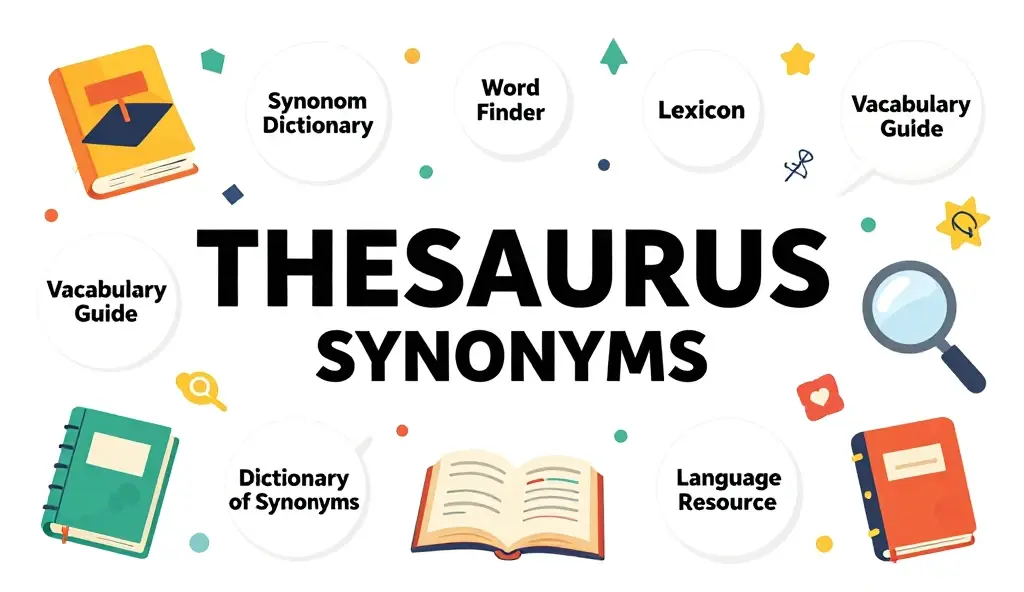
A “thesaurus” is a reference tool most people are familiar with from school the book (or website) you turn to when you’re tired of using the same word over and over. “Check the thesaurus for a better word.” “I looked it up in a thesaurus.”
Because “thesaurus” refers to a specific kind of reference tool, it doesn’t have as many natural synonyms as everyday adjectives like “good” or “nice.” Still, there are several accurate and useful alternatives, especially depending on whether you’re talking about a physical book, a digital tool, or a broader language resource.
People search for “thesaurus synonyms” for a few reasons.
Writers and students want alternative terms for variety in essays or descriptions of research tools.
Content creators want fresh wording for articles about vocabulary or writing tips.
And some people are simply curious what other words mean the same thing as “thesaurus.”
You should reach for a synonym when “thesaurus” feels repetitive in writing about vocabulary, word choice, or reference tools.
If you mean a formal printed reference, try “synonym dictionary” or “wordbook.” If you mean an online tool, try “word finder” or “synonym finder.”
Meaning
Definition: A “thesaurus” is a reference work either a physical book or a digital tool that lists words grouped by similar meaning, along with their synonyms and often antonyms.
Context: The word is most often used in educational or writing contexts. “Use a thesaurus to find a stronger word” is a common piece of writing advice. Online tools that perform the same function are also commonly called thesauruses.
Common usage: People use “thesaurus” when referring to any resource print or digital that helps find words with similar meanings to improve variety and precision in writing.
Pronunciation
“Thesaurus” is pronounced /θɪˈsɔːrəs/ “thih-SAWR-us,” with the stress on the second syllable. The plural form is “thesauri” or, more commonly in everyday use, “thesauruses.”
Part of Speech
“Thesaurus” is a noun, referring to a reference tool or resource.
- Example: She checked the thesaurus for a more vivid word.
There is no standard verb or adjective form, though people sometimes say “thesaurus-like” informally to describe something that lists synonyms.
Synonyms for Thesaurus
| Word/Phrase | Meaning | Usage | Formality | Example | Difficulty Level |
| Synonym dictionary | A reference book specifically for synonyms | General | Neutral | “She looked up the word in a synonym dictionary.” | Easy |
| Word finder | A tool used to find alternative words (often digital) | Casual/digital | Casual | “He used a word finder to spice up his essay.” | Easy |
| Synonym finder | A tool or resource for locating synonyms | General/digital | Neutral | “The synonym finder suggested five alternatives.” | Easy |
| Lexicon | A collection of words, often specialized or comprehensive | Formal/academic | Formal | “The lexicon includes technical terms specific to the field.” | Medium |
| Wordbook | An older or more literary term for a word reference | Formal/literary | Formal | “The wordbook was passed down from her grandfather.” | Hard |
| Synonym guide | A resource guiding word choice through synonyms | General | Neutral | “The style guide included a helpful synonym guide.” | Medium |
| Word bank | A collection of words, often for learning or reference | Educational | Neutral | “The teacher provided a word bank for the writing assignment.” | Easy |
| Glossary | A list of terms and definitions, often subject-specific | Formal/academic | Formal | “The textbook includes a glossary of key terms.” | Medium |
| Reference book | A general term for books used to look up information | General | Neutral | “The thesaurus is one of many reference books in the library.” | Easy |
| Word resource | A general term for any tool that helps with word choice | Casual/general | Neutral | “This app is a great word resource for writers.” | Easy |
| Roget’s | A common name reference to Roget’s Thesaurus specifically | Casual/proper noun | Neutral | “I found the word in Roget’s.” | Medium |
| Synonym database | A digital collection of words and their synonyms | Technical | Formal | “The app pulls from a large synonym database.” | Medium |
| Vocabulary guide | A resource for expanding word choice and vocabulary | Educational | Neutral | “The vocabulary guide helped her prepare for the exam.” | Medium |
| Language reference | A broad term for tools that assist with word choice and grammar | Formal | Formal | “Dictionaries and thesauruses are common language references.” | Medium |
| Word list | A simple collection of related or alternative words | Casual | Casual | “She kept a word list of stronger verbs to use in writing.” | Easy |
Best Synonyms Explained
Synonym dictionary
Meaning: A reference book specifically organized around synonyms. Difference from “thesaurus”: More descriptive and immediately clear about its function, though slightly less common as a term. Example: “He flipped through the synonym dictionary looking for a stronger verb.” Best situation: General writing about reference tools, especially for readers unfamiliar with the word “thesaurus.” Common mistake: Assuming it’s identical to a regular dictionary a synonym dictionary focuses specifically on word relationships, not full definitions.
Word finder
Meaning: A tool, often digital, used to locate alternative words. Difference from “thesaurus”: More casual and commonly associated with online tools or apps rather than printed books. Example: “I used an online word finder to avoid repeating the same adjective.” Best situation: Describing digital tools, apps, or websites that help with word choice. Common mistake: Using it to describe a printed book “word finder” typically implies a digital or interactive tool.
Lexicon
Meaning: A collection of words, often specialized to a particular field, language, or person. Difference from “thesaurus”: Broader in meaning a lexicon isn’t necessarily organized around synonyms specifically. Example: “The medical lexicon includes thousands of specialized terms.” Best situation: Formal or academic writing, especially when referring to specialized vocabulary. Common mistake: Using it interchangeably with “thesaurus” a lexicon is a broader collection of vocabulary, not specifically a synonym-finding tool.
Word bank
Meaning: A collection of words, often used in educational settings to support writing or vocabulary building. Difference from “thesaurus”: Usually smaller and curated for a specific task or lesson, rather than a comprehensive reference. Example: “The worksheet included a word bank to help students choose descriptive adjectives.” Best situation: Educational contexts, classroom materials, writing exercises. Common mistake: Using it to describe a comprehensive reference tool “word bank” implies a smaller, curated list.
Glossary
Meaning: A list of terms and their definitions, often specific to a subject or text. Difference from “thesaurus”: Focuses on definitions of specific terms, not synonym relationships between words. Example: “The science textbook includes a glossary of important vocabulary.” Best situation: Academic or technical writing, textbooks, and subject-specific resources. Common mistake: Using it in place of “thesaurus” a glossary defines terms, while a thesaurus groups words by similar meaning.
Antonyms for Thesaurus
Since “thesaurus” refers to a specific type of reference tool, it doesn’t have true antonyms in the traditional sense. However, these terms represent contrasting types of reference material:
| Word/Phrase | Meaning | Example |
| Dictionary | Defines words rather than listing synonyms | “Check the dictionary for the exact definition.” |
| Antonym list | Lists opposite words rather than similar ones | “The antonym list helped clarify the contrast in meaning.” |
| Style guide | Focuses on writing rules rather than word choice | “The company follows a specific style guide for formatting.” |
| Encyclopedia | Provides detailed factual information, not word relationships | “She looked up the historical event in an encyclopedia.” |
Examples of Synonyms in Real Sentences
- She reached for the synonym dictionary while editing her essay.
- He used a word finder app to avoid repeating himself.
- The synonym finder suggested several strong alternatives.
- The book’s lexicon includes terms specific to sailing.
- The old wordbook had beautifully illustrated pages.
- The writing guide included a helpful synonym guide.
- Students used the word bank to complete their paragraphs.
- The textbook ends with a detailed glossary.
- The library keeps several reference books near the front desk.
- This website is a great word resource for writers.
- I found a better word by checking Roget’s.
- The app pulls suggestions from a massive synonym database.
- The vocabulary guide helped prepare her for the test.
- Dictionaries and thesauruses are both useful language references.
- She kept a personal word list of vivid verbs.
- He always keeps a synonym dictionary on his desk.
- The teacher recommended a word finder for younger students.
- I checked the synonym finder for a stronger adjective.
- That specialized lexicon took years to compile.
- The antique wordbook was a treasured family heirloom.
- Our style manual includes a built-in synonym guide.
- The worksheet came with a small word bank.
- Every chapter ends with a mini glossary.
- The library’s reference books section is on the second floor.
- That app has become my go-to word resource.
- According to Roget’s, there are dozens of related words.
- The tool draws from an enormous synonym database.
- This vocabulary guide is perfect for ESL learners.
- Most language references are now available online.
- I jotted a quick word list before starting the essay.
25 Naturally Written Sentences
- I always keep a synonym dictionary nearby when I’m writing.
- She used a word finder to make her essay sound less repetitive.
- The synonym finder gave me exactly the word I needed.
- That specialized lexicon took the team years to compile.
- His grandfather’s old wordbook is still on the shelf.
- The style guide includes a helpful synonym guide at the back.
- The worksheet came with a word bank to guide students.
- Every textbook chapter ends with a short glossary.
- The library has a whole shelf of reference books.
- This app has become my favorite word resource.
- I found a better verb by flipping through Roget’s.
- The tool searches a massive synonym database in seconds.
- The vocabulary guide really helped before my exam.
- Most language references are digital these days.
- I always jot down a quick word list before writing.
- My teacher told us to check the synonym dictionary before submitting.
- The word finder suggested three great alternatives instantly.
- This synonym finder is way faster than flipping through pages.
- The company’s internal lexicon includes a lot of jargon.
- That old wordbook smells like it’s a hundred years old.
- The synonym guide in the back of the book is really useful.
- The classroom word bank had over fifty descriptive words.
- The appendix includes a glossary of technical terms.
- The reference books section is my favorite part of the library.
- This site has become a trusted word resource for our team.
Formal vs. Informal Usage
| Situation | Formal Word/Phrase | Informal Word/Phrase |
| Printed reference books | Synonym dictionary, Wordbook | Thesaurus |
| Digital tools | Synonym database, Language reference | Word finder |
| Educational settings | Vocabulary guide, Word bank | Word list |
| Academic/technical writing | Lexicon, Glossary | — |
| Everyday conversation | Reference book | Thesaurus, Word finder |
In formal writing academic papers, style guides, professional documentation use terms like “synonym dictionary,” “lexicon,” or “language reference.” In casual conversation, “thesaurus” and “word finder” feel more natural.
Academic Usage
In academic writing about language, linguistics, or writing instruction, more specific terms are often preferred over the general word “thesaurus.”
- General: “Students were told to use a thesaurus.”
- More specific: “Students were encouraged to consult a synonym dictionary or lexical resource during revision.”
Other academic-friendly synonyms include: lexicon, lexical resource, and reference work.
Daily Conversation
In everyday talk, people almost always just say “thesaurus,” but casual alternatives occasionally come up.
- “Did you check the thesaurus for a better word?”
- “I used a word finder online instead of flipping through a book.”
- “Roget’s has a ton of options for that word.”
These casual synonyms keep conversation natural, especially when referring to digital tools.
Grammar Tips
- “Thesaurus” is a countable noun: a thesaurus, two thesauruses (or the more formal plural, “thesauri”).
- “Roget’s” is a proper noun referring to the specific, well-known Roget’s Thesaurus, and is often used informally to mean “thesaurus” in general.
- When referring to digital tools, “word finder” and “synonym finder” are more common than “thesaurus,” even though they perform a similar function.
Collocations
Common word pairings using “thesaurus” and its synonyms:
- Check the thesaurus / Check the synonym dictionary
- Online thesaurus / Digital word finder
- Thesaurus entry / Synonym dictionary entry
- Dictionary and thesaurus / Language references
- Thesaurus.com (a well-known online thesaurus)
- Roget’s Thesaurus (the original, widely referenced thesaurus)
These pairings are common in writing, education, and everyday conversation about vocabulary.
Common Phrases
- “Straight out of a thesaurus” describing writing that uses overly formal or unnatural synonyms.
- “Thesaurus-speak” informal criticism of writing that sounds artificially fancy.
- “Look it up in the thesaurus” common advice for finding a better word choice.
- “Thesaurus.com says…” a casual way to cite an online synonym source.
- “He swallowed a thesaurus” a humorous way to describe someone using overly elaborate vocabulary.
Idioms
There aren’t many traditional idioms built around the word “thesaurus” itself, but a few informal expressions reference it:
- “Sounds like he swallowed a thesaurus” describing someone who uses unnecessarily complex vocabulary. Example: “His emails sound like he swallowed a thesaurus.”
- “Straight from the thesaurus” describing word choices that feel artificial or forced. Example: “That word choice feels straight from the thesaurus try something more natural.”
Similar Words Comparison
| Word | Meaning | Difference | Example |
| Thesaurus | A reference tool listing synonyms | General, most commonly used term | “Check the thesaurus for a better word.” |
| Dictionary | A reference tool defining words | Focuses on definitions, not synonyms | “Check the dictionary for the meaning.” |
| Lexicon | A broader collection of vocabulary | Not necessarily organized by synonym | “The lexicon includes technical terms.” |
| Glossary | A list of terms and definitions, often subject-specific | Narrower, tied to a specific text or field | “The textbook glossary explains key terms.” |
| Word finder | A tool (often digital) for finding word alternatives | More casual, often app-based | “I used a word finder for my essay.” |
FAQs
Q1. What is the best synonym for “thesaurus”?
A: Synonym dictionary is the most accurate and widely understood alternative to thesaurus, especially when referring to a reference book or writing tool. Word finder is another popular option, particularly for online tools and apps.
Q2. Is “lexicon” the same as “thesaurus”?
A: Not exactly. A lexicon is a collection of words or vocabulary, often related to a specific language or subject, while a thesaurus organizes words by similar meanings, synonyms, and related terms.
Q3. What is a formal synonym for “thesaurus”?
A: Formal alternatives include synonym dictionary, lexicon, lexical resource, and language reference. These terms are suitable for academic writing, research papers, and professional communication.
Q4. What is a casual synonym for “thesaurus”?
A: Common informal alternatives include word finder, synonym finder, and Roget’s (when referring to the famous thesaurus). These expressions are common in everyday conversations about writing tools.
Q5. Is there an opposite of “thesaurus”?
A: Not exactly. A thesaurus is a specific type of reference tool, so it has no true opposite. However, a dictionary serves a different purpose by defining words instead of grouping them by similar meanings.
Q6. How can I say “thesaurus” in a more specific way?
A: Choose a term that matches the context. Use synonym dictionary for a printed reference, word finder for an online tool, synonym database for digital resources, or language reference for a broader category.
Q7. What word can replace “thesaurus” in an essay?
A: In academic writing, use synonym dictionary, lexical resource, language reference, or vocabulary reference, depending on the context. These alternatives sound more precise and formal.
Q8. Which synonym for “thesaurus” refers to a digital tool?
A: Terms such as word finder, synonym finder, synonym database, and online thesaurus specifically describe digital tools and websites that help users find alternative words.
Q9. What is a synonym for “thesaurus” used in classrooms?
A: In educational settings, teachers may use terms like word bank, vocabulary guide, or synonym guide. These resources are often simpler and more focused than a full thesaurus.
Q10. What is another way to say “look it up in the thesaurus”?
A: You can say check the synonym dictionary, use a word finder, search a synonym finder, or look for an alternative word. Each phrase describes the same action in a slightly different way.
Q11. Can “glossary” mean the same as “thesaurus”?
A: No. A glossary explains the meanings of specialized terms within a book or subject, while a thesaurus groups words according to similar meanings and related vocabulary.
Q12. What is a good synonym for “thesaurus” in professional or technical writing?
A: Professional alternatives include lexicon, lexical resource, reference work, and terminology database. These terms are commonly used when discussing specialized vocabulary and language resources.
Q13. Why should I use a synonym for “thesaurus” instead of repeating the word?
A: Repeating thesaurus can make your writing sound repetitive. Using alternatives such as synonym dictionary, word finder, or lexical resource adds variety, improves clarity, and better matches different contexts.
Q14. What is the most well-known thesaurus?
A: Roget’s Thesaurus is the most famous and influential thesaurus in the English language. Because of its popularity, people sometimes use Roget’s informally to refer to a thesaurus in general.
Expert Tips
- Match the synonym to the format you mean. Use “synonym dictionary” or “wordbook” for printed references, and “word finder” or “synonym database” for digital tools.
- In academic or technical writing, “lexicon” and “language reference” sound more precise and professional than the general word “thesaurus.”
- If you’re writing about a specific tool, like an app or website, “word finder” tends to feel more natural and current than “thesaurus.”
- For classroom materials, “word bank” is usually the better term, since it implies a smaller, curated set of words rather than a full reference tool.
Conclusion:
“Thesaurus” is a clear, widely understood word, but it doesn’t have to be the only term you use when writing or talking about vocabulary resources.
Swapping it for the right synonym “synonym dictionary” for a formal reference, “word finder” for a digital tool, or “lexicon” for specialized vocabulary helps your writing feel more precise and varied.
Keep this list handy, and next time you reach for “thesaurus,” pick a word that fits the exact type of resource you mean.

Megan Stewart is dedicated to producing reliable English language resources that support vocabulary growth and better writing habits.