
Hate” is a strong word.
People use it every day.
They say, “I hate Mondays.” “I hate broccoli.” “I hate being late.” Sometimes people really mean it.
Sometimes they mean they do not like something very much.
People use the word “hate” a lot.
Because of that, it does not always show the right feeling.
Hating traffic is not the same as hating a person.
These feelings are very different.
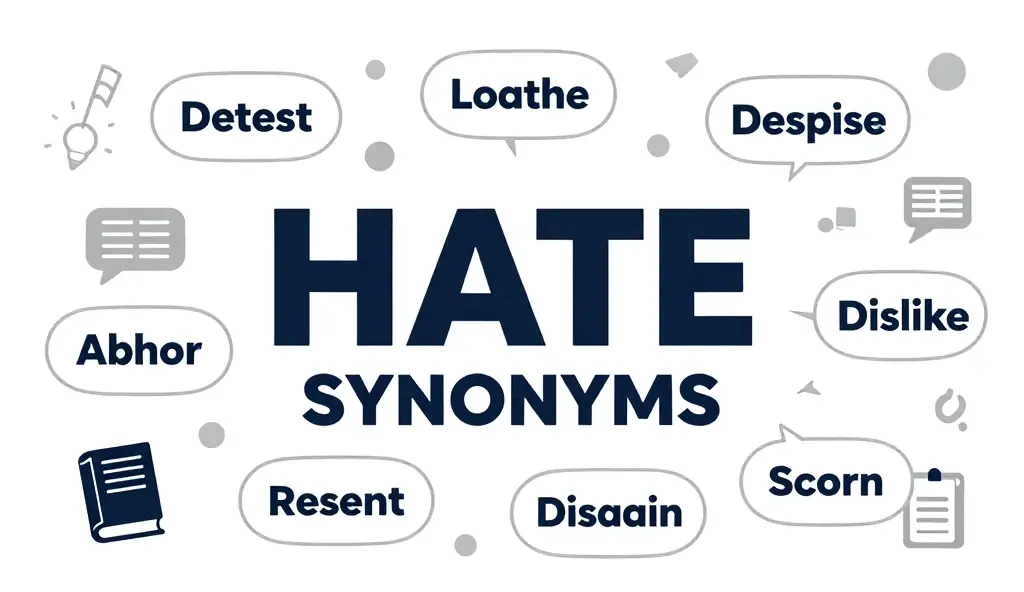
That is why people use other words instead of “hate.” These words are called synonyms.
A synonym is a word that has a similar meaning.
Some words are stronger. Some words are softer.
Writers, students, and others look for synonyms for “hate”.
Writers want better words for stories. Students want different words for schoolwork.
Other people want words that match how they really feel.
Use a different word if “hate” does not sound right.
If you do not like something very much, you can say “dislike.” If your feeling is very strong, you can say “despise,” “loathe,” or “abhor.”
Be careful when you use the word “hate.” It can be a very serious word.
It is used when people are very unkind to others.
Sometimes a kinder word is better.
You can say “I disagree,” or “I am upset,” if that is what you really mean.
Meaning
Definition: “Hate” means to feel intense dislike, hostility, or aversion toward someone or something. It’s the opposite of love, but it’s often used more loosely to mean strong dislike or annoyance.
Context: The meaning shifts depending on intensity and context. “I hate broccoli” usually means simple dislike. “He hates his rival” can imply real hostility or resentment. “Hate speech” refers to serious, harmful language targeting people based on identity.
Common usage: People use “hate” casually to describe strong dislikes (foods, weather, chores) and more seriously to describe deep emotional hostility toward people or situations.
Pronunciation
“Hate” is pronounced /heɪt/ — “hayt,” rhyming with “late” and “wait.” It’s a single syllable.
Part of Speech
“Hate” is most commonly used as a verb, meaning to feel strong dislike.
- Example: I hate waiting in long lines.
It can also be used as a noun, referring to the feeling itself.
- Example: There was no hate in his voice, just disappointment.
Synonyms for Hate
| Word | Meaning | Usage | Formality | Example | Difficulty Level |
| Despise | To feel deep contempt for someone or something | Strong dislike | Neutral | “She despises dishonesty.” | Medium |
| Detest | To dislike intensely | Strong dislike | Formal | “He detests small talk.” | Medium |
| Loathe | To feel intense disgust or hatred | Strong emotional dislike | Formal | “I loathe waking up early.” | Medium |
| Abhor | To regard with deep repulsion | Formal/moral | Formal | “She abhors cruelty of any kind.” | Hard |
| Resent | To feel bitter or angry about something | Emotional/relational | Formal | “He resents being left out of decisions.” | Medium |
| Dislike | To have a feeling of aversion, milder than hate | General, mild | Neutral | “I dislike loud restaurants.” | Easy |
| Disdain | To view with contempt, as beneath consideration | Formal | Formal | “She treated the offer with disdain.” | Hard |
| Can’t stand | To be unable to tolerate something (informal) | Casual | Casual | “I can’t stand rude customers.” | Easy |
| Be repulsed by | To feel strong physical or moral disgust | Formal/emotional | Formal | “He was repulsed by the smell.” | Medium |
| Be averse to | To have a strong dislike or opposition to | Formal | Formal | “She’s averse to taking risks.” | Hard |
| Abominate | To detest utterly (formal/literary) | Formal/literary | Formal | “He abominates injustice.” | Hard |
| Despite | (Not a synonym — commonly confused with “despise”) | N/A | N/A | N/A | N/A |
| Object to | To disagree with or oppose something | Formal | Formal | “She objects to the new policy.” | Medium |
| Be repelled by | To feel a strong urge to avoid something | Formal | Formal | “He was repelled by the idea.” | Medium |
| Scorn | To view with contempt | Formal/literary | Formal | “He scorned their weak excuse.” | Hard |
| Despise | To regard with deep contempt | Formal | Formal | “She despises arrogance.” | Medium |
| Recoil from | To pull back in disgust or fear | Descriptive | Formal | “She recoiled from the harsh criticism.” | Hard |
| Have an aversion to | To feel a settled dislike toward something | Formal | Formal | “He has an aversion to conflict.” | Hard |
| Be turned off by | To lose interest or attraction due to dislike (informal) | Casual | Casual | “I was turned off by their attitude.” | Easy |
| Be repulsed by | To feel strong disgust | Formal | Formal | “The audience was repulsed by the scene.” | Medium |
| Not be a fan of | A mild, understated way to express dislike | Casual | Casual | “I’m not really a fan of spicy food.” | Easy |
| Detest | To dislike intensely and persistently | Formal | Formal | “She detests hypocrisy.” | Medium |
| Bear a grudge against | To hold long-term resentment | Formal/relational | Formal | “He still bears a grudge against his old boss.” | Hard |
| Have it in for | To hold a specific dislike toward someone (informal) | Casual | Casual | “She’s had it in for him since the meeting.” | Medium |
| Be sick of | To be tired of and annoyed by something (informal) | Casual | Casual | “I’m sick of this rainy weather.” | Easy |
| Be fed up with | To be frustrated and impatient with something | Casual | Casual | “He’s fed up with the constant delays.” | Easy |
| Take a dim view of | To disapprove of something (formal/idiomatic) | Formal | Formal | “The committee takes a dim view of tardiness.” | Hard |
| Be hostile toward | To show open unfriendliness or aggression | Formal | Formal | “The two companies remained hostile toward each other.” | Medium |
| Feel contempt for | To feel that someone deserves no respect | Formal | Formal | “He feels contempt for dishonest leaders.” | Hard |
Best Synonyms Explained
Despise
Meaning: To feel deep contempt or disdain for someone or something. Difference from “hate”: Focuses more on looking down on something, not just disliking it. Example: “She despises people who talk over others.” Best situation: Describing strong moral or character-based disapproval. Common mistake: Using it for mild preferences, like food — “despise” implies a deeper, more personal judgment.
Detest
Meaning: To dislike something intensely and consistently. Difference from “hate”: Slightly more formal and often used for ongoing annoyances or habits. Example: “He detests being interrupted during meetings.” Best situation: Describing consistent, strong dislikes, often behavioral. Common mistake: Overusing it for small, temporary annoyances.
Loathe
Meaning: To feel intense disgust or hatred toward something. Difference from “hate”: Adds a stronger emotional and often physical sense of aversion. Example: “I loathe the sound of chalk on a chalkboard.” Best situation: Describing visceral, strong reactions to specific things or habits. Common mistake: Using it too casually — “loathe” should signal genuine intensity, not mild annoyance.
Resent
Meaning: To feel bitter or angry about something, often due to unfair treatment. Difference from “hate”: Focuses on a lingering, personal sense of unfairness rather than pure dislike. Example: “She resents having to redo the project without credit.” Best situation: Describing feelings tied to unfair treatment or missed recognition. Common mistake: Using it for simple dislikes unrelated to fairness or personal grievance.
Can’t stand
Meaning: To be unable to tolerate something. Difference from “hate”: More casual and expressive, often used in spoken language. Example: “I can’t stand when people chew loudly.” Best situation: Everyday conversation about pet peeves or annoyances. Common mistake: Using it in formal writing, where “cannot tolerate” or “find intolerable” fit better.
Be averse to
Meaning: To have a strong, often long-standing dislike or opposition toward something. Difference from “hate”: More formal and typically used to describe attitudes toward risk, change, or decisions. Example: “The company is averse to taking on debt.” Best situation: Business, formal writing, or describing consistent attitudes or preferences. Common mistake: Using it for people — “averse to” fits situations, ideas, or risks better than personal dislike of a person.
Antonyms for Hate
| Word | Meaning | Example |
| Love | Deep affection or fondness | “She loves spending time outdoors.” |
| Adore | To love deeply and admire | “He adores his grandchildren.” |
| Cherish | To hold something dear | “They cherish their family traditions.” |
| Admire | To respect and think highly of | “I admire her dedication.” |
| Appreciate | To recognize the value of something | “We appreciate your hard work.” |
| Enjoy | To take pleasure in something | “She enjoys long walks in the park.” |
| Fancy | To like or be attracted to (informal, British) | “He fancies trying new restaurants.” |
| Treasure | To value something greatly | “They treasure their old family photos.” |
| Favor | To prefer or support something | “The committee favors the new proposal.” |
| Embrace | To accept and welcome something | “She embraces new challenges.” |
Examples of Synonyms in Real Sentences
- He despises being told what to do.
- I detest waiting in long checkout lines.
- She loathes early morning meetings.
- They abhor any form of dishonesty.
- He resents never being asked for input.
- I dislike overly spicy food.
- She treated the criticism with total disdain.
- I can’t stand when people are late without warning.
- The audience was repulsed by the graphic scene.
- He’s always been averse to unnecessary risk.
- The philosopher abominated cruelty in all its forms.
- The council objects to the proposed zoning change.
- She was repelled by the dishonest sales pitch.
- He scorned the excuse without hesitation.
- The critic despises predictable plot twists.
- She recoiled from the harsh tone of the email.
- He has an aversion to confrontation of any kind.
- I was completely turned off by their rude comment.
- The crowd seemed genuinely repulsed by the decision.
- Honestly, I’m not a fan of crowded events.
- She detests being interrupted mid-sentence.
- He still bears a grudge against his former business partner.
- She’s clearly had it in for him since the argument.
- I’m completely sick of these constant delays.
- The staff is fed up with the lack of communication.
- The board takes a dim view of missed deadlines.
- The two rivals remained hostile toward one another for years.
- He feels contempt for people who cut corners.
- She despises arrogance more than almost anything.
- They resent being excluded from the final decision.
25 Naturally Written Sentences
- He despises when people cancel plans last minute.
- I detest the sound of nails on a chalkboard.
- She loathes long car rides more than anything.
- They abhor any kind of unfair treatment at work.
- He resents not getting credit for the idea.
- I dislike when restaurants play music too loud.
- She looked at the offer with obvious disdain.
- I can’t stand it when people talk during movies.
- He was repulsed by how the situation was handled.
- She’s always been averse to sudden changes in plans.
- The old professor abominated laziness in his students.
- The neighbors object to the proposed construction plan.
- He felt repelled by the dishonesty in the pitch.
- She scorned the weak apology he offered.
- The reviewer despises movies with predictable endings.
- He recoiled from the blunt feedback at first.
- She has an aversion to public speaking.
- I was turned off by how the meeting was run.
- Fans were repulsed by the sudden price increase.
- Honestly, I’m not a fan of overly formal events.
- He detests when meetings run past their scheduled time.
- She still bears a grudge against her old roommate.
- He’s had it in for that coworker since day one.
- I’m sick of hearing the same excuses every week.
- The team is fed up with the constant last-minute changes.
Formal vs. Informal Usage
| Situation | Formal Word | Informal Word |
| Strong dislike | Despise, Detest | Can’t stand, Hate |
| Moral disapproval | Abhor, Condemn | Hate |
| Ongoing frustration | Resent, Be averse to | Be fed up with, Be sick of |
| Mild dislike | Dislike, Disfavor | Not a fan of |
| Business/formal writing | Object to, Oppose | Hate |
In formal writing — essays, reviews, professional communication — use words like “despise,” “detest,” or “resent.” In casual conversation, phrases like “can’t stand,” “sick of,” or “not a fan of” feel more natural.
Academic Usage
In academic writing, “hate” is often considered too emotionally charged or imprecise, so writers usually choose more analytical language.
- Weak: “Many people hate the new policy.”
- Strong: “Many people strongly oppose the new policy, citing concerns about fairness.”
Other academic-friendly synonyms include: oppose, disapprove of, reject, criticize, and condemn.
Daily Conversation
In everyday talk, people naturally reach for casual, expressive alternatives.
- “How do you feel about Mondays?” — “Honestly, I can’t stand them.”
- “Do you like this song?” — “Not really, I’m not a fan.”
- “Are you upset with him?” — “A little, I guess I resent how he handled it.”
These casual synonyms keep conversation relaxed and expressive without sounding overly dramatic.
Grammar Tips
- “Hate” can be followed by a noun, a gerund (-ing verb), or an infinitive: I hate mornings. I hate waking up early. I hate to wake up early. All are grammatically correct.
- “Despise” and “detest” are typically followed by a noun or gerund, not an infinitive: She despises lying, not She despises to lie.
- “Be averse to” is followed by a gerund, not a base verb: He’s averse to taking risks, not He’s averse to take risks.
Collocations
Common word pairings using “hate” and its synonyms:
- Hate speech / Hateful rhetoric
- Hate crime / Bias-motivated crime
- Can’t stand + noun/gerund
- Strongly dislike / Strongly oppose
- Hold a grudge / Bear a grudge
- Fed up with + noun/gerund
These pairings sound natural and appear often in both writing and speech.
Common Phrases
- “Hate to admit it” — reluctantly acknowledging something.
- “Love-hate relationship” — mixed feelings toward something or someone.
- “Hate on someone” — informal slang meaning to criticize or put someone down.
- “For what it’s worth, I hate that” — casual way to express strong dislike.
- “No hard feelings” — used to show there’s no lingering resentment.
Idioms
- “Hold a grudge” — to continue feeling resentment toward someone over time. Example: “She’s held a grudge against him for years.”
- “Rub someone the wrong way” — to unintentionally irritate or annoy someone. Example: “His comment rubbed her the wrong way.”
- “Can’t stand the sight of” — to strongly dislike seeing or being around someone. Example: “After the argument, he couldn’t stand the sight of her.”
Similar Words Comparison
| Word | Meaning | Difference | Example |
| Hate | Intense dislike or hostility | Broad, casual or serious | “I hate waiting in traffic.” |
| Despise | Deep contempt | Focuses on judgment, not just dislike | “I despise dishonesty.” |
| Detest | Intense, ongoing dislike | Slightly more formal | “I detest small talk.” |
| Dislike | Mild aversion | Much weaker than hate | “I dislike loud noises.” |
| Resent | Bitterness over unfairness | Focuses on personal grievance | “I resent being ignored.” |
FAQs
Q1. What is the best synonym for “hate”?
A: “Despise” and “detest” are the most commonly used strong synonyms, while “dislike” works better for milder feelings. The right choice depends on how intense the emotion actually is.
Q2. Is “despise” stronger than “hate”?
A: They’re similar in intensity, but “despise” specifically implies looking down on someone or something with contempt, while “hate” is broader and can apply to simple dislikes as well as serious hostility.
Q3. What’s a formal synonym for “hate”?
A: Formal alternatives include “despise,” “detest,” “abhor,” and “resent.” These fit essays, reviews, and professional writing better than the casual word “hate.”
Q4. What’s a casual synonym for “hate”?
A: Casual options include “can’t stand,” “not a fan of,” and “sick of.” These fit everyday conversation but sound too relaxed for formal or academic writing.
Q5. What is the opposite of “hate”?
A: Common antonyms include “love,” “adore,” “cherish,” and “admire.” Each expresses positive affection, in contrast to the strong negative feeling behind “hate.”
Q6. How do you say “hate” in a milder way?
A: Instead of “hate,” try “dislike,” “not a fan of,” or “am not keen on.” These options express a weaker, more measured feeling than the intensity of “hate.”
Q7. What word can replace “hate” in an essay?
A: In essays, try “oppose,” “disapprove of,” “reject,” or “criticize,” depending on context. These words sound more analytical and precise than the emotionally charged word “hate.”
Q8. What’s a synonym for “hate” that means extreme hatred?
A: Words like “abhor,” “loathe,” and “abominate” all describe intense, almost visceral hatred. Choose based on tone—”abominate” is especially formal and literary.
Q9. Is it okay to say “I hate” someone?
A: It’s grammatically fine, but saying “I hate” a person is emotionally strong language. If you mean frustration or disagreement rather than genuine hostility, milder words like “am frustrated with” may better reflect how you feel.
Q10. What’s another way to say “I hate this”?
A: Try “I can’t stand this,” “this really bothers me,” or “I’m so fed up with this.” Each phrase expresses frustration while sounding slightly different in tone.
Q11. Can “dislike” mean the same as “hate”?
A: Not exactly. “Dislike” is much milder and simply means something isn’t enjoyable or preferred, while “hate” implies a stronger, more intense negative emotion.
Q12. What’s a synonym for “hate” in professional writing?
A: In professional contexts, use words like “oppose,” “object to,” or “disapprove of.” These terms sound measured and appropriate for workplace communication.
Q13. Why should I avoid overusing “hate” in writing?
A: Overusing “hate” can make writing sound exaggerated or emotionally flat, especially when describing minor annoyances. Using varied synonyms helps match the actual intensity of the feeling.
Q14. What’s a fun, casual way to say “hate”?
A: Casual alternatives like “can’t stand,” “not here for it,” and “so over it” keep everyday conversation relaxed and expressive, especially when venting about small annoyances.
Expert Tips
- Match the synonym to the actual intensity of your feeling. Reserve words like “despise” or “loathe” for genuinely strong emotions, and use “dislike” or “not a fan of” for smaller annoyances.
- In formal or professional writing, replace “hate” with more measured language like “oppose” or “disapprove of” — it keeps tone professional and avoids sounding overly emotional.
- Be especially thoughtful with “hate” when writing about people or groups, since the word carries serious weight in contexts like hate speech or hate crimes.
- In casual writing, phrases like “can’t stand” or “not a fan of” often sound more natural and relatable than a blunt “I hate.”
Conclusion:
“Hate” is a powerful word, but it’s often used for things that don’t really deserve that much weight.
Swapping it for the right synonym “dislike” for a small annoyance, “resent” for lingering unfairness, or “despise” for genuine contempt helps your writing and speech match how you actually feel.
Keep this list handy, and next time you reach for “hate,” pick a word that says exactly what you mean.

Abigail Hughes enjoys creating educational resources that make English vocabulary simple, practical, and enjoyable to learn.