
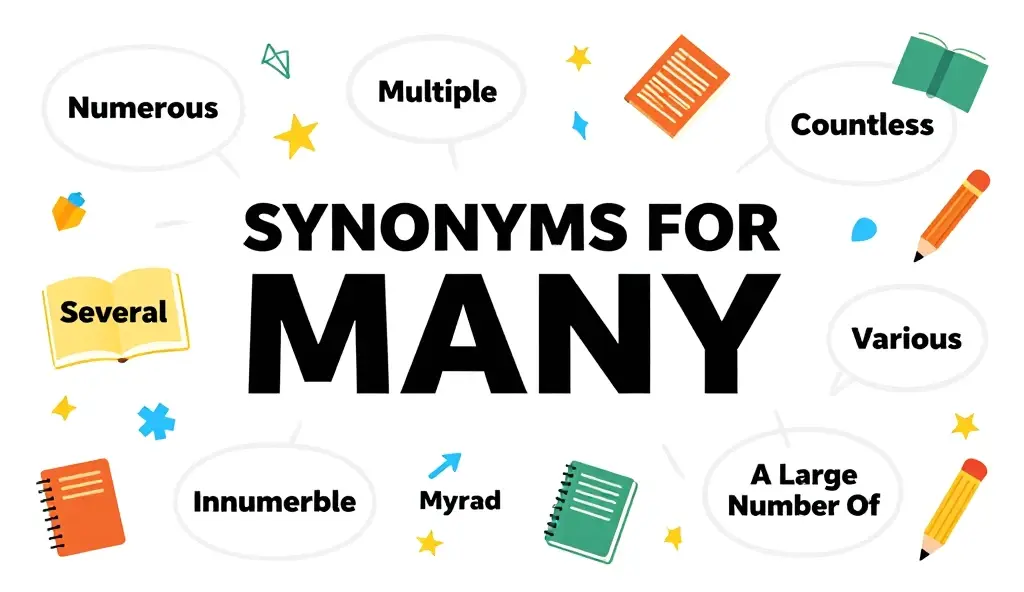
**”Many” is a word we use every day.
It tells us there is a big number of things. We say, “Many people came.” “She has many books.” “There are many reasons.”
We use “many” a lot.
When we use it too many times, our writing can sound boring.
It also does not tell how big the number really is.
That is why people use other words.
These words are called synonyms.
A synonym is a word with a similar meaning.
Some words sound stronger.
Some sound more formal.
Students, writers, and workers look for synonyms for many.
Students want better school writing.
Writers want more interesting words.
Workers want clear and neat reports.
Other people just want different words.
Use another word if “many” does not fit.
You can say “several” for a small group.
You can say “numerous” for a large group.
You can say “countless” or “myriad” when the number is very, very big.
These words help people understand you better.
Meaning
Definition: “Many” means a large number of countable people, things, or instances. It expresses quantity, usually referring to something more than a few but not necessarily “all.”
Context: The meaning shifts slightly depending on scale and tone. “Many people” simply means a large group. “So many mistakes” adds emphasis or frustration. “Many, many years” adds emotional weight through repetition.
Common usage: People use “many” to describe quantities of countable nouns — people, things, reasons, options, and more — in both casual and formal contexts.
Pronunciation
“Many” is pronounced /ˈmɛn.i/ — “MEH-nee,” with the stress on the first syllable.
Part of Speech
“Many” is used as a quantifier, functioning similarly to an adjective or pronoun.
As an adjective before a noun:
- Example: Many students passed the exam.
As a pronoun standing in for a noun:
- Example: Many of them agreed with the plan.
“Many” is only used with countable nouns (many books, many people) — not with uncountable nouns, where “much” is used instead (much water, much time).
Synonyms for Many
| Word | Meaning | Usage | Formality | Example | Difficulty Level |
| Numerous | A large number, formal tone | General/formal | Formal | “There were numerous complaints about the delay.” | Medium |
| Several | More than two or three, but not a huge number | General | Neutral | “Several employees volunteered for the project.” | Easy |
| Plenty | More than enough | General | Neutral | “There are plenty of seats available.” | Easy |
| Countless | Too many to count | Descriptive/emphatic | Neutral | “She’s answered countless questions today.” | Medium |
| Various | Of several different kinds | General | Neutral | “The store sells various types of cheese.” | Easy |
| Multiple | More than one, often several | General/formal | Neutral | “The report cites multiple sources.” | Easy |
| Abundant | Existing in large quantity | Formal/descriptive | Formal | “The region has abundant natural resources.” | Medium |
| A large number of | A big quantity (neutral phrase) | General | Neutral | “A large number of applicants applied this year.” | Easy |
| Myriad | An extremely large, often uncountable number | Formal/literary | Formal | “There are myriad reasons to visit the city.” | Hard |
| A host of | A large number, often positive connotation | Formal/literary | Formal | “The festival offers a host of activities.” | Hard |
| A multitude of | A large number, formal | Formal/literary | Formal | “There are a multitude of options to choose from.” | Hard |
| A number of | An unspecified but notable amount | General | Neutral | “A number of factors contributed to the delay.” | Easy |
| Scores of | A large number (literary/older usage) | Formal/literary | Formal | “Scores of fans lined up outside the venue.” | Hard |
| Dozens of | A large, informal estimate (implies tens) | Casual/general | Casual | “Dozens of people showed up to the event.” | Easy |
| Loads of | A lot of (informal) | Casual | Casual | “There are loads of options on the menu.” | Easy |
| Tons of | A huge amount (informal) | Casual | Casual | “We got tons of feedback after the launch.” | Easy |
| A great many | An emphatic version of “many” | Formal/literary | Formal | “A great many people attended the funeral.” | Medium |
| Untold | An extremely large, often unspecified number | Formal/literary | Formal | “The project caused untold delays.” | Hard |
| Innumerable | Too many to be counted | Formal/literary | Formal | “There are innumerable stars in the sky.” | Hard |
| Copious | Abundant, plentiful | Formal/literary | Formal | “She took copious notes during the lecture.” | Hard |
| Sundry | Various, of different kinds (slightly old-fashioned) | Formal/literary | Formal | “The shop sold sundry items from around the world.” | Hard |
| Manifold | Many and varied (formal/literary) | Formal/literary | Formal | “The benefits of exercise are manifold.” | Hard |
| A wealth of | A large, valuable amount | Formal | Formal | “The archive contains a wealth of historical records.” | Hard |
| A significant number of | A notable, formal quantity | Formal | Formal | “A significant number of users reported issues.” | Medium |
| Umpteen | An unspecified, exaggerated large number (informal) | Casual | Casual | “I’ve told him umpteen times to be careful.” | Medium |
| Legion | Extremely numerous (formal/literary) | Formal/literary | Formal | “His accomplishments are legion.” | Hard |
| Ample | Sufficient, more than enough | Formal | Formal | “There’s ample evidence to support the claim.” | Medium |
| Assorted | Various, of mixed types | General | Neutral | “The basket contained assorted fruits.” | Easy |
| Diverse | Varied in kind | Formal/general | Neutral | “The team includes people from diverse backgrounds.” | Medium |
Best Synonyms Explained
Numerous
Meaning: A large number, expressed formally. Difference from “many”: More formal and precise, common in reports and academic writing. Example: “The study cites numerous examples to support its conclusion.” Best situation: Formal writing, business reports, academic papers. Common mistake: Using it in casual conversation, where it can sound stiff — “many” or “a lot of” fit better there.
Several
Meaning: More than two or three, but not an overwhelming amount. Difference from “many”: Implies a smaller, more specific quantity than “many.” Example: “Several people asked about the refund policy.” Best situation: Describing a moderate, countable amount — usually between three and around ten. Common mistake: Using it interchangeably with “many” when describing a truly large group — “several” implies fewer.
Countless
Meaning: Too many to count. Difference from “many”: Adds emphasis and emotional weight, implying an overwhelming or unlimited quantity. Example: “She’s spent countless hours volunteering at the shelter.” Best situation: Descriptive or emotional writing that wants to emphasize scale. Common mistake: Using it for modest amounts — it should signal a genuinely huge or seemingly endless number.
Myriad
Meaning: An extremely large, often uncountable number. Difference from “many”: More literary and formal, often used to sound sophisticated or poetic. Example: “The festival offers a myriad of food and music options.” Best situation: Formal or creative writing, descriptions of variety and abundance. Common mistake: Overusing it in casual writing — it can sound overly formal or forced in everyday speech.
A multitude of
Meaning: A large number, often used formally. Difference from “many”: Sounds more elevated and deliberate. Example: “There are a multitude of reasons the project was delayed.” Best situation: Formal writing, speeches, or persuasive essays. Common mistake: Using it in casual conversation, where it can sound overly formal.
A number of
Meaning: An unspecified but noticeable quantity. Difference from “many”: More neutral and often used to soften a claim, especially when the exact number is unclear or being downplayed. Example: “A number of employees raised concerns about the new policy.” Best situation: Formal or professional writing, especially when the writer wants to sound measured rather than dramatic. Common mistake: Using it when you actually mean a huge number — “a number of” can sound more modest than “many” or “numerous.”
Antonyms for Many
| Word | Meaning | Example |
| Few | A small number | “Few people showed up to the meeting.” |
| Scarce | Insufficient, rare | “Resources were scarce during the shortage.” |
| Sparse | Thinly distributed, not abundant | “The audience was sparse for the early show.” |
| Limited | Restricted in number or amount | “There are limited spots available.” |
| A handful of | A small number | “Only a handful of volunteers signed up.” |
| Hardly any | Almost none | “There’s hardly any interest in the old model.” |
| Minimal | The smallest possible number | “There was minimal turnout at the event.” |
| Not many | A small, unspecified number | “Not many people knew about the change.” |
| A small number of | An explicitly small quantity | “A small number of students opted out.” |
| Isolated | Occurring rarely, individually | “There were only isolated complaints.” |
Examples of Synonyms in Real Sentences
- Numerous studies support this conclusion.
- Several coworkers offered to help with the move.
- There’s plenty of time before the deadline.
- He’s made countless sacrifices for his family.
- The menu includes various vegetarian options.
- The team considered multiple possible solutions.
- The garden has abundant wildflowers in spring.
- A large number of applicants applied for the internship.
- There are myriad ways to approach this problem.
- The city offers a host of cultural attractions.
- There are a multitude of factors to consider.
- A number of clients expressed interest in the new service.
- Scores of volunteers showed up for the beach cleanup.
- Dozens of photos were taken during the ceremony.
- There are loads of great restaurants nearby.
- We received tons of positive feedback.
- A great many readers wrote in with questions.
- The scandal caused untold damage to the company’s reputation.
- There are innumerable stars visible on a clear night.
- He took copious notes throughout the seminar.
- The shop sells sundry items from local artisans.
- The advantages of remote work are manifold.
- The library holds a wealth of rare manuscripts.
- A significant number of employees requested flexible hours.
- I’ve reminded him umpteen times about the deadline.
- Her achievements in the field are legion.
- There’s ample parking near the stadium.
- The gift basket included assorted chocolates.
- The panel featured speakers from diverse backgrounds.
- Several guests arrived early to help set up.
25 Naturally Written Sentences
- Numerous customers have asked about the new product launch.
- Several friends offered to help me move apartments.
- There’s plenty of food left if anyone wants seconds.
- I’ve made countless trips to that coffee shop this year.
- The bakery offers various flavors of sourdough.
- We reviewed multiple proposals before choosing one.
- Their farm produces abundant fresh produce every summer.
- A large number of students signed up for the workshop.
- There are myriad reasons why the project was delayed.
- The conference offered a host of networking opportunities.
- There are a multitude of apps that do the same thing.
- A number of neighbors complained about the noise.
- Scores of runners participated in the charity marathon.
- Dozens of emails came in after the announcement.
- There are loads of hiking trails around here.
- We got tons of applications for the open position.
- A great many people showed up despite the rain.
- The delay caused untold frustration among passengers.
- There are innumerable ways to interpret the poem.
- She kept copious records of every transaction.
- The market sells sundry goods from around the region.
- The reasons for his success are manifold.
- This archive holds a wealth of unpublished letters.
- A significant number of reviewers praised the film.
- I’ve told my kids umpteen times to clean their rooms.
Formal vs. Informal Usage
| Situation | Formal Word | Informal Word |
| General large quantity | Numerous, Various | Many, Lots of |
| Emphasizing scale | Countless, Myriad | Tons of, Loads of |
| Moderate quantity | Several, A number of | A few, Some |
| Formal writing/reports | A multitude of, A significant number of | A bunch of |
| Everyday conversation | Plenty, Several | Dozens of, Tons |
In formal writing — reports, essays, professional communication — use words like “numerous,” “a multitude of,” or “a significant number of.” In casual conversation, “lots of,” “tons of,” or “dozens of” feel more natural.
Academic Usage
In academic writing, “many” is generally acceptable but is often replaced with more specific or formal phrasing depending on precision needed.
- Weak: “Many studies show a connection between sleep and memory.”
- Strong: “Numerous studies demonstrate a significant connection between sleep and memory.”
Other academic-friendly synonyms include: numerous, a significant number of, a substantial proportion of, and a considerable number of.
Daily Conversation
In everyday talk, people naturally reach for casual, expressive alternatives.
- “Did a lot of people come to the party?” — “Yeah, dozens showed up!”
- “How many messages do you have?” — “Honestly, tons.”
- “Are there many options?” — “Yeah, loads, take your time deciding.”
These casual synonyms keep conversation lively and natural without sounding overly formal.
Grammar Tips
- “Many” is used only with countable nouns: many books, many people. For uncountable nouns, use “much”: much time, much water.
- “Many” can stand alone as a pronoun: Many of us agreed with the decision.
- Comparative and superlative forms are irregular: “many” becomes “more” and “most” — not “manier” or “maniest.”
- “A number of” takes a plural verb: A number of people are attending, not is attending.
Collocations
Common word pairings using “many” and its synonyms:
- Many people / Numerous people / Countless people
- Many times / Countless times / Umpteen times
- Many reasons / Myriad reasons / A host of reasons
- So many / A great many
- Many options / Various options / Multiple options
- Many years / Countless years
These pairings sound natural and appear often in both writing and everyday speech.
Common Phrases
- “Many hands make light work” — a saying meaning tasks are easier with many people helping.
- “So many, so little time” — an informal expression about having too much to do.
- “Many happy returns” — a traditional birthday greeting.
- “One of many” — describing something as just one example among a large group.
- “Too many cooks in the kitchen” — an idiom warning against too many people trying to lead a task.
Idioms
- “Many hands make light work” — tasks become easier when many people help. Example: “We finished decorating quickly — many hands make light work.”
- “Too many cooks spoil the broth” — too many people involved in a task can cause problems. Example: “The project stalled because too many cooks spoiled the broth.”
- “A man of many talents” — someone skilled in many different areas. Example: “He’s a man of many talents — musician, coder, and chef.”
Similar Words Comparison
| Word | Meaning | Difference | Example |
| Many | A large number (countable) | Neutral, broad | “Many people attended.” |
| Several | A moderate number, more than a few | Smaller than “many” | “Several people attended.” |
| Numerous | A large number, formal | More formal tone | “Numerous people attended.” |
| Countless | Too many to count | Stronger, emphatic | “Countless people attended.” |
| Various | Different kinds, not necessarily a huge number | Focuses on variety, not quantity | “Various people attended.” |
FAQs
Q1. What is the best synonym for “many”?
A: Numerous is one of the best all-purpose synonyms for many, especially in formal writing. If you’re referring to a smaller quantity, several is often a better choice. The best synonym depends on the number and the tone of your sentence.
Q2. Is “numerous” the same as “many”?
A: They have nearly the same meaning, but numerous sounds more formal and is commonly used in academic or professional writing. Many is more neutral and works well in both everyday conversation and formal contexts.
Q3. What is a formal synonym for “many”?
A: Formal alternatives include numerous, a significant number of, a considerable number of, myriad, and a multitude of. These expressions are suitable for essays, reports, and business writing.
Q4. What is a casual synonym for “many”?
A: Common informal alternatives include tons of, loads of, heaps of, and dozens of. These phrases are perfect for casual conversations but are generally too informal for academic or professional writing.
Q5. What is the opposite of “many”?
A: The most common antonyms are few, scarce, limited, and a handful of. These words describe a relatively small quantity compared with many.
Q6. How can I say “many” in a more descriptive way?
A: Choose a synonym based on the amount you want to express. Use countless for an overwhelming number, several for a moderate amount, myriad for great variety or abundance, or a host of for a large collection.
Q7. What word can replace “many” in an essay?
A: For academic writing, use numerous, a significant number of, a considerable number of, or multiple. These alternatives sound more precise and professional than simply using many.
Q8. Which synonym for “many” means an extremely large number?
A: Words like countless, innumerable, myriad, and numberless describe an exceptionally large quantity. Innumerable sounds more literary, while countless is more common in everyday English.
Q9. Is “several” the same as “many”?
A: No. Several usually refers to a relatively small number, often between three and ten items, while many suggests a larger and less specific quantity.
Q10. What is another way to say “many people”?
A: You can say numerous people, a large number of people, countless people, or many individuals, depending on the tone and context.
Q11. Can “various” mean the same as “many”?
A: Not exactly. Various emphasizes different kinds or types, while many refers only to quantity. Although they can appear in similar sentences, they are not interchangeable.
Q12. What is a good synonym for “many” in business writing?
A: Professional alternatives include numerous, multiple, a significant number of, and a considerable number of. These terms are widely used in reports, proposals, presentations, and other business documents.
Q13. Why should I avoid repeating “many” in writing?
A: Repeating many can make your writing sound repetitive and less engaging. Using a variety of synonyms improves readability, adds precision, and makes your content more interesting.
Q14. What is a fun or informal way to say “many”?
A: Playful alternatives include tons of, loads of, heaps of, umpteen, and a whole bunch of. These expressions add personality to casual conversations and informal writing.
Expert Tips
- Match the synonym to the actual scale you mean. Use “several” for a moderate amount, “numerous” for a large but countable number, and “countless” or “myriad” for something that feels endless.
- In formal writing, replace “many” with more specific alternatives like “a significant number of” — it adds precision and sounds more professional.
- Save dramatic words like “countless” or “innumerable” for situations that genuinely feel overwhelming — overusing them weakens their impact.
- Remember that “many” only works with countable nouns. For uncountable amounts, reach for “much,” “a great deal of,” or “an abundance of” instead.
Conclusion:
“Many” is simple and effective, but it doesn’t always capture exactly how large a quantity is.
Swapping it for the right synonym “several” for a moderate group, “numerous” for a formal report, or “countless” for something that feels endless makes your writing sound more precise and intentional.
Keep this list nearby, and next time you reach for “many,” pick a word that says exactly how much you mean.

Christopher Ward writes practical guides on word usage, synonyms, and effective written communication for a global audience.