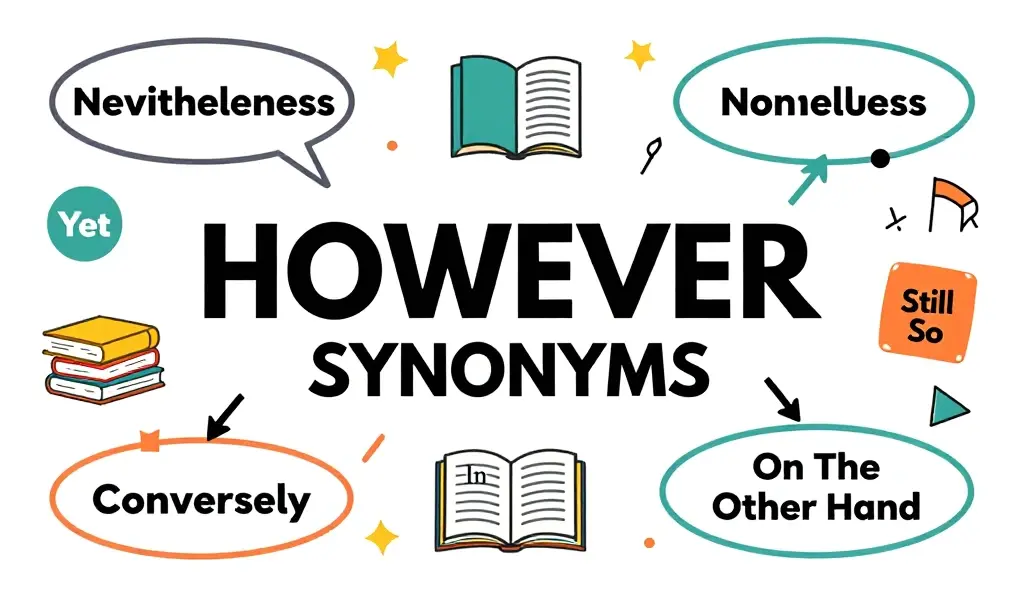
“However” is one of the most useful words in English for showing contrast.
We use it to introduce an exception, a contradiction, or a shift in thought. “The plan sounded great. However, it had one major flaw.” “She was tired; however, she kept working.”
It’s a reliable word, but it also gets repeated often, especially in essays, reports, and articles that make a lot of comparisons.
When “however” shows up in every paragraph, writing can start to feel repetitive and mechanical.
That’s why writers, students, and editors look for synonyms.
A synonym is a word or phrase that signals the same kind of contrast but adds variety, tone, or a different level of formality.
People search for “however synonyms” for a few common reasons.
Students want to avoid repeating “however” in essays.
Writers want smoother transitions in longer pieces.
Business professionals want more polished wording for reports and emails.
And editors just want more natural-sounding sentence flow.
You should reach for a synonym when “however” feels too repetitive or too formal for the moment.
If you’re writing casually, try “but” or “though.” If you want a slightly softer contrast, try “still” or “yet.” If you’re writing something formal or academic, try “nevertheless” or “notwithstanding.”
Meaning
Definition: “However” is a conjunctive adverb used to introduce a contrast, exception, or contradiction to a previous statement. It signals that what follows goes against or qualifies what came before.
Context: The meaning stays fairly consistent, but placement changes tone. At the start of a sentence, “however” often feels formal and clear. In the middle of a sentence, set off by commas, it can feel more conversational.
Common usage: People use “however” in essays, articles, business writing, and everyday speech to introduce a contrasting idea or an exception to something just stated.
Pronunciation
“However” is pronounced /haʊˈɛv.ər/ — “how-EV-er,” with the stress on the second syllable.
Part of Speech
“However” functions as a conjunctive adverb, connecting two ideas by showing contrast.
- Example: The weather was cold. However, we still went hiking.
It can also function as an adverb meaning “to whatever extent” or “in whatever way.”
- Example: You can solve this however you like.
This article focuses mainly on “however” as a contrast connector, since that’s the most common and most frequently searched usage.
Synonyms for However
| Word/Phrase | Meaning | Usage | Formality | Example | Difficulty Level |
| But | Simple contrast connector | General | Casual | “The trip was fun, but exhausting.” | Easy |
| Nevertheless | Despite what was just said | Formal writing | Formal | “It was raining; nevertheless, they went for a run.” | Medium |
| Nonetheless | In spite of that | Formal writing | Formal | “The cost was high; nonetheless, they approved the budget.” | Medium |
| Yet | Still, despite this | General | Neutral | “The plan was risky, yet it worked.” | Easy |
| Still | Despite that, continuing to be true | General | Casual | “He was nervous. Still, he gave a great speech.” | Easy |
| Though | Although, but (used at end or start of sentence) | Casual | Casual | “It’s expensive, though it’s worth it.” | Easy |
| On the other hand | Introducing a contrasting viewpoint | Formal/general | Neutral | “On the other hand, the new plan reduces costs.” | Medium |
| That said | Acknowledging a point while shifting focus | Casual/business | Neutral | “The idea has flaws. That said, it’s still promising.” | Medium |
| Even so | Despite that fact | General | Neutral | “The odds were low. Even so, they succeeded.” | Medium |
| Notwithstanding | In spite of, despite (formal/legal) | Formal/legal | Formal | “Notwithstanding the risks, they proceeded with the merger.” | Hard |
| Despite this | Regardless of what was just mentioned | Formal | Formal | “Despite this, sales continued to grow.” | Medium |
| In spite of this | Regardless of the previous point | Formal | Formal | “In spite of this, morale remained high.” | Medium |
| Regardless | Without being affected by the previous statement | General | Neutral | “The weather was bad. Regardless, the event continued.” | Medium |
| All the same | Despite that, nonetheless | Casual | Casual | “It was risky. All the same, we went ahead.” | Medium |
| At the same time | Introducing a contrasting or balancing point | General | Neutral | “It’s efficient; at the same time, it’s expensive.” | Medium |
| Conversely | Introducing an opposite point | Formal/academic | Formal | “Conversely, the second study found no correlation.” | Hard |
| In contrast | Highlighting a difference | Formal/academic | Formal | “In contrast, the second method proved faster.” | Medium |
| By contrast | Emphasizing a clear difference | Formal/academic | Formal | “By contrast, sales dropped in the second quarter.” | Medium |
| Alternatively | Offering another option or view | Formal | Formal | “Alternatively, we could delay the launch.” | Medium |
| Be that as it may | Acknowledging a point while moving forward (formal/older usage) | Formal | Formal | “Be that as it may, the deadline hasn’t changed.” | Hard |
| Having said that | Acknowledging something while shifting focus | Casual/business | Neutral | “It’s a solid plan. Having said that, we should test it first.” | Medium |
| For all that | Despite everything mentioned (literary) | Formal/literary | Formal | “For all that, the project still succeeded.” | Hard |
| Although | Introducing a contrasting clause | General | Neutral | “Although it rained, the game continued.” | Easy |
| Whereas | Highlighting a contrast between two things | Formal | Formal | “The first plan is cheaper, whereas the second is faster.” | Medium |
| While | Introducing a contrast (used within a sentence) | General | Neutral | “While the idea is good, the timing is off.” | Easy |
| Anyway | Casually shifting back to a point despite what was said | Casual | Casual | “It’s late. Anyway, let’s finish this tomorrow.” | Easy |
| Anyhow | Similar to “anyway,” casual shift | Casual | Casual | “It’s confusing. Anyhow, let’s move on.” | Easy |
| Just the same | Despite that (casual) | Casual | Casual | “It’s a long shot. Just the same, it’s worth trying.” | Medium |
| Withal | Nevertheless, all the same (archaic/literary) | Formal/literary | Formal | “The plan was risky; withal, it succeeded.” | Hard |
Best Synonyms Explained
But
Meaning: The simplest, most common word for introducing contrast. Difference from “however”: Much more casual and typically joins two clauses in the same sentence without a semicolon. Example: “I wanted to go, but I was too tired.” Best situation: Everyday writing and conversation, short and direct contrasts. Common mistake: Starting every sentence with “but” in formal writing — it’s fine occasionally, but overuse feels too casual for academic or business contexts.
Nevertheless
Meaning: Despite what was just said; in spite of that. Difference from “however”: Slightly more formal and emphatic, often used to acknowledge a challenge before moving forward anyway. Example: “The project faced delays. Nevertheless, it launched on time.” Best situation: Formal writing, professional reports, persuasive essays. Common mistake: Using it in casual conversation, where it can sound stiff — “still” or “but” fit better there.
Nonetheless
Meaning: In spite of that; regardless. Difference from “however”: Very similar to “nevertheless,” slightly more common in modern business and journalistic writing. Example: “Ticket sales were slow. Nonetheless, the concert was a success.” Best situation: Business writing, news articles, formal reports. Common mistake: Using it interchangeably with “but” in casual speech, where it feels overly formal.
On the other hand
Meaning: Introducing a contrasting viewpoint or option. Difference from “however”: Specifically useful when comparing two distinct sides or choices, not just softening a contradiction. Example: “The city apartment is convenient. On the other hand, the suburban house is more affordable.” Best situation: Comparing two clear options or perspectives. Common mistake: Using it without first presenting one side clearly — “on the other hand” needs a “one hand” to contrast with.
That said
Meaning: Acknowledging a previous point while shifting focus or adding a contrasting note. Difference from “however”: More conversational and commonly used in spoken English and informal business writing. Example: “The report has some gaps. That said, it’s a strong start.” Best situation: Casual professional writing, meetings, presentations. Common mistake: Overusing it as filler — it works best when there’s a genuine shift in perspective.
Notwithstanding
Meaning: In spite of, despite. Difference from “however”: Much more formal, often used in legal, academic, or highly formal writing. Example: “Notwithstanding the objections, the board approved the merger.” Best situation: Legal documents, academic writing, very formal reports. Common mistake: Using it in everyday conversation — it can sound stiff or overly formal outside of legal or academic contexts.
Antonyms for However
Since “however” signals contrast, its opposites are words that signal continuation, agreement, or addition rather than contradiction.
| Word/Phrase | Meaning | Example |
| Furthermore | Adding another supporting point | “The plan is affordable. Furthermore, it’s fast to implement.” |
| Moreover | Adding emphasis to a similar point | “The results were positive. Moreover, they exceeded expectations.” |
| In addition | Adding more information | “In addition, the team hired two new members.” |
| Additionally | Adding a related point | “Additionally, the software received a security update.” |
| Similarly | Showing agreement or likeness | “Similarly, the second test produced the same result.” |
| Likewise | Showing the same is true elsewhere | “Likewise, the other branch reported strong sales.” |
| As well | Adding a related point (casual) | “The event was fun, and the food was great as well.” |
| Also | Adding a related point (casual) | “The venue was beautiful, and it was also affordable.” |
| Consequently | Showing a result, not contrast | “Sales rose. Consequently, the company expanded.” |
| Therefore | Showing a logical result | “The tests passed. Therefore, the product launched on schedule.” |
Examples of Synonyms in Real Sentences
- The hotel was expensive, but the location was excellent.
- Sales dropped in the spring; nevertheless, the company stayed profitable.
- The plan had risks; nonetheless, the team moved forward.
- It was a long shot, yet it worked out perfectly.
- He was exhausted. Still, he finished the marathon.
- The idea is unconventional, though it might just work.
- Option A is cheaper. On the other hand, Option B is faster.
- The report needs edits. That said, it’s a strong draft.
- The odds were against them. Even so, they succeeded.
- Notwithstanding the delays, the project shipped on time.
- Despite this, the team remained optimistic.
- In spite of this, morale stayed high through the layoffs.
- It was raining heavily. Regardless, the parade continued.
- It’s risky. All the same, it’s worth considering.
- The design is elegant; at the same time, it’s expensive to produce.
- Conversely, the second experiment showed no improvement.
- In contrast, the newer model performs significantly better.
- By contrast, last year’s numbers were much lower.
- Alternatively, we could push the launch back a week.
- Be that as it may, the deadline remains unchanged.
- It’s a bold strategy. Having said that, it aligns with our goals.
- For all that, the campaign still exceeded expectations.
- Although it was late, they kept working.
- The first draft is rough, whereas the final version reads smoothly.
- While the budget is tight, the results have been strong.
- It’s getting late. Anyway, let’s pick this up tomorrow.
- The instructions were confusing. Anyhow, we figured it out.
- It’s unlikely to work. Just the same, we should try it.
- The terrain was difficult; withal, the hikers reached the summit.
- The feedback was harsh, but it was fair.
25 Naturally Written Sentences
- I wanted to finish the project early, but other tasks came up.
- The weather was terrible; nevertheless, the flight departed on schedule.
- Costs went up this quarter; nonetheless, profits remained steady.
- The idea sounded strange at first, yet it turned out to be brilliant.
- She was nervous before the interview. Still, she nailed it.
- It’s a small apartment, though it has a great view.
- The city has more job opportunities. On the other hand, the cost of living is higher.
- The presentation ran long. That said, the content was excellent.
- The chances were slim. Even so, they gave it their best shot.
- Notwithstanding the criticism, the film became a huge success.
- Despite this setback, the team stayed motivated.
- In spite of this challenge, the community came together.
- The forecast called for rain. Regardless, the wedding stayed outdoors.
- It’s a lot of work. All the same, it’ll be worth it in the end.
- The system is fast. At the same time, it’s harder to maintain.
- Conversely, the control group showed no change at all.
- In contrast, this year’s turnout was much higher than expected.
- By contrast, the older version required manual updates.
- Alternatively, we could try a smaller pilot program first.
- Be that as it may, we still need to submit the report on time.
- It’s an ambitious goal. Having said that, I think we can hit it.
- For all that, the small business managed to survive the recession.
- Although the meeting ran late, everyone stayed engaged.
- The first model was cheap, whereas the second one lasted longer.
- While the process is slow, the results are usually worth it.
Formal vs. Informal Usage
| Situation | Formal Word/Phrase | Informal Word/Phrase |
| Academic writing | Nevertheless, Notwithstanding | But, Still |
| Business reports | Nonetheless, In contrast | That said, On the flip side |
| Everyday conversation | Yet, Though | But, Anyway |
| Comparing two options | On the other hand, Conversely | On the flip side |
| Casual writing/texting | Still, Though | But, Anyway |
In formal writing — academic papers, legal documents, professional reports — use words like “nevertheless,” “notwithstanding,” or “in contrast.” In casual conversation, “but,” “still,” or “though” feel more natural and relaxed.
Academic Usage
In academic writing, “however” is common, but varying your transitions with formal alternatives improves flow and avoids repetition.
- Repetitive: “However, the results were inconclusive. However, further research is needed.”
- Improved: “The results were inconclusive. Nevertheless, further research is needed.”
Other academic-friendly synonyms include: nonetheless, notwithstanding, conversely, in contrast, and whereas.
Daily Conversation
In everyday talk, people naturally reach for shorter, more casual alternatives.
- “I wanted to go, but I was too tired.”
- “It’s expensive, though it might be worth it.”
- “That’s a good point. Still, I think we should wait.”
These casual synonyms keep conversation natural without sounding overly formal or academic.
Grammar Tips
- When “however” starts a sentence, it’s usually followed by a comma: However, the results were surprising.
- When “however” appears mid-sentence, it’s often set off by commas or preceded by a semicolon: The results were surprising; however, they were not statistically significant.
- “But” is a coordinating conjunction and doesn’t require a semicolon before it: The results were surprising, but they were not significant.
- “Though” can appear at the end of a sentence in casual speech: The results were surprising. They weren’t significant, though.
Collocations
Common word pairings and structures using “however” and its synonyms:
- However, + [contrasting statement]
- [Statement]; nevertheless, [contrasting statement]
- On the other hand, + [contrasting viewpoint]
- That said, + [qualifying statement]
- Despite this, + [contrasting outcome]
- [Statement], but [contrasting statement]
These structures are common in essays, articles, and professional writing to introduce contrast smoothly.
Common Phrases
- “However you look at it” — no matter the perspective.
- “However that may be” — regardless of what was just said (formal).
- “That said” — acknowledging a point before adding a contrast.
- “Be that as it may” — a formal way of accepting a point while moving forward.
- “Having said that” — similar to “that said,” often used in speech.
Idioms
- “Every cloud has a silver lining” — used to introduce a positive contrast to a negative situation. Example: “The flight was delayed, but every cloud has a silver lining — we got free upgrades.”
- “On the flip side” — an informal way to introduce a contrasting point. Example: “The apartment is small. On the flip side, it’s really affordable.”
- “That being said” — used to shift from one point to a contrasting one. Example: “It’s a great deal. That being said, read the contract carefully.”
Similar Words Comparison
| Word/Phrase | Meaning | Difference | Example |
| However | Introduces contrast or exception | Neutral, versatile | “It’s late; however, we should finish this.” |
| But | Simple contrast connector | More casual, joins clauses directly | “It’s late, but we should finish this.” |
| Nevertheless | Despite what was just said | More formal and emphatic | “It’s late; nevertheless, we should finish this.” |
| Yet | Still, despite this | Slightly softer contrast | “It’s late, yet we should finish this.” |
| On the other hand | Introduces a contrasting option or view | Best for comparing two sides | “It’s late. On the other hand, we’re almost done.” |
FAQs
Q1. What is the best synonym for “however”?
A: But is the most common and versatile synonym for however in everyday writing. For formal writing, nevertheless and nonetheless are excellent alternatives. The best choice depends on your tone and sentence structure.
Q2. Is “nevertheless” the same as “however”?
A: They are very similar in meaning, but nevertheless is more formal and often emphasizes continuing despite a difficulty. However is more neutral and works well in both formal and informal writing.
Q3. What is a formal synonym for “however”?
A: Formal alternatives include nevertheless, nonetheless, notwithstanding, in contrast, and conversely. These expressions are commonly used in academic papers, legal documents, and professional reports.
Q4. What is a casual synonym for “however”?
A: Common informal alternatives include but, though, still, and anyway. These words fit everyday conversations and informal writing but may sound too relaxed for formal documents.
Q5. What is the opposite of “however”?
A: Since however introduces contrast, its opposites include furthermore, moreover, additionally, likewise, and similarly, which introduce supporting or related ideas instead.
Q6. How do you use “however” correctly in a sentence?
A: When however begins a sentence, place a comma after it: However, the meeting was postponed. When it joins two independent clauses, use a semicolon before it and a comma after it: The meeting was scheduled; however, it was postponed.
Q7. What word can replace “however” in an essay?
A: In essays, you can use nevertheless, nonetheless, in contrast, conversely, or on the other hand, depending on the type of comparison or contrast you want to express.
Q8. Which synonym for “however” means “despite this”?
A: Expressions such as nevertheless, notwithstanding, despite this, and in spite of this all convey the meaning of “despite this,” with some sounding more formal than others.
Q9. Can “but” replace “however” in every sentence?
A: No. But is a coordinating conjunction, while however is a conjunctive adverb. They follow different grammar and punctuation rules, so they are not always interchangeable.
Q10. What is another way to say “however” at the beginning of a paragraph?
A: Good alternatives include That said, On the other hand, Even so, Nevertheless, and Still. Choose the one that best matches the tone of your writing.
Q11. Is “however” the same as “although”?
A: Not exactly. Although introduces a dependent clause within a sentence, while however connects separate ideas or independent clauses to show contrast.
Q12. What is a good synonym for “however” in business writing?
A: Professional alternatives include nonetheless, in contrast, that said, nevertheless, and conversely. These expressions are widely used in business reports, emails, proposals, and presentations.
Q13. Why should I avoid repeating “however” in writing?
A: Repeating however can make your writing sound repetitive and mechanical. Using different transition words improves readability, creates variety, and makes your writing more engaging.
Q14. What is a fun or informal way to say “however”?
A: Casual alternatives include anyway, still, on the flip side, then again, and all the same. These expressions make conversations and informal writing sound more natural.
Expert Tips
- Match the synonym to your sentence structure. “But” connects clauses directly, while “however” and “nevertheless” typically need a semicolon or a new sentence.
- In formal writing, vary your transitions — mixing “however,” “nevertheless,” and “in contrast” keeps your writing from feeling repetitive.
- Reserve highly formal words like “notwithstanding” for legal, academic, or very formal writing — it can sound out of place in everyday text.
- Double-check your punctuation whenever you use “however.” Incorrect comma or semicolon placement is one of the most common grammar mistakes with this word.
Conclusion:
“However” is a dependable word for showing contrast, but leaning on it too heavily can make writing feel repetitive and stiff. Swapping it for the right synonym “but” for a casual tone, “nevertheless” for formal emphasis, or “on the other hand” for comparing two ideas makes your writing sound smoother and more varied.
Keep this list handy, and next time you reach for “however,” pick a word that fits your tone and sentence structure exactly.

Harper Nelson is a language researcher and content writer dedicated to helping readers master English vocabulary through reliable and easy-to-understand educational resources.