
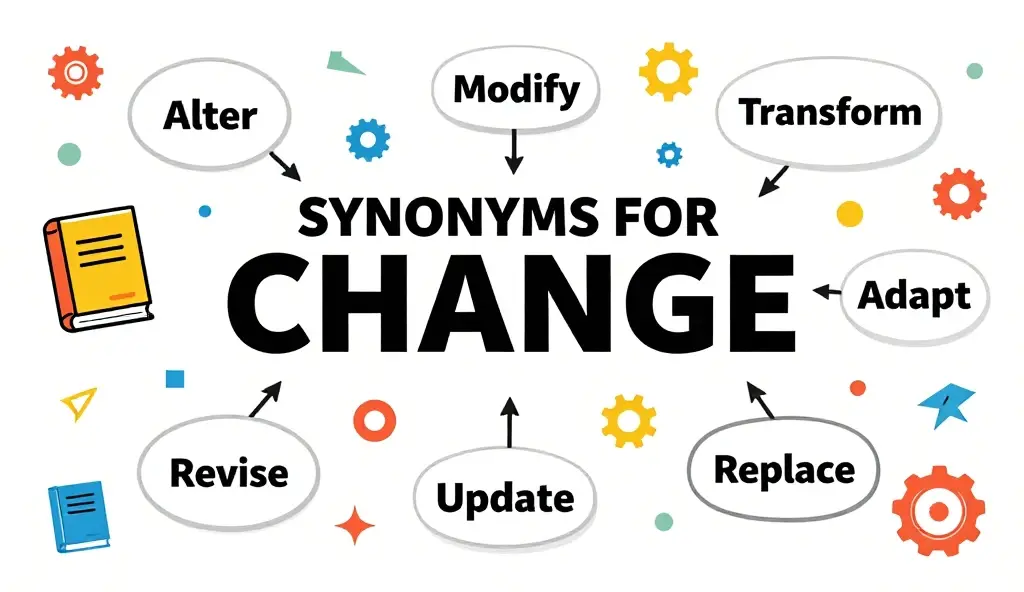
“Change” is one of the most essential words in English.
We use it to describe anything different from before a new plan, a new habit, a new appearance, a new direction. “The company changed its strategy.” “She changed her mind.” “The weather is changing.”
Because it applies to almost anything, it’s also easy to overuse.
When “change” appears again and again in the same piece of writing, it starts to feel vague and repetitive.
It also doesn’t always tell your reader how something changed was it a small tweak, or a total transformation?
That’s why writers, students, and professionals reach for synonyms.
A synonym is a word that carries a similar meaning but adds more precision about the size, speed, or type of change.
People search for “synonyms for change” for a few common reasons.
Students want to avoid repeating “change” in essays.
Writers want more expressive language for describing transformation.
Business professionals want more polished wording for reports on strategy or process.
And everyday speakers just want variety when talking about life changes.
You should reach for a synonym when “change” feels too generic.
If something changed dramatically, try “transform” or “revolutionize.” If it was a small tweak, try “adjust” or “tweak.” If it changed gradually over time, try “evolve” or “develop.”
Meaning
Definition: “Change” means to make or become different. It can refer to a small adjustment, a complete transformation, or a shift from one state to another.
Context: The meaning shifts depending on the scale and context. “Change your clothes” means to physically swap one thing for another. “Change your mind” means to reconsider a decision. “The city has changed a lot” means it looks or functions differently than before.
Common usage: People use “change” as both a verb (to make different) and a noun (the act or result of becoming different), making it one of the most versatile words in English.
Pronunciation
“Change” is pronounced /tʃeɪndʒ/ — “chaynj,” rhyming with “range” and “strange.” It’s a single syllable.
Part of Speech
“Change” is most commonly used as a verb, meaning to make or become different.
- Example: She changed her approach to the project.
It is also frequently used as a noun, referring to the result or process of becoming different.
- Example: The company announced a major change in leadership.
Synonyms for Change
| Word | Meaning | Usage | Formality | Example | Difficulty Level |
| Transform | To change completely, often dramatically | General/strong | Neutral | “The renovation transformed the old house.” | Easy |
| Alter | To make a smaller, specific change | Formal | Formal | “They altered the contract slightly.” | Medium |
| Adjust | To make a minor change for improvement | General | Neutral | “Please adjust the settings as needed.” | Easy |
| Modify | To change something to improve or adapt it | Formal/technical | Formal | “The team modified the design based on feedback.” | Medium |
| Shift | To change position, direction, or focus | General | Neutral | “Public opinion has shifted on this issue.” | Easy |
| Convert | To change from one form or use to another | Formal/technical | Formal | “They converted the garage into an office.” | Medium |
| Revise | To change and improve, especially text or plans | Formal/academic | Formal | “She revised the essay before submitting it.” | Medium |
| Adapt | To change to suit new conditions | Formal/general | Neutral | “The species adapted to its new environment.” | Medium |
| Evolve | To change gradually over time | Formal/descriptive | Formal | “The industry has evolved significantly in a decade.” | Medium |
| Transition | To change from one state or stage to another | Formal | Formal | “The company is transitioning to remote work.” | Medium |
| Reform | To change something for the better, especially systems | Formal/political | Formal | “Lawmakers proposed reforming the tax code.” | Medium |
| Revamp | To change and improve, especially design or structure | Casual/business | Neutral | “They revamped the entire website.” | Easy |
| Overhaul | To make thorough, significant changes | Formal/technical | Formal | “The company overhauled its supply chain.” | Medium |
| Amend | To make small, formal changes, especially to text | Formal/legal | Formal | “The committee amended the proposal.” | Medium |
| Update | To bring something up to date | General/technical | Neutral | “We updated the software last week.” | Easy |
| Revolutionize | To change something completely and dramatically | Formal/dramatic | Formal | “The invention revolutionized transportation.” | Medium |
| Vary | To change or differ from time to time | General | Neutral | “Prices vary depending on the season.” | Easy |
| Switch | To change from one thing to another, often quickly | Casual | Casual | “She switched careers last year.” | Easy |
| Turn into | To become something different | Casual | Casual | “The friendly chat turned into an argument.” | Easy |
| Morph | To gradually change form (informal, often figurative) | Casual | Casual | “The project morphed into something much bigger.” | Medium |
| Rearrange | To change the order or arrangement of things | General | Neutral | “They rearranged the furniture in the living room.” | Easy |
| Reshape | To change the form or structure of something | Formal | Formal | “The new policy reshaped the entire department.” | Medium |
| Renew | To make something new or different again | Formal | Formal | “They renewed their commitment to the cause.” | Medium |
| Diversify | To change by adding variety | Formal/business | Formal | “The company diversified its product line.” | Medium |
| Fluctuate | To change repeatedly, often unpredictably | Formal | Formal | “Stock prices fluctuate throughout the day.” | Hard |
| Mutate | To change genetically or unpredictably | Formal/scientific | Formal | “The virus mutated over several months.” | Hard |
| Metamorphose | To change form completely, often dramatically | Formal/literary | Formal | “The caterpillar metamorphosed into a butterfly.” | Hard |
| Tweak | To make a small adjustment (informal) | Casual | Casual | “Just tweak the wording a little.” | Easy |
| Shake up | To change significantly, often disruptively | Casual/business | Casual | “The new CEO shook up the whole department.” | Medium |
Best Synonyms Explained
Transform
Meaning: To change completely, often dramatically or impressively. Difference from “change”: Much stronger, implying a total shift rather than a minor adjustment. Example: “The training program transformed her confidence at work.” Best situation: Describing dramatic, positive shifts in appearance, ability, or circumstances. Common mistake: Using it for small tweaks — “transform” implies a complete, noticeable shift.
Adjust
Meaning: To make a minor change, usually for improvement or accuracy. Difference from “change”: Implies a small, precise tweak rather than a major shift. Example: “We adjusted the schedule slightly to fit everyone’s availability.” Best situation: Describing small refinements to plans, settings, or approaches. Common mistake: Using it for dramatic transformations — “adjust” should signal something modest.
Adapt
Meaning: To change in order to fit new circumstances or conditions. Difference from “change”: Focuses on responding to something external, not change for its own sake. Example: “The company adapted quickly to the new market conditions.” Best situation: Describing responses to new environments, challenges, or requirements. Common mistake: Using it for planned, deliberate change unrelated to external conditions — “adapt” implies responding to circumstances.
Revise
Meaning: To change and improve something, especially written or planned material. Difference from “change”: Implies a thoughtful process of review and improvement. Example: “She revised her business plan after getting investor feedback.” Best situation: Describing edits to documents, plans, or strategies based on new information. Common mistake: Using it for physical or unrelated changes — “revise” typically applies to text, plans, or ideas.
Evolve
Meaning: To change gradually over time, often through a natural process. Difference from “change”: Implies a slow, ongoing progression rather than a sudden shift. Example: “Their relationship evolved from friendship into something deeper.” Best situation: Describing gradual development in ideas, relationships, industries, or systems. Common mistake: Using it for sudden or forced changes — “evolve” should imply a natural, gradual process.
Overhaul
Meaning: To make thorough, significant changes to something. Difference from “change”: Implies a complete rework, often of a system or process. Example: “The company overhauled its entire onboarding process.” Best situation: Describing major restructuring of systems, processes, or organizations. Common mistake: Using it for small tweaks — “overhaul” should signal a comprehensive, large-scale change.
Antonyms for Change
| Word | Meaning | Example |
| Maintain | To keep something the same | “They maintained the same pricing structure.” |
| Preserve | To keep something in its original state | “The town worked to preserve its historic buildings.” |
| Stabilize | To make something steady and unchanging | “The medication helped stabilize her condition.” |
| Continue | To keep going without change | “They continued the same routine for years.” |
| Retain | To keep something as it is | “The company retained its original branding.” |
| Sustain | To keep something going at the same level | “They sustained steady growth for a decade.” |
| Persist | To continue existing without change | “The problem persisted despite their efforts.” |
| Remain | To stay the same, unchanged | “Prices remained steady throughout the year.” |
| Fix | To make something permanent or unchanging | “They fixed the meeting time for every Monday.” |
| Stay put | To remain in the same position or state (informal) | “We decided to stay put instead of moving.” |
Examples of Synonyms in Real Sentences
- The renovation completely transformed the old warehouse.
- They altered the schedule to accommodate the new hires.
- Can you adjust the thermostat a little?
- The team modified the app based on user feedback.
- Public sentiment has shifted over the past year.
- They converted the spare room into a home office.
- She revised her resume before applying.
- The plant adapted to the drier climate over time.
- The industry has evolved dramatically in the last decade.
- The company is transitioning to a hybrid work model.
- Lawmakers proposed reforming the outdated policy.
- The team revamped their entire marketing strategy.
- They overhauled the customer service process.
- The board amended the original proposal.
- We updated the website with new photos.
- The discovery revolutionized the entire field.
- Results vary depending on individual circumstances.
- She switched majors halfway through college.
- The small disagreement quickly turned into a bigger issue.
- Their business plan morphed into something much larger.
- They rearranged the office to improve workflow.
- The merger reshaped the company’s leadership structure.
- They renewed their focus on customer satisfaction.
- The company diversified its investments last year.
- Sales fluctuate significantly during the holidays.
- The virus mutated, creating a new strain.
- The design metamorphosed completely after user testing.
- Just tweak the header size a little.
- The new manager shook up the whole team’s routine.
- Their relationship gradually evolved over the years.
25 Naturally Written Sentences
- The city has transformed a lot since I last visited.
- We altered our plans slightly due to the weather.
- Could you adjust the volume a bit?
- They modified the recipe to make it healthier.
- My opinion has shifted after reading more about it.
- We converted our extra bedroom into a home gym.
- She revised her essay three times before turning it in.
- Businesses had to adapt quickly during the pandemic.
- Technology has evolved so much in just a few years.
- The team is transitioning to a new project management tool.
- The city council is working to reform local zoning laws.
- They revamped their branding to feel more modern.
- The company overhauled its entire hiring process.
- The agreement was amended after further negotiation.
- We updated our contact information on the website.
- That invention truly revolutionized the industry.
- Prices vary a lot depending on the season.
- He switched jobs to pursue something more creative.
- Their small hobby turned into a full-time business.
- The plan morphed into something completely different.
- We rearranged the schedule to fit everyone’s availability.
- New leadership reshaped the direction of the company.
- They renewed their lease for another year.
- The startup diversified into a few new markets.
- Attendance tends to fluctuate throughout the year.
Formal vs. Informal Usage
| Situation | Formal Word | Informal Word |
| Small adjustments | Adjust, Modify | Tweak, Fiddle with |
| Major transformations | Overhaul, Revolutionize | Shake up, Revamp |
| Business/strategy | Transition, Reform | Switch, Shift |
| Written documents | Revise, Amend | Update, Fix |
| Everyday conversation | Alter, Adapt | Change, Switch |
In formal writing — business reports, legal documents, academic writing — use words like “modify,” “amend,” or “transition.” In casual conversation, “tweak,” “switch,” or “revamp” feel more natural.
Academic Usage
In academic writing, “change” is often replaced with more specific, precise language depending on the type of change being described.
- Weak: “The results changed after the second trial.”
- Strong: “The results shifted significantly after the second trial.”
Other academic-friendly synonyms include: fluctuate, evolve, transition, and modify.
Daily Conversation
In everyday talk, people naturally reach for casual, expressive alternatives.
- “Did you change your hair?” — “Yeah, I switched it up a bit.”
- “The plan changed last minute.” — “Oh no, what happened?”
- “How’s the new job?” — “It’s been a big adjustment, but a good one.”
These casual synonyms keep conversation natural and expressive without sounding overly formal.
Grammar Tips
- “Change” can function as both a countable and uncountable noun: a change in plans (countable) versus lots of change ahead (more abstract, uncountable use).
- As a verb, “change” can be transitive (taking an object) or intransitive: She changed her mind (transitive) versus The weather is changing (intransitive).
- Be careful not to confuse “change” (to become different) with “exchange” (to trade one thing for another) — they’re related but not interchangeable.
Collocations
Common word pairings using “change” and its synonyms:
- Change of plans / Shift in plans
- Change your mind / Reconsider
- Major change / Significant shift
- Change of pace / Switch of pace
- Adapt to change / Adjust to change
- Embrace change / Welcome change
These pairings sound natural and appear often in everyday speech and writing.
Common Phrases
- “Change of heart” — a shift in feelings or opinion.
- “For a change” — doing something different than usual.
- “Change of scenery” — a shift to a new environment.
- “Change of pace” — a shift in speed, rhythm, or routine.
- “The only constant is change” — a saying acknowledging that change is inevitable.
Idioms
- “Turn over a new leaf” — to make a positive change in behavior or habits. Example: “After the health scare, he decided to turn over a new leaf.”
- “A change of heart” — a shift in feelings, opinion, or decision. Example: “She had a change of heart and decided to stay.”
- “Go with the flow” — to adapt easily to change without resistance. Example: “He’s easygoing and always goes with the flow.”
Similar Words Comparison
| Word | Meaning | Difference | Example |
| Change | To become different | Broad, general | “The plan will change.” |
| Transform | To change completely, often dramatically | Much stronger | “The plan will transform.” |
| Adjust | To make a small, precise change | Weaker, more minor | “The plan will adjust.” |
| Evolve | To change gradually over time | Focuses on gradual process | “The plan will evolve.” |
| Transition | To change from one state to another | Focuses on process/stages | “The plan will transition.” |
FAQs
Q1. What is the best synonym for “change”?
A: Transform and shift are two of the most versatile synonyms for change. Transform describes a dramatic or complete change, while shift is better for gradual changes in direction, position, or focus. The best choice depends on the context.
Q2. Is “transform” stronger than “change”?
A: Yes. Transform suggests a significant or complete alteration, whereas change is a broader, more neutral word that can describe anything from a minor adjustment to a major transformation.
Q3. What is a formal synonym for “change”?
A: Formal alternatives include modify, amend, transition, reform, and revise. These words are commonly used in business reports, legal documents, academic writing, and professional communication.
Q4. What is a casual synonym for “change”?
A: Common informal alternatives include tweak, switch, revamp, switch up, and shake up. These expressions are natural in everyday conversations but may be too informal for professional or legal writing.
Q5. What is the opposite of “change”?
A: Common antonyms include maintain, preserve, remain, retain, and sustain. These words describe keeping something the same rather than altering it.
Q6. How can I say “change” in a more descriptive way?
A: Choose a synonym that matches the type of change. Use overhaul for a major restructuring, tweak for a small adjustment, evolve for gradual development, adapt for responding to new conditions, or revolutionize for a groundbreaking transformation.
Q7. What word can replace “change” in an essay?
A: In essays, use words like shift, transition, evolve, modify, adapt, or fluctuate, depending on the context. These alternatives sound more precise and analytical than the general word change.
Q8. Which synonym for “change” means a complete transformation?
A: Words such as transform, revolutionize, metamorphose, and overhaul describe a dramatic or complete change. Metamorphose often has a more literary tone, while transform is the most commonly used.
Q9. What is a good synonym for “change” in business writing?
A: Professional alternatives include transition, reform, overhaul, modify, restructure, and adapt. These words are commonly used in reports, proposals, and strategic planning documents.
Q10. What is another way to say “things have changed”?
A: You can say things have shifted, things have evolved, things are different now, circumstances have changed, or a lot has changed. Each expression conveys the same idea with a slightly different tone.
Q11. Can “adjust” mean the same as “change”?
A: Not always. Adjust usually refers to a small or specific improvement, while change is a broader term that can describe alterations of any size or significance.
Q12. What is a synonym for “change” in technology or software writing?
A: Common alternatives include update, modify, revise, upgrade, and patch. These terms are widely used when discussing software features, bug fixes, and new versions.
Q13. Why should I avoid repeating “change” in writing?
A: Repeating change can make your writing sound vague and repetitive. Using more specific synonyms helps readers understand the type, size, and purpose of the change while making your writing more engaging.
Q14. What is a fun or informal way to say “change”?
A: Casual alternatives include switch up, revamp, shake up, mix things up, and flip the script. These expressions add energy and personality to everyday conversations about change.
Expert Tips
- Match the synonym to the scale of the change. Use “adjust” or “tweak” for small changes, and “transform” or “overhaul” for major, sweeping ones.
- In business writing, words like “transition” and “reform” sound more strategic and intentional than a repeated “change.”
- Save dramatic words like “revolutionize” or “metamorphose” for genuinely significant shifts — overusing them weakens their impact.
- When describing gradual change over time, “evolve” or “develop” often sound more natural than a plain “change.”
Conclusion:
“Change” is essential, but it doesn’t always tell your reader how big the shift really was.
Swapping it for the right synonym “adjust” for a small tweak, “transform” for a dramatic shift, or “evolve” for gradual progress makes your writing and speech feel more precise and intentional. Keep this list handy, and next time you reach for “change,” pick a word that says exactly what kind of change you mean.

Christopher Ward writes practical guides on word usage, synonyms, and effective written communication for a global audience.