
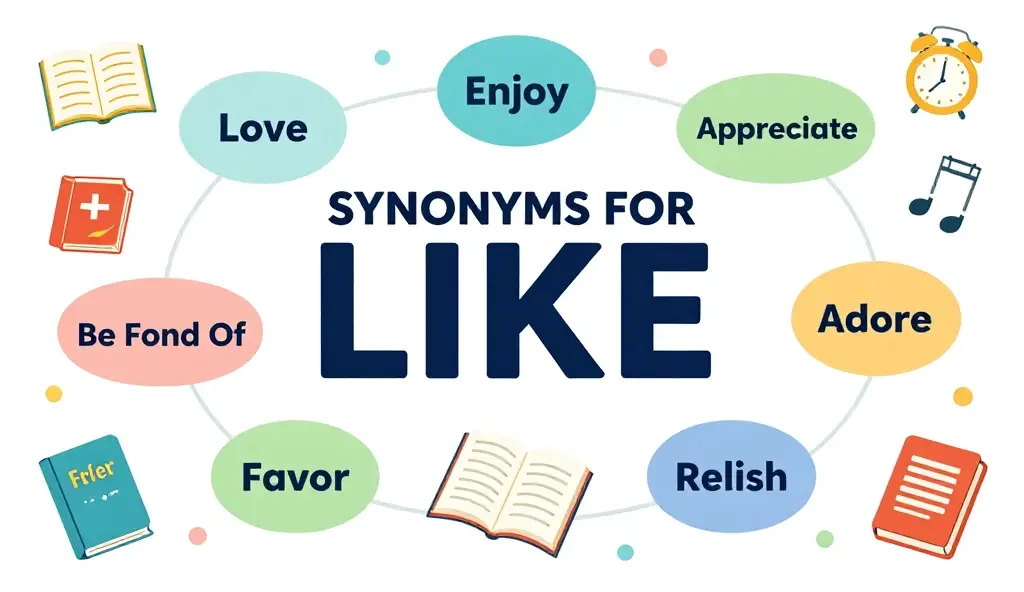
“Like” is a word we use every day.
We say, “I like ice cream.” We also use it to compare things.
We say, “She sings like a bird.” Some people also say “like” many times when they talk.
We use “like” a lot.
When we say it too much, our writing or talking can sound boring.
It may not sound clear.
That is why people use other words. These words are called synonyms.
A synonym is a word with a similar meaning.
Some words are stronger.
Some words are more polite.
Students, writers, and speakers look for synonyms for like.
Students want better school work. Writers want better words.
Speakers want to stop saying “like” too much.
Other people just want new ways to talk.
Use another word if “like” does not fit.
You can say “enjoy,” “love,” or “appreciate” if you really like something.
You can say “similar to” or “resembles” when you compare things.
If you say “like” too much while talking, just stop for a moment before you speak.
That can help you sound clear.
Meaning
Definition: “Like” has several meanings. As a verb, it means to find something enjoyable or pleasant. As a preposition, it means similar to or resembling something. As a casual filler word, it’s used in speech without adding real meaning.
Context: “I like coffee” expresses enjoyment. “She looks like her mother” expresses similarity. “It was, like, amazing” uses “like” as an informal filler, common in casual speech.
Common usage: People use “like” constantly in everyday conversation and writing to express preferences, make comparisons, and — especially in spoken English — to fill pauses or hesitations.
Pronunciation
“Like” is pronounced /laɪk/ — “lyk,” rhyming with “bike” and “hike.” It’s a single syllable.
Part of Speech
“Like” is most commonly used as a verb, meaning to enjoy or be fond of something.
- Example: I like reading before bed.
It’s also used as a preposition, meaning similar to.
- Example: He runs like a professional athlete.
Informally, it functions as a filler word or discourse marker in casual speech, without adding grammatical meaning.
- Example: It was, like, really surprising.
This article focuses mainly on “like” as a verb expressing enjoyment, since that’s the most commonly searched meaning, with a section covering the comparison sense as well.
Synonyms for Like (Meaning “To Enjoy”)
| Word | Meaning | Usage | Formality | Example | Difficulty Level |
| Enjoy | To take pleasure in something | General | Neutral | “I enjoy hiking on weekends.” | Easy |
| Appreciate | To value or recognize something positively | Formal/general | Formal | “I really appreciate good coffee.” | Medium |
| Admire | To respect and think highly of something | Formal | Formal | “She admires his dedication to his work.” | Medium |
| Fancy | To like or be attracted to (informal, British) | Casual | Casual | “I fancy trying that new restaurant.” | Medium |
| Favor | To prefer one thing over another | Formal | Formal | “The committee favors the second proposal.” | Medium |
| Adore | To love deeply, strong version of “like” | Emotional/general | Neutral | “She adores spending time outdoors.” | Easy |
| Relish | To enjoy greatly, often referring to an experience | Formal/descriptive | Formal | “He relishes a good challenge.” | Medium |
| Be fond of | To have affection or liking for something | General | Neutral | “I’m quite fond of old movies.” | Easy |
| Be into | To be interested in or enjoy (informal) | Casual | Casual | “She’s really into photography lately.” | Easy |
| Prefer | To like one thing more than another | General/formal | Neutral | “I prefer tea over coffee.” | Easy |
| Delight in | To take great pleasure in | Formal/literary | Formal | “He delights in solving puzzles.” | Hard |
| Take pleasure in | To enjoy, often used formally | Formal | Formal | “She takes pleasure in helping others.” | Medium |
| Love | To have strong affection for something | General, stronger than “like” | Neutral | “I love this song.” | Easy |
| Cherish | To hold something dear | Formal/emotional | Formal | “They cherish their weekend traditions.” | Medium |
| Have a soft spot for | To feel particular fondness for | Casual/idiomatic | Casual | “I have a soft spot for old sitcoms.” | Medium |
| Get a kick out of | To find enjoyment or amusement in something | Casual/idiomatic | Casual | “He gets a kick out of trivia nights.” | Medium |
| Dig | To like or enjoy (informal, slightly dated slang) | Casual/slang | Casual | “I really dig this new album.” | Medium |
| Be keen on | To be enthusiastic about (British English) | General | Neutral | “She’s keen on trying new recipes.” | Medium |
| Be partial to | To have a liking or preference for | Formal | Formal | “He’s partial to spicy food.” | Hard |
| Get pleasure from | To derive enjoyment from | Formal | Formal | “She gets pleasure from painting.” | Medium |
| Be drawn to | To feel a natural interest or attraction toward | Formal/descriptive | Formal | “He’s always been drawn to storytelling.” | Medium |
| Approve of | To have a favorable opinion of | Formal | Formal | “The board approves of the new strategy.” | Medium |
| Take a liking to | To develop fondness for something or someone | General | Neutral | “She took a liking to the new intern right away.” | Medium |
| Have a taste for | To enjoy a particular type of thing | Formal/descriptive | Formal | “He has a taste for classic literature.” | Medium |
| Be captivated by | To be strongly interested in or charmed by | Formal | Formal | “She was captivated by the documentary.” | Hard |
| Vibe with | To connect with or enjoy (very informal slang) | Casual/slang | Casual | “I really vibe with this playlist.” | Medium |
| Be smitten with | To be strongly attracted to or fond of | Casual/romantic | Casual | “He’s smitten with the new café downtown.” | Medium |
| Warm to | To gradually start liking something or someone | General | Neutral | “She warmed to the idea after thinking it over.” | Medium |
| Take to | To develop a liking for something quickly | General | Neutral | “The dog took to its new home right away.” | Medium |
Best Synonyms Explained
Enjoy
Meaning: To take pleasure in something. Difference from “like”: Slightly more active — implies experiencing something with pleasure, not just having a positive opinion. Example: “I really enjoy cooking on weekends.” Best situation: Describing activities or experiences that bring genuine pleasure. Common mistake: Using it for mild preferences — “enjoy” implies actual pleasure, not just neutral approval.
Appreciate
Meaning: To value or recognize the worth of something. Difference from “like”: Adds a sense of gratitude or thoughtful recognition, not just enjoyment. Example: “I appreciate a well-organized schedule.” Best situation: Formal writing, professional contexts, or expressing gratitude for something. Common mistake: Using it for simple, casual preferences — “appreciate” often implies deeper recognition of value.
Fancy
Meaning: To like or be attracted to something (especially British English). Difference from “like”: More casual and often implies a spontaneous or light preference. Example: “I fancy going for a walk later.” Best situation: Casual British English conversation. Common mistake: Using it in American formal writing, where it’s uncommon and may sound unusual.
Relish
Meaning: To enjoy something greatly, often an experience or challenge. Difference from “like”: Implies deep, active enjoyment, often of something demanding. Example: “She relishes every opportunity to learn something new.” Best situation: Describing enthusiasm for challenges, opportunities, or meaningful experiences. Common mistake: Using it for mild, everyday preferences — “relish” implies strong enthusiasm.
Be fond of
Meaning: To have genuine affection or liking for something. Difference from “like”: Slightly warmer and more personal in tone. Example: “I’ve always been fond of rainy afternoons.” Best situation: Describing gentle, ongoing affection for something familiar. Common mistake: Using it for strong excitement — “fond of” implies quiet, steady affection rather than intense enthusiasm.
Prefer
Meaning: To like one option more than another. Difference from “like”: Always implies comparison between two or more choices. Example: “I prefer working in the morning rather than at night.” Best situation: Describing choices between alternatives. Common mistake: Using it without a clear comparison — “prefer” needs at least an implied alternative.
Synonyms for Like (Meaning “Similar To”)
| Word/Phrase | Meaning | Example |
| Similar to | Resembling in some way | “Her style is similar to her mother’s.” |
| Resembling | Looking or seeming similar to | “The building is resembling something out of a fairy tale.” |
| Comparable to | On a similar level or scale | “The results are comparable to last year’s data.” |
| Akin to | Similar in nature or character | “His approach is akin to that of a scientist.” |
| Reminiscent of | Bringing something similar to mind | “The song is reminiscent of 90s pop.” |
| Along the lines of | Roughly similar to (informal) | “I want something along the lines of what we did last time.” |
| In the same vein as | Similar in style or type | “The film is in the same vein as classic noir movies.” |
| Analogous to | Comparable in a structured or logical way (formal) | “The process is analogous to how the heart pumps blood.” |
Antonyms for Like
| Word | Meaning | Example |
| Dislike | To find something unpleasant | “She dislikes loud noises.” |
| Despise | To feel strong contempt for | “He despises dishonesty.” |
| Detest | To dislike intensely | “I detest waiting in long lines.” |
| Loathe | To feel intense hatred or disgust | “I loathe early morning meetings.” |
| Hate | To feel strong dislike or hostility | “He hates being interrupted.” |
| Disapprove of | To have an unfavorable opinion of | “They disapprove of the new policy.” |
| Be repelled by | To feel strong aversion toward | “She was repelled by the smell.” |
| Object to | To oppose or disagree with | “He objects to the proposed changes.” |
Examples of Synonyms in Real Sentences
- I really enjoy long walks in the evening.
- She appreciates thoughtful, detailed feedback.
- He admires people who stay calm under pressure.
- I fancy trying that new bakery this weekend.
- The board favors the more cost-effective option.
- They adore spending weekends at the lake.
- She relishes a good debate.
- He’s always been fond of classic rock music.
- My sister is really into rock climbing lately.
- I prefer working early in the morning.
- He delights in teaching new employees.
- She takes pleasure in organizing her bookshelf.
- I love this new song they just released.
- They cherish their annual family reunion.
- I have a soft spot for old black-and-white films.
- He gets a kick out of solving riddles.
- I really dig this new coffee shop.
- She’s keen on learning a new language this year.
- He’s partial to anything with chocolate in it.
- She gets pleasure from helping others succeed.
- He’s always been drawn to creative work.
- The manager approves of the new scheduling system.
- She took a liking to the neighborhood right away.
- He has a taste for adventure travel.
- The audience was captivated by the performance.
- I really vibe with this kind of music.
- He’s completely smitten with the new puppy.
- She slowly warmed to the idea of moving abroad.
- The kids took to their new teacher immediately.
- Her writing style is similar to her favorite author’s.
25 Naturally Written Sentences
- I enjoy quiet mornings with a cup of coffee.
- She appreciates when people show up on time.
- He admires anyone who can stay organized under pressure.
- I fancy a slice of cake right about now.
- The team favors the second design over the first.
- They adore their new apartment near the park.
- She relishes every chance to travel somewhere new.
- He’s fond of long conversations about history.
- My roommate is really into baking lately.
- I prefer quiet cafés over loud restaurants.
- He delights in surprising people with small gifts.
- She takes pleasure in a well-organized closet.
- I love how this playlist always fits my mood.
- We cherish the time we get to spend together.
- I have a soft spot for old arcade games.
- He gets a kick out of telling bad puns.
- I really dig the new layout of the website.
- She’s keen on starting a garden this spring.
- He’s partial to anything spicy.
- She gets pleasure from mentoring new hires.
- He’s always been drawn to music with a strong melody.
- The client approves of the revised proposal.
- She took a liking to hiking after just one trip.
- He has a taste for vintage furniture.
- The crowd was captivated by the fireworks display.
Formal vs. Informal Usage
| Situation | Formal Word | Informal Word |
| Expressing enjoyment | Appreciate, Relish | Like, Dig |
| Expressing fondness | Be fond of, Cherish | Have a soft spot for |
| Expressing preference | Prefer, Favor | Be into, Be keen on |
| Comparisons | Similar to, Resembling | Like, Along the lines of |
| Casual conversation | Enjoy, Admire | Like, Vibe with |
In formal writing — reviews, professional communication, essays — use words like “appreciate,” “prefer,” or “resembling.” In casual conversation, “like,” “dig,” or “be into” feel more natural.
Academic Usage
In academic writing, “like” as a filler word should always be avoided, and even “like” as a verb is often replaced with more precise language.
- Weak: “Many participants said they like the new format.”
- Strong: “Many participants expressed a preference for the new format.”
Other academic-friendly synonyms include: prefer, favor, appreciate, and demonstrate a preference for.
Daily Conversation
In everyday talk, people naturally use “like” constantly, sometimes swapping in casual alternatives for variety.
- “Do you like sushi?” — “Yeah, I’m really into it lately.”
- “I really like this song.” — “Same, I totally vibe with it.”
- “She looks like her sister.” — “Yeah, they’re pretty similar.”
These casual synonyms keep conversation natural and expressive without sounding overly formal.
Grammar Tips
- As a verb, “like” is often followed by a noun or a gerund: I like coffee. I like reading. It can also be followed by an infinitive in casual speech: I like to read before bed.
- As a preposition meaning “similar to,” “like” is followed by a noun, not a clause: She sings like a professional, not She sings like she is a professional (that would use “as if” or “as though” instead).
- Using “like” as a filler word (It was, like, really cool) is common in casual speech but should be avoided in formal writing and public speaking.
Collocations
Common word pairings using “like” and its synonyms:
- Like a lot / Enjoy immensely
- Really like / Genuinely enjoy
- Like the idea of / Favor the idea of
- Look like / Resemble
- Feel like / Have a sense of
- Sound like / Reminiscent of
These pairings sound natural and appear often in both writing and everyday speech.
Common Phrases
- “I like the sound of that” — expressing approval of an idea.
- “More like” — used to correct or clarify a comparison.
- “Something like that” — indicating an approximate description.
- “Just like old times” — expressing nostalgia through comparison.
- “Nothing like it” — expressing that something is uniquely good or enjoyable.
Idioms
- “Take a shine to” — to develop a liking for someone or something. Example: “The dog immediately took a shine to the new neighbor.”
- “Right up my alley” — something that strongly matches your interests or preferences. Example: “This job is right up my alley.”
- “My cup of tea” — something that suits your personal taste (often used in the negative, “not my cup of tea”). Example: “Horror movies aren’t really my cup of tea.”
Similar Words Comparison
| Word | Meaning | Difference | Example |
| Like | To enjoy or find pleasant | Broad, general, casual | “I like this song.” |
| Enjoy | To take pleasure in something | Slightly stronger, active | “I enjoy this song.” |
| Appreciate | To value or recognize positively | More formal, thoughtful | “I appreciate this song.” |
| Love | To feel strong affection for | Much stronger than “like” | “I love this song.” |
| Prefer | To like one thing more than another | Implies comparison | “I prefer this song over the other one.” |
FAQs
Q1. What is the best synonym for “like”?
A: Enjoy and appreciate are two of the most versatile synonyms for like. Enjoy expresses pleasure in an activity or experience, while appreciate has a more thoughtful and formal tone. The best choice depends on the context.
Q2. Is “enjoy” the same as “like”?
A: They are very similar, but enjoy suggests actively taking pleasure in something, while like expresses a more general preference or positive opinion. Enjoy is often stronger than like.
Q3. What is a formal synonym for “like”?
A: Formal alternatives include appreciate, favor, prefer, be partial to, and value. These words are suitable for professional writing, academic work, reviews, and formal communication.
Q4. What is a casual synonym for “like”?
A: Common informal alternatives include dig, be into, vibe with, go for, and be a fan of. These expressions are popular in everyday conversations and text messages.
Q5. What is the opposite of “like”?
A: Common antonyms include dislike, hate, despise, detest, and loathe. These words express different levels of negative feeling, with loathe and detest being stronger than dislike.
Q6. How can I say “like” in a more descriptive way?
A: Choose a synonym that matches the level of feeling. Use relish for strong enjoyment, be fond of for gentle affection, prefer when making comparisons, admire for respect, or appreciate for thoughtful approval.
Q7. What word can replace “like” in an essay?
A: In essays, use words like prefer, favor, appreciate, value, or support, depending on the context. These alternatives sound more formal and precise than the general word like.
Q8. Which synonym for “like” means to be very fond of something?
A: Words such as adore, cherish, relish, love, and treasure express stronger affection or enjoyment than like. Adore is often the most expressive choice.
Q9. What is a synonym for “like” when comparing two things?
A: When like means similar to, good alternatives include similar to, resembling, comparable to, akin to, and analogous to. These expressions describe similarity rather than preference.
Q10. What is another way to say “I really like this”?
A: You can say I really enjoy this, I’m really into this, I absolutely love this, This is right up my alley, or This really appeals to me. Each expression conveys enthusiasm with a slightly different tone.
Q11. Should I avoid using “like” as a filler word?
A: Yes. Using like as a filler word, such as It was, like, amazing, can make speech sound less polished, especially in formal settings. Pausing naturally or choosing more precise words usually creates a stronger impression.
Q12. What is a good synonym for “like” in a professional review?
A: Professional alternatives include appreciate, recommend, value, favor, and endorse. These words sound polished and are commonly used when reviewing products, services, or experiences.
Q13. Why should I avoid repeating “like” in writing?
A: Repeating like can make your writing sound repetitive and less precise. Using a variety of synonyms improves clarity, strengthens your vocabulary, and better communicates your intended meaning.
Q14. What is a fun or informal way to say “like”?
A: Casual alternatives include dig, be into, vibe with, go for, and be crazy about. These expressions make conversations sound more natural and expressive, especially when discussing hobbies, entertainment, or personal preferences.
Expert Tips
- Match the synonym to how much you enjoy something. Use “be fond of” for mild affection, “enjoy” for genuine pleasure, and “adore” or “relish” for strong enthusiasm.
- Remember that “like” has multiple meanings — enjoyment, comparison, and filler word — so choose your synonym based on which meaning you actually intend.
- In public speaking or formal writing, eliminate “like” as a filler word entirely. A brief pause is almost always more effective.
- In casual writing or conversation, playful alternatives like “dig” or “vibe with” often feel more natural and personal than a plain “like.”
Conclusion:
“Like” is short, familiar, and endlessly useful, but it doesn’t always capture how much you enjoy something, or whether you mean comparison instead of preference.
Swapping it for the right synonym “enjoy” for genuine pleasure, “adore” for strong fondness, or “resembling” for comparisons makes your writing and speech feel more specific and intentional.
Keep this list handy, and next time you reach for “like,” pick a word that says exactly what you mean.

Abigail Hughes enjoys creating educational resources that make English vocabulary simple, practical, and enjoyable to learn.