
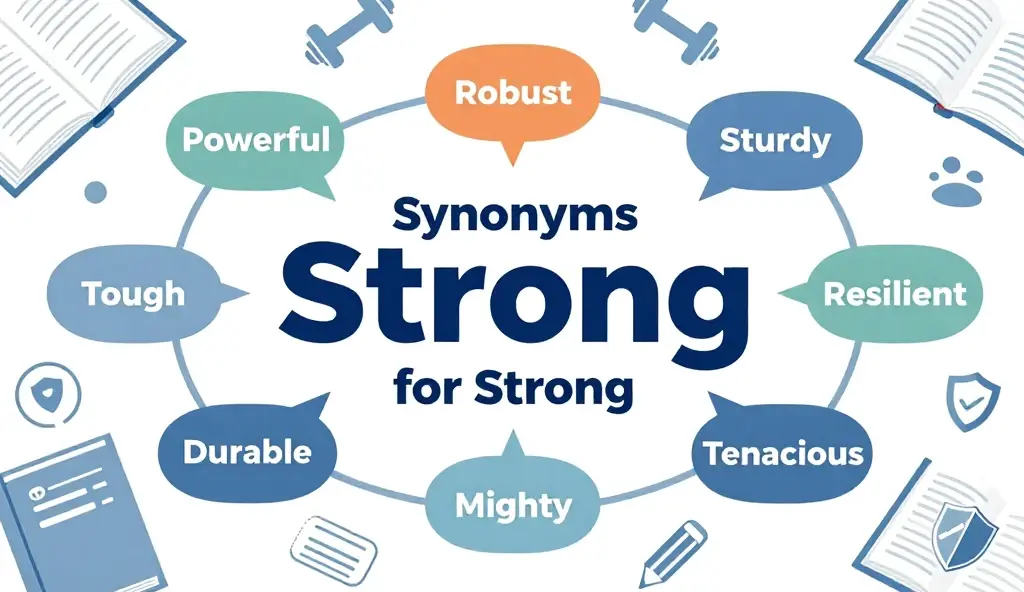
“Strong” is one of the most common words in English. We use it for muscles, coffee, arguments, relationships, and even smells. But because it’s so common, it can start to feel flat in your writing.
That’s why writers, students, and speakers look for synonyms. A good synonym adds color. It tells your reader exactly what kind of strong you mean. Is it muscular strong? Sturdy strong? Tough strong? Each word paints a slightly different picture.
You’ll want a synonym for strong when:
- You’re writing an essay and don’t want to repeat the same word.
- You’re describing a person, object, or feeling with more detail.
- You’re speaking and want to sound more natural and specific.
- You’re translating a feeling that “strong” alone doesn’t quite capture.
Meaning
Strong (adjective) describes something or someone with a high degree of physical power, durability, intensity, or the ability to resist damage, pressure, or failure.
Definition: Having physical power, force, or the capacity to withstand strain, damage, or opposition.
Context: The word shifts meaning slightly depending on what it describes:
- A strong person has physical power or muscle.
- A strong material resists breaking.
- A strong argument is convincing and well-supported.
- A strong smell or taste is intense.
- A strong relationship is stable and close.
Common usage: “Strong” shows up in fitness (“get strong”), cooking (“strong coffee”), emotions (“stay strong”), and business (“strong economy”).
Pronunciation
Strong is pronounced /strɒŋ/ in British English and /strɔːŋ/ in American English. Say it like “strawng,” with the emphasis on one single syllable. The “str” blend at the start is quick and hard, and the ending “-ong” rhymes with “song” and “long.”
Part of Speech
Strong is most often used as an adjective.
- Adjective: “He has a strong grip.” (describes the grip)
- Adverb form: “strongly” — “She strongly disagreed with the plan.”
- It does not function as a noun or verb on its own.
Example sentences by form:
- Adjective: “The rope is strong enough to hold the weight.”
- Adverb: “He strongly believes in fair play.”
Synonyms for Strong (Table)
| Word | Meaning | Usage | Formality | Example | Difficulty Level |
| Powerful | Having great strength or influence | People, machines, ideas | Neutral | “A powerful engine drives the truck.” | Easy |
| Sturdy | Strongly built, not easily damaged | Objects, furniture, structures | Neutral | “The table is sturdy enough for kids to climb on.” | Easy |
| Robust | Strong and healthy, or well-built | Health, systems, economies | Formal | “The economy showed robust growth this year.” | Medium |
| Tough | Able to endure hardship or damage | People, materials, situations | Informal | “She’s tough; she never complains.” | Easy |
| Mighty | Extremely powerful | Literary, dramatic contexts | Formal/Literary | “The mighty river carved the canyon.” | Medium |
| Muscular | Having well-developed muscles | Physical body description | Neutral | “The athlete has a muscular build.” | Easy |
| Forceful | Full of force or energy | Arguments, personality | Neutral | “He gave a forceful speech.” | Medium |
| Potent | Having great power or effect | Medicine, arguments, drinks | Formal | “The potent medicine worked fast.” | Medium |
| Solid | Firm, dependable, well-made | Objects, plans, relationships | Neutral | “They built a solid foundation.” | Easy |
| Durable | Able to last a long time without damage | Products, materials | Neutral | “This fabric is durable and long-lasting.” | Easy |
| Resilient | Able to recover quickly from difficulty | People, materials, systems | Formal | “Children can be surprisingly resilient.” | Medium |
| Vigorous | Full of energy and strength | Activity, exercise, debate | Neutral | “He took a vigorous walk every morning.” | Medium |
| Hardy | Able to survive difficult conditions | Plants, people, animals | Neutral | “Hardy plants survive the cold winter.” | Medium |
| Stalwart | Loyal, dependable, and strong | People, supporters | Formal | “She remained a stalwart friend.” | Hard |
| Formidable | Impressively strong or powerful | Opponents, challenges | Formal | “He is a formidable opponent in chess.” | Hard |
| Brawny | Physically strong and muscular | Physical description | Informal | “The brawny man lifted the crate easily.” | Medium |
| Herculean | Requiring or showing great strength | Tasks, effort | Formal/Literary | “It was a herculean effort to finish on time.” | Hard |
| Unyielding | Not giving in; firm | Attitude, materials | Formal | “Her unyielding determination impressed everyone.” | Hard |
| Dominant | Having the most power or control | Position, personality | Formal | “The team took a dominant lead.” | Medium |
| Tenacious | Holding firmly; persistent | Personality, grip | Formal | “He has a tenacious work ethic.” | Medium |
| Rugged | Tough and able to handle rough conditions | Terrain, equipment, people | Informal | “The rugged boots survived the hike.” | Easy |
| Stout | Strong and thick; solidly built | Objects, people | Neutral | “The stout wooden beam held the roof.” | Medium |
| Fortified | Strengthened against attack or damage | Structures, food, arguments | Formal | “The castle walls were heavily fortified.” | Medium |
Best Synonyms Explained
Powerful
Meaning: Having great strength, influence, or ability to affect things. Difference: Broader than “strong” — often used for machines, people in authority, or ideas, not just muscles. Example: “The senator delivered a powerful message about change.” Best situation: Use it when strength includes influence, not just physical force. Common mistake: Don’t use “powerful” for a small, minor detail — it implies significant force or effect.
Sturdy
Meaning: Strongly built and unlikely to break or fall apart. Difference: Focuses on physical construction, not muscles or personality. Example: “We need a sturdy ladder for this job.” Best situation: Describing furniture, tools, or structures. Common mistake: Avoid using it to describe emotions or arguments — it’s mainly physical.
Robust
Meaning: Strong and healthy, or built to handle stress well. Difference: Slightly more formal, often used in health, business, and technical writing. Example: “The software has a robust security system.” Best situation: Formal writing about systems, health, or economies. Common mistake: Overusing it in casual conversation can sound stiff.
Tough
Meaning: Able to endure hardship, pain, or damage without breaking. Difference: More casual than “strong,” and often about resilience under stress. Example: “That was a tough workout, but she pushed through.” Best situation: Everyday conversation about people or situations. Common mistake: “Tough” can also mean “difficult,” so context matters — make sure it’s clear you mean strength, not difficulty.
Mighty
Meaning: Possessing great and often impressive power. Difference: Sounds dramatic or old-fashioned; common in stories and speeches. Example: “The mighty oak stood for two hundred years.” Best situation: Creative writing, speeches, or describing something awe-inspiring. Common mistake: Using it in casual daily talk can sound overly theatrical.
Muscular
Meaning: Having strong, well-developed muscles. Difference: Purely physical — describes the body, not personality or objects. Example: “The swimmer has a muscular back and shoulders.” Best situation: Describing a person’s physical build. Common mistake: Don’t use it for non-physical things like arguments or economies.
Forceful
Meaning: Showing strength and energy, especially in expression. Difference: Often describes personality, speech, or action rather than muscles. Example: “Her forceful tone left no room for doubt.” Best situation: Describing communication style or leadership. Common mistake: Can sound aggressive if overused; balance it with context.
Potent
Meaning: Having a strong effect, especially chemically or persuasively. Difference: Used for effects and impact, not physical muscles. Example: “The potent argument changed the jury’s mind.” Best situation: Describing medicine, drinks, or persuasive ideas. Common mistake: Avoid using it to describe someone’s physical body strength.
Solid
Meaning: Firm, well-built, and dependable. Difference: Casual and versatile — works for objects, plans, or relationships. Example: “They have a solid friendship built on trust.” Best situation: Everyday talk about reliability. Common mistake: Don’t confuse with “solid” meaning the physical state of matter in scientific writing.
Durable
Meaning: Able to withstand wear and last a long time. Difference: Specifically about lasting through time and use. Example: “This suitcase is durable enough for years of travel.” Best situation: Describing products, materials, or equipment. Common mistake: Don’t use it for people’s emotions — it fits objects better.
Resilient
Meaning: Able to bounce back from difficulty or damage quickly. Difference: Focuses on recovery, not raw power. Example: “The resilient community rebuilt after the storm.” Best situation: Describing people or systems recovering from hardship. Common mistake: Don’t use it to describe simple physical strength — it’s about recovery, not raw force.
Vigorous
Meaning: Full of energy, strength, and enthusiasm. Difference: Suggests active, energetic strength, not just static power. Example: “He gave the floor a vigorous scrub.” Best situation: Describing energetic actions or exercise. Common mistake: Avoid using it for still, unmoving objects.
Hardy
Meaning: Able to endure difficult conditions, especially cold or hardship. Difference: Common in describing plants, animals, or tough people. Example: “Only hardy travelers attempt that mountain in winter.” Best situation: Talking about survival in harsh environments. Common mistake: Don’t use it for indoor, comfortable settings — it implies exposure to hardship.
Stalwart
Meaning: Loyal, dependable, and strong in support. Difference: Combines strength with loyalty and reliability. Example: “He was a stalwart defender of free speech.” Best situation: Describing loyal supporters or steadfast people. Common mistake: Avoid using it for physical objects; it’s about people and character.
Formidable
Meaning: Impressive because of strength, size, or skill; often a challenge. Difference: Suggests something that inspires respect or even fear. Example: “She built a formidable business from nothing.” Best situation: Describing strong opponents, challenges, or achievements. Common mistake: Don’t use it for something simple or unimpressive — it needs real weight behind it.
Antonyms for Strong (Table)
| Word | Meaning | Difference | Example |
| Weak | Lacking physical strength or power | Direct opposite; general use | “His grip felt weak after the injury.” |
| Feeble | Very weak, lacking energy | Stronger emphasis on frailty | “The feeble old fence collapsed in the wind.” |
| Fragile | Easily broken or damaged | Focuses on delicacy of objects | “The fragile vase shattered on the floor.” |
| Frail | Physically weak, especially due to age or illness | Common for people’s health | “Her frail hands shook as she wrote.” |
| Delicate | Easily damaged; needs careful handling | Softer, more gentle connotation | “The delicate lace tore easily.” |
| Powerless | Having no power or ability to act | About control, not just muscles | “He felt powerless to stop the flood.” |
| Flimsy | Weak and poorly made | Common for objects and materials | “The flimsy umbrella broke in the wind.” |
| Brittle | Hard but easily broken | Common for materials like glass | “The brittle branch snapped underfoot.” |
| Faint | Weak and lacking strength or clarity | Common for sounds, feelings, light | “She heard a faint, weak cry for help.” |
| Vulnerable | Easily hurt or affected | Emotional or physical exposure | “The vulnerable coastline needs protection.” |
30 Real-World Examples
- “You need strong arms to carry that box up the stairs.”
- “The coffee this morning was really strong.”
- “She has a strong sense of right and wrong.”
- “The bridge was built with strong steel cables.”
- “His strong accent made him easy to recognize.”
- “They share a strong bond after years of friendship.”
- “The wrestler has a strong, muscular frame.”
- “A strong smell of garlic filled the kitchen.”
- “The company posted strong earnings this quarter.”
- “The wind grew strong enough to knock over chairs.”
- “Her strong will helped her finish the marathon.”
- “The rope must be strong enough to hold two hundred pounds.”
- “He made a strong case for changing the policy.”
- “The team showed a strong defense in the second half.”
- “The medicine had a strong, bitter taste.”
- “Their strong leadership guided the company through crisis.”
- “The dog has a strong bite for its size.”
- “A strong current pulled the boat off course.”
- “She felt a strong urge to call her mother.”
- “The walls were built strong enough to survive an earthquake.”
- “His strong opinions often surprised his coworkers.”
- “The strong scent of pine filled the cabin.”
- “The athlete trained hard to build strong legs.”
- “The old oak door was strong and heavy.”
- “Her strong faith carried her through hard times.”
- “The strong economy created thousands of new jobs.”
- “He has a strong handshake that shows confidence.”
- “The fortress had strong, thick stone walls.”
- “The strong flavor of chili pepper surprised everyone.”
- “Their strong teamwork won them the championship.”
25 Sentences Using Strong (and Its Synonyms)
- “The powerful storm knocked down several trees.”
- “She built a sturdy shelf using old wood.”
- “The robust design lets the phone survive drops.”
- “He’s tough enough to finish the race with an injury.”
- “The mighty waterfall roared below the cliff.”
- “Years of training gave him a muscular chest.”
- “Her forceful reply ended the argument quickly.”
- “The potent chili sauce made everyone’s eyes water.”
- “We need a solid plan before the meeting.”
- “This backpack is durable and handles rough travel well.”
- “Kids are often more resilient than we expect.”
- “The vigorous debate lasted almost two hours.”
- “Hardy desert plants need very little water.”
- “He remained a stalwart supporter of the cause.”
- “The formidable challenge didn’t scare the new hire.”
- “The brawny mover carried the sofa by himself.”
- “It took a herculean push to move the boulder.”
- “Her unyielding focus helped her pass the exam.”
- “The dominant team controlled the game from start to finish.”
- “His tenacious attitude impressed the whole office.”
- “They hiked the rugged trail without stopping.”
- “The stout table leg didn’t even wobble.”
- “The city fortified its old walls centuries ago.”
- “A strong grip helped her win the arm-wrestling match.”
- “The strong wind carried the kite far above the trees.”
Formal vs. Informal Usage
| Context | Formal Word | Informal Word | Example |
| Describing a person | Robust | Tough | “He’s a tough guy.” vs. “He has a robust constitution.” |
| Describing an object | Durable | Sturdy | “This bag is sturdy.” vs. “This bag is durable under load.” |
| Describing an argument | Compelling | Strong | “That’s a strong point.” vs. “That’s a compelling argument.” |
| Describing effort | Vigorous | Hard | “He worked hard.” vs. “He made a vigorous effort.” |
| Describing a smell/taste | Potent | Strong | “That’s strong coffee.” vs. “That coffee is quite potent.” |
Academic Usage
In academic writing, “strong” often appears in phrases like “strong correlation,” “strong evidence,” or “strong argument.” Formal alternatives such as robust, compelling, and substantial are common in research papers.
Example: “The study found a robust correlation between sleep and memory performance.”
Example: “The data provides compelling evidence for the new theory.”
Academic writing favors precise words over general ones, so instead of “strong,” you’ll often see “significant,” “considerable,” or “marked.”
Daily Conversation
In everyday talk, people use simpler synonyms like tough, sturdy, and powerful.
Example: “Wow, that coffee is really strong this morning.”
Example: “He’s tough — he barely complained after the fall.”
Example: “We need a sturdy box for the move.”
Casual conversation rarely uses words like “robust” or “formidable” — they can sound too formal for a quick chat.
Grammar Tips
- “Strong” is a gradable adjective, so it can be modified: “very strong,” “extremely strong,” “somewhat strong.”
- The comparative form is stronger, and the superlative is strongest. (“This rope is stronger than that one.” / “This is the strongest rope we have.”)
- The adverb form is strongly, used to modify verbs: “She strongly recommends this book.”
- Don’t confuse “strong” (adjective) with “strength” (noun): “He has great strength” is correct, not “He has great strong.”
Collocations
- Strong coffee – coffee with an intense flavor
- Strong opinion – a firmly held belief
- Strong smell – an intense odor
- Strong economy – a healthy, growing economy
- Strong grip – a firm handhold
- Strong bond – a close relationship
- Strong wind – powerful moving air
- Strong evidence – convincing proof
- Strong accent – a very noticeable way of speaking
- Strong leadership – confident, effective guidance
Each of these pairs “strong” with a noun to create a natural, commonly used phrase in English.
Phrases
- “Strong as an ox” – extremely physically strong.
- “Stronger together” – more powerful when united.
- “On strong footing” – in a stable, secure position.
- “Strong-arm tactics” – using force or pressure to get what you want.
- “Strong suit” – something a person is especially good at.
Idioms
- “Strong as an ox” – Used to describe someone with great physical strength. Example: “He carried the fridge alone; he’s strong as an ox.”
- “Take it on the chin” – Related idiom meaning to endure hardship strongly and without complaint.
- “Hold your own” – To remain strong or capable in a difficult situation. Example: “She held her own in the debate against experienced speakers.”
Similar Words Compared
| Word | Meaning | Difference | Example |
| Strong | Having great power or force | General, all-purpose word | “He has strong arms.” |
| Powerful | Having great strength or influence | Broader — includes influence, not just muscles | “A powerful leader.” |
| Sturdy | Solidly built | Focused on construction | “A sturdy chair.” |
| Tough | Able to endure hardship | Focused on resilience, casual tone | “A tough competitor.” |
| Robust | Strong and healthy or well-designed | Formal, often technical or health-related | “A robust immune system.” |
Frequently Asked Questions
1. What is the best synonym for strong?
“Powerful” is one of the most versatile synonyms for strong, since it works for people, machines, and ideas alike. Still, the best choice depends on context use “sturdy” for objects, “tough” for resilience, and “robust” for formal writing about health or systems.
2. What is a stronger word than strong?
Words like “mighty,” “formidable,” and “herculean” all carry more intensity than “strong.” They suggest an impressive or even overwhelming level of power, and work best in dramatic or descriptive writing rather than casual conversation.
3. What do you call a person who is very strong?
You can call a very strong person “muscular,” “brawny,” “powerful,” or informally, “a powerhouse.” These words highlight physical strength, while “formidable” or “stalwart” suggest strength of character or determination.
4. What is another word for strong in a sentence?
You could say, “The rope is sturdy enough to hold the weight,” replacing “strong” with “sturdy.” The right substitute depends on whether you’re describing physical strength, intensity, or reliability.
5. Is “robust” the same as “strong”?
“Robust” and “strong” are close in meaning, but “robust” often implies health, durability, or good design rather than raw physical power. It’s commonly used in formal or technical writing, such as describing a robust economy or a robust system.
6. What is the opposite of strong?
The most common opposite of strong is “weak.” Other antonyms include “feeble,” “fragile,” “frail,” and “powerless,” each describing a different type of weakness, whether physical, structural, or emotional.
7. How do you describe a strong personality?
A strong personality can be described using words like “assertive,” “confident,” “forceful,” or “dominant.” These words highlight inner strength and the ability to influence or stand firm in situations.
8. What is a synonym for strong smell?
For a strong smell, you can use “pungent,” “potent,” or “intense.” These words describe an odor that is noticeable and powerful, often used for food, chemicals, or nature scents.
9. What is a formal synonym for strong?
In formal writing, “robust,” “substantial,” or “considerable” often replace “strong,” especially when discussing data, evidence, or systems. These words sound more professional in academic or business contexts.
10. Can “tough” replace “strong” in every sentence?
Not always. “Tough” works well when describing resilience or endurance, like “a tough competitor,” but it doesn’t fit every context for example, “tough coffee” doesn’t make sense, while “strong coffee” does.
11. What are some strong synonyms for kids to learn?
Simple synonyms like “tough,” “sturdy,” and “powerful” are easy for young learners to understand. These words are common in books and daily conversation, making them a great starting point for vocabulary building.
12. What is a synonym for mentally strong?
For mental strength, use words like “resilient,” “tenacious,” or “unyielding.” These describe someone who stays strong emotionally and mentally, even during stressful or difficult situations.
13. How is “strong” used in business writing?
In business writing, “strong” often describes performance, such as “strong sales” or “strong growth.” Formal alternatives like “robust” or “solid” are frequently used to sound more professional and precise.
14. What is a poetic word for strong?
Poetic or literary words for strong include “mighty,” “formidable,” and “herculean.” These words add drama and imagery, making them popular choices in storytelling, poetry, and speeches.
15. Is “strong” a noun or adjective?
“Strong” is primarily used as an adjective, describing a person, object, or quality. The related noun form is “strength,” and the adverb form is “strongly,” used to modify verbs.
Expert Tips
- Match the synonym to the subject. Use “sturdy” for furniture, “muscular” for bodies, and “robust” for systems don’t mix them up.
- In formal writing, swap “strong” for “substantial,” “considerable,” or “compelling” to sound more precise.
- Read your sentence out loud. If the synonym feels forced, it probably doesn’t fit natural flow matters more than variety for its own sake.
- Keep a short list of your five favorite synonyms for strong and rotate them based on context, rather than repeating the same word every time.
- When writing for children or beginners, stick to simple, common synonyms like “tough” and “powerful” instead of rare words like “herculean.”
Conclusion
“Strong” is a simple word, but English gives you many ways to say it better. Whether you need something physical like “muscular,” something durable like “sturdy,” or something impressive like “formidable,” there’s a synonym ready for the moment. Pick the word that matches your subject, keep your sentence natural, and your writing will feel sharper and more precise every time you use it.

Megan Stewart is dedicated to producing reliable English language resources that support vocabulary growth and better writing habits.