
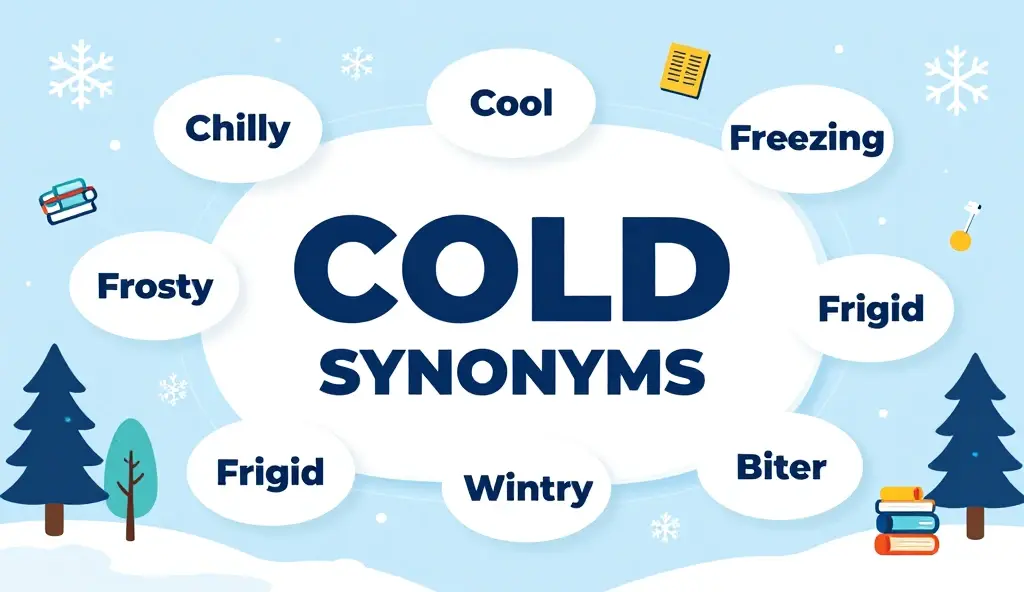
“Cold” is one of the most commonly used words in English.
We use it to describe weather, food, drinks, emotions, and even personalities. “It’s cold outside.” “This soup is cold.” “He gave her a cold look.”
Because it applies to so many situations, it’s also easy to overuse.
When “cold” shows up again and again in the same paragraph, writing loses precision and starts to feel repetitive.
It also doesn’t always capture how cold something is a little chilly, or dangerously freezing?
That’s why writers, students, and speakers look for synonyms.
A synonym is a word that carries a similar meaning but adds intensity, tone, or nuance.
People search for “cold synonyms” for a few common reasons.
Writers want more vivid weather descriptions. Students want variety in essays and creative writing.
Content creators want fresher wording for winter posts or product descriptions.
And everyday speakers just want a livelier way to talk about the weather.
You should reach for a synonym when “cold” feels too plain.
If it’s a light autumn chill, try “brisk” or “crisp.” If it’s dangerously freezing, try “frigid” or “arctic.” If someone’s attitude feels distant or unfriendly, try “aloof” or “icy.”
Meaning
Definition: “Cold” describes a low temperature, or, when used figuratively, a lack of warmth in emotion, tone, or personality.
Context: The meaning shifts depending on what it’s describing. “Cold weather” refers to low outdoor temperature. “Cold soup” means food that has lost its heat or was never heated. “A cold response” means an emotionally distant or unfriendly reaction.
Common usage: People use “cold” to describe weather, temperature of objects and food, physical sensations, and emotional distance or unfriendliness.
Pronunciation
“Cold” is pronounced /koʊld/ — “kohld,” rhyming with “bold” and “sold.” It’s a single syllable.
Part of Speech
“Cold” is most commonly used as an adjective — it describes a noun.
- Example: It’s a cold winter morning.
It can also be used as a noun, referring to the sensation of low temperature or to an illness.
- Example: She caught a cold last week. / He shivered from the cold.
Occasionally, “cold” is used as an adverb in informal speech, meaning “abruptly” or “completely.”
- Example: He stopped cold when he saw her.
Synonyms for Cold
| Word | Meaning | Usage | Formality | Example | Difficulty Level |
| Chilly | Uncomfortably cool | General weather | Neutral | “It’s a bit chilly out tonight.” | Easy |
| Freezing | Extremely cold, at or below the freezing point | General/informal | Casual | “It’s freezing outside today.” | Easy |
| Frigid | Very cold, harshly so | Formal/weather | Formal | “The frigid air made it hard to breathe.” | Medium |
| Icy | Covered in ice or extremely cold | General/descriptive | Neutral | “The roads are icy this morning.” | Easy |
| Brisk | Refreshingly cool, often pleasant | Weather/activity | Neutral | “We took a brisk walk in the fall air.” | Medium |
| Frosty | Covered with frost, coldly cool | Weather/emotional | Neutral | “The grass was frosty at sunrise.” | Easy |
| Bitter | Sharply and painfully cold | Weather | Neutral | “A bitter wind cut through our coats.” | Medium |
| Arctic | Extremely cold, like the Arctic region | Formal/dramatic | Formal | “The office felt arctic with the AC blasting.” | Medium |
| Cool | Mildly cold, refreshing | General | Casual | “The evening air felt cool and pleasant.” | Easy |
| Wintry | Characteristic of winter, cold | Weather/descriptive | Neutral | “The forecast predicted wintry conditions.” | Medium |
| Nippy | Uncomfortably cool, informal | Casual | Casual | “It’s a bit nippy this morning.” | Easy |
| Glacial | Extremely cold, like a glacier | Formal/figurative | Formal | “Her glacial tone made the room tense.” | Hard |
| Raw | Damp and unpleasantly cold | Weather | Neutral | “It was a raw, gray November day.” | Medium |
| Frozen | Turned to ice, extremely cold | General/descriptive | Neutral | “The lake was completely frozen by morning.” | Easy |
| Numbing | So cold it causes numbness | Descriptive | Neutral | “The numbing wind made our fingers ache.” | Medium |
| Polar | Extremely cold, like the poles | Formal/dramatic | Formal | “It felt like a polar vortex outside.” | Medium |
| Crisp | Cold in a fresh, invigorating way | Weather | Neutral | “The crisp autumn air felt refreshing.” | Medium |
| Aloof | Emotionally distant and cold (figurative) | Describing personality | Formal | “His aloof manner made him seem unfriendly.” | Medium |
| Distant | Emotionally cold or detached (figurative) | Relationships | Neutral | “She’s been distant since the argument.” | Easy |
| Unfeeling | Lacking emotional warmth (figurative) | Describing personality | Formal | “His unfeeling response surprised everyone.” | Hard |
| Frosty (figurative) | Unfriendly or unwelcoming | Emotional tone | Neutral | “She gave him a frosty greeting.” | Easy |
| Chilling | Causing fear or a cold sensation | Emotional/descriptive | Neutral | “It was a chilling story to hear at night.” | Medium |
| Iced | Chilled with ice, especially drinks | Food/drink | Neutral | “I’ll have an iced coffee, please.” | Easy |
| Refrigerated | Kept cold through mechanical cooling | Food/formal | Formal | “The medication must be refrigerated.” | Medium |
| Cold-hearted | Lacking compassion or warmth | Describing personality | Formal | “His cold-hearted decision shocked the team.” | Medium |
| Detached | Emotionally uninvolved, distant | Formal/figurative | Formal | “Her detached tone made the meeting awkward.” | Medium |
| Wintery | Alternate spelling of “wintry,” cold and snowy | Weather | Neutral | “It looked wintery even though it was only October.” | Medium |
| Sub-zero | Below zero degrees, extremely cold | Formal/weather | Formal | “Temperatures dropped to sub-zero overnight.” | Medium |
| Shivery | Causing or feeling shivers | Casual | Casual | “It’s a shivery kind of morning.” | Easy |
Best Synonyms Explained
Chilly
Meaning: Uncomfortably cool, but not extreme. Difference from “cold”: Milder — describes a mild discomfort rather than intense cold. Example: “It’s a bit chilly, grab a jacket before we go.” Best situation: Describing mild autumn or spring weather. Common mistake: Using it for freezing or dangerous cold — “chilly” implies only mild discomfort.
Frigid
Meaning: Very cold, often harshly or extremely. Difference from “cold”: More formal and intense, often used for dangerously low temperatures. Example: “The frigid temperatures kept schools closed for two days.” Best situation: Extreme winter weather, formal writing, weather reports. Common mistake: Using it for mildly cool weather — “frigid” should signal genuinely harsh cold.
Brisk
Meaning: Refreshingly cool, often pleasant rather than uncomfortable. Difference from “cold”: Carries a positive, invigorating tone. Example: “We enjoyed a brisk walk along the beach.” Best situation: Describing pleasant, energizing cold weather, especially during activity. Common mistake: Using it for extreme or unpleasant cold — “brisk” should feel refreshing, not harsh.
Glacial
Meaning: Extremely cold, often used figuratively to describe tone or attitude. Difference from “cold”: Much stronger and more dramatic, often used for emotional distance. Example: “Her glacial stare silenced the whole room.” Best situation: Describing intense emotional coldness or extremely low temperatures in formal or literary writing. Common mistake: Using it casually for everyday cold weather — it can sound overly dramatic.
Aloof
Meaning: Emotionally distant, reserved, and uninvolved. Difference from “cold”: Focuses specifically on personality and social behavior, not temperature. Example: “He remained aloof throughout the meeting, barely speaking.” Best situation: Describing someone’s personality or social behavior. Common mistake: Using it to describe temperature — “aloof” only applies to people’s demeanor.
Crisp
Meaning: Cold in a fresh, clean, invigorating way. Difference from “cold”: Adds a positive, sensory quality often associated with clear autumn or winter days. Example: “The crisp morning air made the hike feel energizing.” Best situation: Describing pleasant seasonal weather, especially fall and early winter. Common mistake: Using it for damp, unpleasant cold — “crisp” implies dry, clear conditions.
Antonyms for Cold
| Word | Meaning | Example |
| Hot | High in temperature | “It was hot enough to fry an egg on the sidewalk.” |
| Warm | Moderately hot, comfortable | “The soup was warm and comforting.” |
| Sweltering | Extremely and uncomfortably hot | “It was a sweltering summer afternoon.” |
| Scorching | Extremely hot, burning | “The scorching sun forced us indoors.” |
| Balmy | Pleasantly warm | “It was a balmy evening on the coast.” |
| Toasty | Comfortably warm | “The cabin felt toasty by the fireplace.” |
| Mild | Moderate, not extreme | “The weather was mild for December.” |
| Tropical | Warm and humid, like the tropics | “The greenhouse had a tropical climate.” |
| Sizzling | Very hot, intense | “It was a sizzling day at the beach.” |
| Muggy | Warm and uncomfortably humid | “The muggy air made it hard to breathe.” |
Examples of Synonyms in Real Sentences
- It’s been chilly all week, so bring a sweater.
- Temperatures are expected to drop below freezing tonight.
- The frigid wind made it feel much colder than it actually was.
- The sidewalks are icy, so please walk carefully.
- We took a brisk jog before breakfast.
- The rooftops were frosty in the early morning light.
- A bitter cold snap hit the region this weekend.
- The walk-in freezer felt absolutely arctic.
- The breeze felt cool and refreshing after the hike.
- The forecast predicts wintry mix by Friday.
- It’s a bit nippy out, grab a scarf.
- His glacial silence made the meeting uncomfortable.
- It’s been a damp, raw kind of day.
- The pond was completely frozen by mid-January.
- The numbing cold made it hard to zip my jacket.
- This week’s storm brought polar temperatures to the region.
- The crisp fall air smelled like fireplaces and leaves.
- She’s always been aloof with new coworkers.
- Their relationship grew increasingly distant over time.
- His unfeeling reaction surprised the whole family.
- She gave a frosty reply and walked away.
- It was a chilling tale to tell around the campfire.
- I’ll have my tea iced, please.
- The vaccine must be refrigerated at all times.
- His cold-hearted decision left the team stunned.
- Her tone became strangely detached during the call.
- The mountains already looked wintery in early November.
- Wind chills pushed temperatures to sub-zero levels.
- It’s a shivery kind of morning, isn’t it?
- Even indoors, the air conditioning made it feel arctic.
25 Naturally Written Sentences
- It’s supposed to be pretty chilly tomorrow, so dress warm.
- The weather forecast says it’ll be freezing by midnight.
- That frigid air front is expected to last through the weekend.
- Watch your step, the driveway is icy this morning.
- We took a brisk walk around the neighborhood before dinner.
- The car windows were frosty when we left the house.
- A bitter wind made the walk to school miserable.
- Their basement feels absolutely arctic in the winter.
- There’s a cool breeze coming off the lake tonight.
- The mountains are already showing wintry conditions.
- It’s a little nippy out, so I grabbed my jacket.
- Her glacial response made everyone go quiet.
- It’s been a raw, overcast kind of week.
- The pipes froze solid overnight.
- My hands went numbing cold after building the snowman.
- This week brought polar temperatures we haven’t seen in years.
- There’s something about crisp fall mornings I really love.
- He tends to seem aloof until you get to know him.
- She’s felt more distant since starting the new job.
- His unfeeling comment ruined the mood of the party.
- The receptionist gave us a frosty look when we walked in.
- That horror movie had a genuinely chilling ending.
- Could I get this drink iced instead of hot?
- These samples need to stay refrigerated during shipping.
- It felt like a cold-hearted move to cancel the event last minute.
Formal vs. Informal Usage
| Situation | Formal Word | Informal Word |
| Describing weather | Frigid, Arctic | Freezing, Nippy |
| Describing food/drinks | Chilled, Refrigerated | Iced, Cold |
| Describing personality | Aloof, Detached | Cold, Distant |
| Describing mild coolness | Brisk, Crisp | Chilly, Cool |
| Formal weather reports | Sub-zero, Wintry | Freezing, Icy |
In formal writing — weather reports, professional descriptions, formal storytelling — use words like “frigid,” “arctic,” or “sub-zero.” In casual conversation, words like “freezing,” “chilly,” or “nippy” feel more natural and relaxed.
Academic Usage
In academic or scientific writing, “cold” is often replaced with more precise, measurable language.
- Weak: “The samples were kept cold during transport.”
- Strong: “The samples were maintained at a refrigerated temperature of 4°C during transport.”
Other academic-friendly synonyms include: low-temperature, sub-zero, refrigerated, and frigid.
Daily Conversation
In everyday talk, people naturally reach for expressive, casual words.
- “How’s the weather?” — “Pretty chilly, you’ll want a jacket.”
- “Is it freezing out there?” — “Yeah, feels like it’s below zero.”
- “Why is she being so distant lately?” — “I’m not sure, she’s seemed kind of cold since the meeting.”
These casual synonyms keep conversation natural and expressive without sounding stiff.
Grammar Tips
- “Cold” is a regular adjective, so its comparative and superlative forms are “colder” and “coldest”: Today is colder than yesterday. This is the coldest week of the year.
- Longer synonyms like “frigid” and “arctic” use “more” and “most”: more frigid, most frigid — not “frigidest.”
- When “cold” describes an illness (a common cold), it becomes a countable noun: I have a cold, not I have cold.
Collocations
Common word pairings using “cold” and its synonyms:
- Cold weather / Frigid weather / Wintry weather
- Cold shoulder (meaning to ignore someone) / Frosty reception
- Cold feet (meaning nervousness before an event)
- Cold snap / Cold front
- Ice cold / Freezing cold
- Cold-blooded (describing lack of empathy)
These pairings sound natural and appear frequently in everyday speech and writing.
Common Phrases
- “Give someone the cold shoulder” — to intentionally ignore or be unfriendly toward someone.
- “Get cold feet” — to become nervous or hesitant before doing something.
- “Cold snap” — a sudden period of very cold weather.
- “Out in the cold” — to be excluded or left without support.
- “Cold turkey” — to stop a habit suddenly and completely.
Idioms
- “Break the ice” — to ease tension or start a conversation in an awkward situation. Example: “He told a joke to break the ice at the meeting.”
- “Cold as ice” — describing someone emotionally distant or unfeeling. Example: “She stayed cold as ice throughout the negotiation.”
- “Left out in the cold” — feeling excluded or unsupported. Example: “After the merger, several employees felt left out in the cold.”
Similar Words Comparison
| Word | Meaning | Difference | Example |
| Cold | Low temperature, or emotionally distant | Broad, general | “It’s cold outside.” |
| Chilly | Mildly uncomfortable coolness | Weaker, milder | “It’s chilly outside.” |
| Freezing | Extremely cold, near/below freezing point | Stronger, informal | “It’s freezing outside.” |
| Frigid | Harshly, extremely cold | Formal, intense | “It’s frigid outside.” |
| Brisk | Refreshingly cool | Positive connotation | “It’s brisk outside.” |
FAQs
Q1. What is the best synonym for “cold”?
A: “Chilly” and “freezing” are the most commonly used general synonyms. “Chilly” works for mild coolness, while “freezing” fits more intense, uncomfortable cold.
Q2. Is “frigid” stronger than “cold”?
A: Yes. “Frigid” implies a harsher, more extreme level of cold, often used to describe dangerous or record-breaking low temperatures, rather than everyday chilliness.
Q3. What’s a formal synonym for “cold”?
A: Formal alternatives include “frigid,” “arctic,” “sub-zero,” and “refrigerated.” These fit weather reports, scientific writing, and professional descriptions better than casual words.
Q4. What’s a casual synonym for “cold”?
A: Casual options include “chilly,” “freezing,” and “nippy.” These fit everyday conversation and informal writing but sound too relaxed for formal or scientific contexts.
Q5. What is the opposite of “cold”?
A: Common antonyms include “hot,” “warm,” “balmy,” and “toasty.” Each expresses a higher temperature, with “sweltering” and “scorching” describing especially intense heat.
Q6. How do you say “cold” in a more descriptive way?
A: Instead of “cold,” be specific: “brisk” for refreshing coolness, “bitter” for painful wind chill, “frosty” for icy mornings, or “aloof” for emotional distance.
Q7. What word can replace “cold” in a weather report?
A: In weather writing, try “frigid,” “sub-zero,” “arctic,” or “wintry,” depending on severity. These words sound more precise and professional than the generic word “cold.”
Q8. What’s a synonym for “cold” that means extremely cold?
A: Words like “frigid,” “arctic,” and “glacial” all describe temperatures far below average comfort levels. Choose based on tone—”glacial” often sounds more literary or dramatic.
Q9. What’s a synonym for “cold” when describing a person’s personality?
A: You might say “aloof,” “distant,” or “unfeeling.” These words focus on emotional detachment rather than physical temperature.
Q10. What’s another way to say “it’s cold outside”?
A: Try “it’s freezing out there,” “there’s a real bite in the air,” or “it’s bitter today.” Each phrase communicates the same idea with a slightly different tone.
Q11. Can “cool” mean the same as “cold”?
A: Not exactly. “Cool” usually describes mild, often pleasant coolness, while “cold” can range from mildly uncomfortable to dangerously low temperatures. “Cool” is generally milder.
Q12. What’s a synonym for “cold” in scientific writing?
A: In scientific contexts, use words like “low-temperature,” “sub-zero,” or “refrigerated.” These terms sound precise and are common in research papers and technical reports.
Q13. Why should I avoid repeating “cold” in writing?
A: Repeating “cold” makes writing sound flat and imprecise. Using varied synonyms helps readers understand exactly how cold something is, from mildly chilly to dangerously frigid.
Q14. What’s a fun, casual way to say “cold”?
A: Casual alternatives like “nippy,” “freezing,” and “shivery” keep everyday conversation lively and expressive, especially when talking about the weather.
Expert Tips
- Match the synonym to the level of cold you mean. Use “chilly” for mild discomfort, “frigid” or “arctic” for extreme cold, and “brisk” when the cold actually feels pleasant.
- When describing personality, remember that words like “aloof” and “cold-hearted” only work figuratively — they describe emotional distance, not temperature.
- In weather writing, precise words like “sub-zero” or “wintry” sound more professional and informative than a repeated “cold.”
- Save dramatic words like “arctic” or “glacial” for situations that truly justify that intensity — overusing them weakens their impact.
Conclusion:
“Cold” gets the basic point across, but it doesn’t always capture how cold something feels, or whether you’re describing weather, food, or a person’s mood.
Swapping it for the right synonym “brisk” for a refreshing walk, “frigid” for a dangerous cold snap, or “aloof” for someone’s distant attitude makes your writing and speech feel sharper and more specific.
Keep this list handy, and next time you reach for “cold,” pick a word that says exactly what you mean.

Christopher Ward writes practical guides on word usage, synonyms, and effective written communication for a global audience.