
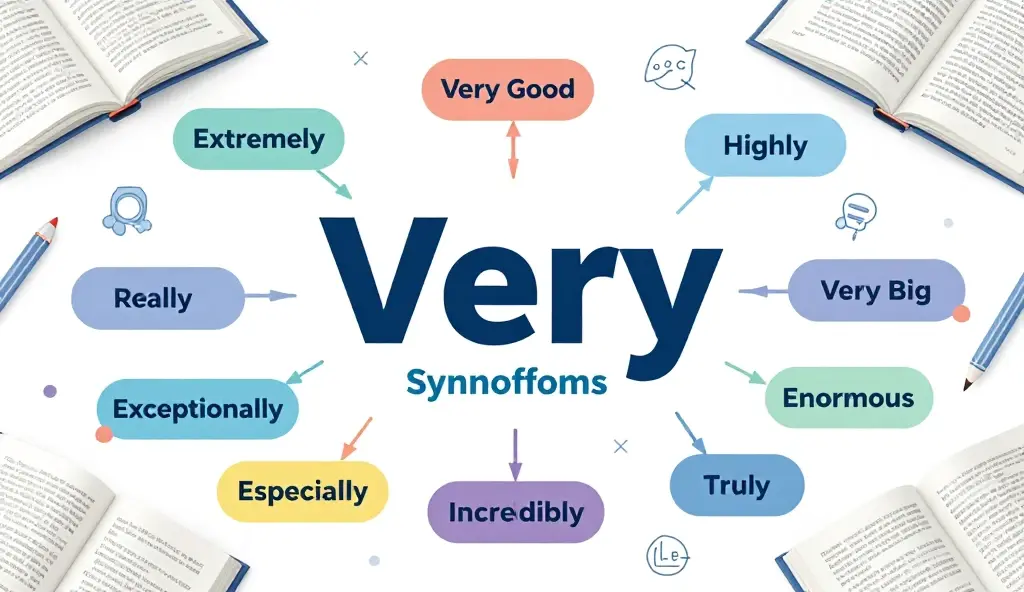
“Very” is one of the most overused words in English. We add it in front of almost anything: very good, very tired, very cold, very happy. It gets the job done, but it doesn’t say much on its own.
That’s why teachers, writers, and editors often ask you to replace “very” with a stronger, more specific word. A good synonym doesn’t just intensify — it adds a feeling or tone that “very” can’t.
You’ll want a synonym for very when:
- You’re writing an essay or story and want to avoid repeating “very” again and again.
- You want your writing to sound more vivid and precise.
- You’re speaking and want to sound more expressive.
- You’re trying to match a specific tone — casual, dramatic, or formal.
Meaning
Very (adverb) is used before an adjective or another adverb to make its meaning stronger.
Definition: To a high degree; extremely; used to emphasize the word that follows it.
Context: “Very” can attach to almost any adjective or adverb:
- Very tired – extremely tired
- Very quickly – extremely fast
- Very good – excellent
- Very cold – freezing
- Very happy – thrilled
Common usage: “Very” shows up constantly in daily speech (“I’m very hungry”), writing (“a very important decision”), and formal contexts (“a very significant finding”).
Pronunciation
Very is pronounced /ˈvɛri/. Say it as “VEH-ree,” with the stress on the first syllable. The “v” sound is soft, and the ending “-ry” is quick and light, similar to the ending in “merry” or “ferry.”
Part of Speech
Very is most often used as an adverb. In rare, more formal or old-fashioned use, it can also function as an adjective meaning “exact” or “precise.”
- Adverb: “She was very kind to everyone.” (intensifies “kind”)
- Adjective (rare/formal): “This is the very book I was looking for.” (means “exact”)
Example sentences by form:
- Adverb: “He runs very fast.”
- Adjective: “That is the very reason I left early.”
Synonyms for Very (Table)
| Word | Meaning | Usage | Formality | Example | Difficulty Level |
| Extremely | To a very high degree | General intensifier | Neutral | “She was extremely tired after the trip.” | Easy |
| Incredibly | Beyond belief; very | Emotional, dramatic tone | Neutral | “The movie was incredibly boring.” | Easy |
| Highly | To a great extent | Formal, professional contexts | Formal | “He is highly respected in his field.” | Medium |
| Deeply | Intensely, at an emotional level | Feelings, emotions | Neutral | “She was deeply moved by the speech.” | Medium |
| Remarkably | Notably; unusually | Surprising qualities | Formal | “The results were remarkably consistent.” | Medium |
| Exceedingly | To an extreme degree | Formal writing | Formal | “The task was exceedingly difficult.” | Hard |
| Really | Truly; very (casual) | Everyday speech | Informal | “That’s really cool!” | Easy |
| Especially | More than usual; particularly | Comparisons, emphasis | Neutral | “It was especially cold this morning.” | Easy |
| Particularly | Specifically; more than others | Comparisons, emphasis | Neutral | “She was particularly nervous before the exam.” | Medium |
| Terribly | Very; extremely (often negative) | Casual, expressive | Informal | “I’m terribly sorry for the delay.” | Easy |
| Utterly | Completely; totally | Strong emotional emphasis | Formal | “The plan was utterly ridiculous.” | Medium |
| Immensely | Enormously; very greatly | Feelings, size, scale | Formal | “I immensely enjoyed the concert.” | Medium |
| Profoundly | Very deeply; intensely | Emotional or intellectual impact | Formal | “The loss affected her profoundly.” | Hard |
| Awfully | Very (casual, often ironic) | Everyday speech | Informal | “It’s awfully hot today.” | Easy |
| Truly | Genuinely; very | Sincere emphasis | Neutral | “I am truly grateful for your help.” | Easy |
| Genuinely | Sincerely; really | Honest emphasis | Neutral | “I’m genuinely excited about this.” | Medium |
| Absolutely | Completely; totally | Strong agreement or emphasis | Neutral | “That’s absolutely true.” | Easy |
| Intensely | To a strong or extreme degree | Emotions, focus, sensations | Formal | “She stared intensely at the screen.” | Medium |
| Wildly | Extremely; in an uncontrolled way | Enthusiasm, popularity | Informal | “The show was wildly popular.” | Medium |
| Insanely | Extremely (very casual/slang) | Informal speech | Informal | “This pizza is insanely good.” | Easy |
| Tremendously | Greatly; enormously | Achievements, size | Formal | “The project helped tremendously.” | Medium |
| Overwhelmingly | To a very great, often surprising degree | Votes, opinions, emotions | Formal | “Voters responded overwhelmingly in favor.” | Hard |
| Considerably | To a noticeably large degree | Comparisons, measurements | Formal | “Sales increased considerably last year.” | Medium |
Best Synonyms Explained
Extremely
Meaning: To a very high or intense degree. Difference: More neutral and versatile than “very” — fits almost any context, casual or formal. Example: “The exam was extremely difficult this year.” Best situation: Use it as a safe, all-purpose replacement for “very” in most sentences. Common mistake: Don’t stack it with other intensifiers, like “extremely very” — pick one.
Incredibly
Meaning: To a degree that’s hard to believe. Difference: Adds a sense of surprise or disbelief that “very” doesn’t carry. Example: “She was incredibly calm during the emergency.” Best situation: Use it when something exceeds expectations. Common mistake: Overusing it can make your writing sound exaggerated.
Highly
Meaning: To a great extent, often used with positive or professional qualities. Difference: Sounds more formal and is common in professional or academic writing. Example: “The candidate is highly qualified for the role.” Best situation: Formal writing, resumes, reviews, and reports. Common mistake: Avoid using “highly” with casual adjectives like “highly fun” — it sounds awkward.
Deeply
Meaning: Intensely, especially regarding emotions or feelings. Difference: Focuses on emotional depth rather than general intensity. Example: “He was deeply hurt by the comment.” Best situation: Describing emotional reactions or personal impact. Common mistake: Don’t use it for physical descriptions like size or speed.
Remarkably
Meaning: In a way that draws attention because it’s surprising or notable. Difference: Implies the reader should be impressed or surprised. Example: “The team performed remarkably well under pressure.” Best situation: Highlighting achievements or unexpected outcomes. Common mistake: Don’t use it for ordinary, expected situations.
Exceedingly
Meaning: To an extreme or unusual degree. Difference: More formal and slightly old-fashioned compared to “very.” Example: “The instructions were exceedingly clear.” Best situation: Formal or literary writing. Common mistake: Sounds stiff in casual conversation — avoid it in texting or small talk.
Really
Meaning: Truly; used casually to mean “very.” Difference: Much more informal and conversational than “very.” Example: “That movie was really funny.” Best situation: Everyday speech and casual writing. Common mistake: Avoid using it in formal essays or professional reports.
Especially
Meaning: More than usual, or more than others in a group. Difference: Often compares one thing to others, rather than just intensifying. Example: “She was especially proud of her final project.” Best situation: When comparing or singling something out. Common mistake: Don’t confuse with “specially,” which means “for a particular purpose.”
Utterly
Meaning: Completely and totally, often with strong emotion. Difference: Adds drama and finality that “very” lacks. Example: “The news left her utterly speechless.” Best situation: Strong emotional statements or dramatic writing. Common mistake: Avoid pairing it with mild adjectives like “utterly nice” — it needs a strong word.
Immensely
Meaning: Enormously; to a very great extent. Difference: Suggests a large, almost overwhelming scale. Example: “I immensely appreciate your support.” Best situation: Expressing gratitude, enjoyment, or scale. Common mistake: Don’t use it for small, minor things — it implies a big degree.
Profoundly
Meaning: Very deeply, especially in emotional or intellectual impact. Difference: More serious and formal than “very.” Example: “The book profoundly changed how I think.” Best situation: Describing lasting emotional or intellectual effects. Common mistake: Avoid using it in light, casual conversation — it carries weight.
Absolutely
Meaning: Completely; without exception. Difference: Often used for agreement or certainty, not just intensity. Example: “That’s absolutely the best pizza I’ve had.” Best situation: Strong agreement or firm statements. Common mistake: Overusing it in every sentence weakens its impact.
Overwhelmingly
Meaning: To a degree that is very strong, often surprisingly so. Difference: Suggests a large majority or an intense, almost unmanageable degree. Example: “The proposal was overwhelmingly supported by the board.” Best situation: Describing votes, opinions, or emotional reactions. Common mistake: Don’t use it for small, individual reactions — it works better for groups or large effects.
Antonyms for Very (Table)
Since “very” is an intensifier rather than a descriptive word, its antonyms are words that reduce intensity instead of adding it.
| Word | Meaning | Difference | Example |
| Slightly | To a small degree | Minimizes intensity | “She was slightly tired after the walk.” |
| Somewhat | To some extent, not fully | Moderate, mild degree | “The soup was somewhat spicy.” |
| Barely | Almost not at all | Very low degree | “He was barely awake during the meeting.” |
| Hardly | Almost not | Suggests near absence of the quality | “I could hardly hear the music.” |
| Mildly | In a gentle, low-intensity way | Soft, not strong | “The joke was mildly funny.” |
| A little | A small amount | Casual, everyday reduction | “I’m a little nervous about the test.” |
| Somewhat less | Reduced compared to before | Comparative reduction | “The pain felt somewhat less today.” |
30 Real-World Examples
- “I’m very excited about the trip next week.”
- “The soup was very spicy for my taste.”
- “She’s very good at solving math problems.”
- “It’s very cold outside this morning.”
- “He was very quiet during the meeting.”
- “The movie was very long, almost three hours.”
- “They were very kind to help us move.”
- “The instructions were very clear and easy to follow.”
- “I felt very nervous before the interview.”
- “The city is very crowded during rush hour.”
- “She spoke very softly during the presentation.”
- “The cake turned out very sweet.”
- “He’s very tall for his age.”
- “The room was very quiet after everyone left.”
- “I was very impressed by her performance.”
- “The water felt very cold when I jumped in.”
- “That was a very generous gift.”
- “The traffic was very heavy this afternoon.”
- “She’s very talented at painting.”
- “The lecture was very informative.”
- “He seemed very confident during the debate.”
- “The apartment is very small but comfortable.”
- “I’m very grateful for your patience.”
- “The mountain trail was very steep near the top.”
- “The coffee tasted very bitter without sugar.”
- “They were very supportive throughout the project.”
- “The exam questions were very tricky.”
- “The garden looked very colorful in spring.”
- “He gave a very detailed explanation.”
- “The concert was very loud but exciting.”
25 Sentences Using Very (and Its Synonyms)
- “The results were extremely surprising to the researchers.”
- “She felt incredibly relieved after the test came back clear.”
- “He is highly skilled at negotiating deals.”
- “They were deeply thankful for the community’s support.”
- “The findings were remarkably similar across all groups.”
- “It was an exceedingly long meeting.”
- “That joke was really funny.”
- “She was especially quiet during dinner.”
- “He remained particularly calm during the storm.”
- “I’m terribly sorry I missed your call.”
- “The plan turned out to be utterly impossible.”
- “We immensely enjoyed the weekend trip.”
- “The speech profoundly affected the audience.”
- “It’s awfully humid today.”
- “I am truly amazed by your progress.”
- “She’s genuinely happy for your success.”
- “That’s absolutely the right decision.”
- “He stared intensely at the puzzle for hours.”
- “The concert became wildly popular overnight.”
- “This burger is insanely delicious.”
- “The donation helped the shelter tremendously.”
- “The community responded overwhelmingly to the request.”
- “Prices increased considerably over the past year.”
- “The lake was extremely calm at sunrise.”
- “Her essay was highly praised by the teacher.”
Formal vs. Informal Usage
| Context | Formal Word | Informal Word | Example |
| General emphasis | Extremely | Really | “That’s really cool.” vs. “That’s extremely impressive.” |
| Emotional impact | Profoundly | Super | “I’m super happy.” vs. “I’m profoundly grateful.” |
| Surprise | Remarkably | Insanely | “That’s insanely good.” vs. “That’s remarkably good.” |
| Agreement | Absolutely | Totally | “Totally agree.” vs. “I absolutely agree.” |
| Degree of quality | Highly | Awfully | “It’s awfully nice.” vs. “It’s highly commendable.” |
Academic Usage
Academic writing avoids “very” because it’s considered vague and weak. Instead, writers use words like considerably, significantly, or substantially to sound more precise and data-driven.
Example: “The results showed a considerably higher success rate than expected.”
Example: “Participation increased significantly after the new policy was introduced.”
Academic style favors specific, measurable words over general intensifiers like “very.”
Daily Conversation
In everyday talk, people naturally reach for really, super, and so instead of formal alternatives.
Example: “That show is really good, you should watch it.”
Example: “I’m so tired after work today.”
Example: “This food is super spicy!”
These casual synonyms feel natural in speech but would sound too informal in a report or essay.
Grammar Tips
- “Very” is an adverb of degree, and it usually comes directly before the adjective or adverb it modifies: “very tall,” “very quickly.”
- “Very” cannot modify verbs directly. You can’t say “I very like it” — instead, say “I like it very much.”
- Avoid combining “very” with adjectives that are already extreme, like “very perfect” or “very unique” — these are already at their highest degree.
- Many of “very”‘s synonyms (like “extremely” and “incredibly”) follow the same placement rule: directly before the adjective.
Collocations
- Very much – used to intensify verbs: “I like it very much.”
- Very well – expressing good health or quality: “She’s doing very well.”
- Very little – a small amount: “We have very little time left.”
- Very few – a small number: “Very few people showed up.”
- Very much so – a common response meaning “yes, strongly”: “Are you excited? Very much so.”
- Pretty much – casual equivalent meaning “almost completely”: “I’m pretty much done.”
- Not very – a mild negative: “It’s not very interesting.”
Phrases
- “Very much so” – used to strongly agree with something.
- “Not very” – a soft way to say something is lacking a quality.
- “Very well then” – used to show reluctant agreement.
- “The very best” – the highest possible quality.
- “Very first / very last” – emphasizing the beginning or end of something.
Idioms
- “The very same” – Used to emphasize that something is exactly identical. Example: “He wore the very same shirt as yesterday.”
- “In the very nick of time” – Just in time, at the last possible moment. Example: “We arrived in the very nick of time before the doors closed.”
- “Very much a part of” – Deeply connected or involved with something. Example: “She is very much a part of this team’s success.”
Similar Words Compared
| Word | Meaning | Difference | Example |
| Very | To a high degree | General, most common intensifier | “It’s very hot today.” |
| Extremely | To an intense degree | Slightly stronger and more formal | “It’s extremely hot today.” |
| Really | Truly, to a high degree | Casual, conversational | “It’s really hot today.” |
| Highly | To a great extent | Formal, professional tone | “He is highly regarded.” |
| Absolutely | Completely, without doubt | Stronger, more definite emphasis | “That’s absolutely true.” |
Frequently Asked Questions
1. What is the best synonym for very?
“Extremely” is one of the most versatile synonyms for very, since it fits both casual and formal writing. Depending on tone, you might also choose “really” for everyday speech or “highly” for professional contexts.
2. What is a stronger word than very?
Words like “incredibly,” “exceedingly,” and “utterly” carry more intensity than “very.” They add drama or emphasis, making your writing feel more expressive and less repetitive.
3. Why should I avoid using “very” in writing?
“Very” is considered a weak, overused word because it doesn’t add much meaning on its own. Replacing it with a more specific synonym, like “deeply” or “remarkably,” makes your writing sound more precise and engaging.
4. What can I use instead of “very” in an essay?
In essays, formal alternatives like “significantly,” “considerably,” or “substantially” work well. These words sound more academic and help avoid the repetitive use of “very” throughout your writing.
5. Is “really” the same as “very”?
“Really” and “very” both intensify meaning, but “really” is more casual and common in spoken English. “Very” fits both casual and formal writing, while “really” is best kept for everyday conversation.
6. What is the opposite of very?
Words like “slightly,” “somewhat,” and “barely” act as opposites of “very” because they reduce intensity instead of adding to it. For example, “slightly tired” means much less tired than “very tired.”
7. How do you use “very” correctly in a sentence?
“Very” should be placed directly before the adjective or adverb it modifies, such as “very cold” or “very quickly.” It should not be used to modify verbs directly — for example, “I very like it” is incorrect.
8. What is a formal synonym for very?
In formal writing, words like “considerably,” “substantially,” and “significantly” replace “very,” especially in academic or professional documents. These words sound more precise and are common in reports and research papers.
9. Can you use “very” with every adjective?
No. Some adjectives, like “unique,” “perfect,” or “impossible,” already represent an extreme degree, so adding “very” is unnecessary and considered incorrect. For those words, it’s better to use “truly” or “absolutely” instead.
10. What is a synonym for “very” that shows surprise?
“Incredibly” and “remarkably” both express a sense of surprise, unlike “very,” which is more neutral. Use these words when something exceeds expectations or is unusually impressive.
11. What is a casual way to say “very”?
Casual alternatives to “very” include “really,” “super,” and “so,” which are common in daily conversation. These words feel natural in speech but are usually too informal for academic or professional writing.
12. What is a synonym for “very” used in emotional contexts?
“Deeply” and “profoundly” are ideal for emotional contexts, as they emphasize the intensity of feelings rather than physical qualities. For example, “deeply moved” carries more emotional weight than “very moved.”
13. Are “very” and “highly” interchangeable?
Not always. “Highly” tends to pair with positive, professional qualities like “highly skilled” or “highly recommended,” while “very” is more general and flexible, fitting almost any context.
14. What’s a fun or unique synonym for very?
For informal or playful writing, “insanely,” “ridiculously,” and “wildly” add energy and personality. These words work great in casual blogs or social media but should be avoided in formal writing.
15. Is “very” a filler word?
Many writers consider “very” a filler word because it’s often used out of habit rather than necessity. Choosing a more specific synonym usually makes writing sound stronger and more intentional.
Expert Tips
- Try deleting “very” from your sentence first. If the adjective still works alone, you may not need an intensifier at all — for example, “very huge” can simply become “huge” or “enormous.”
- Match your synonym to your tone. Use “really” and “super” for casual writing, and “considerably” or “substantially” for formal reports.
- Avoid pairing “very” or its synonyms with already-extreme adjectives like “perfect,” “unique,” or “impossible.”
- Keep a running list of five or six go-to synonyms for very, and rotate them so your writing doesn’t feel repetitive.
- When writing for children or beginners, stick to simple, familiar synonyms like “really” and “super” instead of advanced words like “exceedingly.”
Conclusion
“Very” gets the job done, but it rarely makes writing memorable. Whether you need something dramatic like “incredibly,” something formal like “considerably,” or something casual like “really,” there’s a synonym ready for the moment. Choose the word that fits your tone, keep the sentence natural, and your writing will feel sharper every time you use it.

Natalie Phillips is an experienced content writer with expertise in vocabulary education and language-learning resources.